EXOA16 | Advances in Terrestrial Planet Formation: A Comparison of the Three Currently Leading Scenarios

EXOA16

Advances in Terrestrial Planet Formation: A Comparison of the Three Currently Leading Scenarios
Convener: Nader Haghighipour | Co-conveners: Jeffrey Sudol, Nikolaos Georgakarakos
Orals MON-OB4
| Mon, 08 Sep, 14:00–16:00 (EEST)
 
Room Mercury (Veranda 4)
Posters MON-POS
| Attendance Mon, 08 Sep, 18:00–19:30 (EEST) | Display Mon, 08 Sep, 08:30–19:30
 
Finlandia Hall foyer, F204–210
Mon, 14:00
Mon, 18:00
The past few years have witnessed major developments in the field of terrestrial planet formation. Thanks to the advances in computational technology, the three leading scenarios, namely, the traditional model, pebble accretion, and formation in rings, have become more complex, and have demonstrated their broad and expansive success. How these three approaches compare, and how they contribute to developing a comprehensive model of terrestrial planet formation are now among the most outstanding questions in planetary astrophysics. Through a collection of invited talks and contributed oral and poster presentations, this session aims at introducing each approach and assessing their capabilities by comparing their results to our knowledge of terrestrial planets in our solar system and extrasolar planets. As part of this session, we also plan to organize a press conference or town hall, where renowned experts from each formation scenario will answer questions from the press and an audience of peers.

We cordially invite all experts and interested colleagues to submit abstracts for oral and poster contributions in all areas related to theoretical, observational, and experimental studies of terrestrial planet formation in our solar system and extrasolar planets. We strongly encourage contributions from early career scientists.

Session assets

Orals: Mon, 8 Sep, 14:00–16:00 | Room Mercury (Veranda 4)

Chairpersons: Jeffrey Sudol, Nikolaos Georgakarakos, Nader Haghighipour
14:00–14:12
|
EPSC-DPS2025-1405
|
On-site presentation
Haiyang Wang and Anders Johansen

Earth and Mars are both depleted in moderately volatile elements with sublimation temperatures between 400 K and 1300 K, such as F, Na and Li. A similar depletion pattern is observed in the spectra of both white dwarfs and Sun-like stars suspected of recently having accreted rocky planetary materials. Here we model the sublimative loss of volatiles (devolatilization) during pebble accretion, while simultaneously considering growth by collisions with volatile-predepleted planetesimals. We find that bulk silicate Earth composition is well-explained by a mixture of at least 70% contribution from two protoplanets that grew by pebble accretion together with up to 30% contribution from planetesimals with composition resembling the asteroid Vesta. Bulk silicate Mars, in contrast, is best described by 20-40% contribution from pebble accretion and 60-80% contribution from compositionally Vesta-like planetesimals. Our results lend support to a hybrid formation scenario where terrestrial planets around the Sun and other stars grow by a combination of rapid pebble accretion and a prolonged period of planetesimal accretion and giant impacts.

How to cite: Wang, H. and Johansen, A.: Devolatilization during pebble accretion: A hybrid pathway in forming terrestrial planets, EPSC-DPS Joint Meeting 2025, Helsinki, Finland, 7–13 Sep 2025, EPSC-DPS2025-1405, https://doi.org/10.5194/epsc-dps2025-1405, 2025.

14:12–14:24
|
EPSC-DPS2025-1027
|
ECP
|
On-site presentation
Claudia Danti, Michiel Lambrechts, and Sebastian Lorek

Around our Sun, terrestrial planets did not grow beyond Earth in mass, while super-Earths are found to orbit approximately every other solar-like star. It remains unclear what divides these super-Earth systems from those that form terrestrial planets, and what role wide-orbit gas giants play in this process. 

To address this problem we use a 1D pebble accretion semi-analytical model to simulate the simultaneous growth of inner embryos and outer giant planets, focusing on the effect of mutual pebble filtering between outer and inner embryos. We assume pebble sizes limited both by fragmentation and radial drift and also investigate the significant influence of the pebble scale height and assumed fragmentation velocity on the pebble accretion efficiency. The initial seed planetesimals for the embryo growth are taken from the top of the streaming instability mass distribution. In our simulations we include two different disc models: one whose temperature profile is entirely set by stellar irradiation and another one that includes viscous heating.

We show that the key uncertainty in determining the system’s final architecture is the degree of viscous heating in the inner disc. In systems with maximally efficient viscous heating, pebble accretion in the terrestrial region is suppressed. More realistic levels of viscous heating, at higher elevation, allow both super-Earth and terrestrial embryo formation at Earth-like orbits. We also find that the role of the water iceline in preventing super-Earth formation is minor, except in cases involving extreme volatile loss and a significant reduction in pebble sizes.

Furthermore, we show that in systems with gas-giant formation, the role of mutual pebble filtering by outer pebble-accreting embryos is limited, unless some mechanism of delaying inner disc growth, like viscous heating or the presence of an iceline, is simultaneously employed. This latter point appears to be consistent with the fact that no strong suppression is seen in the occurrence rate of super-Earths in systems with known gas giants in wider orbits. We conclude that the diversity in inner-disc systems may largely be driven by complex, and as-of-yet poorly understood, disc accretion physics inside the water ice line.

How to cite: Danti, C., Lambrechts, M., and Lorek, S.: Super-Earth formation in systems with cold giants, EPSC-DPS Joint Meeting 2025, Helsinki, Finland, 7–13 Sep 2025, EPSC-DPS2025-1027, https://doi.org/10.5194/epsc-dps2025-1027, 2025.

14:24–14:36
|
EPSC-DPS2025-1317
|
On-site presentation
Thorsten Kleine, Alessandro Morbidelli, and Francis Nimmo

The dominant accretion process leading to the formation of the terrestrial planets of the Solar System is a subject of intense scientific debate. Two radically different scenarios have been proposed. The classic scenario starts from a disk of planetesimals which, by mutual collisions, produce a set of Moon to Mars-mass planetary embryos. After the removal of gas from the disk, the embryos experience mutual giant impacts which, together with the accretion of additional planetesimals, lead to the formation of the terrestrial planets on a timescale of tens of millions of years. In the alternative, pebble accretion scenario, the terrestrial planets grow by accreting sunward-drifting mm-cm sized particles from the outer disk. The planets all form within the lifetime of the disk, with the sole exception of Earth, which undergoes a single post-disk giant impact to form the Moon. To distinguish between these two scenarios, we revisit all available constraints: dynamical, chronological, and compositional (chemical and in terms of the nucleosynthetic isotope dichotomy between non-carbonaceous (NC) and carbonaceous chondrite (CC) type materials, representing the inner and outer disk, respectively). We find that, taken together, these constraints argue against a simple model of terrestrial planet formation by pebble accretion. In particular we find that the necessary substantial flux of pebbles from the outer protoplanetary disk necessary in this model is inconsistent with (i) the lack of a clear temporal trend of the isotopic composition of the NC reservoir towards more CC-rich compositions, (ii) the isotopic composition of Earth in the framework of the NC–CC dichotomy of the Solar System, (iii) the close isotopic similarity between Earth and some meteorites (i.e. aubrites and enstatite chondrites), and (iv) the lack of a CC contribution to Mars together with the overall low CC fraction in Earth. Together, these observations indicate that CC dust from the outer disk never penetrated in significant amount into the terrestrial planet-forming inner disk. Thus, if planets accreted from pebbles, they did so from a reservoir of local dust, presumably trapped in a pressure bump of the disk. However, even this scenario faces difficulties. The gradual depletion of the Earth in volatile elements of decreasing condensation temperature appears to be difficult to reconcile with pebble accretion, which should lead to a quasi-stepwise depletion pattern (i.e. full retention/depletion of elements with condensation temperature above/below a certain value). Moreover, the rapid formation of the proto-Earth within the lifetime of the disk, required in the pebble accretion model, would have inevitably led to a much more radiogenic 182W composition of Earth’s mantle than observed. A single late giant impact, as is commonly invoked for the origin of the Moon, is insufficient for removing this radiogenic 182W to Earth’s core because of the small degree of equilibration between the impactor core and Earth’s mantle expected for giant impacts. We thus conclude that the pebble accretion scenario is unable to match the available dynamical, chronological, and compositional constraints in a self-consistent manner, unlike the classic scenario.

How to cite: Kleine, T., Morbidelli, A., and Nimmo, F.: Did the terrestrial planets of the Solar System form by pebble accretion?, EPSC-DPS Joint Meeting 2025, Helsinki, Finland, 7–13 Sep 2025, EPSC-DPS2025-1317, https://doi.org/10.5194/epsc-dps2025-1317, 2025.

14:36–14:48
|
EPSC-DPS2025-208
|
On-site presentation
Eiichiro Kokubo, Haruka Hoshino, Yuji Matsumoto, and Re'em Sari

Recent exoplanet surveys revealed that the most common planets in the Galaxy are close-in planets with semimajor axes smaller than about 0.3 au and masses less than about 30 Earth masses. Most of them reside in multi-planet systems with a typical multiplicity of three. Their composition is not well constrained yet, but most may consist mainly of solid components. We call these planets close-in super-Earths.

It is widely accepted that the final stage of terrestrial planet formation in the solar system is giant impacts among protoplanets or planetary embryos after disk gas dispersal. In this stage, protoplanets gravitationally scatter and collide with one another to form planets, and then the orbital structure is determined. A similar model is proposed for the formation model of close-in super-Earths, in which planets are formed through giant impacts from a protoplanet system formed in situ or by migration from the outer disk. One of this model's crucial merits is the natural formation of planets in non-resonant orbits. In this paper, we focus on the giant-impact formation model that may be responsible for creating the solar system terrestrial planets and the majority of close-in super-Earths. 

This study aims to clarify a fundamental scaling law for the orbital architecture of planetary systems formed by giant impacts that can be applied to both the terrestrial planet system in the solar system and the close-in super-Earth systems. In the giant impact stage, protoplanets gravitationally scatter and collide with one another to form planets. We perform N-body simulations of the giant impact stage from protoplanet systems. We clarify how a protoplanet system evolves through gravitational scattering and collisions among protoplanets and what determines the final system configuration. As the orbital architecture parameters, we focus on the mean orbital separation between two adjacent planets and the mean orbital eccentricity of planets in a planetary system. Since the system evolution in the giant impact stage is stochastic, we investigate the orbital architecture statistically with many runs. We find that the orbital architecture is determined by the ratio of the two-body surface escape velocity of planets vesc to the Keplerian circular velocity vK, k = vesc/vK. The mean orbital separation and eccentricity are about 2 ka and 0.3 k, respectively, where a is the system semimajor axis. With this scaling, the orbital architecture parameters of planetary systems are nearly independent of their total mass and semimajor axis. 

How to cite: Kokubo, E., Hoshino, H., Matsumoto, Y., and Sari, R.: A Fundamental Scaling Law for the Orbital Architecture of Planetary Systems Formed by Giant Impacts, EPSC-DPS Joint Meeting 2025, Helsinki, Finland, 7–13 Sep 2025, EPSC-DPS2025-208, https://doi.org/10.5194/epsc-dps2025-208, 2025.

14:48–15:00
|
EPSC-DPS2025-435
|
On-site presentation
Nader Haghighipour and Jeff Sudol

We report the results of a new and comprehensive approach to simulating the formation of terrestrial planets. Our approach begins with the collisional growth of the first planetesimals, and continues with resolving giant impacts using our SPH-based model. We take into account all relevant physical processes including the dynamical friction due to the debris and planetesimal disks, migration of planetesimals and embryos, and the perturbation as well as possible migration of giant planets. Also, for the first time, we consider a more realistic protoplanetary disk where the distribution of planetesimals and planetary embryos are not approximated by a mathematical function, but instead contain depletions and inhomogeneities. Results point to several important findings. In the context of our solar system, almost all simulations produce an Earth-analog. Mars-analogs appear routinely in regions with local density depletions where the disk lacks material. These results seem to imply that the formation of Earth could have been due to the natural dynamical evolution of the protoplanetary disk and the small mass of Mars seem to be due to the non-uniform distribution of material in the disk. Simulations also show that the capture into resonance of migrating giant planets does not play a significant role on the formation of rocky planets. Super-Earths are formed routinely when giant planets migrate. In regard to the composition of terrestrial planets, our results suggest that while giant planets may affect the inventory of planet-forming material, they play no role in the mechanics of the formation of rocky planets and the transfer/transport of chemical compounds to them. Delivery of chemical compounds are merely due to the mutual interactions and successive collisions among planetary embryos, a process that occurs even when no giant planet exists. We will present the results of our study and discuss their applications for the formation and composition of terrestrial planets in our solar system and extrasolar planets.

How to cite: Haghighipour, N. and Sudol, J.: An Advanced Approach to the Formation and Composition of Terrestrial Planets, EPSC-DPS Joint Meeting 2025, Helsinki, Finland, 7–13 Sep 2025, EPSC-DPS2025-435, https://doi.org/10.5194/epsc-dps2025-435, 2025.

15:00–15:12
|
EPSC-DPS2025-1160
|
On-site presentation
Yuki Kambara and Eiichiro Kokubo
In the standard planet formation scenario, planetesimals have been assumed to form throughout the protoplanetary disk and to be smoothly distributed in the radial direction except for the snowline. Planetesimal evolution theory is also investigated based on this assumption. Recently, however, simulations of gas and dust evolution have shown that planetesimals form only in radially limited locations, such as gas pressure bumps and snowlines, and are concentrated in ring-like regions.  On the other hand, simulations starting from protoplanets arranged in a narrow annulus successfully reproduced the mass distribution of terrestrial planets in the solar system. The evolution process of planetesimals distributed in a ring is crucial to understanding planet formation theory. However, the evolution of planetesimal rings has not been studied in detail.
 
We investigate the evolution of a  planetesimal ring (Kambara & Kokubo 2025). We systematically change the initial conditions and investigate the dependence on them.
Figure 1.  Snapshots of one of the simulations on a--e plane (Kambara & Kokubo 2025).  The blue dots represent planetesimals, and red circles represent protoplanets more massive than 1000 times of the initial mass. The ratios of the circles' radii correspond to the ratios of the particles' radii.
 
 Figure 1 shows snapshots from one of the simulations. In the simulations, protoplanets undergo oligarchic growth while the ring expands. Protoplanets keep the orbital separation due to orbital repulsion. This is a typical outcome of oligarchic growth. Protoplanets' mass and orbital separation between adjacent protoplanets in the ring can be predicted by the oligarchic growth model and the surface density after ring expansion. The ring width and protoplanets' mass weakly depend on the initial ring width. When we fix the initial ring width, protoplanets get heavier and the ring expands faster in a more massive ring. We do not find any simulations that reproduce a narrow protoplanet ring which is thought to be favorable to reproduce the solar system. We can use our results as an initial condition of giant impact stage and test if  planetesimal rings can succesfully  reproduce the solar system planets and exoplanets.


How to cite: Kambara, Y. and Kokubo, E.: Oligarchic growth of protoplanets in an expanding planetesimal ring, EPSC-DPS Joint Meeting 2025, Helsinki, Finland, 7–13 Sep 2025, EPSC-DPS2025-1160, https://doi.org/10.5194/epsc-dps2025-1160, 2025.

15:12–15:24
|
EPSC-DPS2025-737
|
ECP
|
On-site presentation
Katherine Dale, Alessandro Morbidelli, Gabriel Nathan, Jason Woo, David Nesvorny, and David Rubie

Dynamical simulations have long been employed to model terrestrial planet formation. Several frameworks, including the Grand Tack [1], ring model [2], and pebble accretion [3], have successfully reproduced the mass, size, and orbital distribution of the terrestrial planets. Accurately reproducing the chemical composition of these planets must now be paramount in evaluating the success of a model of terrestrial planet formation.

By coupling N-body accretionary scenarios to models of metal-silicate equilibration and impact simulations (using the methods of [4], updated in [5] and [6]), we can assess whether a given scenario can reproduce the composition of the bulk silicate Earth (BSE).

Studies of element partitioning between Earth's mantle and core [7] indicate that, under classical accretion scenarios, Earth initially accreted reduced material before later incorporating oxidised material. Recent work [8] further supports that Earth should have formed from a mixture of oxidised and reduced material to match the composition of the BSE.

Here we focus on the ring model of terrestrial planet formation in which the Earth accretes from a narrow band of material around 1 AU [2], [9], [10], [11]. This implies that all accreting material must originate within the ring, and thus, all oxidation states required to form the Earth were contained within the narrow band.

However, we show that because planetary embryos quickly accrete planetesimals from across the ring's width, they inevitably incorporate both reduced and oxidised material. This leads to early embryos being partially oxidised, which creates a mismatch with the BSE due to the strong dependence of siderophile element partitioning on oxygen fugacity.

We demonstrate that reproducing the BSE requires the initial separation of reduced and oxidised reservoirs until the giant impact stage, where planetary differentiation is controlled by melting from embryo-embryo collisions. The late delivery of oxidised material towards the end of the disc’s lifetime is thus essential for the success of the ring model and likely necessary in all dynamical models of terrestrial planet formation. This demonstrates the importance of considering chemistry when assessing dynamical simulations of planet formation.


References:

[1] Walsh et al., 2011. Nature, vol. 475, Issue 7355.

[2] Hansen et al., 2009. The Astrophysical Journal, vol. 703, Issue 1.

[3] Johansen et al., 2021. Science Advances, vol. 7, Issue 8.

[4] Rubie et al., 2015. Icarus, vol. 248.

[5] Rubie et al., 2025. Earth and Planetary Science Letters, vol. 651.

[6] Dale et al., 2023. Icarus, vol. 406.

[7] Rubie et al., 2011. Earth and Planetary Science Letters, vol. 301.

[8] Dale et al., 2025. Earth and Planetary Science Letters, vol. 658.

[9] Woo et al., 2023. Icarus, vol. 396.

[10] Izidoro et al., 2022. Nature Astronomy, vol. 6.

[11] Nesvorný et al., 2021. The Astronomical Journal, vol. 161, Issue 2.

How to cite: Dale, K., Morbidelli, A., Nathan, G., Woo, J., Nesvorny, D., and Rubie, D.: Oxidation Constraints on Terrestrial Planet Formation in the Ring Model, EPSC-DPS Joint Meeting 2025, Helsinki, Finland, 7–13 Sep 2025, EPSC-DPS2025-737, https://doi.org/10.5194/epsc-dps2025-737, 2025.

15:24–15:36
|
EPSC-DPS2025-354
|
On-site presentation
Alessandro Morbidelli, Jason Woo, Max Goldberg, Katherine Dale, and David Nesvorny

The formation of terrestrial planets from a ring of planetesimals was initially proposed by Hansen (2009) as a solution to the planet’s mass distribution pattern, namely with two small planets at the edges of the  semi major axis distribution and two major ones at the center, rather than a system of planets with uniform masses.

An early attempt to explain why planetesimals should have been concentrated into a ring invoked a specific inward-then-outward migration pattern of Jupiter, dubbed the Grand Tack (Walsh et al., 2011). However, modern models of planetesimal formation predict that the first planetesimals naturally form in rings (Drazkowska et al., 2016; Morbidelli et al., 2022; Izidoro et al., 2022; Marchall and Morbidelli, 2024). These works support the fundaments of the ring formation model.

Whereas early simulations of terrestrial planet formations assumed the existence of a narrow ring of planetesimals and planetary embryos after gas removal (Hansen et al., 2009; Nesvorny et al., 2021), more recent simulations start from a ring of sole planetesimals (super-particles) and simulate the growth of planetary embryos during the gas-disk stage (Woo et al. 2023, 2024). This phase leads to the spreading of the ring and the formation of numerous mini-planets, unless the radial profile of the gas surface density distribution peaks itself near 1 au (Broz et al., 2021).  In these conditions, it is not necessary that the ring of planetesimals is located at 1 au.

Although the terrestrial planets formed from almost exclusively non-carbonaceous material from the inner Solar system, the chemistry of the Earth’s mantle, in particular the moderately siderophile element depletion pattern and FeO and SiO2 abundances, reveal that our planet should have started its accretion by incorporating reduced material, akin (in terms of oxygen fugacity) to Aubrites and enstatite chondrites, and incorporated later more oxidized material, akin to the known non-carbonaceous iron meteorite parent bodies or of ordinary chondrites (Rubie et al., 2011). This cannot be explained if the terrestrial planets formed from a narrow ring of planetesimals (Dale et al., 2025 and at this conference).

New, still unpublished models will be presented in this review, where the terrestrial planets form from two rings. The first ring, located near 0.5 au, is due to the silicate sublimation line and comprises reduced planetesimals, where the second one, located near 1.5 au, is made of more oxidized planetesimals. The growth of planetary embryos from each of these rings, and their merging near 1 au, gives the best reconstruction of the orbital and mass distribution of the terrestrial planets. The existence of the second ring is justified in Goldberg et al., this conference).

In conclusions, the model of terrestrial planet formation from a ring of planetesimals is definitely more complicated than originally envisioned by Hansen (2009) but is now converging towards a more complex model that can explain both the physical, chemical and isotopic properties of the planets. Moreover, the new model is consistent with the structure of the asteroid belt and with our understanding of the evolution of the giant planets.

Acknowledgment: This work is supported by the ERC grant N. 101019380 HolyEarth

References.

Hansen, B.M.S., 2009. Formation of the Terrestrial Planets from a Narrow Annulus. 703, 1131–1140. doi:10.1088/0004-637X/703/1/1131,

Walsh, K.J., Morbidelli, A., Raymond, S.N., O’Brien, D.P., Mandell, A.M., 2011. A low mass for Mars from Jupiter’s early gas-driven migration. 475, 206–209. doi:10.1038/nature10201

Drążkowska, J.,Alibert,Y.,Moore, B., 2016. Close-in planetesimal formation by pile-up of drifting pebbles. 594,A105. doi:10.1051/0004-6361/201628983,

Morbidelli, A., Baillié, K., Batygin, K., Charnoz, S., Guillot, T., Rubie, D.C., Kleine, T., 2022. Contemporary formation of early Solar System planetesimals at two distinct radial locations. Nature Astronomy 6, 72–79. doi:10.1038/s41550-021-01517-7,

Izidoro, A., Dasgupta, R., Raymond, S.N., Deienno, R., Bitsch, B., Isella, A. 2022. Planetesimal rings as the cause of the Solar System's planetary architecture. Nature Astronomy 6, 357–366. doi:10.1038/s41550-021-01557-z

Marschall, R., Morbidelli, A. 2023. An inflationary disk phase to explain extended protoplanetary dust disks. Astronomy and Astrophysics 677. doi:10.1051/0004-6361/202346616

Nesvorný, D., Roig, F.V., Deienno, R., 2021. The Role of Early Giant-planet Instability in Terrestrial Planet Formation. 161, 50. doi:10.3847/1538-3881/abc8ef

Woo, J.M.Y., Morbidelli, A., Grimm, S.L., Stadel, J., Brasser, R., 2023. Terrestrial planet formation from a ring. 396, 115497. doi:10.1016/j. icarus.2023.115497

Woo, J.M.Y., Nesvorný, D., Scora, J.,Morbidelli, A., 2024. Terrestrial planet formation from a ring: Long-term simulations accounting for the giant planet instability. 417, 116109. doi:10.1016/j.icarus.2024.116109

Broz, M., Chrenko, O., Nesvorny, D., Dauphas, N. 2021. Early terrestrial planet formation by torque-driven convergent migration of planetary embryos. Nature Astronomy 5, 898–902. doi:10.1038/s41550-021-01383-3

Rubie, D.C., Frost, D.J., Mann, U., Asahara, Y., Nimmo, F., Tsuno, K., Kegler, P., Holzheid, A., Palme, H., 2011. Heterogeneous accretion, composition and core-mantle differentiation of the Earth. Earth and Planetary Science Letters 301, 31–42. doi:10.1016/j.epsl.2010.11.030.

Dale, K.I., Morbidelli, A., Nathan, G., Woo, J., Nesvorný, D. and Rubie, D.C. Oxidation Constraints on Terrestrial Planet Formation from a Ring. Icarus, submitted.

How to cite: Morbidelli, A., Woo, J., Goldberg, M., Dale, K., and Nesvorny, D.: Terrestrial planet formation from a ring of planetesimals (Invited), EPSC-DPS Joint Meeting 2025, Helsinki, Finland, 7–13 Sep 2025, EPSC-DPS2025-354, https://doi.org/10.5194/epsc-dps2025-354, 2025.

15:36–15:48
|
EPSC-DPS2025-1217
|
On-site presentation
Konstantin Batygin, Alessandro Morbidelli, and Masahiro Ogihara

Understanding the formation of rocky planets within our solar system and the abundant rocky super-Earths observed throughout the Galaxy represents one of the most compelling challenges in planetary science. In contrast with the relatively low mass and dynamically dispersed terrestrial planets of the solar system, extrasolar planetary systems frequently host rocky super-Earths — planets several times more massive than Earth — arranged in compact orbital configurations. In this talk, we will discuss a unified theoretical framework linking these phenomena: building upon recent advances that show rapid, localized formation of planetesimals within protoplanetary disks, we propose that rocky planets — both terrestrial and super-Earth class — emerge from discrete, silicate-rich rings located around ~1 au. Our model demonstrates that these planetary bodies predominantly grow through pairwise collisions among planetesimals, reaching characteristic final masses set by isolation and orbital migration processes. Numerical simulations reveal that this framework naturally explains both the characteristics of our solar system’s terrestrial planets and the compact architectures commonly observed in short-period exoplanetary systems, highlighting a fundamental link in rocky planet formation across different planetary environments.

How to cite: Batygin, K., Morbidelli, A., and Ogihara, M.: From Rings to Worlds: Linking Terrestrial and Super-Earth Planet Formation, EPSC-DPS Joint Meeting 2025, Helsinki, Finland, 7–13 Sep 2025, EPSC-DPS2025-1217, https://doi.org/10.5194/epsc-dps2025-1217, 2025.

15:48–16:00

Posters: Mon, 8 Sep, 18:00–19:30 | Finlandia Hall foyer

Display time: Mon, 8 Sep, 08:30–19:30
F204
|
EPSC-DPS2025-734
|
ECP
|
On-site presentation
Emeline Decocq, Mathilde Kervazo, and Christophe Sotin

The elemental composition of exoplanets is intimately linked to that of their host stars. Understanding the internal structure and volatile content of small exoplanets is essential for constraining their formation environments and potential habitability. Recent studies on the composition of large icy moons suggest that carbon molecules (graphite and organics) represent an important fraction, on the order of 20 wt%, of their interior (Reynard and Sotin 2023). Using these bodies, in particular Titan, as analogs for exoplanets that would have accreted beyond the snow line, we investigate their thermo-chemical evolution. Some of these exoplanets could have migrated closer to their star and may exist in the present sample of detected exoplanets.

In this study, we investigate how stellar elemental abundances—particularly of C, O, Mg, Si, and Fe—influence the partitioning of silicates, carbon compounds, and ices within exoplanetary interiors. Using data from the Hypatia and APOGEE catalogs, we compile a sample of 23 confirmed small planets (R < 2 R🜨 and 0.1 < M < 10 M🜨) orbiting G-, K-, and M-type stars for which both stellar compositions and planetary parameters are available. We model their internal structures under two end-member scenarios: one assuming carbon as elemental graphite, and another in which carbon is stored as insoluble organic macromolecules (IOM). Ternary diagrams derived from these models reveal a strong compositional dependence on stellar metallicity: stars with low [Fe/H] tend to form volatile-rich planets with high water and organic content, while metal-rich stars favor carbon- and silicate-dominated interiors depleted in ices. A majority of stars align along a compositional trend defined by equal mass fractions of carbon-rich and silicate-bearing phases, which can be derived analytically from Mg/Si and C/Si ratios. This alignment is consistent across spectral types, suggesting that elemental ratios—not stellar classification—are the primary drivers of bulk planetary chemistry.

To contextualize these findings, we apply simple thermochemical models to carbon-rich silicate planets, assessing the fate of primordial organic matter and its role in shaping planetary outgassing. Our results suggest that the degradation of refractory organics leads to the formation of thick N2,-CH4 atmospheres, covering subsurface ocean. We further predict that carbon-rich planets that formed beyond the soot line and then migrated towards their star would have an atmospheric composition quite different from planets forming within the soot line. While the former retain methane- and nitrogen-rich envelopes, the latter are deprived of refractory carbon and more likely to outgas secondary atmospheres dominated by C02. Future observational campaigns with missions like JWST and ARIEL will be essential to test these predictions and to characterize the atmospheres of carbon- and ice-rich worlds beyond the Solar System.

How to cite: Decocq, E., Kervazo, M., and Sotin, C.: Effect of carbon on the thermo-chemical evolution of exo-ocean worlds, EPSC-DPS Joint Meeting 2025, Helsinki, Finland, 7–13 Sep 2025, EPSC-DPS2025-734, https://doi.org/10.5194/epsc-dps2025-734, 2025.

F205
|
EPSC-DPS2025-789
|
ECP
|
On-site presentation
Max Goldberg, Alessandro Morbidelli, David Nesvorny, and Jason Woo

The models most successful in reproducing the dynamical architecture of the inner Solar System invoke a single ring of rocky material that, over 100 Myr, accreted into the rocky planets. This paradigm explains the presence of two closely-spaced massive planets, Earth and Venus, and the low mass of Mercury and Mars (Hansen 2009). However, chemical and isotopic analyses have demonstrated that the Earth accreted from at least two different material reservoirs separated in space and time that differ in oxidation state (Rubie et al. 2011). Traces of this distinction are preserved today in the ordinary and enstatite chondrites, although Earth remains an isotopic end-member compared to known meteoritic material.

Our goal is to build a single self-consistent model of the Solar disk evolution, planetesimal formation, and terrestrial planet accretion compatible with all available constraints. We use GPU-accelerated dynamical simulations and modern disk paradigms to make testable predictions of the orbital architecture of the Solar System and the chemical and isotopic compositions of planets and small bodies (see Woo et al. 2023, 2024). I will discuss in particular the role of two gas-driven mechanisms in transporting material through the early Solar System. First, type I migration can carry large embryos to denser regions of the disk, leaving behind remnants that form Mercury and Mars. Secondly, sweeping secular resonances from the giant planets deliver oxidized proto-asteroid belt bodies that make up most of Mars and 25% of the Earth. After dissipation of the Solar nebula, the giant planet instability finishes terrestrial planet formation and implants asteroids in the main belt. While complex, this scenario simultaneously explains the heterogeneity of Earth's accretion, the chemical diversity seen in the asteroid belt, and the dynamical architecture of the terrestrial planets. Although fully matching the characteristics of the Solar System is a probabilistic endeavor given the stochastic nature of terrestrial planet accretion, our models regularly produce Solar System analogues without neglecting important physics.

How to cite: Goldberg, M., Morbidelli, A., Nesvorny, D., and Woo, J.: Dynamical Origins of the Chemical Architecture of the Terrestrial Planets, EPSC-DPS Joint Meeting 2025, Helsinki, Finland, 7–13 Sep 2025, EPSC-DPS2025-789, https://doi.org/10.5194/epsc-dps2025-789, 2025.

F206
|
EPSC-DPS2025-1131
|
On-site presentation
Seth A. Jacobson, Gabriel Nathan, and Hung D. Nguyen
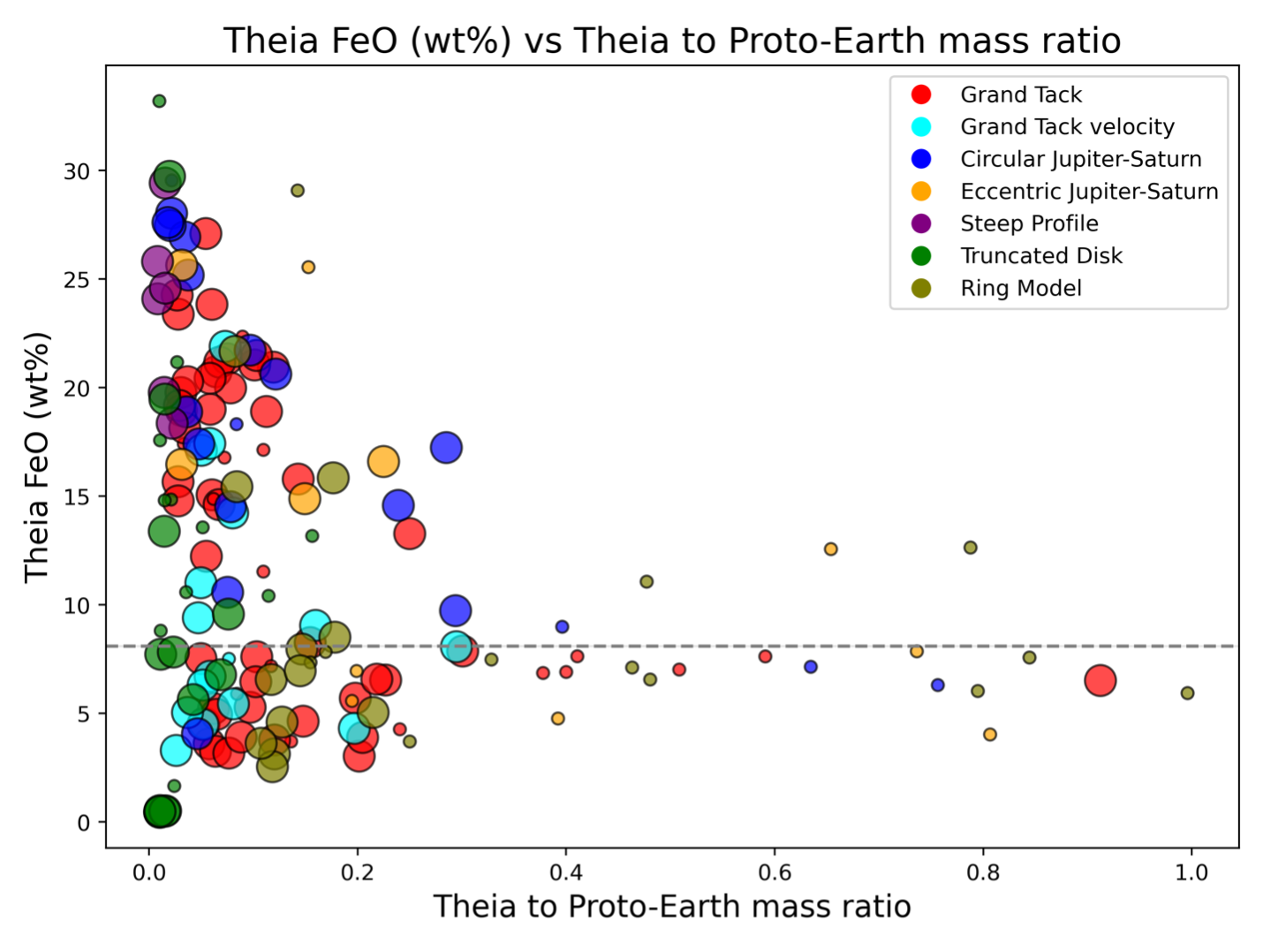
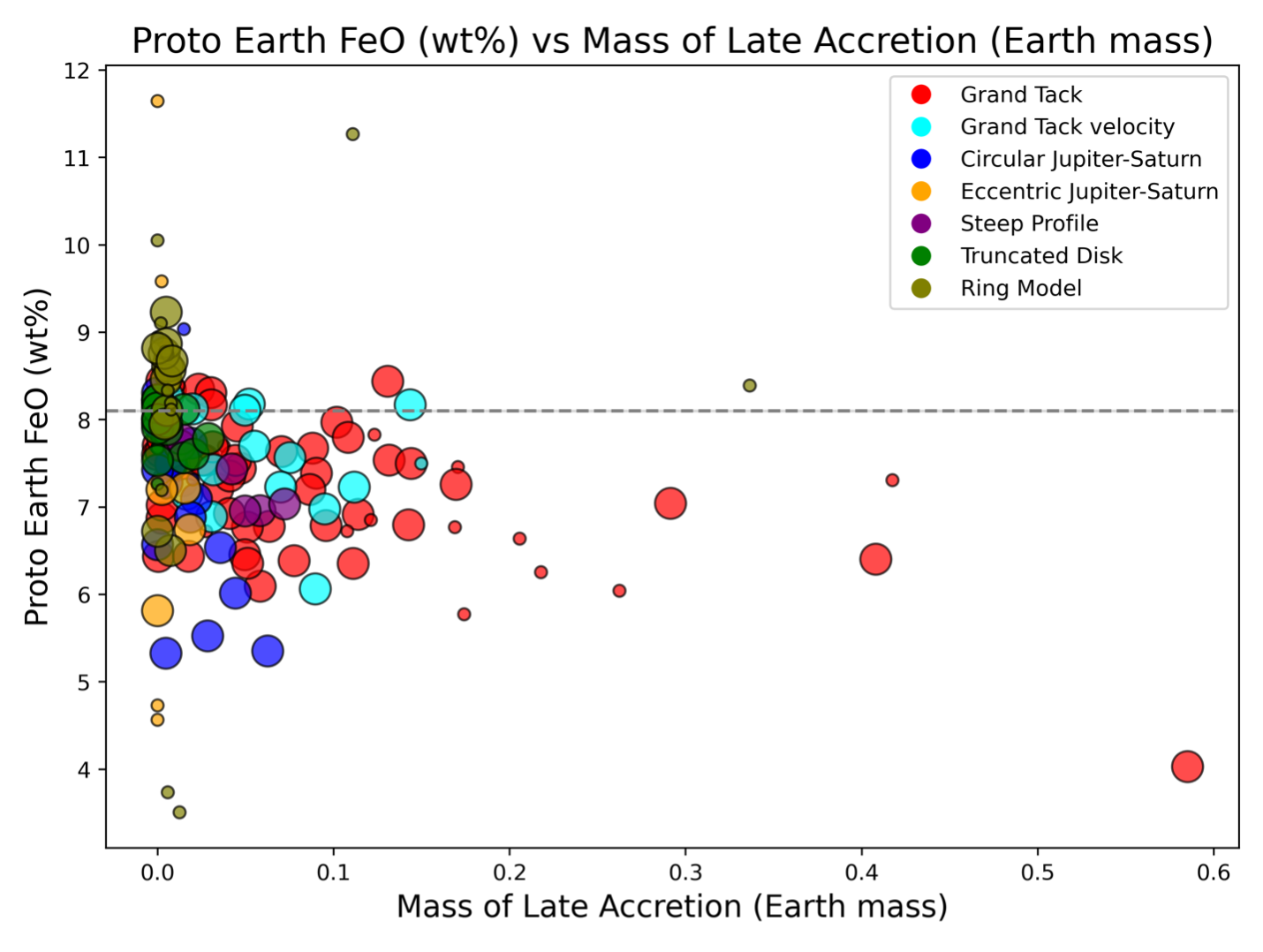
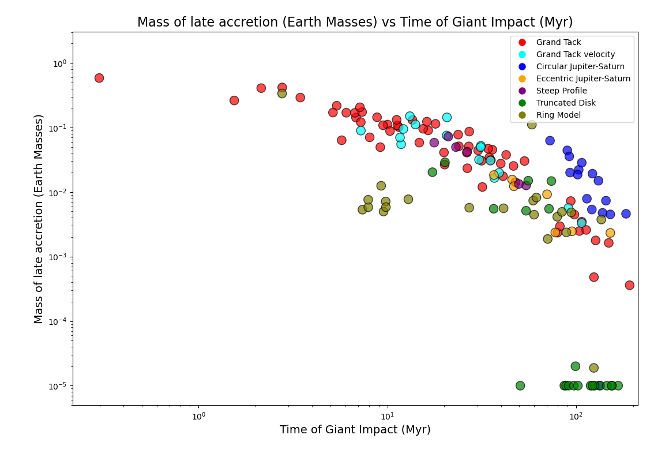
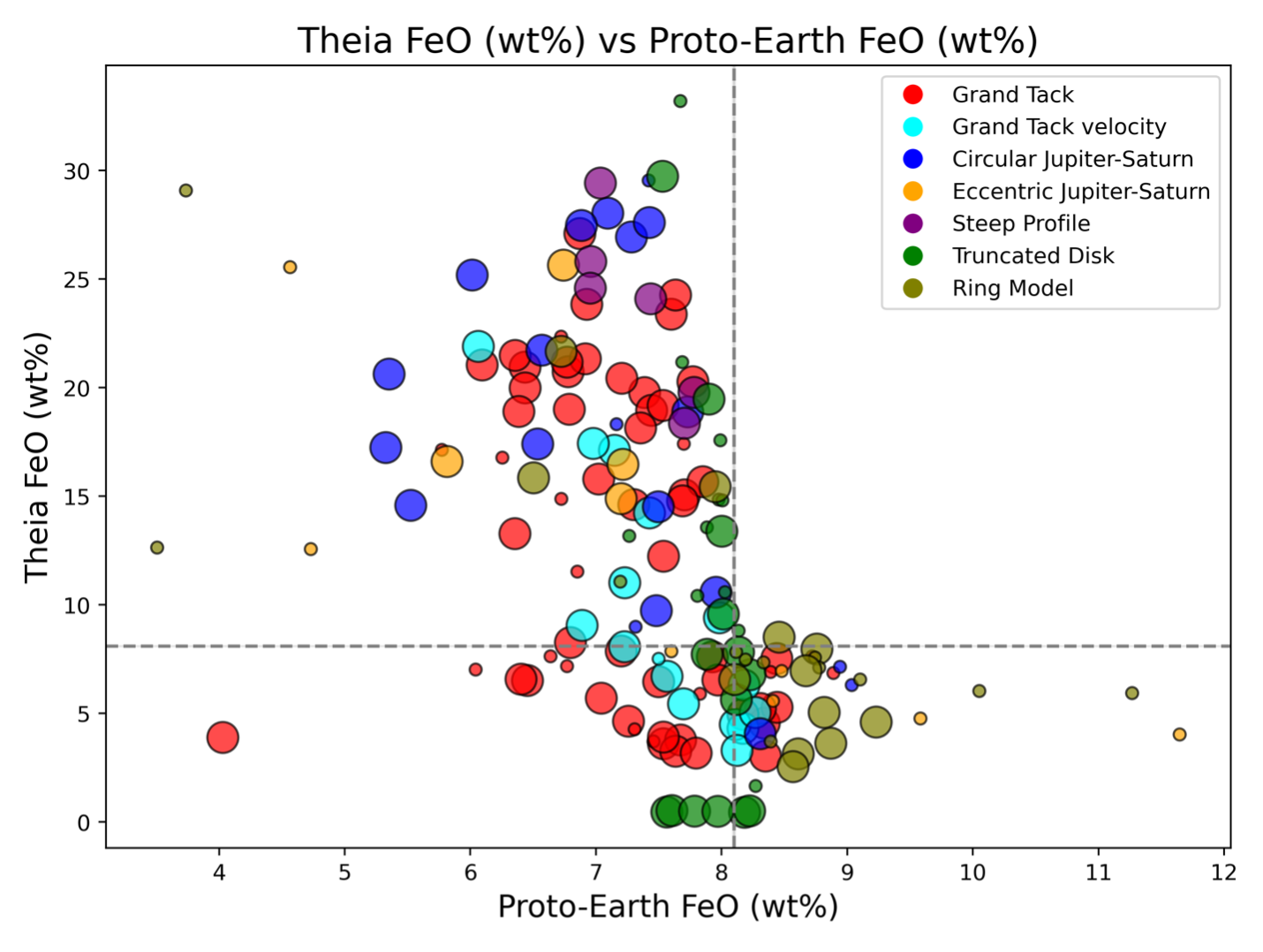
The Moon-forming impact was the most significant event during the accretion of Earth substantially establishing the physical and chemical states of the Earth-Moon system. In the canonical giant impact lunar formation hypothesis, a Mars-sized body (Theia) collides with the proto-Earth, and the Moon forms out of the resulting circumplanetary disk. However, in this scenario, the primary contribution to the composition of the Moon is from Theia, which is problematic given the close isotopic similarity between Earth and Moon across a range of isotopic systems (e.g. W, O, Si, Ti). Multiple alternative hypotheses have since been proposed including a smaller but faster moving Theia and a nearly equal size Theia and proto-Earth. We consider these different lunar formation hypotheses in the context of a complete model of terrestrial planet formation. Here, we show that the oxidation state of the proto-Earth and Theia have specific relationships to each other (Figure 1) and the mass ratio between them (Figure 2) in order to reproduces the mantle chemistry of the bulk silicate Earth. On the other hand, different proposed terrestrial planet formation scenarios have different relationships between the composition of the proto-Earth prior to the Moon-forming impact, the amount of mass accreted after the Moon-forming impact (i.e., late accretion; Figure 3), and the timing of the Moon-forming impact (Figure 4).
 
For this work, we selected 164 N-body simulations of solar system formation from a range of terrestrial planet formation scenarios including the Circular and Eccentric Jupiter-Saturn (Raymond et al., 2009), Truncated Disk (Hansen et al., 2009), Grand Tack (Walsh et al., 2011; Jacobson & Morbidelli, 2014), Early Instability (Clement et al., 2019), and Ring scenarios (Nesvorny et al., 2021). These astrophysical N-body simulations produce solar systems containing Earth analogs with a final mass between 0.9 and 1.1 Earth masses and semi-major axis exterior to the next-largest body. Theia is identified as the final embryo impactor to accrete to the proto-Earth. The composition of every object in each simulation was tracked using a planetary accretion and differentiation model (Rubie et al., 2015).  This model processes the accretion histories from the N-body solar system formation scenarios and determines core and mantle chemical evolution due to metal-silicate equilibration following melt-generating planetary impacts during accretion. After each impact, metal-silicate equilibration occurs between the mantles and cores of the target and impacting planetary bodies in a plume of entrained material surrounding the descending impactor core, as determined by analog experiments (Deguen et al., 2011). Elements partition between the equilibrating mantle- and core-forming fluids from the impactor and target bodies governed by mass-balanced equilibration and laboratory-measured metal-silicate partition coefficients. Free parameters in the model control the oxidation state of initial solids in the protoplanetary disk (set by fractions of iron and silicon in metal versus silicate) as well as the pressures at which metal-silicate equilibration occurs. We found the best fit initial conditions for each simulation that result in a simulated Earth analog most closely matching the composition of the bulk silicate Earth. Then we found the characteristics of proto-Earth and Theia that resulted in the successful reproduction of Earth. 
 
We find that the proto-Earth and Theia may possess a range of mantle compositions and mass ratios and still reproduce Earth’s mantle composition. However, Theia and proto-Earth cannot both possess oxidized mantles, since late accretion is oxidizing across all proposed scenarios (Figure 1). Relatedly, Theia may be significantly more oxidized than Earth, but only if it is relatively small compared to the proto-Earth (Figure 2). Whereas, the proto-Earth is almost always more reduced than Earth regardless of the amount of late accretion (Figure 3). Given the relationship between late accreted mass and the timing of the Moon-forming impact (Figure 4), these results are generally agnostic to when the impact occurred.
 
Figure 1:  Either Theia or proto-Earth can have a FeO wt.% greater than that of the current Earth mantle but not both. Theia and proto-Earth mantle FeO wt.% are shown for each simulated Earth analog (colors indicate the Earth analog’s formation scenario). The size of the marker represents the goodness-of-fit metric of the final Earth analog in the simulation; a large marker indicates a better fit and a small marker indicates a worse fit. The dashed lines show the final Earth FeO 8.1wt.%, forming four quadrants for combinations of Theia and proto-Earth FeO compositions. 
 
Figure 2: Theia can have a wide range of mantle FeO compositions so long as Theia is small relative to the proto-Earth; if it is larger than a third the mass of the proto-Earth, then the final Earth analog is not a good match to Earth. Theia mantle FeO wt.% and Theia to Proto-Earth mass ratio shown for each simulated Earth analog (colors indicate the Earth analog’s formation scenario). The size of the marker represents the goodness-of-fit metric of the final Earth analog in the simulation; a large marker indicates a better fit and a small marker indicates a worse fit. The dashed line shows the final Earth FeO 8.1wt.%.
 
Figure 3: The proto-Earth’s mantle FeO wt.% is typically near or below the current bulk silicate Earth’s FeO wt.%, even when there is a significant mass of late accretion. The proto-Earth mantle FeO wt.% and mass of late accretion are shown for each simulated Earth analog (colors indicate the Earth analog’s formation scenario). The size of the marker represents the goodness-of-fit metric of the final Earth analog in the simulation; a large marker indicates a better fit and a small marker indicates a worse fit. The dashed line shows the final Earth FeO 8.1wt.%.
 
Figure 4: The amount of material accreted by each Earth analog after the Moon-forming impact is related to when the Moon-forming impact occurs. The mass of late accretion and the time of the last (Moon-forming) giant impact are shown for each simulated Earth analog (colors indicate the Earth analog’s formation scenario).

How to cite: Jacobson, S. A., Nathan, G., and Nguyen, H. D.: Theia can arrive late and be oxidized, but not if it is large compared to proto-Earth, EPSC-DPS Joint Meeting 2025, Helsinki, Finland, 7–13 Sep 2025, EPSC-DPS2025-1131, https://doi.org/10.5194/epsc-dps2025-1131, 2025.

F207
|
EPSC-DPS2025-1145
|
On-site presentation
Jeff Sudol and Nader Haghighipour

We compare the bulk properties of the terrestrial planets that form from two different models: smooth-disk models in which the mass distribution of the embryos follows a simple mathematical function, and "clumpy-disk" models which include depletion zones.  Both models are solar-system analogs that include Jupiter and Saturn in their present orbits.  Clumpy-disk models produce slightly more planets on average (3.5 vs. 3.8) and a slightly greater range in the number of planets formed (up to 7 vs. 10).  Both models are equally efficient at ~40%, though the range of efficiencies is slightly greater for the clumpy-disk models.  We will compare additional bulk properties, such as accretion rates and the time of formation for planets, but, overall, the models do not differ significantly from one another with regard to their bulk properties.  The details of how individual planets form, however, vary across the two models, and we will describe the role of depletion zones in the formation of Mars-analogs.

How to cite: Sudol, J. and Haghighipour, N.: A Comparison of Smooth-Disk and Clumpy-Disk Models of Terrestrial Planet Formation, EPSC-DPS Joint Meeting 2025, Helsinki, Finland, 7–13 Sep 2025, EPSC-DPS2025-1145, https://doi.org/10.5194/epsc-dps2025-1145, 2025.

F208
|
EPSC-DPS2025-1153
|
On-site presentation
Raluca Rufu and Robin Canup

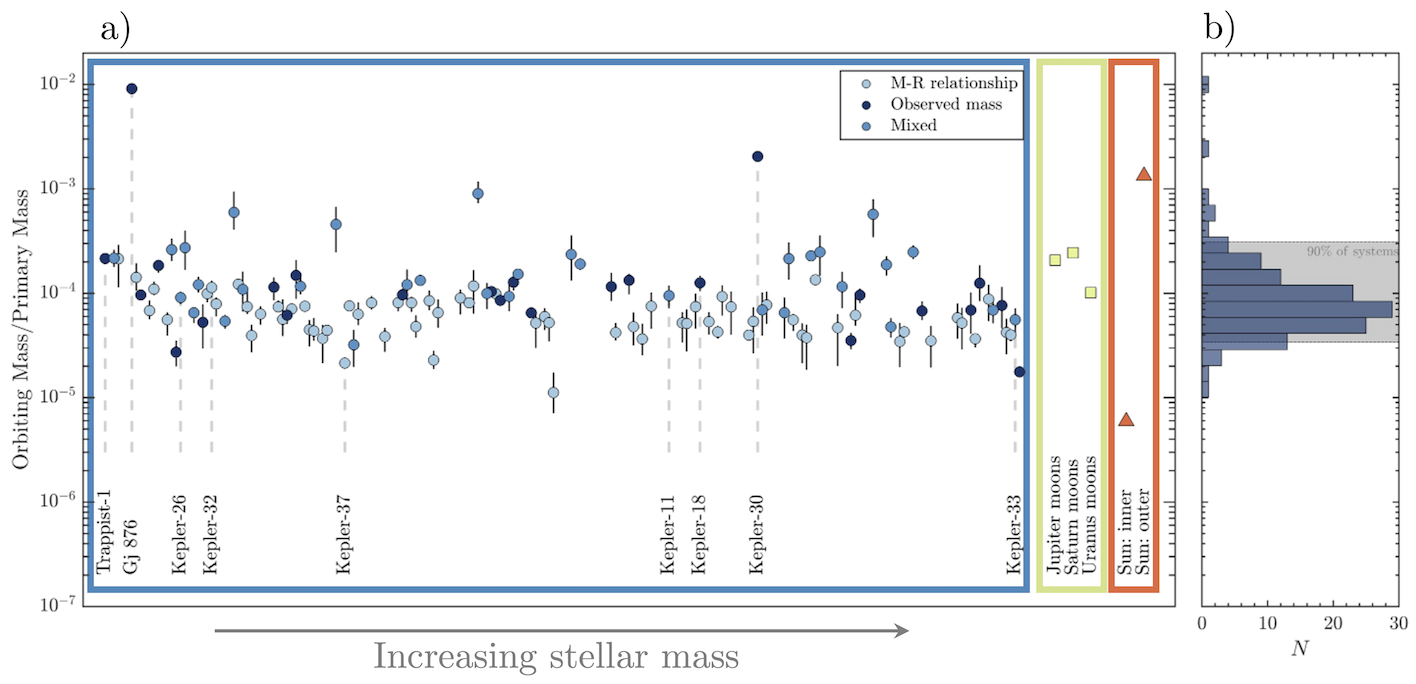
A surprising discovery in exoplanetary science has been compact systems of Earth to super-Earth sized planets orbiting within ∼ 10-2 to 10-1 au from their star, a region lacking planets in our Solar System. While compact systems are common, their origin is debated.  A prevalent assumption is that compact systems formed after the infall of gas and solids to the circumstellar disk ended. However, observational evidence suggests accretion commences earlier.  We propose that compact systems are surviving remnants of planet accretion during the end stages of infall (Rufu & Canup, 2025, Nature Communications, in press). This early accretion condition leads to a characteristic planetary system-to-star mass ratio, offering a compelling explanation for the remarkably similar ratios observed in known compact systems (Fig. 1).

We simulate the accretion of planets using an N-body code that includes a time-dependent infall of gas and solids, with a rate that decays exponentially on a timescale, τin, as well as gas disk interactions modeled with an exponentially decaying surface density characterized by a timescale τg.

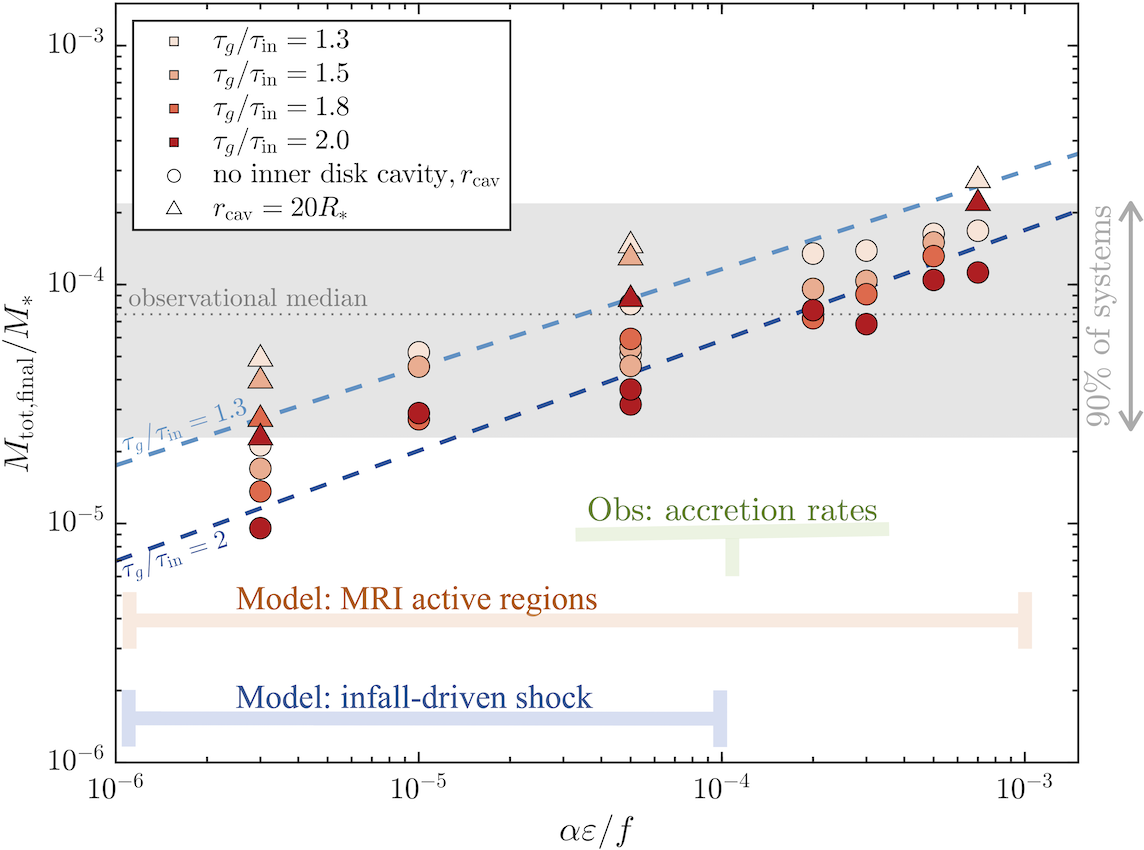
The mass of a planet that accretes within a disk region undergoing infall is regulated by a balance between mass growth due to accretion of infalling solids, and inward gas-driven orbital migration that becomes faster as the planet grows.  This balance selects for similarly-sized planets whose mass is a function of infall and disk conditions.  We show that the infall-produced planets survive until the gas disk disperses and migration ends, and that across a broad range of conditions, the mass of surviving systems is regulated to a few ⊗10-5 to 10-4 times the host star's mass (Fig. 2). Additionally, these simulations predict a relatively weak dependence of planet and planet system mass on stellar metallicity. This appears consistent with the nearly equal occurrence of warm super-Earths around stars of wide-ranging metallicities (Petigura et al, 2018) that has been unexplained.

Whether planets that form during infall survive depend on the radial extent of disk infall, rc, and the ratio of the gas disk lifetime to the infall timescale, τgin.  Here we focus on small rc,  and small  τgin cases, consistent with compact systems.  However,  rc depends sensitively on the angular momentum of the parent cloud core and interactions of infalling material with the disk and stellar magnetosphere, so that even stars with similar masses may have substantially different  rc values, resulting in different system architectures. For larger rc, long accretion timescales in the outer infall region may promote the formation of giant planets after infall has ended.  Larger  systems will also have larger τgin due to their longer gas disk lifetimes (Schib et al. 2021), implying that surviving inner planets that accreted during infall would have a lower total mass compared to the star. Most broadly, our results suggest that the long-standing assumption that planet accretion commences only after infall has ended may not be valid for all systems, and consideration of this early accretionary phase is warranted.


Fig 1 caption - Estimated total mass of transiting compact systems, Mtot, scaled to the stellar mass, M*. a, (Mtot/M*) for compact systems having  ≥3 known planets that orbit a single star within a<0.5 au (circle markers, blue box).  Points are ordered left-to-right by ascending stellar mass. Data are from www.exoplanetarchive.ipac.caltech.edu. For cases without mass estimates, we use the observed planet radius, increase the estimated radius uncertainty by a factor of 2, and then apply a radius vs. mass relation (Weiss & Marcy 2014). Light [medium] blue circles are systems with all [some] planetary masses estimated from this relation, while dark blue circles are systems with measured planetary masses. We include only systems with resulting errors ΔMtot /Mtot<1.  b, Distribution of compact system mass ratios. Over a wide range of stellar masses ( M*~0.1 to 1.3 stellar mass), compact multi-planet systems display a common mass ratio, with 90% of systems having  3⊗10-5<(Mtot/M*)<3⊗10-4 (gray shaded region).  This mass ratio is more similar to that of the gas giant satellite systems (square markers, yellow box) than to the inner or outer planets in our Solar System (triangle markers, red box).

Fig 2 caption - Results of planet accretion simulations with varied disk and infall properties. Final planetary system mass scaled to the stellar mass (1Msun ) as a function of  (αε/ƒ) (α is the viscosity parameter, ε is the fraction of infalling solids incorporated into planets, and ƒ is the infall gas-to-solids ratio). The infall rate decays with timescale τin =5⊗105 yr, while the gas disk disperses over a longer timescale, τg =1.3 to 2τin (colors, legend). The simulations assume either an inner disk cavity with radius  rcav=20R*~0.13 au (triangles) or no cavity (circles). Grey region shows range for 90% of observed compact systems shown in Fig. 1. Dashed lines show analytical predictions for the no-cavity case with τg/ τin=1.3 (light blue) and τg/ τin=2  (dark blue). Horizontal bars show plausible viscosity ranges based on observed stellar accretion rates (Hartmann et al. 1998), models of magnetorotational instability (MRI, Jankovic et al. 2019) and infall-driven shocks (Lesur et al. 2015), assuming ƒ/ε=102.

Fig.1


Fig. 2

How to cite: Rufu, R. and Canup, R.: Origin of compact exoplanetary systems during disk infall, EPSC-DPS Joint Meeting 2025, Helsinki, Finland, 7–13 Sep 2025, EPSC-DPS2025-1153, https://doi.org/10.5194/epsc-dps2025-1153, 2025.

F209
|
EPSC-DPS2025-1633
|
ECP
|
On-site presentation
Maximilian Zimmermann and Elke Pilat-Lohinger
1. Introduction
To date already 711 of the 4469 (∼15%) discovered exoplanet systems are part of a binary or multiple star system. Most studies of the terrestrial planet formation in binary star systems focused on planar binary configurations (e.g. [1], or [5]). However, for binary star systems with separations ab>30-40 au the alignment is highly likely randomly distributed [2]. [4] have shown that in the intermediate phase planetesimal decouple from the gas due to the forced inclination of the secondary star, which may result in more destructive collisions. Thus, in the final phase of terrestrial planet formation in binary stars, the planet forming disk may still contain a large fraction of planetesimals. In the last stage all gravitational interactions of the disk objects have to be taken into account. To handle the N2 gravitational interactions in the N-body problem a parallelized GPU N-body code has to be used (e.g. [6]).
Usually, the so-called perfect merging approach is used to handle collisions in N-body simulations. This might be feasible for low velocity encounters. On the other hand, [3] derived scaling laws to predict collision outcomes.
 
2. Methods and Setup
We investigated the post gas phase, thus we only considered gravitational interactions. Known, that the complexity of the N-body problem scales with O(N2), we applied our self-developed GPU parallelized N-body code GANBISS [6], which allows the simulation of some thousand interacting objects. For the two-body collisions of disk objects we assumed the perfect merging scenario.
Different binary star configurations were simulated where the separation ab and the eccentricity eb of the solar mass binary stars were fixed to ab=60 au and eb=0.2, respectively. We varied the inclination of the secondary star between ib=0, 20, and 45°. The planetesimal - planetary embryo disks were placed between 1-4 au around the primary star with initially 2000 planetesimals (each has a mass of 0.00118 M) and 25 planetary embryos (mass range: 0.0582 - 0.152 M). Each configuration was simulated for 10 Myr.
For all collisions that occurred during the N-body simulation, the collision parameters -- impact velocity and impact angle -- were stored and subsequently analyzed using the analytic model of [3] (LS12) and thus assigned different classes of collision outcomes which mainly depend on the impact velocity, the impact angle, and the mass fraction of the colliding bodies. The different collision outcomes of LS12 can be summarized in three main categories:
  • accretive collisions: perfect merging, graze and merge, and partial accretion
  • destructive collisions: partial erosion, and super catastrophic
  • hit-and-run events

3. Results

Figure 1 shows the post-processed analysis of the recorded collisions following the model of LS12 for the configuration ab=60 au, eb=0.2, and ib=20°. In total 193 perfect merging events occurred, only 16 graze and merge and 229 partial accretions, which are summarized as accretive collisions. Destructive collisions consist of partial erosion (137) and super catastrophic collisions (176), which occurred show less frequently than the accretive collisions. The largest fraction are the hit-and-run collisions (1255). 

Table 1 shows the number of the different collision categories for each computed binary star configuration. The fraction of the three different collision categories differs strongly for the various binary configurations. In the planar configuration the accretive collisions dominate, followed by the hit-and-run collisions. The destructive collisions are very rare. The misalignment of the secondary star results in possible large mutual inclinations of the disk objects [4], which leads to larger impact velocities, and consequently to more destructive collisions. Thus, the numbers of destructive collisions for the configurations i20 and i45 (short for a60-e02-i20/i45) are significantly higher compared to the planar configuration. However, in the i20 configuration the fraction of accretive collisions is larger than the fraction of destructive collisions. The opposite can be seen with the i45 configuration. However, the largest fraction of collisions in the inclined configurations are the hit-and-run collisions.

Table 1: The table shows the number of different collision outcomes according to the analytic model of LS12 for our three different computed binary star configurations. The different outcomes are summarized in accretive (Naccr), destructive (Ndestr) and hit-and-run (Nhr) collisions.

Configuration

Ncoll Naccr Ndestr Nhr
a60-e02-i00 2013 1319 3 691
a60-e02-i20 2006 438 313 1255
a60-e02-i45 1982 232 634 1116


4. Summary and Conclusions
We simulated the late stage of terrestrial planet formation in binary star systems for various configurations. Using our GPU parallelized N-body code GANBISS we were able to simulate the gravitational interactions of the disk objects and the binary stars. For the analysis of the collisions occurred in the N-body simulations, we applied the model from LS12 in a post process. A misalignment of the secondary star with respect to the disk results in more diverse collision outcomes compared to a planar configuration. Especially, more destructive and hit-and-run collisions occurred. This suggests that the perfect merging approach is even less suitable for inclined binary star systems than for planar systems - and should be investigated further.
 
Acknowledgements
M.Z.~and E.P-L want to acknowledge the support by the Austrian Science Fund FWF - projects PAT3059124 and P33351-N. The computational results presented have been achieved using the Vienna Scientific Cluster (projects 71637, 71686, 70320).
 
References
  • [1] Haghighipour, N., Raymond, S.: Habitable Planet Formation in Binary Planetary Systems, Astrophys. Journal 666.1, 2007
  • [2] Hale, A.: Orbital CoPlanetary in Solar-Type Binary Systems: Implications for Planetary System Formation and Detection, Astronomical  Journal, 107, p. 306, 1994
  • [3] Leinhardt, Z., Stewart, S.: Collisions between Gravity-dominated Bodies. I. Outcome  Regimes and Scaling Laws, Astrophys. Journal, 745.1, 2012
  • [4] Marzari, F., Thébault, P., Scholl, H.: Planet formation in highly inclined binaries, Astronomy and Astrohpysics, 507.1, 2009
  • [5] Pilat-Lohinger, E., Sándor, Z., Gyergyvoits, M., et al.: Planets in Binary Stars, Accretion Processes in Cosmic Sources - II, 2018
  • [6] Zimmermann, M., Pilat-Lohinger, E.: GANBISS: a new GPU accelerated N-body code for binary star systems, Celestial Mechanics and Dynamical Astronomy 135.3, 2023


How to cite: Zimmermann, M. and Pilat-Lohinger, E.: Collision outcome maps of planetary embryo - planetesimal disks in inclined binary stars, EPSC-DPS Joint Meeting 2025, Helsinki, Finland, 7–13 Sep 2025, EPSC-DPS2025-1633, https://doi.org/10.5194/epsc-dps2025-1633, 2025.

F210
|
EPSC-DPS2025-1705
|
ECP
|
On-site presentation
Simon Lock, Phil Carter, Sarah Stewart, Erik Davies, Michail Petaev, and Stein Jacobsen

Introduction:

How the parent bodies of chondritic meteorites, and the chondrules they host, formed is one of the most hotly debated questions in planetary sciences. The curious properties of chondrules have presented significant challenges to theoretical models that have tried to understand their formation and there is currently no consensus on the ability of the various proposed mechanisms to form chondrules consistent with the physicochemical constraints.

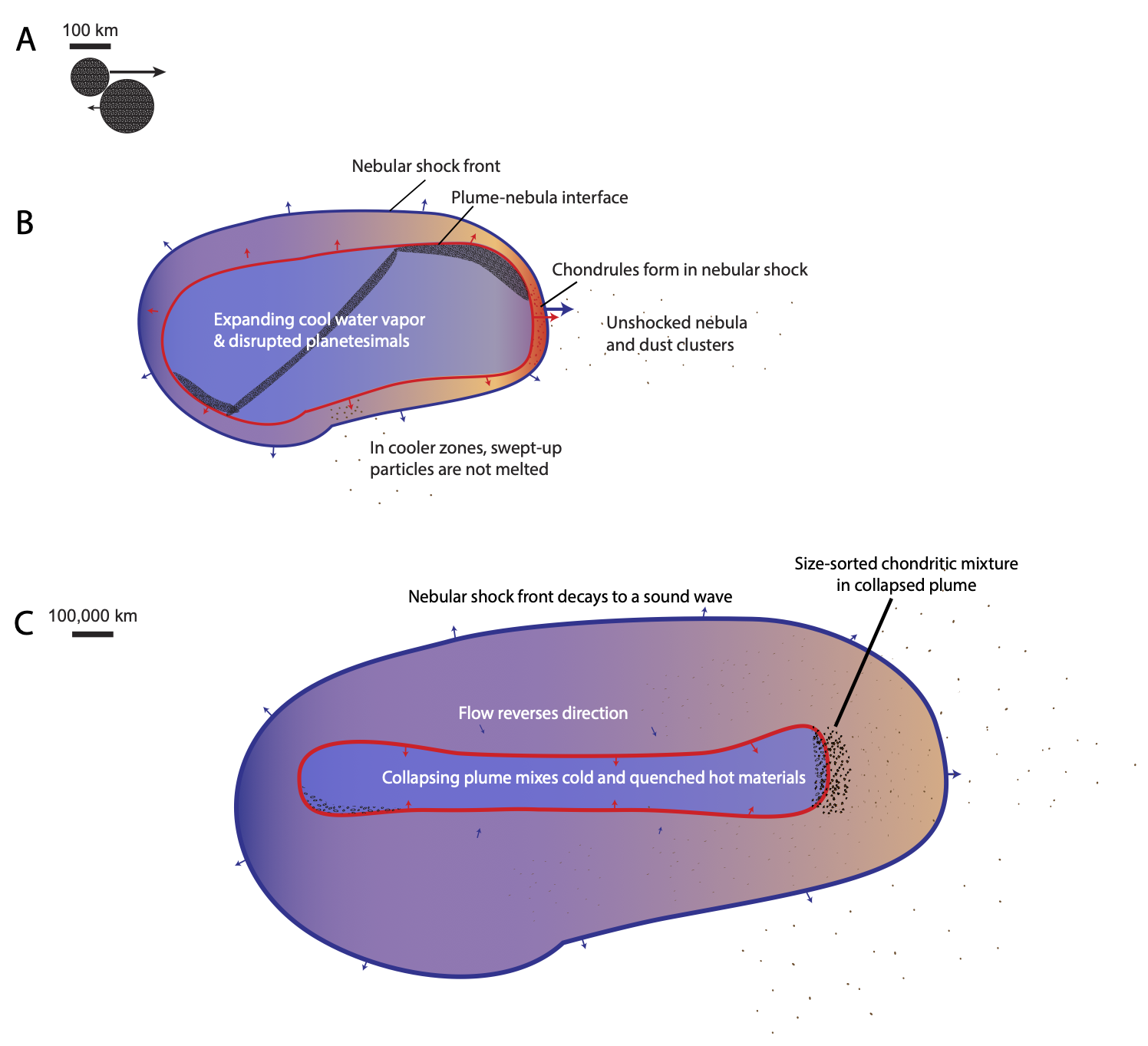
Here, we present the newly proposed IVANS (Impact Vapor Plumes and Nebula Shock) model for chondrule and chondrite formation (Stewart et al. 2025) and discuss how particles are size sorted and collected into chondritic mixtures (Lock et al.).

Figure 1: Schematic overview of the hydrodynamics of impact vapor plumes and nebular shocks (Stewart et al. 2025).

The Impact Vapor Plumes and Nebula Shock (IVANS) model:

A schematic of the IVANS model (Stewart et al. 2025) is shown in Figure 1. The IVANS model is based on vaporizing collisions between planetesimals composed of dust and ice in the presence of the nebular gas. Above about 1 km/s, the impact velocity is great enough to drive disruption and vaporization of a fraction of the colliding bodies (Figure 1A). Such collisions are frequent during planet formation before gas disk dispersal, particularly in epochs in which giant planets were growing rapidly and/or migrating (Carter & Stewart 2020). Each impact generates a cloud of cooling water vapor from the planetesimals which expands supersonically (inner blue region in Figure 1B), driving a warmer shock wave into the solar nebula (outer ring with warm colors). The elongated expanding shell of shocked nebula is hotter in the principal impact direction and cooler in the opposite and lateral dimensions (indicated by the color gradient). Portions of the shocked nebula are warm enough to melt free-floating nebular dust and form chondrules. Expansion of the vapor plume eventually leads to a pressure low in the solar nebula and subsequent hydrodynamic reversal in the flow field (Figure 1C). The nebular gas, dust, and chondrules flow into the low pressure region, mixing materials that were processed in different regions. The collapsed mixture has the characteristics observed in chondritic mixtures: quenched chondrules mixed with dust and ice. The mixed region is orders of magnitude larger in scale than the original planetesimals and the timescale of the collapse is order 10s hours. 

Breakup and coupling of particles in the IVANS model:

We calculated the drag force on individual dust grains and aggregates to determine which size particles can couple to the gas in impact-driven nebular shocks. The nebular shock and the vapor plume-nebular interface were both treated as step changes in gas velocity. The acceleration of particles were then calculated using drag formulations for the relevant regime  (Brown & Lawler 2003; Probstein 1969). The stability of particles to shear was assessed using experimentally-determined criteria (Theofanous 2011), or comparison between the drag force and surface tension (liquid droplets) or tensile strength (aggregates).

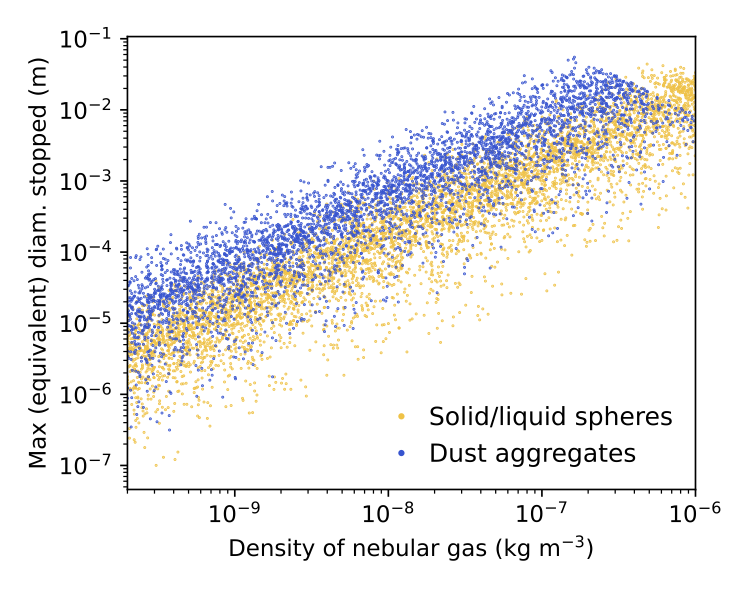
Using a Monte-Carlo approach, we varied the densities of the nebular gas, plume gas, nebular shock velocity, nebular shock length scale, and plume length scale over a large range. We found that the dominant parameter that determines the maximum size particle that is coupled to the nebular shock or plume front is the density of the nebular gas (Figure 2). Larger particles simply pass through the shock and are then not collected in the collapsing system. In this sense, the system acts as a ‘reverse-sieve’.

Under the conditions of impact-driven nebular shocks, the maximum size of coupled particles agrees well with the maximum size range of chondrules for the plausible range of nebular gas densities (chondrules typically span 0.1 to a few mm in size; Metzler, 2018). Different chondrite groups have different maxima and mean size chondrules (Jones 2012), which is interpreted to mean that they formed in distinct nebular environments. Within the framework of the IVANS model, the variation in the nebula pressures/densities at the time/place the chondrule forming impact occurred is responsible for the difference in chondrule sizes.

Figure 2: The maximum sizes of chondrules collected  in the IVANS model are a strong function of the nebular gas density. Points are the maximum size of particles stopped in the nebular shock for each of our Monte-Carlo simulations for both dust grains or (partially) molten droplets (orange) and dust aggregates (blue). The size of aggregates is given as the equivalent size if the aggregate melted to form a chondrule.

Conclusions:

We find that processing of material by vaporizing collisions in the solar nebula produces a size-sorted assembly of melted silicates with the first-order physical and chemical properties of chondrules. The IVANS model therefore provides a promising new explanation for the origin of chondrules and chondrites.

In the IVANS model there is a mechanistic link between vaporizing collisions and chondrites. Chondrites are not only precious time capsules of primitive nebular materials but also key records of the wider dynamics of planet formation. The different degrees of thermal processing through nebular shocks experienced by different meteorite groups reflects the collisional histories in different locations and at different times in the solar nebula (Carter & Stewart 2020). The chondritic record can therefore place constraints on the formation and migration of the gas giants and so the dynamics of giant and terrestrial planet formation.

References:

Brown PP, Lawler DF. 2003. J. Environ. Eng. 129(3):222–31

Carter PJ, Stewart ST. 2020. Planet. Sci. J. 1(2):45

Jones RH. 2012. Meteorit. Planet. Sci. 47(7):1176–90

Lock SJ, et al. In prep.

Metzler K. 2018. Meteorit. Planet. Sci. 53(7):1489–99

Probstein RF. 1969. In Problems of Hydrodynamics and Continuum Mechanics, pp. 568–83.

Stewart ST, et al. In press. Planet. Sci. J. doi: 10.3847/PSJ/adbe71. arxiv: 2503.05636

Theofanous TG. 2011. Annu. Rev. Fluid Mech. 43(1):661–90

How to cite: Lock, S., Carter, P., Stewart, S., Davies, E., Petaev, M., and Jacobsen, S.: Coupling and breakup of particles in the impact vapor and nebular shocks (IVANS) model of chondrule formation, EPSC-DPS Joint Meeting 2025, Helsinki, Finland, 7–13 Sep 2025, EPSC-DPS2025-1705, https://doi.org/10.5194/epsc-dps2025-1705, 2025.