EXOA2 | Dynamics and stability of (exo-)planetary systems

EXOA2

Dynamics and stability of (exo-)planetary systems
Conveners: Lorenzo Biasiotti, Clàudia Soriano Guerrero
Orals FRI3
| Fri, 11 Sep, 14:00–15:30 (CEST)|Room Uranus (Swing)
Posters THU-POS
| Attendance Thu, 10 Sep, 18:00–19:30 (CEST) | Display Thu, 10 Sep, 08:30–19:30|Foyer 2, F2.50–53
Fri, 14:00
Thu, 18:00
The orbital stability of (exo-)planetary systems is far from trivial, as chaotic diffusion can strongly affect the long-term evolution of planetary orbits. Mean‑motion and secular resonances may act as stabilizing mechanisms, constraining the range of orbital parameters compatible with current observations. A variety of additional dynamical processes further shape system architectures, including perturbations on close‑in exoplanets, resonant interactions involving giant planets, planetesimal scattering during and after formation, and episodes of planetary ejection driven by collisions or tidal disruptions.

This session aims to bring together observational, theoretical, and modeling studies that investigate the dynamical pathways of these systems, from early formation stages to mature planetary systems, and to understand how these mechanisms interplay for interpreting observed architectures and assessing the long‑term stability of both compact and widely separated planetary systems.
We welcome contributions employing numerical simulations, N-body studies, stability analyses and observational constraints.

Orals: Fri, 11 Sep, 14:00–15:30 | Room Uranus (Swing)

Chairpersons: Lorenzo Biasiotti, Clàudia Soriano Guerrero
Dynamics and stability of (exo-)planetary systems
14:00–14:15
|
EPSC2026-205
|
ECP
|
On-site presentation
Gabriel Guimarães and Eiichiro Kokubo

The planetary system v1298 Tauri can be considered a landmark in our current theories of planetary formation: It harbors four near-resonant super-earths orbiting its host star, whose age is estimated to be 20Myr. Recent analysis of  Transiting Time Variations (TTV) data allowed to precisely characterize the dynamical architecture of the system and to pinpoint it in the early stages of it's formation and evolution, shortly after the dispersal of it's protoplanetary gas disk and after the break-up of the resonant chain 6:4:2:1.

The efforts to characterize the dynamical architecture of v1298 Tauri system allowed for tight constrains on the orbital elements of the three inner planets (c, d and b), but planet e's eccentricities ee are not as sharply determined as those of the inner planets. Additionaly, its longitude of periapsis ϖe display an essentially uniform distribution, whereas it was clearly defined for the other planets of the system.

In this context, we propose to better understand how the different possible apsidal configurations of planet e could impact the dynamical stability and the domains of different regimes of motion in v1298 Tauri planetary system.

For this, we mapped the distinct regimes of motion in the (eee) plane, which allowed us to observe apsidal corotation for a range of longitudes and eccentricities. After understanding which ϖe give rise to apsidal corotation, we dynamically probed stability of the phase space of planets b and e in the (P,e) plane for selected apsidal configurations by making use of the Spectral Number, which calculates through a Fast Fourier Transform (FFT) how many dominant frequencies dominate the motion of the planets. We also mapped the regions in which the secular and the resonant angles (Δϖ = ϖbe and σbe=2λb-1λeb,e, respectively) were librating for the b-e planet pair. The stability maps are shown in Figure 1.

Figure 1: Stability maps of the phase space of planet e for an anti-aligned apsidal orientation (left panel) and aligned (right panel). Darker blue regions are considered dynamically stable due to being subject to few identifiable frequencies, whereas yellow ones are considered highly chaotic, with motions composed of a high number of noise-like frequencies in the FFT spectra. Greener regions are related to dynamical structures related to the  separatrix of the Mean Motion Resonance. The red dot represents the mean value of Pe, ee and its errorbars.

We observed that systems that are initially in apsidal alignment (ϖeb) allow for persistent apsidal corotation for larger values of ee, while shrinking the instability region associated with the 2:1 Mean Motion Resonance (MMR) between planets b and e. On the other hand, in the case of anti-aligned apsis (ϖeb-π), the instability strip related to the MMR increases around the MMR location, giving rise to regions where the resonant angle λ1be librates rather than circulates. We also observed an extended region in low eccentricity regime where λ1be librates for different orientations of ϖe, hinting for a low-eccentricity resonant regime.

We further investigated sections of the phase space for fixed values of ee, in which we applied the Frequency Map Analysis, so as to understand the behaviour of the independent frequencies associated with the MMR and with the secular angle, which allowed us to better understand in detail the dynamical mechanisms acting in this system.

Considering how young this planetary system is, better characterizing the possible regimes of motion it can be subject to is fundamental in pointing possible formation and evolutionary pathways.

How to cite: Guimarães, G. and Kokubo, E.: Dynamical Characterization of v1298 b-e planetary pair, Europlanet Science Congress 2026, The Hague, The Netherlands, 7–11 Sep 2026, EPSC2026-205, https://doi.org/10.5194/epsc2026-205, 2026.

14:15–14:27
|
EPSC2026-733
|
On-site presentation
Nader Haghighipour, Jeffrey Sudol, and Leila Honarbakhsh

Giant planets are fundamental to the dynamical evolution of planetary systems. In our solar system, Jupiter and Saturn act as key architects in shaping the asteroid belt and promoting terrestrial planet formation. Among extrasolar planets many similar systems exist such as the system of GJ 876 where three cold giants created an empty inner region analogous to our asteroid belt while driving a super-Earth into a 2-day orbit. To identify the specific mechanisms through which giant planets affect their systems, we performed over 1,200 numerical simulations of planet formation across diverse protoplanetary disks. We found that secular resonances induced by giant planets are, by far, the most dominant factors in the subsequent formation, long-term stability, and final architecture of their systems. For instance, in our solar system, it is the secular resonance of Saturn that limits our terrestrial planets to within 1.9 (au) and inhibits the formation of super-Earths. In contrast, in GJ 876 system, a super-Earth did in fact form, but it was the sweeping secular resonances due to the migration of giant planets that created the system’s asteroid belt-analog and caused the inward scattering of the super-Earth into its close-in and stable orbit. Furthermore, our results demonstrate that secular resonances are crucial to the scattering of planetesimals to large distances, especially during the formation of planets. These scattered bodies are the primary sources of the exo-Oort cloud comets and serve as the origin of the interstellar objects. In this talk, we present a detailed analysis of these implications and highlight how secular resonances dictate system architecture and stability, and also drive the formation of interstellar bodies.

How to cite: Haghighipour, N., Sudol, J., and Honarbakhsh, L.: The Dominant Role of Secular Resonance in Shaping Planetary Architecture, Stability, and the Origin of Interstellar Objects, Europlanet Science Congress 2026, The Hague, The Netherlands, 7–11 Sep 2026, EPSC2026-733, https://doi.org/10.5194/epsc2026-733, 2026.

14:27–14:39
|
EPSC2026-820
|
On-site presentation
Nikolaos Georgakarakos, Siegfried Eggl, Mohamad Ali-Dib, and Ian Dobbs-Dixon

In this work we investigate the problem of orbital stability of planetary orbits in stellar binaries. We carry out  a large number of numerical simulations of  planets on circumbinary (p-type) and circumstellar (s-type) orbits over long timescales.  We cover the whole parameter space by considering three dimensional and eccentric orbits for all bodies in the system, while exploring a wide range of mass ratios.  The results of the numerical integrations provide us with two critical borders: i) for the p-type case, an outer border beyond which all planetary orbits are stable and an inner border closer to the binary below which all planetary orbits are unstable. In between the two borders, a mixture of stable and unstable planetary orbits is observed.  ii) For the s-type case, an inner border closer to the planet hosting star below which all planetary orbits are stable and an outer border beyond which all planetary orbits are unstable. Again, between the two borders, a mixture of stable and unstable planetary orbits is observed. We provide empirical expressions in the form of easy to use fits for these two critical borders. Application of our results to known planetary systems are presented and comparison is made with past results on the subject.

How to cite: Georgakarakos, N., Eggl, S., Ali-Dib, M., and Dobbs-Dixon, I.: Stability of planets in double star systems, Europlanet Science Congress 2026, The Hague, The Netherlands, 7–11 Sep 2026, EPSC2026-820, https://doi.org/10.5194/epsc2026-820, 2026.

14:39–14:51
|
EPSC2026-1072
|
ECP
|
On-site presentation
Romain Grane, Nicolás Cuello, Mario Sucerquia, Emmanuel Gianuzzi, Milenne Ávila-Bravo, Carolina Charalambous, and Amaury H. M. J. Triaud

Circumbinary planets are commonly observed close to the dynamical stability limit of their host binaries, although planet formation is expected to be inefficient in the regions where these planets are currently found. A widely accepted scenario therefore suggests that circumbinary planets formed farther out in a circumbinary disk and migrated inward through planet–disk interactions. During this migration phase, resonant multi-planet configurations may naturally emerge. However, only two multi-planet circumbinary systems orbiting main-sequence binaries have been detected so far, and observational biases are unlikely to fully account for this apparent scarcity. This suggests that the dynamical environment induced by the central binary may strongly affect the long-term stability of such systems.
    
    In this presentation, we investigate the conditions required for the formation of stable circumbinary multi-planet systems through more than 1,000 N-body simulations of migrating super-Earth pairs. We explore the impact of a broad range of binary and migration parameters on the resulting planetary architectures. We first show that planets can be trapped in mean-motion resonance with the central binary, providing the starting point for potential resonant multi-planet chains. We further show that the binary mass ratio and eccentricity strongly influence the long-term stability of these systems, with distinct regions of parameter space leading either to stable configurations or to strong dynamical instability. In addition, for a given binary configuration, the final system architecture can still depend on the adopted migration timescales, related to disk and planet properties. Overall, these results help identify which binary configurations are most favourable for hosting stable circumbinary multi-planet systems. They also provide guidance for future observational surveys and constitute a first step toward studying the stability of circumbinary multi-planet systems in higher-order stellar systems.

How to cite: Grane, R., Cuello, N., Sucerquia, M., Gianuzzi, E., Ávila-Bravo, M., Charalambous, C., and Triaud, A. H. M. J.: Stability of circumbinary multi-planet systems, Europlanet Science Congress 2026, The Hague, The Netherlands, 7–11 Sep 2026, EPSC2026-1072, https://doi.org/10.5194/epsc2026-1072, 2026.

14:51–15:03
|
EPSC2026-1030
|
ECP
|
On-site presentation
Luke Gauvrit, Antoine Petit, Tristan Guillot, Olga Suarez, Djamel Mekarnia, Lyu Abe, Georgina Dransfield, Amaury H.M.J Triaud, and Jose Manuel Almenara

Long-period transiting planets provide important constraints on planet formation and evolution, but remain difficult to characterize because their transits are rare and require extended photometric follow-up. Thanks to its unique Antarctic location, ASTEP (Antarctic Search for Transiting ExoPlanets) is particularly well suited to the monitoring of such systems, enabling continuous observations over long time baselines and contributing to the characterization of planets on orbits of several tens to hundreds of days. For long-period planets in multi-planet systems, mutual gravitational perturbations can generate detectable transit timing variations, providing a valuable route to measuring planetary masses and characterizing the architecture of systems that are otherwise difficult to constrain.

Several of these long-period TTV planets appear to have unusually low densities and inflated radii. The origin of these properties remains unclear, especially in systems where stellar irradiation alone cannot easily account for the observed inflation. These planets therefore represent important benchmarks for testing our understanding of formation pathways, interior composition, atmospheric evolution, and cooling histories. In this contribution, I will present the analysis of long-period TTV systems observed with ASTEP, with a focus on their photometric follow-up and physical characterization. I will also discuss preliminary interior and evolution models computed with the stellar evolution code Cesam2k20, recently extended to model exoplanets through updated equations of state, opacity tables, and planetary atmosphere prescriptions. Finally, I will discuss how these results fit into the perspective of PLATO, which is expected to uncover new long-period transiting planets for which dedicated ground-based follow-up will be essential.

How to cite: Gauvrit, L., Petit, A., Guillot, T., Suarez, O., Mekarnia, D., Abe, L., Dransfield, G., H.M.J Triaud, A., and Almenara, J. M.: Long-period TTV planets observed with ASTEP: analysis and modelling with Cesam2k20 in preparation for PLATO, Europlanet Science Congress 2026, The Hague, The Netherlands, 7–11 Sep 2026, EPSC2026-1030, https://doi.org/10.5194/epsc2026-1030, 2026.

15:03–15:15
|
EPSC2026-283
|
ECP
|
On-site presentation
Andrea Bernardi

Over the past decade, advances in high-contrast imaging and extreme adaptive optics have enabled the discovery of planets and brown dwarfs orbiting at wide separations from their host stars, challenging current planet-formation paradigms. We present SaNDi-SHoP, a VLT/SPHERE star-hopping survey aimed at the search for satellites and circumplanetary disks around direct imaged companions. Our sample comprises thirteen planetary-mass and brown dwarf companions observed between June 2023 and July 2025. The survey also provides updated near-infrared photometry, new high-precision astrometry, and low-resolution IFS spectra for GQ Lup B, PZ Tel B, and HD 984 B.  We identify extended residuals around TYC 8047-232-1 B consistent with a possible 3-6 Jupiter masses satellite companion, and marginal residuals at the location of the previously proposed candidate around DH Tau b, compatible with a 1 Jupiter mass satellite. Our analysis generally excludes companions more massive than a few Jupiter masses beyond 1-5 au. Combining our astrometry with literature measurements, we derive updated orbital solutions for all systems, including the first orbital fits for CT Cha b, HIP 78530 B, HIP 64892 B, and RX J1609.5–2105 b. The updated orbital constraints favor eccentric, non-circular orbits for most companions, supporting formation scenarios involving gravitational instability or molecular cloud fragmentation. Alternatively, the observed eccentricities may result from dynamical interactions and planet–planet scattering. 

How to cite: Bernardi, A.: SaNDi-SHoP: Searching for Satellites’N’Disks with a Star-Hopping Program, Europlanet Science Congress 2026, The Hague, The Netherlands, 7–11 Sep 2026, EPSC2026-283, https://doi.org/10.5194/epsc2026-283, 2026.

15:15–15:27
|
EPSC2026-1402
|
On-site presentation
Emily Wong, Vincent Bourrier, Yann Alibert, patrick Eggenberger, Joann Egger, Caroline Dorn, Jeremy Leconte, Christoph Mordasini, James Owen, and Marilina Valatsou

Atmospheric escape and orbital evolution play a central role in shaping the observed exoplanet population, particularly the structure of the radius–period diagram. Features like the Neptunian desert raise fundamental questions about formation, long-term evolution and survivability. Yet, dynamical and atmospheric evolutions are usually treated separately. To address this need, we developed JADE (Joining Atmosphere and Dynamics for Exoplanets), a framework that self-consistently models the coupled evolution of secular orbital migration and atmospheric escape over billion-year timescales. JADE has successfully reproduced the misaligned orbit of the warm Neptune GJ 436 b, demonstrating how late-stage high-eccentricity migration driven by a massive outer companion can delay atmospheric loss. It is now routinely used to study the evolution of Jupiter- to Neptune-mass planets with H/He-dominated envelopes.
To study the potential erosion of gas giants into sub-Neptunes, we expanded JADE to include metal-enriched and water-dominated atmospheres. By refining atmospheric opacities and equations of state, and by implementing fractionated mass loss of hydrogen and oxygen, we enable more realistic simulations of envelope erosion and internal structure evolution. JADE is an open-source and versatile tool, and we welcome collaborations to broaden its applicability across diverse exoplanetary systems. JADE, constrained by atmospheric escape signatures from near-IR spectrographs, high-precision constraints from transit (e.g., PLATO) and radial-velocity (e.g., ESPRESSO, ANDES) surveys, as well as compositional constraints from atmospheric measurements (e.g., JWST, ARIEL), will enable population-level studies across the entire close-in planets landscape.

How to cite: Wong, E., Bourrier, V., Alibert, Y., Eggenberger, P., Egger, J., Dorn, C., Leconte, J., Mordasini, C., Owen, J., and Valatsou, M.: Long-Term Evolution of Gas Giants and Sub-Neptunes with the JADE Code, Europlanet Science Congress 2026, The Hague, The Netherlands, 7–11 Sep 2026, EPSC2026-1402, https://doi.org/10.5194/epsc2026-1402, 2026.

15:27–15:30

Posters: Thu, 10 Sep, 18:00–19:30 | Foyer 2

Display time: Thu, 10 Sep, 08:30–19:30
F2.50
|
EPSC2026-567
|
Virtual presentation
Precision orbital dynamics and apsidal precession in eccentric exoplanetary systems
(withdrawn)
Abraao Capistrano
F2.51
|
EPSC2026-743
|
ECP
|
On-site presentation
Nilce Santos and Silvia Giuliatti Winter

The Kepler-90 (K90) extrasolar system is a system that has some characteristics similar to our Solar System: eight planets in a hierarchical arrangement, that is, the innermost planets are terrestrial and the outermost are gas giant planets. The main difference between K90 and the Solar System is that the former is a compact system and the outermost planet orbits at approximately one astronomical unit.

   In this work, we study the possibility of the existence of a planet not yet detected in the regions between planets c and i, and i and d, which are regions of stability of K90 as shown by Gaslac et al. (2024) through the frequency map technique. In the first part of the analysis, we consider the entire region between planets c and i. In the study, we analyze the influence of a hypothetical planet on the confirmed planets in the system. To this end, we considered a hypothetical planet with a radius equal to 0.1 Earth radii and a density of 4.91 g/cm^3 in different positions in the aforementioned region (between c and i), resulting in one hundred and fifteen different positions. In this first analysis, the eccentricities of the confirmed and hypothetical planets are equal to zero, and the hypothetical planets closest to c or i collided, totaling seven collisions. Another analysis performed is the variation in eccentricity that the hypothetical planets can cause on the confirmed planets b, c, and i, and we neglect cases where the hypothetical planets excite eccentricities greater than 10^-2. It is worth noting that the eccentricities of the planets in the system are not confirmed in the literature; thus, Gaslac, in his 2021 study, concluded that the system is stable when the planets assume eccentricities of the order up to 10^-2. We also considered the radii of the hypothetical planets to be equal to 0.5 and 0.7 Earth radii. In both cases, the results are similar: the hypothetical planets closest to c and i collide (resulting in 7 and 6 collisions in each case, respectively), and, in the case of 0.7 Earth radii, more hypothetical planets close to the confirmed ones can cause a greater variation in eccentricity in b, c, and i.
   
   We also initially considered that the eccentricities of the planets (confirmed and hypothetical) were equal to 0.001, a value for which the system is stable. We kept the values ​​of the density of the hypothetical planets and their positions. We considered the radii to be equal to 0.1 and 0.5 Earth radii. For the first radius, no hypothetical planet suffered an eccentricity variation greater than 10^-2, despite having random collisions. For the second radius, the hypothetical planets closest to c or i induced greater variations in eccentricities; however, in both cases, most hypothetical planets maintain the eccentricity variations within the stability limit. Thus, we conclude that, under the given conditions, it is possible that the existence of a hypothetical planet in the region proves the system in such a way that it does not induce a variation in eccentricity in the confirmed planets of the system that would make it unstable. In the next step, we will analyze the possibility of the existence of more massive planets in this region and the breaking of resonance between b and c due to the presence of hypothetical planets. Furthermore, we will investigate a region, also stable, between planets i and d.

How to cite: Santos, N. and Giuliatti Winter, S.: Study of the stability of Kepler-90 with hypothetical planets in stable regions, Europlanet Science Congress 2026, The Hague, The Netherlands, 7–11 Sep 2026, EPSC2026-743, https://doi.org/10.5194/epsc2026-743, 2026.

F2.52
|
EPSC2026-1125
|
ECP
|
On-site presentation
Anıl Temelci and Ekrem Murat Esmer
Eclipsing binaries provide precise stellar parameters and highly accurate eclipse times, making them valuable laboratories for detecting unseen companions and studying the dynamical architecture of multiple systems. The same timing and dynamical techniques are also widely used in searches for circumbinary planets, creating a direct methodological connection between studies of stellar multiplicity and exoplanetary systems. In particular, eclipse-timing variations constitute one of the most productive methods in terms of the number of circumbinary-planet candidates, making a broader understanding of the physical origins of these variations essential for interpreting potential planetary signals.
As a case study of companion detection and dynamical architecture in eclipsing binaries exhibiting timing variations, we examine UZ Lyr, an Algol-type system for which previous studies have suggested the presence of two additional stellar companions. In this work, we present a new analysis combining light-curve modeling, radial-velocity fitting, and a comprehensive eclipse-timing study. Using all available eclipse times from the literature and from space- and ground-based observations, we update the physical parameters of the binary, investigate the origin of the observed orbital-period variations, and model the timing residuals with two light-travel-time signals having periods of approximately 15 and 168 years. Long-term direct N-body integrations over approximately one billion years, performed with different numerical integrators and orbital geometries, show that the inferred two-companion configuration is dynamically stable.

How to cite: Temelci, A. and Esmer, E. M.: Orbital Stability in Multiple Stellar Systems: A Case Study of UZ Lyr , Europlanet Science Congress 2026, The Hague, The Netherlands, 7–11 Sep 2026, EPSC2026-1125, https://doi.org/10.5194/epsc2026-1125, 2026.

F2.53
|
EPSC2026-1131
|
On-site presentation
Maximilian Zimmermann and Elke Pilat-Lohinger
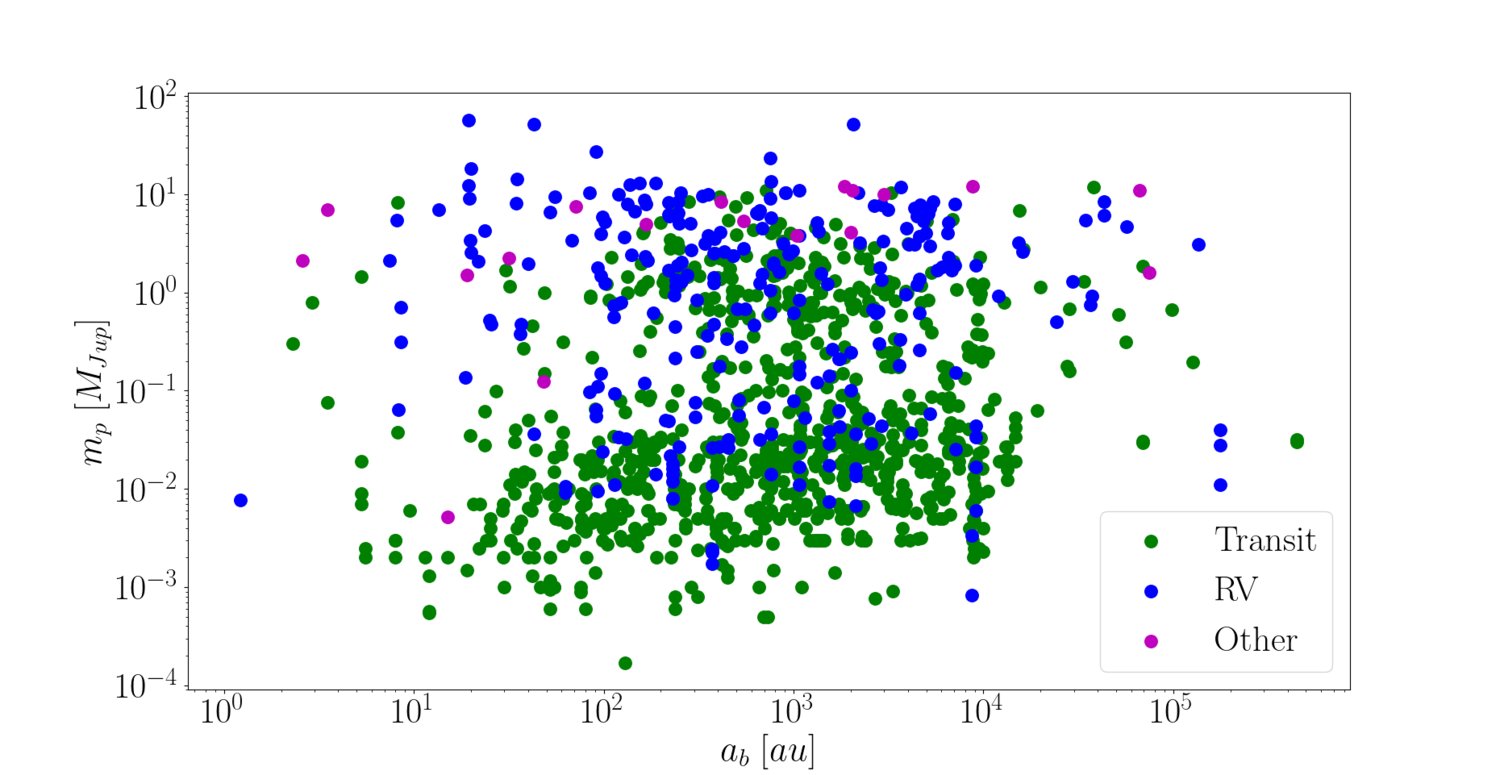
Approximately 50 % of FGK-type stars are part of a binary star system, yet only about 20 % (https://exoplanet.eu/planets_binary/) of the 4,815 exoplanetary systems discovered to date hosted by such stellar system. It is therefore important to study these in more detail. Of these discovered exoplanet systems, 844 are in so-called S-type motion, i.e. they orbit one of the two stars. Figure 1 shows the different masses of the planets in S-type motion for the separation of the binary star system.
Figure 1: The distribution of planets in S-type motion in binary stars. The different colors indicate different detection methods for the planets.
  
The formation of planets in close binary stars (ab ≤ 30 au) is suppressed in both the formation via core accretion ([4]), as shown by e.g. [7], as well as via disc fragmentation due to gravitational instabilities ([2]), as simulations have shown that discs can only fragment at binary separations of approximately ab ~ 50 au (e.g. [1]). In a recent study, [8] propose a different formation scenario, where the secondary star forms via disc fragmentation after a "smaller" fragment—a planet-sized object—has already been formed and migrates towards the primary star. 
In this study, we aim to build on the work of [8] and investigate whether it is possible for terrestrial, already harboring a gas giant, in particular, the systems HD 217958 and HD 176051. The first system has a separation of ab=25.09 au, an eccentricity of eb=0.245 and an inclination of ib=26.826°. The two stars have masses of mA = 1.08 M (G0V type) and mB = 0.077 M (M-type). A gas giant with mp = 0.524 MJ orbits the G-type star at a distance ap=3.758 au with ep=0.156 and ip = 91.357°. The HD 176051 system consists of a G0V star with mA=1.07 M and a K1V star with mB=0.71 M, which have a separation of ab=19 au, an eccentricity of eb = 0.266 and are in a retrograde orbit with ib=144.16°. In this system, it is not entirely clear which component the gas giant is orbiting. Depending on the interpretation, the observations yield different masses and semi-major axes. In the case the host star is the G-type star, the parametters for the plant are mp = 2.26 MJ and ap=2.02 au. If the K-type star is the host star, the resulting parameter of the planet are mp=1.5 MJ and ap=1.76 au. For both cases, a circular retrograde orbit (ep=0) with ip=115.8° is assumed.
When considering the formation of terrestrial planets, we study the evolution, after the gas has dissipated, and therefore focus solely on gravitational interactions and collisions. We start with a planetesimal–planetary embryo disc consisting of 1000 planetesimals and about 20 planetary embryos, placed around the habitable zone of the corresponding star (HD 217958: adisk=0.7-2.0 au, HD 176051A: adisk = 0.7–1.9 au, HD 176051B: adisk = 0.4–1.5 au) which are initially dynamically cold. Fifty per cent of the total mass of the disc is contained in each the planetesimals and planetary embryos. As the orbital parameters of the gas giants contain significant errors in some cases, we checked the stability of the gas giant's motion using FLI computations ([3]). Figure 2 shows regular and chaotic motion for the system for various mutual inclinations between the gas giant and the secondary star. In order to calculate the interaction between all disc objects, the stars and the gas giants within a reasonable time, we use our GPU-parallelised N-body code GANBISS ([9]). For the two-body collisions of disk objects we assumed the perfect merging scenario. Each configuration is simulated for 100 Myr. However, after 10 Myr, the number of objects is greatly reduced, so that a parallelised N-body code is no longer necessary. Therefore, for the long-term integration (10 - 100 Myr), we switch to the rebound package ([5]) using the IAS15 integrator ([6]).
The results show that, in some configurations, the formation of one or few terrestrial planets is possible.
Figure 2: The figure shows the FLIs for the different inclinations of the gas giant in the system HD217958.
 
Acknowledgements
M.Z. and E.P-L want to acknowledge the support by the Austrian Science Fund FWF - project PAT3059124. The computational results presented have been achieved using the Vienna Scientific Cluster (projects 71637, 71686, 70320).
 
References
  • [1] Kratter, K., Murray-Clay, R. and Youdin, A.: The runts of the Litter: Why Planets Formed Through Gravitational Instability Can Only Be Failed Binary Stars, The Astrophysical Journal, 710.2, pp. 1375-1386, 2010
  • [2] Kuiper, G.: On the Evolution of the Protoplanets, Proceedings of the National Academy of Sciences of the United States of America, 37.7, pp. 383-393, 1951
  • [3] Pilat-Lohinger, E. and Dvorak, R.: Stability of S-type orbits in binaries, Celestial Mechanics and Dynamical Astronomy 82.2, pp. 143-153, 2002
  • [4] Pollack, J., Hubickyj, O., Bodenheimer, P., Lissauer, J., Podolak, M. and Greenzweig, Y.: Formation of Giant Planets by Concurrent Accretion of Solids and Gas, Icarus 124.1, pp. 62-85, 1996
  • [5] Rein, H. and Liu, S.-F.: REBOUND: an open-source multi-purpose N-body code for collisional dynamics, Astronomy & Astrophysics, 537.A128, pp. A128, 2012
  • [6] Rein, H. and Spiegel, D.: IAS15: a fast, adaptive, high-order integrator for gravitational dynamics, accurate to machine precision over a billion orbits, Monthly Notices of the Royal Astronomical Society, 446.2, pp. 1424-1437, 2015
  • [7] Thebault, P., Marzari, F. and Scholl,H.: Planet formation in the habitable zone of α Centauri B, Monthly Notices of the Royal Astronomical Society, 393.1, pp. L21-L25, 2009
  • [8] Zhang, L., Nayakshin, S., Baruteau, C., Thebault, P. and Vorobyov E.: Disc Fragmentation. III. The need for a new paradigm for formation of planets within close binary systems, eprint arXiv:2603.02395, 2026
  • [9] Zimmermann, M. and Pilat-Lohinger, E.: GANBISS: a new GPU accelerated N-body code for binary star systems, Celestial Mechanics and Dynamical Astronomy 135.3, 2023

How to cite: Zimmermann, M. and Pilat-Lohinger, E.: Terrestrial planet formation in tight binary star systems: The case of HD217958 and HD176051, Europlanet Science Congress 2026, The Hague, The Netherlands, 7–11 Sep 2026, EPSC2026-1131, https://doi.org/10.5194/epsc2026-1131, 2026.