EXOA14 | Giant Planets Across the Solar System and Beyond

EXOA14

Giant Planets Across the Solar System and Beyond
Conveners: Yamila Miguel, Keren Duer-Milner, Thaddeus Komacek
Orals THU3
| Thu, 10 Sep, 14:00–15:30 (CEST)|Room Saturn (Jazz 3)
Orals THU4
| Thu, 10 Sep, 16:00–17:30 (CEST)|Room Saturn (Jazz 3)
Posters THU-POS
| Attendance Thu, 10 Sep, 18:00–19:30 (CEST) | Display Thu, 10 Sep, 08:30–19:30|Foyer 2, F2.71–72
Thu, 14:00
Thu, 16:00
Thu, 18:00
Recent results from Juno and Cassini have transformed our view of Jupiter and Saturn, revealing complex interior structures, non-uniform mixing, and deep processes coupled to atmospheric circulation and long-term evolution. In parallel, JWST and ground-based observatories are delivering unprecedented data of both Solar System giants and exoplanets, enabling direct comparisons of chemistry, thermal structure, clouds/hazes, and atmospheric dynamics across a wide range of irradiation and ages. Together, these advances create a timely opportunity for comparative planetology that bridges Solar System and exoplanet communities and connects observations with physical understanding.
This session welcomes contributions on giant planets in the Solar System and beyond, with a broad scope spanning observations, lab experiments and theory. Topics include (but are not limited to): formation, evolution, and interior structure, interior-atmosphere connections, atmospheric composition and chemistry, clouds and hazes, circulation, jets and atmospheric variability, and comparative analyses connecting Solar System gas giants, ice giants, and exoplanet populations. We also welcome studies using JWST and ground-based facilities, as well as work that combines multi-wavelength datasets, experiments and modelling to interpret emerging observations.
The session aims to strengthen the physical links between Solar System giants and exoplanet populations through comparative studies grounded in both data and theory.

Orals THU3: Thu, 10 Sep, 14:00–15:30 | Room Saturn (Jazz 3)

Chairperson: Keren Duer-Milner
Planet Formation, the Solar System, and Exoplanet Connections
14:00–14:12
|
EPSC2026-1151
|
On-site presentation
Lorenzo Peerani, Sho Shibata, and Ravit Helled
Studying gas giant planet formation is crucial for understanding the diversity of planets we observe across the Galaxy. Gas giants represent the most efficient products of planetary accretion, yet the substantial diversity in their observed masses, radii, and compositions suggests that the physical conditions governing their formation vary markedly across planetary systems. We present a theoretical framework for giant planet formation which couples pebble accretion, gas accretion, disk evolution, and migration across different stellar hosts.  
 
We find that the initial embryo formation timescale is a primary bottleneck, and that whether a gas giant ultimately forms is largely controlled by its initial formation location. Two distinct formation pathways emerge depending on the initial orbital distance: At small separations, the core mass is set by the pressure bump the planet opens in the disk, but high midplane temperatures suppress envelope cooling and stall the planet before runaway gas accretion can begin. At larger distances, inward pebble drift depletes the available solid supply before gap opening occurs, yet slow but efficient envelope contraction still allows gas giants to form with anomalously small cores. The resulting core masses range from 0.7 to 20 Earth masses, spanning a much broader interval than is typically assumed in classical models. We also find that the resulting planets differ significantly in masses and compositions depending on their formation conditions and the mass of their host star.  
 
The inferred diversity in core masses, final masses and compositions, and orbital periods, provides a natural explanation for the variety of physical properties observed among giant exoplanets. 

How to cite: Peerani, L., Shibata, S., and Helled, R.: How Birthplace Shapes the Cores of Gas Giant Planets, Europlanet Science Congress 2026, The Hague, The Netherlands, 7–11 Sep 2026, EPSC2026-1151, https://doi.org/10.5194/epsc2026-1151, 2026.

14:12–14:24
|
EPSC2026-364
|
On-site presentation
Hiroshi Kobayashi and Hidekazu Tanaka

Gas-giant planets, such as Jupiter, Saturn, and massive exoplanets, were formed via the gas accretion onto the solid cores, each with a mass of roughly 10 Earth masses. However, rapid radial migration due to disk–planet interaction prevents the formation of such massive cores via planetesimal accretion. Comparably rapid core growth via pebble accretion requires very massive protoplanetary disks because most pebbles fall into the central star. Although planetesimal formation, planetary migration, and gas-giant core formation have been studied with a lot of effort, the full evolution path from dust to planets is still uncertain.  We report the result of full simulations for collisional evolution from dust to planets in a whole disk. Dust growth allows the formation of icy planetesimals in the inner disk (< 5-10 au), while pebbles formed in the outer disk drift to the inner disk and there grow to planetesimals. The growth of those pebbles to planetesimals suppresses their radial drift and supplies small planetesimals sustainably in the vicinity of cores. This enables rapid formation of sufficiently massive planetary cores within 0.2–0.4 million years, prior to the planetary migration. Our models shows the first gas giants form at 2–7 au in rather common protoplanetary disks, in agreement with the exoplanet and solar systems (Kobayashi and Tanaka 2021, 2023). 

How to cite: Kobayashi, H. and Tanaka, H.: Rapid Formation of Gas-giant Planets via Collisional Coagulation from Dust Grains to Planetary Cores, Europlanet Science Congress 2026, The Hague, The Netherlands, 7–11 Sep 2026, EPSC2026-364, https://doi.org/10.5194/epsc2026-364, 2026.

14:24–14:36
|
EPSC2026-435
|
ECP
|
On-site presentation
Nils-Martin Robeling, Sudeshna Boro Saikia, Ivan Stanković, and Manuel Güdel

Motivation

Recent observations by the James Webb Space Telescope have demonstrated that disequilibrium chemistry shapes the transmission spectra of exoplanet atmospheres, making robust theoretical modelling of these processes essential for accurate atmospheric characterisation. This is particularly pressing for the upcoming ESA Ariel mission, which will observe hundreds of exoplanets across a diverse range of conditions, yet our understanding of disequilibrium processes at the population level remains limited.

Methods

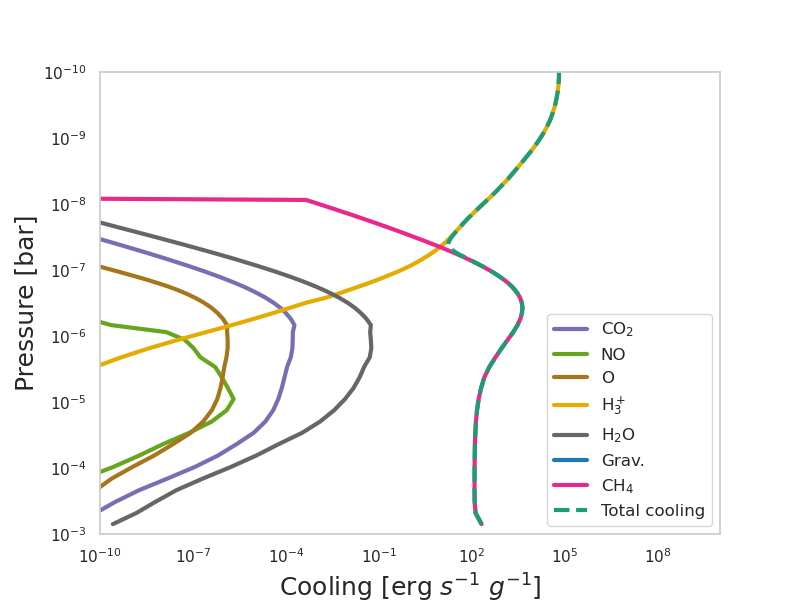
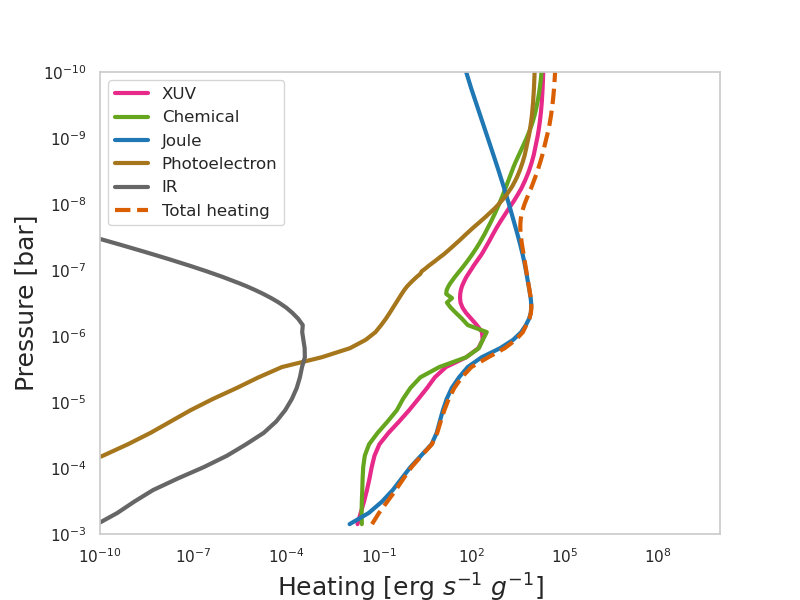
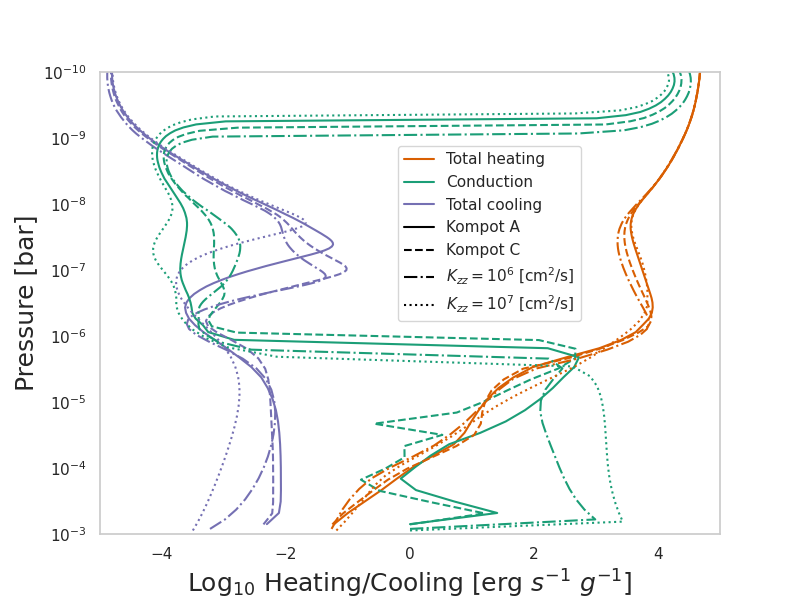
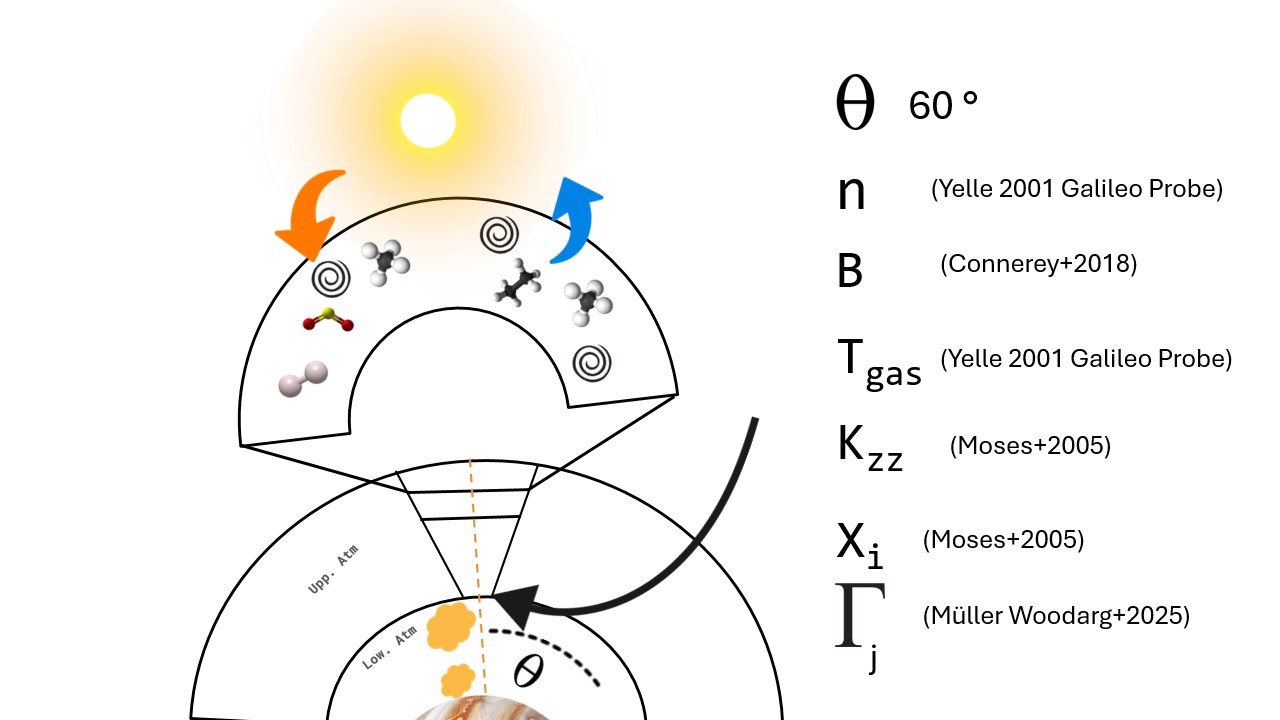
We present the extension and benchmarking of Kompot, a one-dimensional, first-principles, self-consistent thermo-chemical model, to gas giant atmospheres. Kompot solves the coupled hydrodynamical, (photo-)chemical, and thermal balance equations without prescribing an input temperature profile, allowing the physical structure, including the thermal profile, to emerge self-consistently from the underlying processes, and capturing feedback between chemistry and thermal structure.

Results

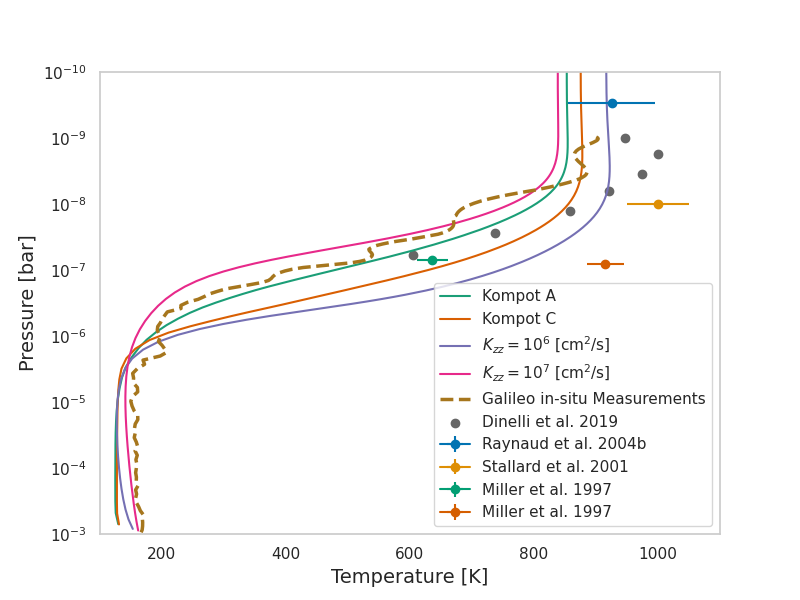
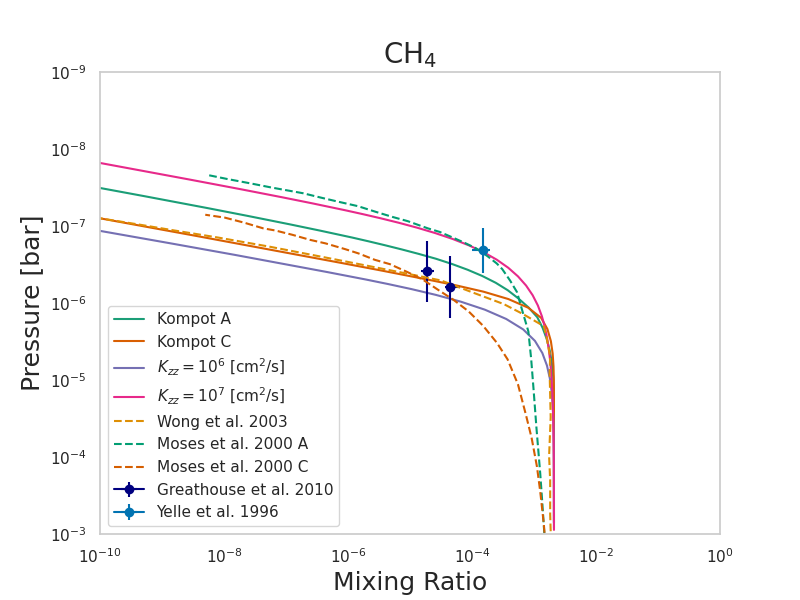
Applying Kompot to Jupiter, we establish its first benchmark for gas giants, demonstrating that the model successfully reproduces both temperature and chemical structure of Jupiter's upper atmosphere. In particular, we find that photochemical feedback plays a significant role in shaping the upper atmospheric thermal structure, with implications for how disequilibrium signatures manifest in transmission spectra. In addition to discussing our model results for Jupiter, I will also present our ongoing work to expand the model to simulate the upper atmospheres of hot and warm Jupiters. Thus, expanding the parameter space to provide self-consistent modelling of the temperature and the chemical structure of a diverse gas giant population for which observational constraints are relatively sparse.  


How to cite: Robeling, N.-M., Boro Saikia, S., Stanković, I., and Güdel, M.: Jupiter as an Exoplanet, Europlanet Science Congress 2026, The Hague, The Netherlands, 7–11 Sep 2026, EPSC2026-435, https://doi.org/10.5194/epsc2026-435, 2026.

14:36–14:48
|
EPSC2026-922
|
ECP
|
On-site presentation
Luca Morf and Ravit Helled

We advocate for a more agnostic approach to modelling the interiors of Uranus, Neptune, and sub-Neptune exoplanets. In this talk, we examine what can and cannot be inferred from the limited observables currently available.

It is well established that mass and radius alone provide insufficient information to meaningfully constrain the internal distributions of materials such as hydrogen and helium, water, rocky silicates, and iron. We show that this degeneracy persists even within the Solar System, despite precise measurements of the masses, radii, and even gravitational fields of Uranus and Neptune. Using interior models that do not impose layered structures or homogeneous adiabatic profiles, we demonstrate that both rock-dominated and water-dominated solutions remain consistent with existing constraints for the Solar System ice giants (rock-to-water mass ratios between 0.04-3.92 for Uranus and 0.20-1.78 for Neptune).  Their traditional classification as “ice giants” is therefore more historical than reflective of physical reality.

For sub-Neptune exoplanets, the problem becomes substantially more severe because the available observational constraints are far more limited. We use K2-18 b, TOI-270 d, and LHS 1140 b as case studies and apply the same agnostic interior inference framework used for Uranus and Neptune. For K2-18 b and TOI-270 d, only weak upper limits can be robustly established: the hydrogen and helium mass fraction must remain below approximately 10% for K2-18 b and 5% for TOI-270 d, and neither planet can consist purely of iron. Beyond these simple limits, a broad range of interior structures remains admissible.

We further show that many solutions excluded by homogeneous adiabatic models reappear once composition gradients are permitted. As an example, low-temperature and water-rich interiors can be artificially ruled out within simplified homogeneous models when observational uncertainties are reduced. When composition gradients are included however, these solutions become viable again, demonstrating that the apparent reduction in degeneracy arises primarily from modelling assumptions rather than from the data themselves.

As a further example, we also investigate the effect of the assumed 1-bar temperature boundary condition. For K2-18 b, changing this assumption from 300 K to 600 K significantly alters the inferred compositions in homogeneous adiabatic models. However, this sensitivity is strongly reduced once composition gradients are allowed.

LHS 1140 b, which lies more in the super-Earth rather than sub-Neptune regime, is more strongly constrained even in the presence of composition gradients. All viable models require at least ~70% combined rocky silicates and iron, less than ~30% water, and less than ~2% hydrogen and helium. Nevertheless, composition gradients still broaden the allowed ranges of internal temperature, entropy, and density profiles relative to homogeneous models.

Overall, we argue that the dominant limitation in current interior inference is not observational precision, but the modelling assumptions themselves. Homogeneous adiabatic models systematically overestimate the information content of measurements and can create the illusion of tighter constraints where none physically exist. If composition gradients, mixed materials, and non-convective regions are allowed, the interiors of Uranus, Neptune, and sub-Neptunes remain substantially more degenerate than is often assumed. These results suggest that interior modelling should adopt agnostic frameworks by default, and that questions of formation, evolution, and habitability must be addressed with explicit recognition of the broad range of admissible internal states.

How to cite: Morf, L. and Helled, R.: Composition gradients in Uranus, Neptune, and sub-Neptunes, Europlanet Science Congress 2026, The Hague, The Netherlands, 7–11 Sep 2026, EPSC2026-922, https://doi.org/10.5194/epsc2026-922, 2026.

14:48–15:00
|
EPSC2026-810
|
On-site presentation
Louis Siebenaler, Nicole Allard Allard, Yamila Miguel, and Esther van Dijk

Alkali lines, in particular the sodium (Na D) and potassium (K D) resonance doublets, are dominant opacity sources in giant planets over a wide range of temperatures (~ 1000 – 3000 K). Their strong pressure-broadened wings, produced by collisions with hydrogen, can significantly influence the thermal structure of giant planets, especially at high pressures. Most detailed line-profile calculations have so far been limited to moderate perturber densities up to 1021 cm-3. However, conditions in the deep atmospheres and interiors of giant planets can reach significantly higher densities, causing temperature gradients to become increasingly uncertain. This is particularly relevant in the context of stable radiative layers that can exist in Solar System giants and warm giant exoplanets, as well as for hot giant planets that may remain radiative well beyond 100 bar.

In this work, we compute detailed Na D and K D line profiles using the unified line theory, extending to hydrogen perturber densities relevant for the deep atmospheres and interiors of giant planets. At high pressures, the revised line profiles exhibit significantly stronger and more extended wings than those predicted by the commonly used impact approximation, as well as density-dependent line shifts. We further show that Rosseland mean opacities can increase by up to an order of magnitude when using the revised line profiles. Consequently, the radiative-convective boundaries of warm and hot giant planets can shift to lower pressures, producing warmer adiabats and increasing inferred planetary bulk metallicities. While this work addresses the dominant absorption lines relevant for high-pressure opacity calculations in giant planets, it also highlights the broader need for accurate opacity modeling at extreme densities.

How to cite: Siebenaler, L., Allard, N. A., Miguel, Y., and van Dijk, E.: The impact of detailed alkali line profiles at extreme densities on giant planet interiors, Europlanet Science Congress 2026, The Hague, The Netherlands, 7–11 Sep 2026, EPSC2026-810, https://doi.org/10.5194/epsc2026-810, 2026.

15:00–15:12
|
EPSC2026-1139
|
ECP
|
On-site presentation
Emily Sandford and Yamila Miguel

An equation of state (EOS) is thermodynamically consistent if it satisfies the first law of thermodynamics and its derivatives (see e.g. Paxton et al. 2019). Most EOS in widespread use are not perfectly thermodynamically consistent, because other considerations, including fidelity to experiment and smoothness of numerical derivatives, often take priority over thermodynamic consistency. As such, the specific effect of thermodynamic inconsistency on the evolution of stellar or planet models has not yet been evaluated, although it is posited to make structure and evolution models less accurate. Here, we present a procedure for adjusting an EOS table to improve its thermodynamic consistency, based on the work of Timmes & Swesty 2000. We apply this procedure to a set of EOS commonly used for planet modeling: the H/He EOS of Chabrier et al. 2019, with non-ideal mixing terms from Howard & Guillot 2023, and a heavy element EOS based on AQUA H2O (Haldemann et al. 2020) and SESAME rock (Lyon & Johnson 1992). We show that the adjusted, thermodynamically consistent versions are compatible with experimental Hugioniot measurements, where available. Finally, we compare planet models evolved with (1) the original EOS presented in the literature; (2) thermodynamically consistent versions of the EOS; and (3) "control" versions of the EOS, which have roughly the same thermodynamic consistency as the originals, but deviate roughly as much from the original tabulated values as version (2).

How to cite: Sandford, E. and Miguel, Y.: The effect of equation of state thermodynamic consistency on simulated planet evolution, Europlanet Science Congress 2026, The Hague, The Netherlands, 7–11 Sep 2026, EPSC2026-1139, https://doi.org/10.5194/epsc2026-1139, 2026.

15:12–15:24
|
EPSC2026-1231
|
On-site presentation
Paolo Simonetti, Diego Turrini, Stavro Ivanovski, Eugenio Schisano, Sergio Fonte, Sergio Molinari, Elenia Pacetti, Romolo Politi, Danae Polychroni, Michele Zusi, and Valeria Cottini

INTRODUCTION: 

Elemental abundances are central in characterizing the formation and evolution history of giant exoplanets [1,2,3]. Among them, O and C are the most easily accessible due to being carried largely by relatively abundant and very infrared-opaque carriers such as H2O, CO and CH4 [e.g. 4]. However O, being a very reactive element, is expected to be partially sequestered in species difficult to observe and/or in condensates [5]. Chemical modeling is required to correct for this unseen component, called oxygen deficit [6].

Chemical kinetics models capable of including vertical and/or horizontal dynamics, condensation, sedimentation and photochemistry are the best positioned to further our knowledge of exoplanetary atmospheres [7,8]. While most of the work is focused on building detailed and reliable CHON networks [9], research is underway to include the most abundant refractory elements (Mg, Si and Fe) within a disequilibrium framework [10,11].


MODEL:

Here, we present a new chemical network network to study the main Mg, Si and Fe carriers in the atmospheres of gas giants in the [700, 1600] K range of equilibrium temperatures. It is built upon the SNCHO network of the widely used Vulcan code [12] and it includes a simplified treatment of the formation and destruction of the two main silicates, enstatite and forsterite.


RESULTS:

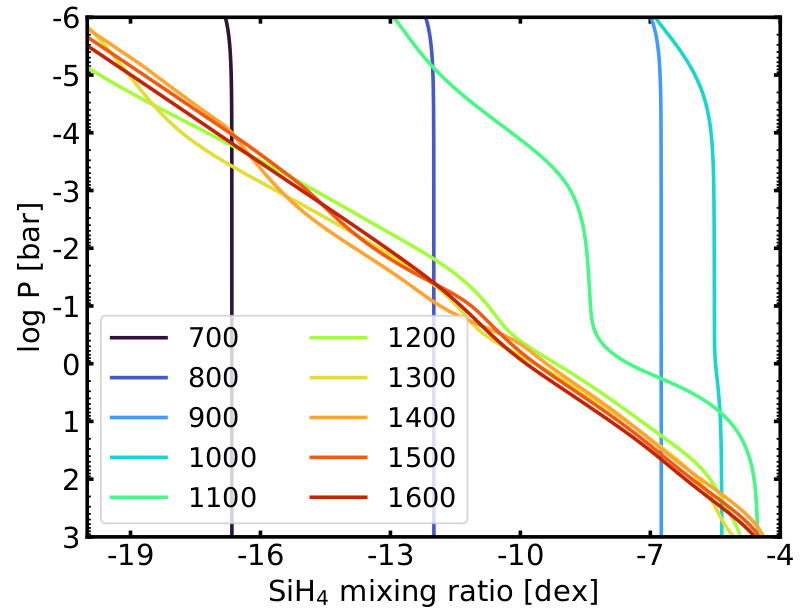
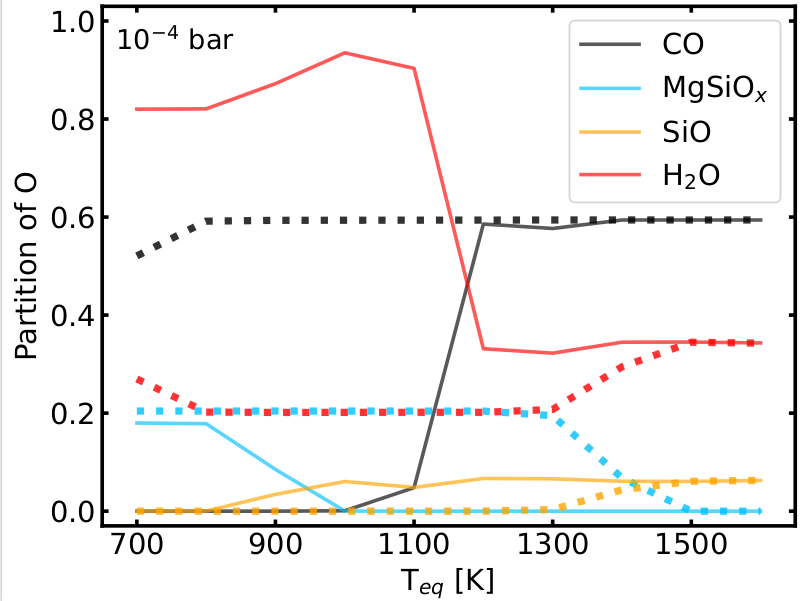
We applied our new network to study the partition of oxygen in a vertically mixed, Solar-composition atmosphere. Figure 1 shows that vertically mixed (Kzz=10^8 cm2 s-1, solid lines) atmospheres are expected to free oxygen from enstatite and forsterite, here reported collectively as MgSiOx, at a substantially lower equilibrium temperature with respect to atmospheres in chemical equilibrium (dotted lines). This means that the oxygen deficit expected at chemical equilibrium is substantially higher in the [900,1300] K equilibrium temperature interval. Si, which in a mixed atmosphere is not entirely tied in condensed form, can then form SiH4, enhancing its volume mixing ratio to ≳ 10^-7 in the upper atmosphere for planets at the warm/hot class interface (Teq=1000 K), as shown in Figure 2. In the same equilibrium temperature range, SiH4 can be also used as a sensitive tracer of the vertical mixing intensity, that can then be used to refine the VMR estimates of other chemical species. The network has also been applied to the case of the young wide-orbit giant planet YSES-1c [13], showing that the atmosphere is likely very well-mixed in the vertical direction.

Figure 1: oxygen partition among its main carriers at the 0.1 mbar level of a Solar-composition atmosphere. Solid: mixed atmosphere. Dotted: equilibrium atmosphere.

Figure 2: vertical volume mixing ratio profile of SiH4 in a mixed, Solar-composition atmosphere.

BIBLIOGRAPHY:

[1] Oberg et al. (2011), ApJ, 743, 16.

[2] Turrini et al. (2021), ApJ, 909, 40.

[3] Pacetti et al. (2022), ApJ, 937, 36.

[4] https://research.iac.es/proyecto/exoatmospheres/index.php

[5] Fegley & Schaefer (2010) in Principles and Perspectives in Cosmochemistry

[6] Fonte et al. (2023), MNRAS, 520, 4683.

[7] Venot et al. (2012), A&A, 546, 43.

[8] Mukherjee et al. (2024), ApJ, 963, 73.

[9] Veillet et al. (2024), A&A, 682, 52.

[10] Kiefer et al. (2024), A&A, 682, 150.

[11] Agundez (2025), A&A, 699, 306.

[12] Tsai et al. (2021), ApJ, 923, 264.

[13] Hoch et al. (2025), Nature, 643, 938.

How to cite: Simonetti, P., Turrini, D., Ivanovski, S., Schisano, E., Fonte, S., Molinari, S., Pacetti, E., Politi, R., Polychroni, D., Zusi, M., and Cottini, V.: A VULCAN-ready chemical kinetics network for gas giants including magnesium, silicon and iron, Europlanet Science Congress 2026, The Hague, The Netherlands, 7–11 Sep 2026, EPSC2026-1231, https://doi.org/10.5194/epsc2026-1231, 2026.

15:24–15:30

Orals THU4: Thu, 10 Sep, 16:00–17:30 | Room Saturn (Jazz 3)

Chairperson: Thaddeus Komacek
Giant Exoplanets: Atmospheres, Interiors, and Dynamics
16:00–16:12
|
EPSC2026-173
|
ECP
|
On-site presentation
Hiroki Matsuo, Hiroyuki Kurokawa, and Takato Tokuno

Recent analyses of JWST transmission spectroscopy have suggested that some transiting giant gas planets and gas dwarfs have low atmospheric C/O ratios, comparable to or lower than the solar value (C/O_solar ~= 0.55), as well as high intrinsic temperatures reaching Tint ≥ 300 K (e.g., Sing et al. 2024; Welbanks et al. 2024). These inferred Tint values are higher than the Tint ~ 100 K predicted by conventional cooling models (Fortney et al. 2020), and are difficult to explain by standard cooling evolution alone.

The origin of low atmospheric C/O ratios may be attributed either to planet formation processes or to post-formation internal evolution. As a planet formation origin, oxygen-rich heavy elements may be supplied by the evaporation of pebbles that drift radially in the protoplanetary disk, or by the evaporation of pebbles accreted into the planetary envelope during formation (e.g., Brouwers et al. 2018). In this study, we instead focus on an internal-evolution origin, namely the transport of heavy elements from a diluted core to the outer envelope.

Observations of Jupiter and Saturn by Juno and Cassini suggest the existence of diluted cores, in which the heavy-element abundance decreases continuously from the center outward, rather than being confined to a compact central core (e.g., Wahl et al. 2017; Mankovich & Fuller 2021). In planets with such diluted cores, heavy elements distributed in the interior can be transported outward over time, thereby altering the atmospheric composition after formation (Knierim & Helled 2025). When this process is applied, even planets that initially accreted high-C/O gas, as predicted by the static disk chemistry model (Öberg et al. 2011), can reduce their atmospheric C/O ratios to solar or sub-solar values if oxygen-rich heavy elements from the diluted core are transported into the atmosphere after formation.

On the other hand, realizing the observed Tint ≥ 300 K may require an additional heat source. One possible mechanism is internal heating, in which a fraction of the incident stellar irradiation is transported into the planetary interior (Komacek & Youdin 2017). Komacek & Youdin (2017) showed that internal heating can delay planetary cooling and contraction by suppressing the vigorous convection that occurs in gas planets. However, because the transport of heavy elements from the diluted core to the outer envelope is mainly driven by convective mixing, suppression of convection by internal heating may inhibit the post-formation decrease in atmospheric C/O. Thus, internal heating that maintains a high Tint and diluted-core mixing that produces a low atmospheric C/O ratio may act as competing processes.

In this study, we introduce internal heating into giant gas planet models with diluted cores and investigate the conditions under which C/O ≤ 0.55 and Tint ≥ 300 K can be simultaneously achieved through post-formation internal evolution. We use the stellar evolution code MESA (Paxton et al. 2011–2019; Jermyn et al. 2023) and the planetary module MESPA (Helled, Müller, & Knierim 2025). As the initial internal structure, we adopt a Jupiter-mass diluted-core model based on Knierim & Helled (2025), and set the initial atmospheric C/O ratio to the high gas-phase value predicted by the disk chemistry model of Öberg et al. (2011). Following Komacek & Youdin (2017), we parameterize internal heating by the heating efficiency and the heating depth. The heating efficiency is defined as the fraction of the incident irradiation deposited as heat in the planetary interior, and is treated here as a free parameter controlling the strength of internal heating. The heating depth specifies where this energy is deposited. We use a model with Teq = 1000 K as a baseline. For a given heating depth, the deposited heating power depends on the product of the incident irradiation and the heating efficiency, so the heating efficiency controls the effective strength of internal heating in our baseline models.

We find that, for the Teq = 1000 K baseline model, a heating efficiency of 1% can maintain Tint > 300 K while reducing the atmospheric C/O ratio to a sub-solar value through the transport of oxygen-rich heavy elements from the diluted core. This 1% case corresponds to a representative heating efficiency discussed by Komacek & Youdin (2017) for explaining the radius inflation of hot Jupiters. In contrast, when the heating efficiency is increased to 10% and the deposited heat reaches the convective envelope, a higher Tint can be achieved, but a radiative layer forms within the envelope and inhibits the transport of heavy elements from the diluted core to the outer envelope. As a result, the post-formation decrease in C/O becomes inefficient. The 10% case corresponds to the upper limit of the heating efficiency adopted by Komacek & Youdin (2017), and is used here as a strong-heating comparison model.

These results have important implications for interpreting the origin of low atmospheric C/O ratios. When internal heating is relatively weak, or when the deposited heat does not strongly affect the convective envelope, convective transport from the diluted core can remain efficient. In such planets, low atmospheric C/O ratios may not directly reflect the composition acquired during formation; even planets that initially accreted high-C/O gas can acquire solar or sub-solar atmospheric C/O ratios after formation through the upward transport of oxygen-rich heavy elements from the diluted core. In contrast, when internal heating is strong and reaches the convective envelope, a radiative layer can form within the planet and suppress convective heavy-element transport, making post-formation C/O reduction inefficient. Because the deposited heating power increases with incident irradiation, strongly irradiated planets can experience strong internal heating even with a modest heating efficiency. If such planets nevertheless show low C/O ratios, their atmospheric compositions may more directly reflect the composition acquired during formation rather than subsequent internal evolution. Therefore, strongly irradiated planets are promising targets for distinguishing the origin of low atmospheric C/O ratios.

In this presentation, we discuss how internal heating affects the evolution of Tint and atmospheric C/O ratios in giant planets with diluted cores, and explore the possibility of distinguishing the origin of atmospheric composition.

How to cite: Matsuo, H., Kurokawa, H., and Tokuno, T.: Post-formation Origin of Low Atmospheric C/O Ratios in Giant Exoplanets and the Role of Internal Heating, Europlanet Science Congress 2026, The Hague, The Netherlands, 7–11 Sep 2026, EPSC2026-173, https://doi.org/10.5194/epsc2026-173, 2026.

16:12–16:24
|
EPSC2026-586
|
ECP
|
On-site presentation
Esther van Dijk, Yamila Miguel, and Paul Mollière

Atmospheric boundary conditions play a critical role in interior modelling because they determine the pressure and temperature at the radiative-convective boundary, which sets the interior adiabat. These boundary conditions depend on the assumed atmospheric composition, which observations of hot Jupiter atmospheres now constrain in increasing detail. However, interior models typically include only atmospheric metallicity in the boundary condition and assume solar values for all other elemental ratios. In this talk, we show how the C/O ratio affects the atmospheric boundary and, consequently, the inferred interior properties of hot Jupiters. We couple a grid of self-consistent 1D radiative-chemical equilibrium models to a static interior structure model. This framework allows atmospheric composition to be incorporated consistently both as an atmospheric boundary condition and as a constraint on the envelope metallicity. We find that variations in the atmospheric C/O ratio can change the temperature at the atmospheric boundary up to 200 K. These temperature differences propagate throughout the planetary interior and can produce radius differences of up to 40% for a fixed interior structure, depending on the equilibrium temperature and atmospheric metallicity. For equilibrium temperatures above 1500 K and super-solar metallicities the assumption of a solar C/O ratio introduces radius errors larger than current observational uncertainties. Finally, we retrieve the interior structure of WASP-19b for different atmospheric C/O ratios and show that assumptions about atmospheric composition alter the inferred intrinsic temperature. Our results highlight the importance of using chemically informed atmospheric boundary conditions when atmospheric abundance constraints are available.

How to cite: van Dijk, E., Miguel, Y., and Mollière, P.: The impact of the atmospheric C/O ratio on hot Jupiter interiors, Europlanet Science Congress 2026, The Hague, The Netherlands, 7–11 Sep 2026, EPSC2026-586, https://doi.org/10.5194/epsc2026-586, 2026.

16:24–16:36
|
EPSC2026-665
|
On-site presentation
Nicolas Crouzet, Billy Edwards, Thomas Konings, Jeroen Bouwman, and Michiel Min and the ExoMIRI

The chemical composition of warm gas giant exoplanet atmospheres (with Teq < 1000 K) is not well known due to the lack of observational constraints. HAT-P-12 b is a warm, sub-Saturn-mass transiting exoplanet that is ideal for transmission spectroscopy. One transit of HAT-P-12 b was observed with JWST NIRSpec in the 2.87--5.10 μm range with a resolving power of ∼1000. We combined the JWST data with archival observations from HST WFC3 covering the 1.1--1.7 μm range. We analysed the data using two data reduction pipelines and two atmospheric retrieval tools, and performed atmospheric simulations using chemical forward models. CO2, CO, and H2O are detected at 12.2, 4.1, and 6.0 σ confidence, respectively. Their volume mixing ratios are consistent with an atmosphere of ∼10× solar metallicity and production of CO2 by photochemistry. CH4 is not detected and seems to be lacking, which could be due to a high intrinsic temperature with strong vertical mixing or other phenomena. SO2 is also not detected and its production seems limited by low upper atmosphere temperatures (∼500 K at P<10−3 bar derived from one-dimensional retrievals), insufficient to produce it in detectable quantities. This study points towards an atmosphere for HAT-P-12 b that could be enriched in carbon and oxygen with respect to its host star. When including the production of CO2 via photochemistry, an atmospheric metallicity that is close to Saturn's can explain the observations. Metallicities inferred for other gas giant exoplanets based on their CO2 mixing ratios may need to account for its photochemical production pathways. This may impact studies on mass-metallicity trends and links between exoplanet atmospheres, interiors, and formation history.

How to cite: Crouzet, N., Edwards, B., Konings, T., Bouwman, J., and Min, M. and the ExoMIRI: Detection of CO2, CO, and H2O in the atmosphere of the warm sub-Saturn HAT-P-12b, Europlanet Science Congress 2026, The Hague, The Netherlands, 7–11 Sep 2026, EPSC2026-665, https://doi.org/10.5194/epsc2026-665, 2026.

16:36–16:48
|
EPSC2026-1014
|
ECP
|
On-site presentation
Daniela Ernestová, Miroslav Brož, and Felix Sainsbury-Martinez

While hot Jupiters are exotic scorching gas giants that have no equivalent in our Solar System, they provide a good bechmarks for atmospheric modelling. They are in synchronous rotation with their host star on very low eccentricity orbit and with negligible axial tilt, so they don’t experience change in seasons. Therefore, their atmospheres shouldn’t vary greatly in time. But despite their size and proximity to the star, which makes them relatively easy to observe, directly resolving their atmospheres is still inacessible. Therefore, interpreting indirect observations is crucial to understanding their global atmospheric circulation.

Here, we aim to test the hypothesis that systematically varying the rotation rate of hot Jupiters influences their general atmospheric circulation, and the phase shift and amplitude of their phase curves. We used DYNAMICO (Dubos et al, 2015), a 3d General Circulation Model (GCM) that uses an energy-conserving Hamiltonian to solve fluid dynamics equations on a rotating sphere.

We modelled benchmark hot Jupiter HD209458b, WASP121b and WASP-34b. We used PICASO (Robbins-Blanch et al., 2022), a 3d state-of-the-art radiative transfer code, to model the phase curves in JWST NIRCam filters for 4.5 μm wavelength. To check if chemical species can condense into quartz and forsterite clouds, we used GGChem (Woitke et al., 2018).

Our simulations show that the general atmospheric circulation can be divided into two circulation regimes: rotational and divergent.

The rotational regime is characteristic of models with fast rotation rates (between one and 40 times the nominal rotation rate). They have a narrow and weak eastward jet due to their rotationally dominated circulation. Its speed drops from 3km/s to 0.3km/s and its width decreases with increasing rotation rate. These weak jets transport less heat from the substellar point, which sustains larger day and night temperature differences, and therefore the synthetic phase curves have a large amplitude (the ratio of the planetary to stellar flux is around 3 × 10‒5) and little to no offset.

The slow rotators have atmospheres dominated by divergent (overturning) circulation, which is more effective at heat transport. The temperature across the planet is more homogenised, therefore, the synthetic phase curves exhibit 3 times smaller amplitudes than in the rotational regime and offsets of the order of tens of degrees. Our results for HD209458b suggest that differences in the shapes and offsets of the phase curve are most prominent in the 4.5 μm band.

However, our model underestimates the amplitude of the phase curves by half (the synthetic value is around 5 × 10‒4 compared to 1 × 10‒3 for the observed one). Even though our model includes accounts for the complex interplay between a planet's physical characteristics (size, mass, period, etc.) and its chemical composition (metallicity and opacity), it is still idealised.

To improve the model, we have computed new models for HD 209458 b with different temperature-pressure (T-P) profiles and cooling timescales. We have models for extended the T-P profile to 10-6 bar, increased its temperature by 200 K, increased the day-to-night temperature contrast and modelled slight temperature inversion. We have also computed models for 10x longer and shorter cooling timescales.  The best model that will match the observed phase curve, will be a one with longer cooling timescale and greater day-to-night temperature contrast. The former increases the model’s phase shift closer to the observed one from 0.030 to 0.127 and the latter increases the amplitude from 5 * 10-4 to 10-3. The models are yet to include high-altitude clouds in phase curve modelling.


 Dubos, T., Dubey, S., Tort, M., Mittal, R., Meurdesoif, Y. and Hourdin, F. DYNAMICO-1.0, an icosahedral hydrostatic dynamical core designed for consistency and versatility. 2015. Geoscientific Model Development. 8: 3131-3150.Robbins-Blanch, N., Kataria, T., Batalha, N. and Adams, D. J. Cloudy and Cloud-free Thermal Phase Curves with PICASO: Applications to WASP-43b. 2022. The Astrophysical Journal. 930: 93-102. Woitke, P., Helling, Ch., Hunter, G. H., Millard, J. D., Turner, G. E., Worters, M., Blecic, J., and Stock, J. W. Equilibrium chemistry down to 100 K. Impact of silicates and phyllosilicates on carbon/oxygen ratio. 2018. Astronomy & Astrophysics. 614.

How to cite: Ernestová, D., Brož, M., and Sainsbury-Martinez, F.: How does rotation rate influence the weather on hot Jupiters?, Europlanet Science Congress 2026, The Hague, The Netherlands, 7–11 Sep 2026, EPSC2026-1014, https://doi.org/10.5194/epsc2026-1014, 2026.

16:48–17:00
|
EPSC2026-649
|
ECP
|
On-site presentation
Vanesa Ramirez, Yamila Miguel, and Billy Edwards

Tidal forces can significantly deform close-in exoplanets, providing a unique probe of their internal structure. The degree of deformation depends on a planet’s internal mass distribution and is quantified by the fluid Love number ($h_{2f}$), which describes the planetary response to external gravitational perturbations. While interior models based solely on mass and radius are often highly degenerate, Love numbers provide a complementary observable that can help break these degeneracies and constrain a planet’s central mass concentration.

In this work, we investigate the capability of current and future space missions, including JWST and Ariel, to detect tidal deformation in close-in giant exoplanets. Using the ultra-hot Jupiter WASP-76b as a benchmark target, we perform end-to-end simulations of phase-curve observations to evaluate whether tidal deformation signatures can be recovered from realistic datasets and to assess the precision with which the Love number can be constrained.

Our results show that tidal deformation in close-in giant exoplanets may be detectable with both JWST and Ariel, opening a new avenue for probing exoplanet interiors through photometric observations. Combined with interior structure models, these measurements could provide novel constraints on the internal mass distribution of close-in giant planets.

How to cite: Ramirez, V., Miguel, Y., and Edwards, B.: Assessing the detectability of tidal deformation in close-in giant exoplanets with JWST and Ariel, Europlanet Science Congress 2026, The Hague, The Netherlands, 7–11 Sep 2026, EPSC2026-649, https://doi.org/10.5194/epsc2026-649, 2026.

17:00–17:12
|
EPSC2026-1242
|
ECP
|
On-site presentation
Albert Elias-López, Aline Vidotto, Daniele Vigano, Emily Sandford, and Simon Muller

Hot Jupiters (HJs) are commonly thought to host the strongest dynamo-generated magnetic fields among exoplanets, potentially exceeding Jupiter’s by an order of magnitude. Yet, despite extensive radio and spectroscopic searches for star–planet interactions (SPI), no unambiguous detections have been made. Here, we present new magnetic field estimates for individual HJs together with general magnetic field scaling laws. Assuming their dynamos operate in the fast-rotating regime (Ro < 0.1), we combine one-dimensional evolutionary models with integral magnetic field scaling laws under two heating scenarios: deep and shallow energy deposition within the convective zone. Using interpolators built from the simulation data, we derive optimistic (deep heating) and pessimistic (shallow heating) magnetic field strengths, and construct scaling relations based on observables, i.e., planetary mass, radius, and incident stellar flux. The deep-heating scenario maximizes convective heat flux in the dynamo and predicts strong magnetic fields of up to ~100 G, whereas shallow heating suppresses convection and yields much weaker fields of order ~1 G. These results challenge the standard assumption that inflated HJs necessarily host exceptionally strong magnetic fields because of their large radii and vigorous interiors. Instead, many HJs may generate fields too weak to produce detectable coherent radio emission or strong SPI signatures, naturally explaining the persistent non-detections in radio surveys. Future facilities may distinguish between these interior-heating scenarios through improved magnetic field constraints.

How to cite: Elias-López, A., Vidotto, A., Vigano, D., Sandford, E., and Muller, S.: New hot-Jupiter magnetic field scaling laws, Europlanet Science Congress 2026, The Hague, The Netherlands, 7–11 Sep 2026, EPSC2026-1242, https://doi.org/10.5194/epsc2026-1242, 2026.

17:12–17:24
|
EPSC2026-136
|
ECP
|
On-site presentation
Clàudia Soriano Guerrero

Hot Jupiters are extreme planetary environments where strong stellar irradiation drives fast atmospheric winds in partially ionised gas. Under these
conditions, magnetic fields can interact with atmospheric dynamics, potentially modifying circulation patterns and contributing to atmospheric heating through Ohmic dissipation. Despite its importance, the role of magnetohydrodynamic (MHD) processes in hot Jupiter atmospheres remains less explored than purely hydrodynamic models.
In this work we investigate magnetic induction and field amplification in the atmospheres of hot Jupiters using a hierarchy of local MHD models with
increasing physical complexity. We begin with three dimensional ideal MHD simulations of a narrow atmospheric column representative of the dayside
radiative layers of ultra-hot Jupiters. These simulations show that strong zonal winds efficiently wind the background magnetic field, generating intense
toroidal components concentrated in shear layers near pressures of order ~1 bar. The resulting fields can reach kilogauss strengths, locally,  and are
sustained by meridional currents without requiring an internal dynamo.

We then incorporate non-ideal MHD effects, including Ohmic diffusion, Hall drift, and ambipolar diffusion, using thermodynamic and wind profiles derived from global circulation models of several hot Jupiters, including WASP-76b, WASP18b, WASP-121b and HD 209458b. While magnetic winding remains the
dominant mechanism, Hall and ambipolar terms modify the structure and orientation of the magnetic field in low-pressure regions.

Finally, we explore fully three-dimensional non-ideal MHD configurations including small-scale perturbations. These perturbations trigger the formation of
coherent magnetic structures superimposed on the dominant toroidal field and lead to additional meridional components.

Overall, our results show that magnetic effects in hot Jupiter atmospheres are highly nonlinear and spatially structured, and may play an important role in
atmospheric energy dissipation. This highlights the need to incorporate MHD processes more consistently in future global circulation and evolutionary models.

How to cite: Soriano Guerrero, C.: MHD atmospheric simulations of Hot Jupiters to study non-ideal effects and turbulence, Europlanet Science Congress 2026, The Hague, The Netherlands, 7–11 Sep 2026, EPSC2026-136, https://doi.org/10.5194/epsc2026-136, 2026.

17:24–17:30

Posters: Thu, 10 Sep, 18:00–19:30 | Foyer 2

Display time: Thu, 10 Sep, 08:30–19:30
F2.71
|
EPSC2026-29
|
On-site presentation
Thaddeus Komacek and Emeline Fromont

Recent JWST transmission and emission spectroscopic observation of hot Jupiters have demonstrated that sub-micron sized silicate mineral clouds may be common hot Jupiter atmospheres. In addition, ground-based high-resolution spectroscopic observations of both transit and eclipse have implied horizontal asymmetries that may be amplified by clouds. Silicate mineral clouds have long been predicted to form and persist on the nightside and western dayside of hot Jupiters by cloud microphysical models and 3D General Circulation Models. Given the capability of current ground-based high resolution spectrographs, complementary JWST observations, as well as recent advancements in modelling techniques, the time is right to determine the prevalence and spatial and particle size distribution of mineral clouds across the parameter regime of hot Jupiters. This effort will provide a detailed test of our present theoretical understanding of cloud nucleation, transport and growth processes, and the radiative feedback of clouds on the atmospheric circulation and climate of hot Jupiters. In this work, we present a combination of analytical and numerical models of the vertical mixing of mineral clouds in hot gas giant atmospheres. Our scaling analyses naively predict that clouds of a broad range of particle sizes (up to 10 microns) should be well-mixed throughout gas giant atmospheres to low pressures (~0.1 mbars). However, the local nature of vertical mixing in more detailed three-dimensional simulations prevents such well-mixed micron-sized mineral clouds in many cases. In addition, we hypothesise that fragmentation may play a role in setting the characteristic maximum particle size of silicate mineral clouds in hot Jupiter atmospheres, much like it impacts the build-up of silicate grains in protoplanetary disks. We predict how mixing scales with cloud particle size and composition using analytic theory and three-dimensional numerical simulations including cloud tracers. We discuss implications for ground-based high resolution characterisation of hot Jupiters, especially with time-resolved spectroscopy. 

How to cite: Komacek, T. and Fromont, E.: Vertical mixing of mineral clouds in hot Jupiter atmospheres, Europlanet Science Congress 2026, The Hague, The Netherlands, 7–11 Sep 2026, EPSC2026-29, https://doi.org/10.5194/epsc2026-29, 2026.

F2.72
|
EPSC2026-659
|
ECP
|
On-site presentation
Keren Duer-Milner, Esther Van Dijk, and Yamila Miguel

The atmospheres of Hot Jupiters (HJs) are strongly shaped by the extreme day-to-night temperature contrasts that drive supersonic jet streams and global-scale circulation patterns. New observational techniques are beginning to provide constraints on both atmospheric wind velocities and planetary deformation, which is expected to be governed primarily by tidal forcing, planetary rotation, and the internal density structure.
However, sufficiently strong global-scale winds can redistribute enough mass to produce an additional dynamical deformation that may be comparable to, or even exceed, the contribution from the static interior structure. Here, we investigate this effect by calculating the lowest-order gravitational harmonic, J2, which characterizes the planetary oblateness and, in the linear hydrostatic regime, is related to the degree-2 tidal Love number k22
We estimate the contributions to J2 from both the interior structure and the atmospheric jet streams. The dynamical contribution is calculated based on 3D circulation models spanning a broad HJ parameter space. We show that atmospheric mass anomalies associated with strong winds can significantly modify the expected deformation signal and may therefore be detectable with current and upcoming observations of HJs Love numbers.
Finally, we compare our predictions with existing measurements of tidal Love numbers for Ultra-HJs and explore the possibility of constraining the deep wind structure of exoplanet atmospheres from deformation measurements.

How to cite: Duer-Milner, K., Van Dijk, E., and Miguel, Y.: Atmospheric contribution to k22 (tidal Love number) in Hot Jupiters, Europlanet Science Congress 2026, The Hague, The Netherlands, 7–11 Sep 2026, EPSC2026-659, https://doi.org/10.5194/epsc2026-659, 2026.