ODAC5 | From wonder to understanding: communicating science through solar eclipses

ODAC5

From wonder to understanding: communicating science through solar eclipses
Convener: Federica Duras | Co-conveners: Claudia Mignone, Federico Di Giacomo, Helen Usher, Graham Jones
Orals TUE4
| Tue, 08 Sep, 16:00–17:30 (CEST)|Room Saturn (Jazz 3)
Posters MON-POS
| Attendance Mon, 07 Sep, 18:00–19:30 (CEST) | Display Mon, 07 Sep, 08:30–19:30|Foyer 3, F3.75–76
Tue, 16:00
Mon, 18:00
Solar eclipses are among the most awe-inspiring celestial phenomena. Their rarity, predictability and dramatic visual impact make them exceptional opportunities to engage the general public with both the wonders of the cosmos and the scientific process trying to make sense of the Universe we live in. The awe of a total eclipse can be transformational for many people experiencing the event, driving curiosity towards STEM topics along with a sense of sharing, reflection, and a prosocial attitude. Besides, the buzz of a total eclipse can be leveraged to extend the engagement into areas where the eclipse is only partial too, making the number of people covered much much bigger.

This session aims at collecting experiences from past solar eclipses, especially the one that will cross parts of Europe on 12 August 2026, showcasing outreach activities, educational resources, communication strategies, and evaluation outcomes. We encourage participants to share best practices, challenges encountered and lessons learnt for future efforts. The discussion will also serve as a forward-looking platform to coordinate continental-scale outreach in preparation for the total solar eclipse that will cross Europe, Africa, and Asia next year, on 2 August 2027. By fostering collaboration among educators, researchers, science communicators and institutions, we seek to maximize the scientific, educational and societal impact of these extraordinary celestial events.

Orals: Tue, 8 Sep, 16:00–17:30 | Room Saturn (Jazz 3)

Chairpersons: Federica Duras, Claudia Mignone
16:00–16:03
16:03–16:05
16:05–16:17
|
EPSC2026-1138
|
On-site presentation
Nicole Shearer and Jans Henke

The trio of European eclipses (August 2026, August 2027, January 2028) provides a unique opportunity to engage millions of people with space science, especially as they all pass through Spain, which is also the home of ESA's Astronomy Centre (ESAC).

ESA is part of the Spanish Scientific and Advisory Committee for the Trio of Eclipses, contributing to the official Spanish eclipse website 'Trio of Eclipses', an initiative led by the Spanish government. Together with partners, ESA has developed the scientific outreach section of the site, providing clear and accurate content to support public understanding of the eclipses.

For the 12 August 2026 total solar eclipse, ESA's dedicated campaign focused on:

  • A live broadcast from Javalambre Observatory
  • An event for the general public in León city, Spain
  • A dedicated web portal for outreach and education (relevant for all three eclipses)
  • An educational campaign (relevant for all three eclipses)
  • Eclipse-themed merchandise and visuals (relevant for all three eclipses)

In this talk, we will present an overview of the initiatives listed above, including the lessons learned that we will apply to the coming two European solar eclipses.

How to cite: Shearer, N. and Henke, J.: How the European Space Agency is connecting millions of people with the trio of European eclipses, Europlanet Science Congress 2026, The Hague, The Netherlands, 7–11 Sep 2026, EPSC2026-1138, https://doi.org/10.5194/epsc2026-1138, 2026.

16:17–16:29
|
EPSC2026-1178
|
ECP
|
On-site presentation
Gemma Domènech Rams, Kike Herrero, and Eduard Masana

Before sunset on 12 August 2026, Catalonia beared witness to a total solar eclipse, a once-in-a-lifetime astronomical event not seen in the region for over 121 years, briefly turning day into night, the sky and landscape darkening, and stars suddenly becoming visible. A spectacular and rare phenomenon on a date already significant to popular astronomy due to the Perseids meteor shower.  It offered a unique scientific, educational, and social opportunity for the country, as the southern third of Catalonia crossed the path of totality, approximately 200 km wide. Locations like Tarragona and Lleida where able to experience the full phenomenon, lasting up to 1 minute and 30 seconds in some observation points, with the whole of the territory and major cities like Barcelona crossing at least parciality.

Catalonia's Interdepartmental Eclipse Commission

To efficiently manage everything related to this unique phenomenon, the Government of Catalonia (Generalitat) approved early on the creation of the Interdepartmental Eclipe Commission in May 2025 [1], with the activation of a comprehensive plan for the total solar eclipse on 12 Augut 2026, to guarantee coordinated, safe management with high social impact actions. Led by the Department of Research and Universities, it comprised 15 government departments into a nation-wide project, with the scientific and technical support of the Institute of Space Studies of Catalonia (IEEC). The comission also held coordination meetings with the wider National Eclipse Commision, with the goal of aligning territorial strategies with state guidelines and ensuring efficient event management.

An institutional kick-off event for the Year of the Total Eclipse of 2026 was heald in Barcelona under the name "Catalonia looks to the sky" [2] with the participation of experts, communicators and international institutions such as UNESCO and the European Space Agency. In preparation for the event, a series of observation points throughout the region where the total eclipse was visible were selected based on the criteria of safety, accessibility and quality of visibility. Outreach, educational, cultural and cientific activities were promoted throughout the territory leading up to the date.

IEEC's scientific and technical support and participation

As a center that promotes the development of activities related to space in Catalonia in the areas of training, research, and innovation, the Institute of Space Studies of Catalonia (IEEC) constituted a transversal Working Group to coordinate communication, educational and scientific actions across the country. This Working Group was able to advise and support the Catalan administration at different levels to ensure the correct deployment of security measures and guarantee the dissemination of rigorous information for a safe observation of the eclipse, as well as in coordination meetings with other relevant institutions and astronomical associations. 

As part of dissemination and promotion activities before the event, the IEEC undertook several projects, such as collaborating on creating the scientific content for the website eclipsicatalunya.cat, the Generalitat's oficcial repository for information on the 2026 eclipse [3], the coordination and preparation of materials for workshops held in schools and educational centers across the territory, and providing safe observing methods readily available for the population (ISO 12312-2 solar filter glasses, pinhole and solarscope projectors).

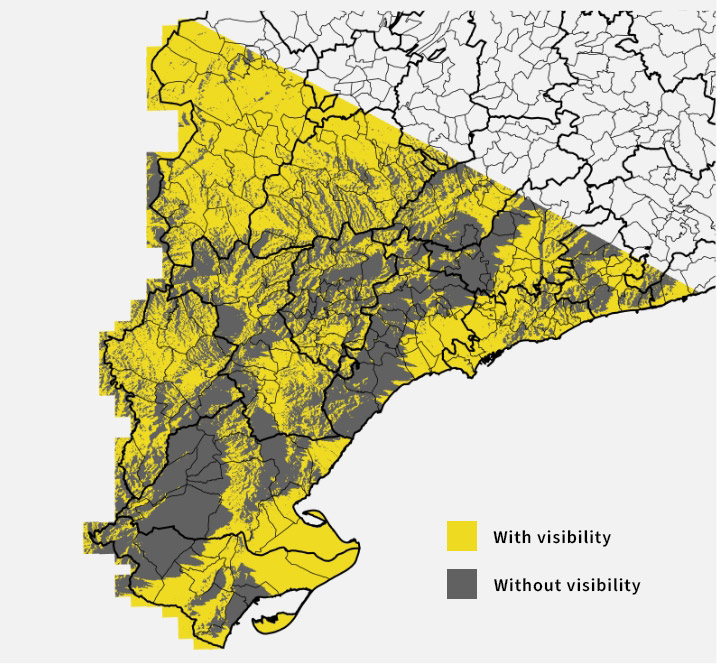
An already existing and globally referenced app, Eclipse Calculator, developed by IEEC member Eduard Masana [4], was also made available for iOS, considerably increasing the number of potential users, also including information on the 2026 total eclipse. The technical teams also produced an interactive visibility map (a “shadow map”) identifying areas of the territory where observation conditions were optimal, without obstructions to the view of the Sun at the critical moment (Fig. 1a). This resource was made available as a reference tool for institutions, organisations, and the general public.


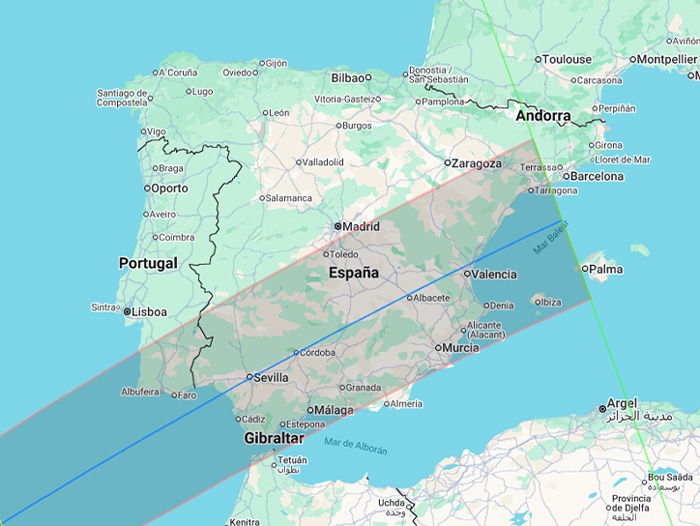
Figure 1. (a) Map of eclipse shadows in Catalonia for 12 August 2026 (Cr. IEEC). (b) Map of the 26 January 2028 annular solar eclipse (Cr. Xavier Jubier).

Social and scientific impact during and after the eclipse

It is expected that such an impressive astronomical event will be of special relevance with great scientific and social impact, especially with the information and educational campaigns in place for schools and from institutional channels. From a scientific standpoint, the Ebre Observatory, the Institute of Cosmos Sciences of the University of Barcelona (ICCUB-IEEC), and the Institute of Space Sciences (ICE-CSIC) will play a prominent role during the day [5]. The event has the potential to act as a catalyst for regional development through astrotourism and the launch of new educational and community-based projects, also looking ahead at the upcoming annular eclipse of 26 January 2028 (Figure 1b), also visible from the southwest and central parts of the territory.

At the time of writing, Catalonia is preparing to welcome the eclipse with a national outlook — grounded in science and education, but also in responsibility, sustainability, and social cohesion. On 12 August 2026, the sky will darken for a few moments. And the entire territory will be ready to look up.

References

[1] Government of Catalonia (2025) Agreement GOV/134/2025 of 20 May regarding the creation of the Interdepartmental Commission for the Coordination and Management of Actions Related to the 2026 Total Solar Eclipse. Diari Oficial de la Generalitat de Catalunya (DOGC), no. 9418. Available at: https://dogc.gencat.cat/ca/document-del-dogc/?documentId=1014586

[2] Government of Catalonia. Department of Research and Universities (2025) Catalonia looks to the sky. Press release / Video summary, 13 November. Available at: https://hdl.handle.net/20.500.14344/605

[3] Institute of Space Studies of Catalonia and Government of Catalonia (2025) Catalonia 2026 Eclipse Website. Available at: https://eclipsicatalunya.cat/

[4] Eduard Masana (2017) Eclipse Calculator 2.0.  Mobile application. Available at: https://play.google.com/store/apps/details?id=calcEclipsi2.src&hl=en

[5] Government of Catalonia. Department of Research and Universities (2025) RECERCAT. Research Bulletin of Catalonia, No. 208 (May 2025): Special issue Maria Assumpció Català i Poch. ISSN 1886-676X. Available at: https://hdl.handle.net/20.500.14344/574

How to cite: Domènech Rams, G., Herrero, K., and Masana, E.: Once in a century: the scientific and collective experience of the Total Solar Eclipse 2026 in Catalonia, Europlanet Science Congress 2026, The Hague, The Netherlands, 7–11 Sep 2026, EPSC2026-1178, https://doi.org/10.5194/epsc2026-1178, 2026.

16:29–16:41
|
EPSC2026-1183
|
ECP
|
On-site presentation
Sadhbh Leahy, Peter Gallagher, Sophie Murray, Laura Hayes, and Sinead Mackle

Eclipse26 (www.eclipse26.ie) is a public engagement programme that will serve as the central hub for education, outreach and media engagement about the 12 August 2026 solar eclipse in Ireland. During this event, Ireland will experience a deep partial solar eclipse, with approximately 92–98% solar coverage depending on location. 

Eclipse26 will maximise public engagement through a coordinated all-island strategy that includes the dissemination of safe viewing guidance, accessible scientific explanations of eclipses, and the promotion of eclipse-related events hosted by institutions and organisations across the island. 

Eclipse26 also highlights the rich historical legacy of eclipse expeditions involving Irish solar physicists (e.g., Annie Maunder) and Irish scientific instruments (e.g., the Grubb Coelostat at the 1919 in Brazil).

Building on experience gained from major public engagement activities during the 2015 eclipse, the team is developing observational opportunities designed to enhance the visitor experience at Dunsink Observatory, Birr Castle Demesne, Armagh Observatory & Planetarium and Met Eireann's Valentia Observatory. 

While still in planning at the time of writing, we also aim to engage the general public with an exciting expedition to observe the total solar eclipse from an aircraft off the west coast of Ireland.

Here, we present the resources, partnerships, and strategic framework underpinning this all-Ireland initiative, and discuss the programme’s anticipated outcomes, impact, and operational challenges.


How to cite: Leahy, S., Gallagher, P., Murray, S., Hayes, L., and Mackle, S.: Eclipse26 - An All-Ireland Approach to Engaging the Public with the 2026 Solar Eclipse, Europlanet Science Congress 2026, The Hague, The Netherlands, 7–11 Sep 2026, EPSC2026-1183, https://doi.org/10.5194/epsc2026-1183, 2026.

16:41–16:53
|
EPSC2026-747
|
ECP
|
Virtual presentation
Edna Galindo-Dellavalle and Raúl Mújica García

The Mexican National Eclipse Committee was formed to promote safe observation and bring scientific knowledge to the public during the solar eclipses visible from Mexico: the annular eclipse of October 14, 2023, and the total eclipse of April 8, 2024.

Composed of astronomers, communicators, and educators from institutions such as INAOE, UNAM, and UANL, the Committee organized various outreach and training activities. These included the virtual lecture series "Toward the Eclipses of 2023 and 2024," the design of infographics on safety and observation, and the publication of articles and four science outreach supplements in collaboration with media outlets such as La Jornada de Oriente and Reforma.

A key effort was inclusivity, with materials translated into 19 Mexican indigenous languages ​​(including Mam, Tojolabal, and Yaqui) and videos developed in Mexican Sign Language. The Committee also focused on teacher training, conducting large-scale hybrid workshops in all 32 states of the country and training more than 5,000 teachers. Additionally, an asynchronous course developed with the Benemérita Universidad Autónoma de Puebla (BUAP) reached over 15,000 participants.

While the number of people who witnessed the eclipses is difficult to quantify, the impact on teachers and underserved communities was significant. This effort solidified a broad national volunteer network ready to collaborate on future astronomical events, underscoring the need for appropriate funding to maximize the social benefits of these events.

How to cite: Galindo-Dellavalle, E. and Mújica García, R.: Mexican Solar Eclipses of 2023 and 2024, Europlanet Science Congress 2026, The Hague, The Netherlands, 7–11 Sep 2026, EPSC2026-747, https://doi.org/10.5194/epsc2026-747, 2026.

16:53–17:05
|
EPSC2026-1079
|
On-site presentation
MohammadJavad Torabi

A solar eclipse is among the few celestial phenomena that possesses an attraction and pull similar to the FIFA World Cup or the Olympic Games in bringing together people from more than 100 countries in a special location. The presenter’s experience in organizing two astrotourism events for observing the total solar eclipse (2 July 2019) on the shores of La Serena, Chile, and the annular/partial eclipse (21 June 2020) aboard a restored sailing ship in the Persian Gulf, as well as the effort and adventure of observing the annular eclipse alongside the indigenous people of a non-touristic region in northern Sri Lanka (26 December 2019), yielded many lessons learned.

If football has fascinated billions of people to the extent that viewership records are broken during the World Cup final, and anyone of any language, color, or race can enjoy this encounter, one may say that an eclipse is like the World Cup final whose host is not limited to affluent countries and for whose viewing there is no ticket sale. The magnitude of excitement and the screams and cheers of hundreds of thousands of people who place themselves beneath the shadow of the eclipse path in order to have this rare experience is no less than the excitement of the most important goals in the history of sports.

The experience of live internet broadcasting of the 2019 eclipse for Persian-speaking audiences also carried other lessons. Namely, that thousands and perhaps millions who miss observing solar eclipses follow the event online or on television until the day when fortune, luck, and their eyes open to solar eclipse observation. Therefore, the circle of eclipse enthusiasts is not limited only to its successful observers.

Observing a solar eclipse merely requires safe equipment, namely special solar eclipse-viewing glasses - of course only before and after totality - and nothing more; neither a common language nor additional explanation is needed. The uniqueness of each solar eclipse, from the perspective of the view to the duration of totality and the appearance of the solar corona, causes many first-time eclipse observers to become permanent followers of eclipses. This is where science communication activists can benefit the most. In this presentation, moving beyond experiences and lessons learned from previous eclipse observations, I will address proposals and subjects that connect this astronomical observation with the worlds of art, industry, and of course other branches of science; perhaps it may even be possible to organize a World Cup for this celestial final.

How to cite: Torabi, M.: Solar Eclipse, the Celestial World Cup; Examining the Capacities of Solar Eclipses for Greater Convergence with the Worlds of Art, Industry, and Science, Europlanet Science Congress 2026, The Hague, The Netherlands, 7–11 Sep 2026, EPSC2026-1079, https://doi.org/10.5194/epsc2026-1079, 2026.

17:05–17:17
|
EPSC2026-1332
|
Virtual presentation
Graham Jones

People are often curious: how exactly are eclipses calculated, and how are those amazingly accurate eclipse maps produced?

And people are often surprised by how much they can learn from the answers. For instance, how looking at eclipse frequencies across the globe gives us an insight into how the amount of daylight per year varies with latitude. Or how trying to make detailed predictions of eclipse paths a few decades into the future teaches us about the unpredictability of Earth’s rotational speed. Or how the whole process is a wonderful lesson in breaking down a daunting challenge into a series of simple steps.

How to cite: Jones, G.: What can we learn from calculating and mapping eclipses?, Europlanet Science Congress 2026, The Hague, The Netherlands, 7–11 Sep 2026, EPSC2026-1332, https://doi.org/10.5194/epsc2026-1332, 2026.

17:17–17:29
|
EPSC2026-1330
|
ECP
|
On-site presentation
Federica Duras, Claudia Mignone, Federico Di Giacomo, Sara Zarrinchang, Chiara Badia, and Giulia Mantovani and the Eclipsing Borders team

Eclipsing Borders is an outreach and educational initiative developed in collaboration with the International Astronomical Union’s Office of Astronomy for Education centre Italy and National Outreach Coordinator team Italy in preparation for the total solar eclipses crossing Europe and North Africa in 2026 and 2027. The project combines local community engagement with international co-design processes to promote scientific curiosity, cultural exchange, and safe eclipse observation practices.

At an international level, the project brings together members of the IAU National Astronomy Education Coordinator (NAEC) Mediterranean network to collaboratively adapt, translate, and create new STEAM-based educational resources related to eclipses, the Sun-Earth-Moon system, and astronomy outreach. The co-design process includes online collaboration meetings and the development of multilingual and interdisciplinary activities, such as creative workshops, storytelling, and hands-on learning experiences accessible to diverse educational contexts.

At a local level, we are currently doing a series of astronomy workshops at a community after-school center in Rome, working with mixed-age primary school children in a socially marginalized context. The workshops combine storytelling, tactile and multisensory activities, observations of the Sun and the Moon, and collaborative laboratories exploring topics such as lunar phases, the Solar System, planets and galaxies. The activities are designed to be low-cost, inclusive, and easily replicable, and are currently being explored as a model for implementation in other Italian cities.

This contribution presents the project methodology, early outcomes, and reflections on how eclipse-related outreach can become a tool for inclusion, participation, and transnational collaboration across the Mediterranean region.

How to cite: Duras, F., Mignone, C., Di Giacomo, F., Zarrinchang, S., Badia, C., and Mantovani, G. and the Eclipsing Borders team: Eclipsing Borders: how solar eclipses can help blur borders through astronomy outreach, Europlanet Science Congress 2026, The Hague, The Netherlands, 7–11 Sep 2026, EPSC2026-1330, https://doi.org/10.5194/epsc2026-1330, 2026.

17:29–17:30

Posters: Mon, 7 Sep, 18:00–19:30 | Foyer 3

Display time: Mon, 7 Sep, 08:30–19:30
Chairpersons: Federica Duras, Livia Giacomini
F3.75
|
EPSC2026-241
|
ECP
|
On-site presentation
Kristers Nagainis, Bernard Foing, Brigitte Schmieder, Tintin Baratashvili, Stefaan Poedts, Andrea Lani, Haopeng Wang, Salim Ansari, Sascha Zeegers, Jara Pascual, Romero Nahum, Ana Gomez de Castro, Ana Heras, Patricija Paula Priga, Greta Cappello, Amaia Razquin, Inmaculada Albert, and Daniel Milosic
The total solar eclipse of 12 August 2026, visible along a path crossing the Russian Arctic, Greenland, Iceland, Portugal, and Spain, will provide an exceptional opportunity for both scientific observations and public engagement. As part of a broader observing campaign [1] (that includes observations from various sites along the path), a group of early career scientists will conduct a set of complementary experiments aimed at obtaining scientifically useful measurements, engaging wider society, and preparing observational strategies for the 2027 total solar eclipse.
 
The optical experiments will include white light imaging of the solar corona using telescopes with different focal lengths. Our wide field setup will be used to image the corona from our observing site during totality. These observations will later be combined with measurements obtained by other sites within the broader campaign, enabling multi-site image stacking and the construction of a temporal sequence of the corona during totality [1,2]. A longer focal length setup will be used to carry out a modern version of the Einstein–Eddington experiment by measuring the apparent positional shifts of stars close to the eclipsed Sun, caused by gravitational light deflection. In addition, sky spectra will be recorded at different eclipse phases to study how the integrated sky spectrum changes as direct photospheric light is suppressed and the corona becomes visible [3,4].
 
The campaign will also include ionospheric experiments using radio observations and GNSS based measurements. Very low frequency and low frequency radio receivers will monitor stable transmitters before, during, and after the eclipse. Changes in received signal strength and propagation conditions can be used to probe eclipse driven changes in the ionosphere caused by reduced solar ionization. In parallel, GNSS data from personal phones and, where available, dedicated receivers will be collected to investigate possible changes in signal strength, positioning residuals, and ionospheric delay proxies. These measurements will be designed as a citizen science activity, allowing the public to contribute geographically distributed data.
 
The observing site and activities will be announced publicly. Outreach will include safe solar viewing, solar projection demonstrations, sunspot observations, distribution of eclipse glasses, and explanations of the science behind the experiments [2,5]. In this way, the campaign will combine eclipse science, public participation, and training for future total eclipse observations.
 
References:
[1]  Schmieder, B., Baratashvili, T., Poedts, S., Lani, A., Wang, H., Foing, B., Sansari, S., Zeegers, S., Pascual, J., Nahum, R., Nagainis, K., Gomez de Castro, A. I., and Heras, A.: Total Eclipse on August 12, 2026: observations in Spain and prediction with COCONUT, EGU General Assembly 2026, Vienna, Austria, 3–8 May 2026, EGU26-1542, https://doi.org/10.5194/egusphere-egu26-1542, 2026.
[2] European Space Agency, “Solar Total Eclipse 1999,” ESA Science & Technology, 1999. Available: https://sci.esa.int/web/observational-astronomy/-/38064-total-eclipse-99
[3] B. H. Foing, L. Duvet, L. Ligot, J. Oliveira, T. Beaufort, J. E. Wiik, B. Altieri, N. Henrich, S. Cravatte, and E. Maurice, “Results from the 3 November 1994 Solar Eclipse: Density and Temperature Variations in Streamers and Coronal Holes,” in The Tenth Cambridge Workshop on Cool Stars, Stellar Systems and the Sun, ASP Conference Series, vol. 154, R. A. Donahue and J. A. Bookbinder, Eds. San Francisco, CA: Astronomical Society of the Pacific, 1998, p. 1035.
[4] B. H. Foing, L. Duvet, K. Muglach, J. E. Wiik, T. Beaufort, and E. Maurice, “Polar plumes and streamers from 1994 and 1998 eclipses,” in Solar Jets and Coronal Plumes, ESA SP-421, 1998, p. 273.
[5] European Space Agency, “Solar Eclipse Index,” ESA Multimedia, 1 July 1999. Available: https://www.esa.int/ESA_Multimedia/Videos/1999/07/Solar_Eclipse_Index

How to cite: Nagainis, K., Foing, B., Schmieder, B., Baratashvili, T., Poedts, S., Lani, A., Wang, H., Ansari, S., Zeegers, S., Pascual, J., Nahum, R., Gomez de Castro, A., Heras, A., Priga, P. P., Cappello, G., Razquin, A., Albert, I., and Milosic, D.: EGU LUNEX 2026 Total Solar Eclipse Campaign in Spain: Early Career Scientist Multiwavelength Observations and Outreach, Europlanet Science Congress 2026, The Hague, The Netherlands, 7–11 Sep 2026, EPSC2026-241, https://doi.org/10.5194/epsc2026-241, 2026.

F3.76
|
EPSC2026-1336
|
ECP
|
Virtual presentation
Helen Usher, Grant Bowskill, and Neill Sanders

We will report on the implementation of the UKeclipse.com coordinated website initiative, highlighting successes, challenges and lessons for the future.

UK Eclipse (www.ukeclipse.com) is an initiative dedicated to inspiring public interest in astronomy through some of nature’s most spectacular events: solar and lunar eclipses.

Created in collaboration between Go Stargazing (www.gostargazing.co.uk) and First Light Optics (www.firstlightoptics.com), the website seeks to bring together outreach organisations, astronomy enthusiasts, educators and supporting partners across the UK to help more people safely experience eclipses for themselves.

The initial focus is the partial solar eclipse visible from the UK on 12 August 2026.  The aim is to help communities across the country make the most of this event by supporting public observing sessions, educational activities, and local eclipse events.

UK Eclipse exists to:

  • Encourage astronomy outreach groups, observatories, schools, societies, and science organisations to run public eclipse events;
  • Provide a central place where people can discover eclipse events happening near them;
  • Share trusted guidance on how to observe eclipses safely;
  • Promote accessible astronomy for beginners and families; and
  • Celebrate future eclipses and other major astronomical events visible from the UK.

The site will feature practical observing advice and educational content developed with the support of experienced astronomy partners and eclipse observers.   The aim is to make eclipse watching safe, enjoyable, and accessible to everyone, whether completely new to astronomy or already an active observer.

A solar eclipse is one of the few astronomical events that can capture the attention of an entire country. By working together with outreach groups and astronomy organisations throughout the UK, we hope to use the 2026 eclipse as an opportunity to introduce more people to the night sky and encourage long-term interest in science and astronomy.

How to cite: Usher, H., Bowskill, G., and Sanders, N.: A Coordinated Hub Approach to Eclipse Outreach and Education in the UK, Europlanet Science Congress 2026, The Hague, The Netherlands, 7–11 Sep 2026, EPSC2026-1336, https://doi.org/10.5194/epsc2026-1336, 2026.