TP16 | Lunar Space Environment

TP16

Lunar Space Environment
Convener: Yoshifumi Futaana | Co-conveners: Iannis Dandouras, Fabrice Cipriani, Francesca McDonald
Orals TUE4
| Tue, 08 Sep, 16:00–17:30 (CEST)|Room Uranus (Swing)
Posters MON-POS
| Attendance Mon, 07 Sep, 18:00–19:30 (CEST) | Display Mon, 07 Sep, 08:30–19:30|Foyer 2, F2.54–60
Tue, 16:00
Mon, 18:00
The lunar space environment is governed by dynamic coupling between the solar wind/magnetospheric plasma, energetic particles, exosphere, dust grains, photoelectrons, the solid surface, and magnetic anomalies. In recent years, many space agencies, as well as private companies and academic institutions, have been actively preparing for a new era of lunar exploration. The number of missions planned to arrive at and operate on the lunar surface in the coming decade is rapidly increasing. While these missions will advance our understanding of the Moon environment, they will also inevitably perturb and modify the pristine lunar environment. Characterizing the pristine state before it is significantly altered by human activity is therefore urgent, and timely action is required.

This session invites oral and poster contributions across this broad area of the lunar environment, addressing both its natural state and its evolution under increasing human activity. Contributions are encouraged from a wide range of approaches, including data analysis, numerical simulations, laboratory experiments, instrumentation, future missions, and combinations thereof. Key themes include innovative science across disciplines, identification of critical observations and methodologies needed for pre-contamination characterization, and interdisciplinary studies that reveal the coupling between different domains of the lunar space environment.

This session aims to gain insight into the complex coupling that shapes the lunar space environment, examine the implications of upcoming exploration for lunar science and human activities, engage scientists from diverse disciplines to share cutting-edge knowledge, and stimulate new ideas for understanding and preserving the lunar environment in the era of intensive exploration.

Orals: Tue, 8 Sep, 16:00–17:30 | Room Uranus (Swing)

16:00–16:06
16:06–16:18
|
EPSC2026-994
|
On-site presentation
Ladislav Rezac, Paul Hartogh, Christopher Jarchow, Thibault Cavalie, Raphael Moreno, Eva Wirström, and Miriam Rengel

The Submillimeter Wave Instrument (SWI) aboard the JUpiter Icy Moon Explorer (JUICE) satellite conducted a series of dedicated observations of the Moon and Earth atmosphere as part of an instrument characterization and calibration campaign during the Lunar-Earth Gravity Assist maneuver in mid-August 2024. The JUICE satellite achieved an altitude of approximately 700 km during its closest approach, while subsequent moon observations were conducted at distances of around 500,000 km. The lunar atmosphere was observed in both nadir and limb geometries in the two bands of SWI (600 and 1200 GHz). Although no direct signature of the water line was detected in the data, these observations allowed upper limits to be placed on the neutral water column density. We proceed to summarize the measurement, modeling approach, and its underlying assumptions, followed by a discussion of the implications for the moon's water cycle.

How to cite: Rezac, L., Hartogh, P., Jarchow, C., Cavalie, T., Moreno, R., Wirström, E., and Rengel, M.: Upper limits of H2O in the exosphere of the Moon from SWI/JUICE during the Lunar-Earth Gravity Assist, Europlanet Science Congress 2026, The Hague, The Netherlands, 7–11 Sep 2026, EPSC2026-994, https://doi.org/10.5194/epsc2026-994, 2026.

16:18–16:30
|
EPSC2026-244
|
ECP
|
On-site presentation
Thomas Maynadié, Yoshifumi Futaana, Stas Stas Barabash, Martin Wieser, Shahab Fatemi, Anil Bhardwaj, and Peter Wurz

Abstract:

Despite their small vertical scale, lunar magnetic anomalies can produce macroscopic, high-altitude compressional disturbances in the solar wind flow [1–5]. Most of these disturbances have been attributed to interactions between the solar wind and counter streaming protons reflected from magnetic structures at low altitudes (<30 km) above the South Pole–Aitken (SPA) magnetic anomaly cluster [4–6]. While previous studies suggest that such disturbances are rare in equatorial regions, hybrid plasma simulations [6] and remote energetic neutral atom observations [7] indicate that they may form frequently above the SPA cluster between 30°S and 90°S. However, in these higher-latitude regions, their occurrence rate and spatial morphology have not yet been characterized using in situ plasma instrumentation.

Using near-terminator ion observations from the Sub-keV Atom Reflecting Analyzer onboard Chandrayaan-1 [8], we find that strong solar wind disturbances, similar to those observed in equatorial regions [4,5], occur frequently between 30°S and 90°S above the SPA magnetic anomaly cluster. These disturbances are observed at 100 km altitude and extend well beyond the crustal fields of the SPA cluster (>1,000 km). Their spatial distribution and properties support the interpretation that they result from interactions between protons reflected by the SPA cluster and the solar wind, rather than from direct low-altitude interactions between the primary solar wind and lunar crustal magnetic fields.

These results suggest that protons reflected by the SPA cluster create a persistent proto-magnetosheath within which solar wind dynamics are governed by the same processes as those in early planetary magnetosheath formation. This proto-magnetosheath region forms above the mini-magnetosphere (altitude <~30 km), and can extend to 500–1,000 km altitude. These findings indicate that the SPA magnetic anomaly cluster dynamically influences solar wind precipitation over a much larger area (>1,000 km) than previously recognized, potentially causing near-surface plasma conditions to differ from those inferred using upstream measurements.

References:

[1] Colburn et al., (1971). JGR, 76(13), 2940–2957. https://doi.org/10.1029/JA076i013p02940

[2] Lin et al. (1998). Science, 281(5382), 1480–1484. https://doi.org/10.1126/science.281.5382.1480

[3] Nishino et al. (2012). Planetary and Space Science, 73(1), 161–167. https://doi.org/10.1016/j.pss.2012.09.011

[4] Halekas et al. (2014). GRL, 41(21), 7436–7443. https://doi.org/10.1002/2014GL061973

[5] Halekas et al. (2017). JGR: Space Physics, 122(6), 6240–6254. https://doi.org/10.1002/2017JA023931

[6] Fatemi et al. (2014). JGR: Space Physics, 119(8), 6095–6105. https://doi.org/10.1002/2014JA019900

[7] Maynadié et al. (2025). JGR: Space Physics, 130(9). https://doi.org/10.1029/2025JA034163

[8] Barabash et al. (2009). CURRENT SCIENCE, 96(4), 526-532

How to cite: Maynadié, T., Futaana, Y., Stas Barabash, S., Wieser, M., Fatemi, S., Bhardwaj, A., and Wurz, P.: A Persistent Proto-Magnetosheath formed by Protons Reflected above the South Pole-Aitken Magnetic Anomaly Cluster, Europlanet Science Congress 2026, The Hague, The Netherlands, 7–11 Sep 2026, EPSC2026-244, https://doi.org/10.5194/epsc2026-244, 2026.

16:30–16:42
|
EPSC2026-1171
|
On-site presentation
Yohei Miyake and Jin Nakazono

Preparations for the lander's exploration of the Moon are progressing rapidly, hence, there is an urgent need for an accurate understanding of the electrostatic environment of the lunar surface, in order to assess any potential hazards. The surface potential of the lunar dayside is on average a few to 10 V positive due to photoelectron emission in addition to the solar wind plasma precipitation. Recent studies, however, have shown that a rough, insulating regolith surface can significantly alter charging conditions. The topography effects not only cause a change in the equilibrium potential value, but they can also significantly alter the current balance regime itself. The commonly accepted ordering of plasma current magnitudes can be disrupted by considering certain classes of surface geometry. Our recent investigations have demonstrated such showcases [Miyake and Nishino, 2015; Nakazono and Miyake, 2023; 2025; Nakazono, Miyake, and Miloch, 2025]; deep depressions, which can be expected to exist on irregular lunar surfaces, exhibit a charging state caused by an anomalous ordering of plasma current magnitudes.

Our numerical study aims to explore and elucidate the detailed properties of such anomalous charging emerged on the rough surface of the Moon. We have performed parametric studies focusing on the dependence of the charging intensity on the solar wind conditions. Based on the results, we will discuss the conditions under which the localized, intense charging mechanism works (or not) on the airless planetary bodies. Furthermore, we will extend the discussion to recent inquiries into anomalous charging states under the influence of active potential perturbations induced by human activities on the Moon.

How to cite: Miyake, Y. and Nakazono, J.: Anomalous modes of lunar surface charging anticipated by numerical analysis, Europlanet Science Congress 2026, The Hague, The Netherlands, 7–11 Sep 2026, EPSC2026-1171, https://doi.org/10.5194/epsc2026-1171, 2026.

16:42–16:54
|
EPSC2026-969
|
On-site presentation
Martin Wieser, Romain Canu-Blot, Stas Barabash, and Gabriella Stenberg Wieser

Solar wind protons precipitating onto the lunar regolith result in backscattering and sputtering of surface atoms. Emitted particles are a source for the lunar  exosphere. The interaction between precipitating solar wind and the surface does not conserve the charge state, thus positive [1] and negative [2] ions as well as energetic neutral atoms are emitted[3]. We combine data from recent measurements on the lunar surface by the NILS instrument[4] on Chang’e-6 and the ASAN instrument[5] on Chang’e-4, with data measured from orbit by Artemis[6] and Chandrayaan-1 [7]  to investigate the full charge state distribution of emitted hydrogen. We discuss the fate of the different observed particle populations and their effect on in the near lunar environment.

[1] Saito, Y., et al., (2008). Solar wind proton reflection at the lunar surface: Low energy ion measurement by MAP-PACE onboard SELENE (KAGUYA). Geophys. Res. Lett., doi:10.1029/2008GL036077.

[2] Wieser, M., et. al, (2025). Direct observations of negative ions on the Lunar surface by Chang’E-6. Communications Earth & Environment, doi: 10.1038/s43247-025-02399-7.

[3] Wieser, M., et al.,(2009). Extremely high reflection of solar wind protons as neutral hydro- gen atoms from regolith in space. Planetary and Space Science. doi: 10.1016/j.pss.2009.09.012.

[4] R. Canu-Blot, et al. (2025), The Negative Ions at the Lunar Surface (NILS) Instrument on the Chang’E-6 Mission. Space Science Reviews, doi:10.1007/s11214-025-01162-w
[5] M. Wieser, et al. (2020), The Advanced Small Analyzer for Neutrals (ASAN) on the Chang’E-4 Rover Yutu-2. Space Science Reviews, doi:10.1007/s11214-020-00691-w
[6] C. Lue, et al.,(2018), Artemis observations of solar wind proton scattering off the lunar surface. Journal of Geophysical Research: Space Physics, doi:10.1029/2018JA025486

[7] Barabash, S., et al., (2009). Investigation of the solar wind–Moon interaction onboard Chandrayaan-1 mission with the SARA experiment. Current Science, 96(4):526–532.

How to cite: Wieser, M., Canu-Blot, R., Barabash, S., and Stenberg Wieser, G.: Backscattered and sputtered atoms and ions in the near surface environment of the Moon, Europlanet Science Congress 2026, The Hague, The Netherlands, 7–11 Sep 2026, EPSC2026-969, https://doi.org/10.5194/epsc2026-969, 2026.

16:54–17:06
|
EPSC2026-1210
|
On-site presentation
Stas Barabash, Manabu Shimoyama, Stefan Karlsson, Burak Yağlioğlu, Burak Karagözoğlu, and Fahri Öztürk

Energetic Neutral Atom (ENA) imaging of the Moon using backscattered and sputtered neutrals is a unique technique for studying lunar mini-magnetospheres. Due to their small size, these structures cannot be effectively studied from typical lunar orbiter altitudes of about 100 km. In situ investigations on the surface require complex mission elements such as landers and rovers. ENA imaging, however, provides instantaneous remote sensing of these structures directly from orbit. The ENA imager CENA (Chandrayaan-1 Energetic Neutral Analyzer) onboard the Chandrayaan-1 mission introduced this technique and revealed the large-scale morphology of lunar mini-magnetospheres. However, its angular resolution of 9° × 40° was insufficient for investigating the fine structures of mini-magnetospheres. The new generation of lunar ENA imagers, the Lunar Neutrals Telescope (LNT), achieves an angular resolution of 7° × 7° while maintaining a geometric factor comparable to that of CENA. LNT is scheduled to launch to the Moon onboard the first Turkish lunar mission in 2027 and is planned to operate for at least three months.

We describe the fundamentals of the ENA imaging technique for lunar studies, present the science objectives and basic performance of LNT, and discuss the expected scientific results. We anticipate exciting observations that will reveal previously unseen features of lunar mini-magnetospheres.

How to cite: Barabash, S., Shimoyama, M., Karlsson, S., Yağlioğlu, B., Karagözoğlu, B., and Öztürk, F.: High angular resolution ENA imaging of the Moon surface onboard the Turkish lunar mission, Europlanet Science Congress 2026, The Hague, The Netherlands, 7–11 Sep 2026, EPSC2026-1210, https://doi.org/10.5194/epsc2026-1210, 2026.

17:06–17:18
|
EPSC2026-1078
|
On-site presentation
Hanna Rothkaehl, Jan Dziuban, Piotr Szyszka, Marek Morawski, Tomasz Grzebyk, Barbara Matyjasiak, and Dorota Przepiórka Skup

To enhance our understanding of the rich plasma physical processes occurring in the plasma dusty Lunar environment, the diagnostics of plasma and electromagnetic measurements located on the Lunar surface can bring new and complex expertise.

An important topic for lunar missions is understanding how the charged dust behaves, the roles of dust transport, levitated dust and electrodynamics around the lunar surface. It could be essential for ensuring the continued safe operation of equipment and long-term exploration. Lunar dust is charged by its interaction with the surrounding plasma. The moon’s orbit carries it through the solar wind and the Earth’s own magnetotail (particularly the charging of the Lunar surface in the plasmasheet region is a significant effect).  The crucial point is to study the influence of the dust particles on various plasma instabilities and fluctuations and then apply the theoretical results to the dusty plasma environment of the lunar surface in order to build space weather services.

In order to achieve these goals, a compact, low-power instrument is proposed. It consists of two blocks: 1) MEMS based mass spectrometer coupled with MEMS based XRF analyzer, both aims in complementary analysis of regolith elemental composition as well as molecules absorbed on its surface; and 2) RFA electric and magnetic radiospectrometer for surrounding plasma diagnostic.


How to cite: Rothkaehl, H., Dziuban, J., Szyszka, P., Morawski, M., Grzebyk, T., Matyjasiak, B., and Przepiórka Skup, D.: Diagnostics of the dusty plasma environment on the lunar surface, Europlanet Science Congress 2026, The Hague, The Netherlands, 7–11 Sep 2026, EPSC2026-1078, https://doi.org/10.5194/epsc2026-1078, 2026.

17:18–17:30
|
EPSC2026-1080
|
ECP
|
On-site presentation
Angèle Pontoni, Yoshifumi Futaana, Stas Barabash, Martin Wieser, Xiao-Dong Wang, and Thomas Maynadie

The Moon’s lack of global magnetic field or substantial atmosphere leads to unique plasma-surface interactions which affect the properties and dynamics of the near surface lunar environment in which robotic and human operations will be conducted in the next decades. Conversely, robotic and human operations are expected to have small- and large-scale on the once-pristine lunar near surface environment. Characterizing and understanding the lunar plasma environment is therefore an urgent task needed to understand unique plasma processes. We present plasma-related science objectives to be addressed by future missions.

How to cite: Pontoni, A., Futaana, Y., Barabash, S., Wieser, M., Wang, X.-D., and Maynadie, T.: The need for plasma measurements from the lunar surface, Europlanet Science Congress 2026, The Hague, The Netherlands, 7–11 Sep 2026, EPSC2026-1080, https://doi.org/10.5194/epsc2026-1080, 2026.

Posters: Mon, 7 Sep, 18:00–19:30 | Foyer 2

Display time: Mon, 7 Sep, 08:30–19:30
F2.54
|
EPSC2026-130
|
ECP
|
On-site presentation
Katerina Stergiopoulou, Shahab Fatemi, and C. Dany Waller

The Moon, unlike Earth, does not have a global dipolar magnetic field. Instead, there are localized patches of crustal magnetization scattered across its surface. The general morphology of crustal magnetic fields has been obtained from low-altitude measurements taken by the Lunar Prospector and Kaguya missions, and surface maps have been generated using both forward and inverse models based on these orbital data, although we are still far from a precise description. Strong crustal magnetic fields can deflect or reflect the solar wind away from the surface, while unprotected regions of the surface undergo a darkening and reddening process in visible to near-infrared wavelengths known as space weathering. Recent satellite observations and advanced numerical simulations, however, showed that the interaction between the solar wind and lunar crustal fields is surprisingly complex, and we still do not fully understand the exact mechanisms behind the solar wind-crustal fields interaction. In this study, we utilize a hybrid-kinetic plasma model, Amitis (https://www.amitiscode.com), to simulate the effects of the lunar crustal magnetic fields on the plasma environment of the Moon. We investigate the interaction between the solar wind and the lunar crustal fields and its dependence on the IMF orientation. We focus on the Reiner Gamma magnetic anomaly and on how the morphology of the crustal fields over it shields the surface from the incoming solar wind and contributes to surface weathering. We further examine the factors controlling surface shielding by strong crustal fields. We find that the lunar crustal fields can either partially or fully shield the surface in the vicinity of their location from solar wind protons depending, in addition to the strength of the magnetic field, on the angle of the incident solar wind.

How to cite: Stergiopoulou, K., Fatemi, S., and Waller, C. D.: Solar wind interaction with lunar crustal magnetic fields: The Reiner Gamma magnetic anomaly, Europlanet Science Congress 2026, The Hague, The Netherlands, 7–11 Sep 2026, EPSC2026-130, https://doi.org/10.5194/epsc2026-130, 2026.

F2.55
|
EPSC2026-615
|
ECP
|
On-site presentation
Adrija Bhowmick, Cauê P. Souza, Felipe Fantuzzi, Nigel Mason, and Béla Sulik

The establishment of long-term human presence on the Moon requires infrastructure capable of operating under persistent radiation exposure and extreme thermal conditions while minimising dependence on Earth-supplied materials. Radiation-induced degradation of construction materials poses a critical risk to the safety, durability, and sustainability of lunar habitats, particularly those based on in situ resource utilisation (ISRU). Understanding the degradation of lunar construction materials under combined radiation and thermal conditions is therefore essential for the development of sustainable lunar infrastructure.

This work investigates the response of ISRU-relevant materials to simulated lunar environmental conditions using a combined modelling and experimental approach. Ion irradiation experiments and thermal cycling studies are being conducted to reproduce key aspects of the lunar surface environment and to assess damage in materials including advanced polymers, metallic composites, aerogels, and lunar regolith analogues. Post-exposure characterisation using spectroscopy and microscopy is employed to evaluate chemical, structural, and mechanical degradation.

In parallel, atomistic and multi-scale modelling approaches are being developed to investigate thermally induced structural evolution in these materials. The modelling framework aims to connect microscale damage processes with macroscopic material degradation relevant to long-term lunar operations.

This research builds on previous atomistic studies of space materials under lunar-like conditions, extending them through experimental validation and the investigation of regolith-derived materials as both structural resources and passive radiation shielding elements. The results will contribute to improved material selection and mitigation strategies for future ISRU-based lunar habitats.

How to cite: Bhowmick, A., Souza, C. P., Fantuzzi, F., Mason, N., and Sulik, B.: Simulating Radiation and Thermal Cycling Effects in Lunar Construction Materials, Europlanet Science Congress 2026, The Hague, The Netherlands, 7–11 Sep 2026, EPSC2026-615, https://doi.org/10.5194/epsc2026-615, 2026.

F2.56
|
EPSC2026-1075
|
ECP
|
On-site presentation
Keval Dabhi

INTRODUCTION:

Lunar dust represents a critical challenge for sustainable lunar exploration, affecting astronaut health, equipment performance, and scientific instrumentation. The finest fraction of lunar regolith (<20 μm) exhibits unique electrostatic properties resulting from solar UV radiation and plasma bombardment, leading to charge-driven levitation and transport phenomena. Observations from Apollo missions, including the enigmatic "horizon glow" detected by Surveyor landers, suggest dust clouds extend tens of centimetres to kilometres above the lunar surface. Recent measurements by NASA's LADEE mission confirmed permanent low-density dust populations at altitudes up to 260 km.

Despite these observations, fundamental questions remain about dust detection methodologies, size-dependent scattering properties, and the feasibility of optical characterization techniques for future in-situ instrumentation. This study addresses these knowledge gaps through controlled laboratory experiments using lunar dust analogs and laser-optical backscattering measurements.

METHODOLOGY:

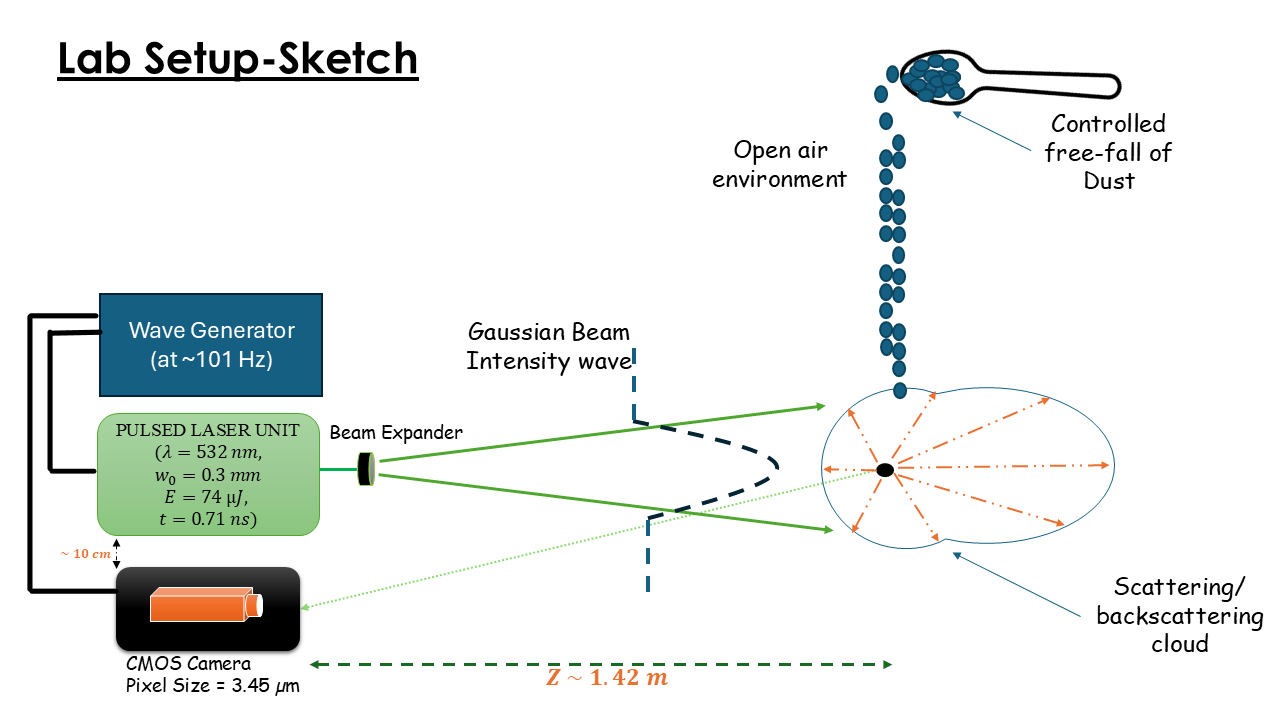
We constructed a laser-optical detection system comprising a pulsed laser (λ = 532 nm, repetition rate ~100 Hz) aligned with a high-resolution CMOS camera. Particles were released in free-fall through the laser beam at two controlled distances (approximately 1.0 m and 1.5 m from the optical system), providing sufficient observation time for detection and tracking. Experiments used two lunar analog materials spanning the size range relevant to electrostatically active lunar dust: silver-coated silica microspheres (nominal diameter ~10 μm) and copper powder (nominal diameter ~30 μm). These materials provide contrasting optical properties for backscattering validation across different refractive indices and compositions.

An automated Python-based analysis workflow using OpenCV and TrackPy libraries for particle detection, sizing, and trajectory tracking was developed. Image preprocessing included contrast enhancement, morphological operations for noise reduction, and adaptive thresholding for segmentation. Particle contours were extracted and characterized by equivalent circular diameter, eccentricity, and spatial coordinates. Validation against synthetic particle images confirmed >95% detection accuracy with minimal sizing error. Mie scattering theory provided theoretical predictions for backscattered photon counts as a function of particle size, wavelength, and complex refractive index, incorporating Gaussian beam propagation and spatially-varying irradiance profiles. Signal-to-noise ratio (SNR) estimates included contributions from dark noise, shot noise, and read noise measured from reference frames.

RESULTS:

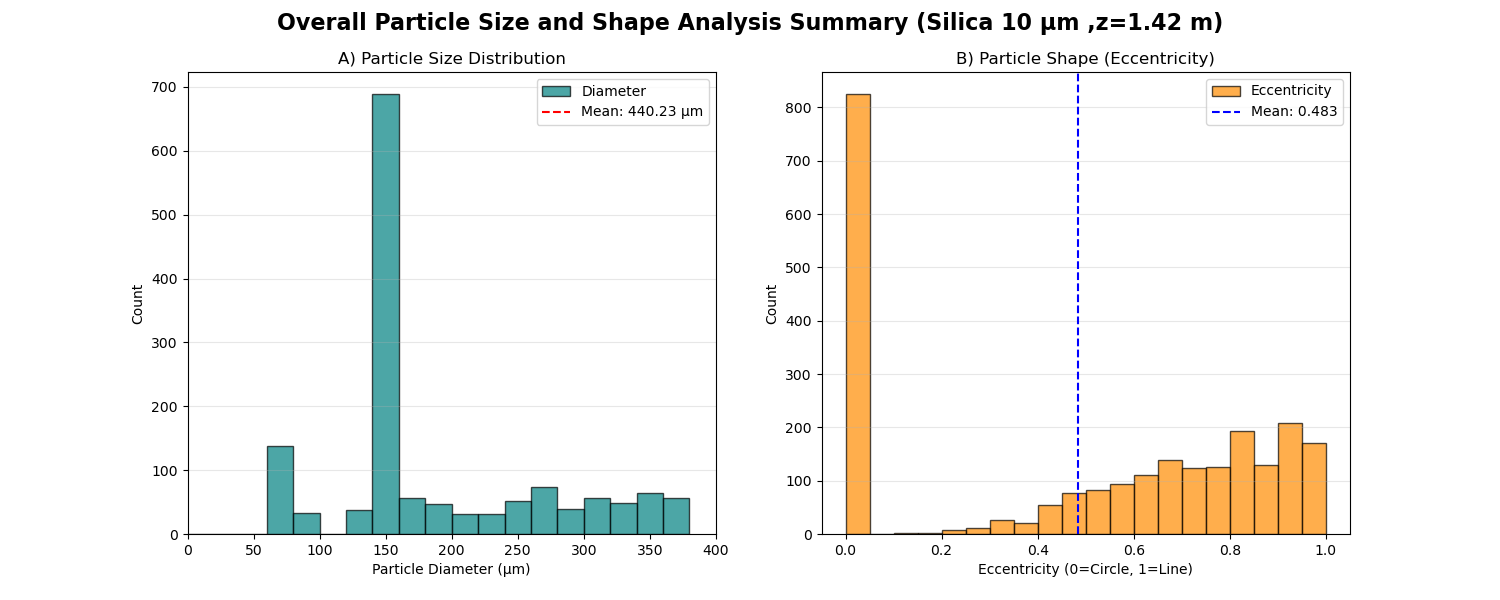
The system successfully detected over 27,000 individual particles across all experimental conditions, demonstrating robust optical detection capabilities. Mean SNR exceeded 30, significantly above the threshold required for reliable sizing, with performance independent of material composition—silica and copper particles exhibited comparable signal quality despite contrasting refractive indices. This material independence is scientifically significant for future lunar applications, as it demonstrates the technique will work reliably across the diverse mineralogy of lunar regolith without recalibration.

Batch analysis revealed systematic electrostatic agglomeration affecting all samples, with severity inversely proportional to nominal particle size. Fine silica particles (~10 μm nominal) exhibited agglomeration factors reaching 40-50×, while coarser copper particles (~30 μm nominal) showed more modest clustering at approximately 8-10×. Size distributions exhibited strong right-skew with occasional extreme outliers, indicating hierarchical agglomeration processes characteristic of electrostatic clustering. This agglomeration reflects genuine electrostatic charging physics rather than measurement artifacts, as confirmed by reproducibility across thousands of independent particle detections. Reducing measurement distance by approximately 30% improved apparent size measurements by 70-75% for both materials, confirming how the detected aggregated brightness of the particle changes the size estimation. Analysis of pixel pitch versus particle size demonstrated that individual grain detection of 10 μm particles requires spatial resolution better than 5 μm/pixel, achievable only at shorter distances. The 30 μm copper particles approached optical resolvability at the closer distance, with agglomeration factors dropping to approximately 2×.

Comparison between experimental backscattered photon counts and Mie predictions revealed qualitative agreement with significant quantitative discrepancies. Correlation analyses confirmed size-dependent scattering trends with moderate-to-strong positive correlations (r ~ 0.5-0.7), demonstrating that the fundamental principle of optical backscattering for size discrimination is sound. However, measured photon counts systematically underestimated theoretical predictions by approximately an order of magnitude. This gap likely reflects following factors: irregular cluster morphology deviating from Mie's spherical assumptions, effective refractive index uncertainties for agglomerated structures with internal voids. Despite this quantitative mismatch, the qualitative validation confirms that larger particles consistently produce more detectable photons—the critical relationship enabling optical sizing.

Particle velocity measurements yielded highly consistent terminal velocities (~0.3 m/s with <5% variation), confirming gravity-dominated vertical trajectories with negligible air convection effects. This reproducibility validates the free-fall experimental approach and demonstrates that particle dynamics are predictable and suitable for controlled laboratory studies.


DISCUSSIONS AND CONCLUSIONS:

This study establishes proof-of-concept for laser-optical dust detection with several key findings relevant to future mission instrumentation. The system demonstrates material-independent detection across diverse mineral compositions, high SNR enabling confident particle discrimination, and successful validation of fundamental Mie scattering physics despite morphological complexities. The automated analysis pipeline is scalable to higher throughput and suitable for real-time processing on rover computers.

Three primary limitations were identified with clear mitigation pathways. First, severe electrostatic agglomeration prevents individual grain characterization without charge neutralization—addressable through ionized atmosphere particle injection or fully-enclosed vacuum chamber designs. Second, optical resolution constraints require either shorter measurement distances, or increased magnification. Third, quantitative Mie discrepancies necessitate empirical calibration with reference particles or advanced scattering models accounting for non-spherical geometries.

For mission applications, proposed rover-mounted instruments incorporating stereo camera configurations could enable 3D particle reconstruction, complete scattering phase function measurements, and real-time dust hazard assessment during surface operations. With identified technical improvements implemented, estimated instrument specifications (mass <5 kg, power <10 W, autonomous 100 Hz operation) are feasible for rover deployment. This work contributes foundational data for understanding dust scattering physics and establishes technical feasibility for future lunar surface dust monitoring systems supporting Artemis exploration objectives.

How to cite: Dabhi, K.: Laser-optical detection and characterization of suspended lunar dust analogs, Europlanet Science Congress 2026, The Hague, The Netherlands, 7–11 Sep 2026, EPSC2026-1075, https://doi.org/10.5194/epsc2026-1075, 2026.

F2.57
|
EPSC2026-782
|
On-site presentation
Yoshifumi Futaana and Iannis Dandouras and the The AstroLEAP Phase A/B1 study team

The Moon is a unique and accessible target that hosts a distinctive space environment. It provides an opportunity to investigate fundamental physics associated with interactions with the undisturbed solar wind, magnetosheath, and magnetosphere. During disturbed space weather events, the lunar environment is influenced by hot plasma within the coronal mass ejections or high-energy particles such as solar energetic particles or cosmic rays. In the absence of an intrinsic magnetic field and a collisional atmosphere, the solar wind directly impacts the lunar surface, resulting in a plasma–regolith interaction, the physics of which remains poorly explored.

The interaction also sputters surface volatiles, producing the exosphere, a fragile gaseous environment surrounding the Moon. Space plasma may also contribute to the formation of surficial water, which can subsequently be released into the exosphere or space by meteoroid impacts. However, direct observational evidence for the production, circulation, and accumulation of such species remains highly limited. In addition, the Moon has localized magnetic anomalies that modify the incident plasma flow and, consequently, the near-surface environment. These disturbances are known as mini-magnetospheres, the smallest magnetospheres known. Local disturbances from environmental changes (electromagnetic fields, illumination, and their temporal variations) can induce significant dust lofting. Lunar dust poses a major hazard to human and robotic explorers. It is adhesive, potentially toxic, and easily mobilized. Dust particles can easily penetrate inside electronics systems and spacesuits, and are significantly influenced by near-surface electric and magnetic fields. Furthermore, since the beginning of the space age, the lunar environment has been increasingly altered by human activities. Planned or ongoing exploration is expected to accelerate this anthropogenic modification. Quantifying the lunar environment is therefore urgently required to distinguish between its (near-)pristine state and its altered conditions on a decadal time scale.

In this presentation, we provide an overview of the multidomain physical processes—both natural and anthropogenic— that occur at the lunar surface in the context of future lunar surface missions. We identify key open scientific questions concerning the lunar space environment and outline the measurements required to address them. These measurements are considered within the framework of the European scientific payload package concept, AstroLEAP (Lunar Environment Analysis Package), which is under study by ESA and the science community.

How to cite: Futaana, Y. and Dandouras, I. and the The AstroLEAP Phase A/B1 study team: Interdisciplinary exploration science enabled by lunar landers: AstroLEAP sciences, Europlanet Science Congress 2026, The Hague, The Netherlands, 7–11 Sep 2026, EPSC2026-782, https://doi.org/10.5194/epsc2026-782, 2026.

F2.58
|
EPSC2026-1122
|
Virtual presentation
Rémi Pacaud and Sylvain Ranvier

During the Apollo missions, it has been well understood that the abrasive and adhesive nature of the lunar regolith was an impediment to the success of future robotic and manned missions. In recent years, many studies focus on understanding dust behaviour under a representative environment. VUV is used to mimic the side of the Moon that is illuminated by the sun, whereas electron irradiation is used to mimic the dark side of the Moon. One major topic that is currently addressed is the assessment of the electrical charge of the lunar regolith under VUV and electron irradiation. The main objective is to study its electrical properties and estimate its adhesion forces. On Earth, different simulants are used and compared to each other. Therefore, the adhesion forces are not only charge and environmental (topography, irradiation conditions, etc) dependent, but also simulant dependent. Studying a large range of dust simulants thus helps us to refine our understanding of the behaviour of the lunar regolith. This will help define and design mitigation techniques that will protect scientific instrument and, more generally, ensure the safety of future lunar missions.

For future lunar missions, it is important characterize the charge and size of dust particles to assess their adhesion forces. Measuring the particles’ charge and size allows us to derive whether the charge of dust particles depends on its size or if it is merely a consequence of the environment and local topography. These measurements will also allow us to compare the significance between the lunar regolith and the different dust simulants (JSC-1A, LHS-1, LMS-1, etc), making it easier to extrapolate the behaviour of the lunar regolith. Additionnally, refining our understanding of the electrical properties of the lunar regolith through experimental analysis will contribute to the improvement of simulating tools, such as SPIS ([1]), and allow us to anticipate future critical cases on the Moon.

Previous studies that have been led at ONERA with BIRA-IASB have shown that lunar dust simulant JSC-1A is charged negatively and positively under VUV irradiation [2]. This behaviour shows that emitted photoelectrons tend to differentially charge neighbouring grains. According to the patch charge model, deeper layers are charged negatively whereas layers at the surface are predominantly charged positively. In this study, it was shown that 50% of particles have a charge lower than +/- 10 fC. This is valuable information for the design of future mitigation techniques, as it gives a good overview of the electrostatic force that could be applied to extract dust particles from their substrate, or simply prevent them from adhering. Other simulants have also been tested but displayed quite different behaviour. LHS-1 has been tested under VUV and electron irradiation, but few dust grains were detected. This indicates that LHS-1 and JSC-1A have quite different electrical properties, that lead to very distinct behaviours under irradiation.


[1]          P. Oudayer et al., « Multiscale Modeling of Dust Charging in Simulated Lunar Environment Conditions », IEEE Trans. Plasma Sci., vol. 47, no 8, p. 3710‑3716, août 2019, doi: 10.1109/TPS.2019.2919932.

[2]          R. Pacaud, J.-C. Matéo-Vélez, S. Hess, et S. Ranvier, « Measurement of bipolar charge distribution of lunar dust simulant under VUV irradiation », Planetary and Space Science, vol. 263, p. 106120, sept. 2025, doi: 10.1016/j.pss.2025.106120.

How to cite: Pacaud, R. and Ranvier, S.: Laboratory measurement of the charge and adhesion forces of lunar regolith simulants, Europlanet Science Congress 2026, The Hague, The Netherlands, 7–11 Sep 2026, EPSC2026-1122, https://doi.org/10.5194/epsc2026-1122, 2026.

F2.59
|
EPSC2026-497
|
ECP
|
On-site presentation
Xi Yang and Anna Mittelholz

The Moon almost certainly hosted an internally generated dynamo in the past [1]. When the lunar crust was modified by impacts or magmatic processes in the presence of a dynamo field, portions of the crust acquired remanent magnetization, leading to pronounced magnetic anomalies (some reaching tens of nT at the surface) detectable from orbit [2–3]. Constraining the structure of magnetized sources that generate these observed magnetic anomalies is key to reconstructing the lunar magnetic history and understanding the thermal and magnetic evolution of its crust.

Assuming the lunar dynamo field was dominated by the dipolar component, and if the geographic locations and the magnetization direction of the source body are known, one can estimate the location of the paleopole at the time when remanent magnetization was acquired. However, paleopoles inferred from orbital data are widely scattered across the lunar surface, spanning all latitudes and longitudes [4]. This distribution may reflect either a time-variable and non-stationary dipole axis or a field that was not predominantly dipolar.

When estimating the magnetization and direction of the magnetizing field, earlier studies used various assumptions of the source geometries, including a single dipole [5,6], a set of unidirectional dipoles (e.g., Parker’s method) [7], and uniformly magnetized prisms [8]. However, these assumptions have not been systematically examined against observational constraints. If the ambient field varied significantly during magnetization (e.g., reversing dynamo field), magnetization intensity may be underestimated, and inaccurate paleofield directions may be retrieved [9].

A uniformly magnetized source of simple geometry that generates homogeneous magnetic fields can be approximated by a point source [10,11], the magnetic field of which follows a simple power law field fall-off function T=Cr-N, where T is the magnetic anomaly, r is the distance, C is the coefficient as a function of direction associated with anomalous magnetization, and N is the scaling index that describe the delay of signal strength with distance. The constant intergal scaling index corresponds to sources of different geometries: N=3 for a dipole or sphere, N=2 for a line (pipe or cylinder), and N=1 for a plane or thin sheet (dike or sill). The depth of the point source lies between the top and center of the source. Non-integer scaling indices are a function of distance and present transitional features between the ideal source geometries [12]. A scaling index N>3 corresponds to a signal that decays faster than a dipole, suggesting contributions from higher orders, implying a non-uniformly magnetized source.

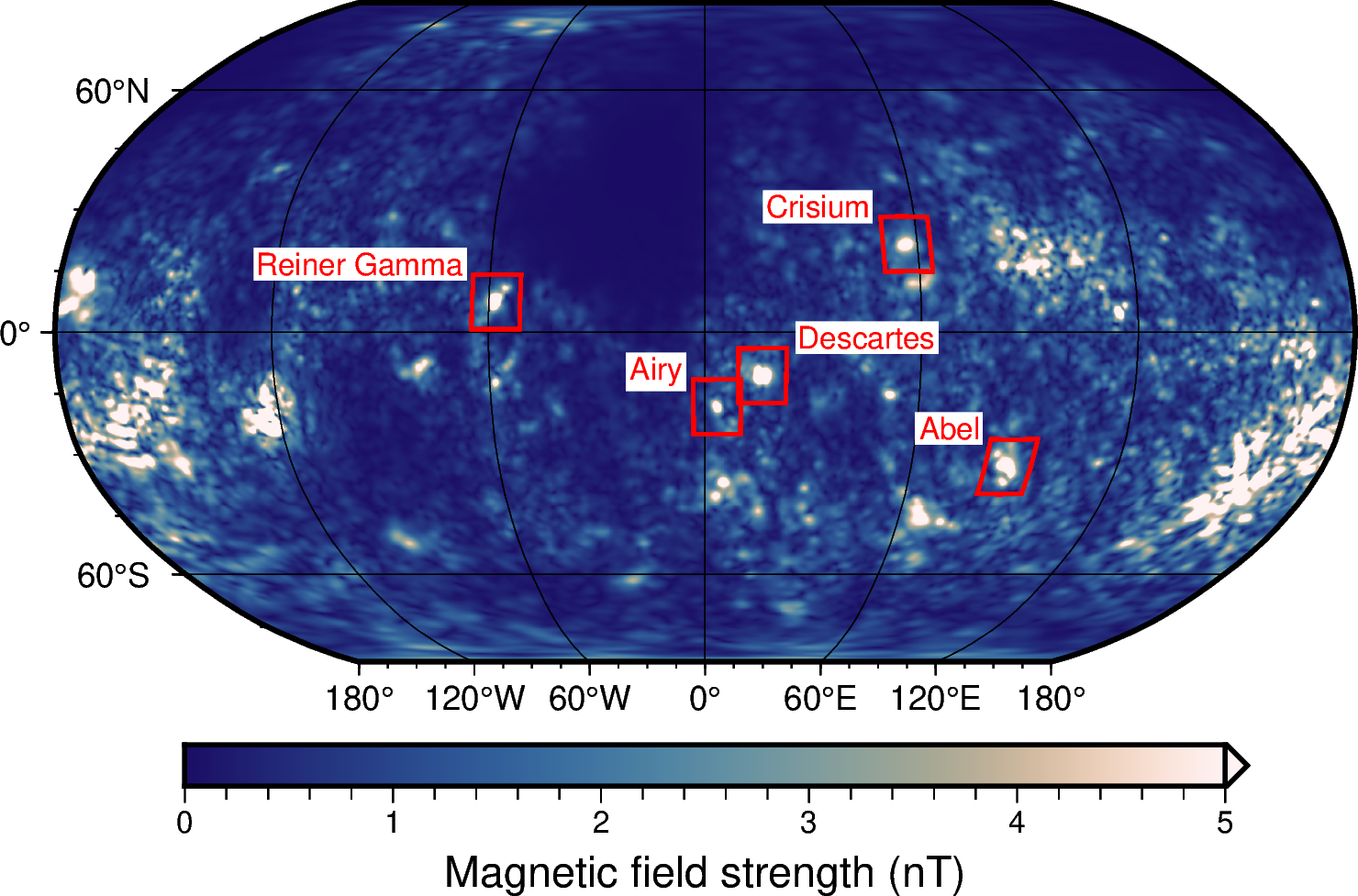
Fig 1. Locations of the studied lunar isolated magnetic anomalies. The shown magnetic field strength at 30 km height was predicted from the model of [13].

We focus on five isolated strong lunar magnetic anomalies (Fig.1) that show similar geometries and total field strengths > 5 nT at 30 km height in the recent lunar magnetic field models [13-15]. When deriving the scaling indices, we use the model of surface vector mapping [13] as primary because the other two models [14,15] use the equivalent source approach, which already imposes assumptions on source geometry. We extract the radial component of the strongest peak of the studied anomalies in the height range of 27—33 km in 0.1 km intervals and derive the best-fit point source depth and scaling indices (Table 1).


Table 1. Scaling indices and source depth of the studied lunar magnetic anomalies

Magnetic anomalies

Scaling index

Source depth (km)

Reiner Gamma

3.3

15.2

Abel

2.3

16.4

Airy

3.3

32.4

Descartes

3.5

27.9

Crisium

3.0

48.5


Among the studied anomalies, Reiner Gamma, Airy, and Descartes show N>3, suggesting non-uniform magnetized sources and inaccurate corresponding paleopoles. These observations are consistent with swirls (surface reflectance anomaly) associated with Reiner Gamma and Airy, which indicate complex field geometry at the surface. Crisium anomaly shows a scaling index equivalent to dipole (N=3.0), while Abel anomaly (N=2.3) is consistent with a source geometry between sphere- and pipe-like sources.

Our results suggest that the Crisum and Abel anomalies can be reasonably approximated by uniform magnetized sources, thus enabling an accurate paleopole reconstruction. Beak et al. [5,6] use a dipole source to model the Crisium anomaly (consistent with the derived scaling index N=3) and estimate a paleo south pole at ∼45N70E. The paleo north pole of the Abel anomaly derived using Parker’s method [7] is located at ∼42N114E. Together, these results indicate that the lunar magnetic paleopole was offset by more than 40 degrees from the present geographic pole and reversed at least once between the formation periods of the Crisium and Abel anomalies.

Estimated source depths further constrain the origins of the studied anomalies. The Crisum and Abel anomalies are consistent with emplacement of iron-rich impactor-derived materials [5,6,8]. Reiner Gamma, Airy, and Descartes anomalies do not show an association with impact basins, and combined with N>3, may reflect multi-stage magmatic processes involving magnetization under varying ambient field directions. In particular, the magmatic origin of Reiner Gamma is consistent with the multi-phase magmatic activities of the region [16]. These results provide new constraints on the structure and origin of lunar magnetic anomalies and implications for their detection and interpretation in upcoming lunar missions, such as Lunar Vertex and Chang’e 7.


Reference

[1] Weiss & Tikoo, Science (2014). [2] Tsunakawa, H. et al. JGR-Planets (2015). [3] Ravat, D. et al. JGR-Planets (2020).  [4] Wieczorek, M. et al., NVM-2 (2023). [5] Beak, S. et al., JGR-Planets (2017).  [6] Beak, S. et al., JGR-Planets (2019). [7] Oliverira, J. and Wieczorek, M., JGR-Planets (2017). [8] Hood, L., Icarus (2011). [9] Chaffee, T. et al., JGR-Planets (2025).[10] Thompson, D., Geophysics (1982). [11] Reid, A. & Thurston J., Geophysics (2014) [12] Florio, G. et al., Geophys. Prospect. (2009). [13] Tsunakawa, H. et al., JGR-Planets (2015) [14] Ravat, D. et al., JGR-Planets (2020). [15] Hood, L. et al., JGR-Planets (2021). [16] Hiesinger, H. et al., JGR-Planets (2003).

How to cite: Yang, X. and Mittelholz, A.: Scaling analysis of strong lunar magnetic anomalies, Europlanet Science Congress 2026, The Hague, The Netherlands, 7–11 Sep 2026, EPSC2026-497, https://doi.org/10.5194/epsc2026-497, 2026.

F2.60
|
EPSC2026-1214
|
On-site presentation
Masahisa Kato, Yuki Harada, Shaosui Xu, Andrew Poppe, Jasper Halekas, Saito Yoshifumi, Masaki Nishino, Shoichiro Yokota, Futoshi Takahashi, and Hisayoshi Shimizu

Since the Moon does not possess a dense atmosphere, its surface directly interacts with surrounding charged particles. In addition, photoelectrons and secondary electrons are emitted from the surface in response to incident photons and charged particles. To evaluate the direct interaction between the lunar surface and the charged particles, it is important to obtain the energy spectra of these particles, including photoelectrons. In this presentation, we introduce a numerical model of electrons emitted from the lunar surface due to solar irradiation. The input of the model is the solar irradiation flux, and it includes some physical and chemical parameters associated with photoemission. The model also considers Auger electrons, which are emitted from an atom following the emission of an inner-shell electron and possess characteristic energies. This model can be applied to various topics at the lunar surface, including surface charging. Surface charging is caused by incoming and outgoing currents and is characterized by the surface potential, which varies to balance incoming and outgoing electric currents. The lunar surface potential can be estimated by comparing model outputs with electron observations above the lunar surface. We also present applications of the model to potential estimation.

How to cite: Kato, M., Harada, Y., Xu, S., Poppe, A., Halekas, J., Yoshifumi, S., Nishino, M., Yokota, S., Takahashi, F., and Shimizu, H.: Developing a numerical model of photo-emitted electron energy spectra and its applications, Europlanet Science Congress 2026, The Hague, The Netherlands, 7–11 Sep 2026, EPSC2026-1214, https://doi.org/10.5194/epsc2026-1214, 2026.