
 1,1,1,1,1,1,1,2
- 1Helmholtz Centre for Environmental Research - UFZ, Computational Hydrosystems, Leipzig, Germany
- 2University of Potsdam, Institute of Environmental Science and Geography, Potsdam, Germany
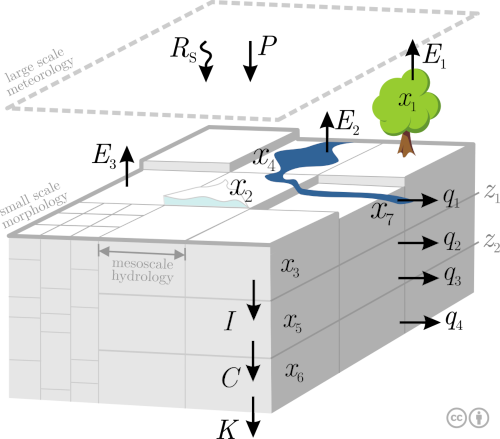
The mesoscale Hydrologic Model (mHM), first released in 2010, is today used both to advance process understanding and to provide operational services for the water sector and the wider public (e.g. the German drought monitor). mHM v5, released in 2014, established a highly modular hydrologic modeling framework. Here, we present mHM v6 – the next-generation mHM release, addressing key limitations of mHM v5 in three areas:
We demonstrate mHM v6 through (i) global river-network routing experiments based on the MERIT Hydro river network, quantifying the performance gains from the new parallel routing scheme, and (ii) a standalone routing setup driven by externally provided runoff to illustrate component-level workflows. We further outline how the same routing component can be embedded into coupled modeling chains via YAC/FINAM and Python-based orchestration. Overall, mHM v6 positions mHM as both a community hydrologic model and a reusable building block for modern, integrated, and scalable hydrologic workflows.
Website: https://mhm-ufz.org/
- Samaniego et al 2010: https://agupubs.onlinelibrary.wiley.com/doi/full/10.1029/2008WR007327
- Kumar et al 2013: https://agupubs.onlinelibrary.wiley.com/doi/full/10.1029/2012WR012195
How to cite: Müller, S., Thober, S., Shrestha, P. K., Fernandez-Palomino, C. A., Nur Kholis, A., Lüdke, S., Kelbling, M., Kumar, R., Attinger, S., and Samaniego, L.: The mesoscale Hydrologic Model mHM v6 – the next generation: Modular, Extensible, and Scalable Hydrological Modeling, EGU General Assembly 2026, Vienna, Austria, 3–8 May 2026, EGU26-20340, https://doi.org/10.5194/egusphere-egu26-20340, 2026.


