
 1,
1,- 1Indian Institute of Technology Bombay, Centre for Climate Studies, Mumbai, India (dewashishtiwari07@gmail.com)
- 2Indian Institute of Technology Bombay, Department of Environmental Science and Engineering, Mumbai, India (srinidhi@iitb.ac.in)
- 3Indian Institute of Tropical Meteorology, Ministry of Earth Sciences, Pune, India (214407002@iitb.ac.in)
- 4Indian Institute of Technology Bombay, Department of Chemical Engineering, Mumbai, India (chandra@iitb.ac.in)
Air pollution, specifically PM2.5 (Particulate matter with a diameter ≤ 2.5 μm), is a leading environmental stressor, contributing to ~1.05 million premature deaths annually in India. Unlike other western regions of the world where higher population densities are concentrated in urban sprawls, India features a majority of its population (two-thirds) concentrated in non-urban (rural) regions. Studies have shown a comparable PM2.5-associated mortality in urban and rural regions at a national scale for India. The contributions of source sectors to regional mortality specifically in urban and non-urban regions, essential for effective policy interventions, are discussed here.
In this study, we performed district-level, source-sector specific PM2.5 attributable mortality analysis for urban and rural populations for India for the year 2019. We first performed a baseline (all-sector combined) and sectoral zero-out WRF-Chem simulations using the SMoG-India emission inventory, gap-filled with CEDS and GFED, for the year 2019 covering the South Asia Cordex Domain with a 27 km horizontal resolution. The sectoral runs were performed for agriculture, residential combustion, industry, energy, and transport sectors. For the mortality calculations, we utilized relative risk curves generated using Meta Regression Bayesian Regularized, trimmed (MR-BRT) splines cause-specific for 6 diseases, developed over baseline PM2.5 concentration; cause-specific baseline mortality rates (BMR) from IHME (https://ghdx.healthdata.org/); and gridded population from SEDAC, segregated into urban and rural grids using VIIRS nighttime light radiance datasets. We scaled the fraction of sectoral PM2.5 contributions with baseline mortality to determine the mortality of each source sector at the grid level.
Relying on a model simulated PM2.5, we estimate population-weighted mean PM2.5 exposure of 42.7 µg/m³ and related mortality of 1.08 million. Our findings suggest that total premature deaths from PM2.5 exposures in India’s rural population are approximately 2 times larger than those in the urban population (Figure 1), similar to previous work. However, contributing emission sectors in both geographies are significantly different. The residential combustion sector contributes the most, approximately 44% of total premature deaths, out of which ~29% are borne by the rural population. Much larger impacts from the residential and agricultural sectors are seen in rural populations. Interestingly, energy emissions (from thermal power plants) have more than twice the impact on rural than on urban populations, indicating a regional scale of impact from an interplay of sulphate chemistry and atmospheric transport. Industry and transport sector emissions have 1.2 times larger mortality in rural than urban populations, indicating their more local-scale impact in urban regions. Sectorally, interventions to reduce residential biomass fuel use can yield the largest health benefits in both the rural and urban populations across India. For energy and industry sectors, regulatory interventions are needed at central and state government levels, since these emissions too impact both rural and urban populations. There is an urgent need for air quality management beyond the city scales and for expansion of air quality monitoring to rural areas in India.
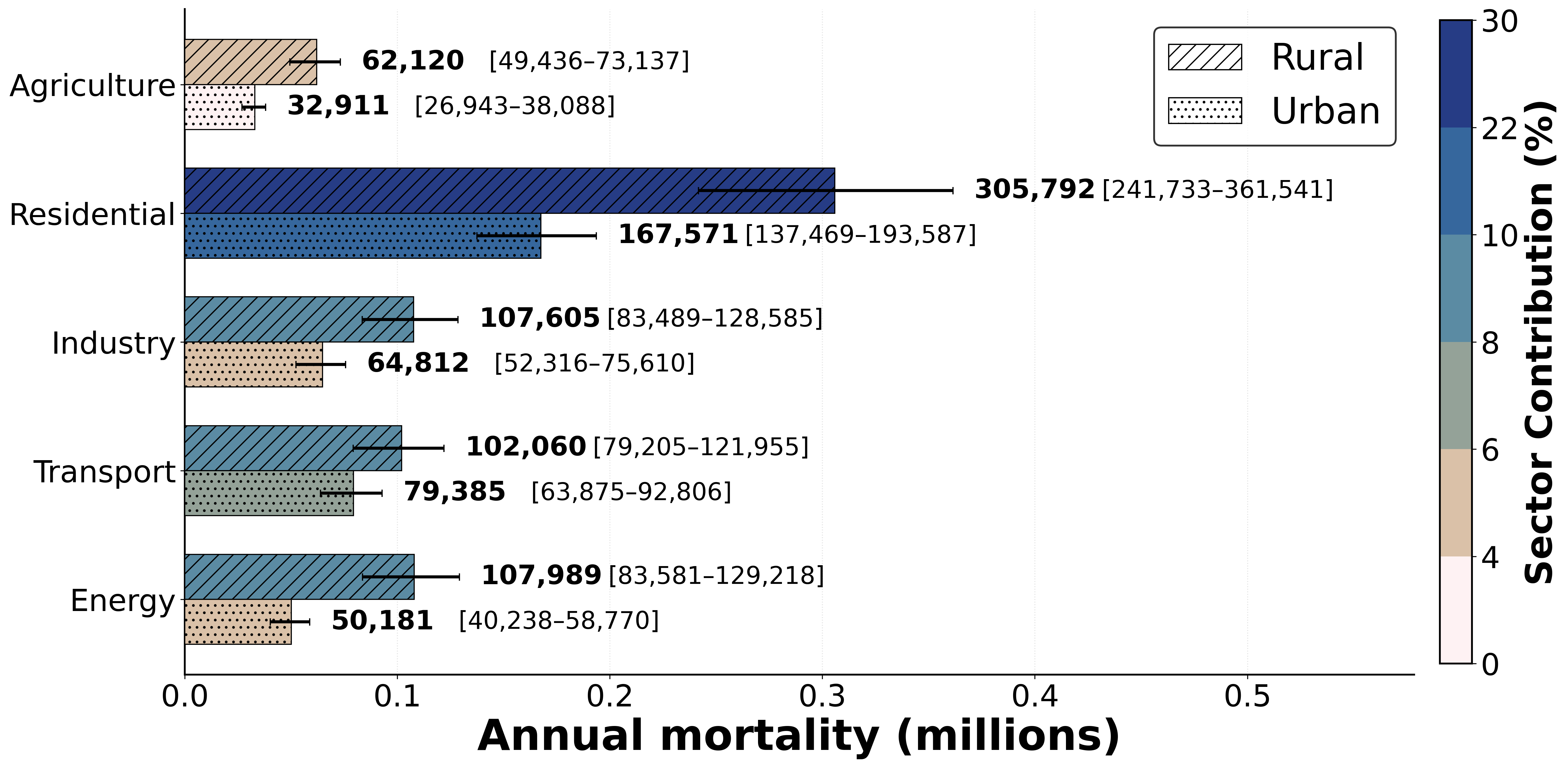
Figure 1. Source sector contribution to mortality in rural and urban population across India
How to cite: Tiwari, D., Balasubramanian, S., Maji, S., and Venkataraman, C.: Contrasting Sources of Air Pollution Exposure and Associated Mortality in Rural and Urban India, EGU General Assembly 2026, Vienna, Austria, 3–8 May 2026, EGU26-3168, https://doi.org/10.5194/egusphere-egu26-3168, 2026.


