
 1,2,1,3,2,1
- 1German Aerospace Center (DLR), Institute of Space Research, Berlin Germany (julia.maia@dlr.de)
- 2Planetary Sciences and Remote Sensing, Institute of Geological Sciences, Freie Universität Berlin, Berlin, Germany
- 3Institute for Planetology, University of Münster, Münster, Germany
Many surface tectonic features on Europa have been hypothesized to form in response to liquid and brine reservoirs within the ice shell [e.g., Schmidt et al., 2011; Steinbrugge et al., 2020; Matteoni et al., 2023]. Because these reservoirs have higher densities than the surrounding ice, they are negatively buoyant, producing surface deflection and generating topographic and gravity anomalies. Although the existence of such signatures has been proposed [e.g., Schmidt et al., 2011; Michaut and Manga, 2017; Lesage et al., 2025], their expected characteristics have not been systematically quantified.
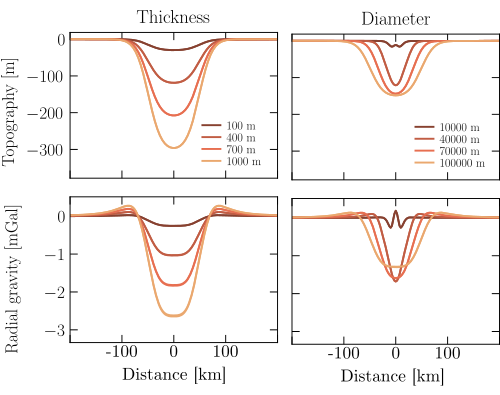
Here we investigate the topographic and gravitational signals produced by subsurface high-density deposits within Europa’s ice shell. Using both elastic loading models [e.g., Turcotte et al., 1981; Maia and Wieczorek, 2022] and viscous loading models [e.g., Richards and Hager, 1984; James et al., 2013; Maia et al., 2023], we predict the observable signatures generated by such reservoirs. The reservoirs are treated purely as density anomalies; they do not modify the rheology of the surrounding ice. We explore four key reservoir properties: (i) diameters of 10–100 km, (ii) thicknesses of 100–1000 m, (iii) density contrasts of 80–680 kg/m³ relative to water ice, and (iv) depths ranging from 1 km to 80% of the total ice-shell thickness. Figure 1 illustrates how the reservoir thickness and diameter influence the predicted topography and gravity for a 20-km-thick ice shell with a viscous, conductive viscosity profile. In this case the feature has a density excess of 280 kg/m3 and is place at 10 km depth. We also tested alternative shell thicknesses and viscosity structures, but these variations produced only minor changes in the amplitudes and shapes of the modeled signatures.
We find that subsurface reservoirs can produce surface displacements of several hundred meters. These signals are potentially detectable by stereo topography and radar sounding from Europa Clipper, as well as by GALA, the laser altimeter onboard JUICE. On the other hand, the associated gravity anomalies are on the order of a few milligals, and the expected horizontal scales of the features (~100 km) fall below the ∼500 km resolution limit of Europa Clipper’s global gravity field recovery [Mazarico et al., 2023]. Such small-amplitude signals will also be difficult to detect using line-of-sight acceleration from individual flybys, though detectability depends strongly on spacecraft altitude [e.g., James, 2016; Mazarico et al., 2023].
How to cite: Maia, J., Matteoni, P., Plesa, A.-C., Rückriemen-Bez, T., Postberg, F., and Hussmann, H.: Signatures of ice shell heterogeneities on Europa from gravity and topography, EGU General Assembly 2026, Vienna, Austria, 3–8 May 2026, EGU26-454, https://doi.org/10.5194/egusphere-egu26-454, 2026.


