

- LI-COR, Lincoln, United States of America (gburba@unl.edu)
Continental-scale research infrastructures and flux networks, alongside smaller networks and individual sites, directly measure evaporative water loss, as well as heat, CO2, CH4, and other gas exchange between the surface and the atmosphere. Over four decades, such flux stations covered 2100+ stationary measurement points and various campaign sites.
Despite such major advantages as extremely high-resolution, real-time results, continuous and direct nature of flux measurements, their applications are only now and rather slowly entering fields beyond academia due to the perceived method complexity, actual complexity and cost of traditional instrumentation and site operation, lack of broad geographic data coverage, and absence of a comprehensive approach focused on direct flux measurements specifically tailored for bringing immediate societal benefits.
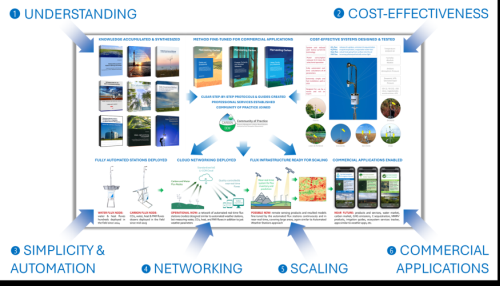
This presentation continues to address these challenges by simplifying explanations, offering detailed guides for practicing the method, presenting the latest lower-cost simple automated instrumentation and novel computing tools, facilitating peer-to-peer cross-sharing to increase data coverage and reduce station setup costs, and providing professional services for experiment design and execution.
One example of the most recent developments is the 2025 publication of three new plain-language guides/protocols on direct dMRV/aMRV/MMRV (Figure below). These aim to fundamentally change carbon markets by providing a direct, defensible, traceable, repeatable, real-time, evidence-based approach to quantify sequestration and emission in application beyond academia.
The ultimate goal of this presentation is to ignite discussions on utilizing flux measurements for practical decision-making applications to benefit society and to identify current needs, ideas, and examples for leveraging flux data in everyday decision contexts.
How to cite: Burba, G.: Latest Tools and Protocols for Using Direct Flux Measurement outside Academia, EGU General Assembly 2026, Vienna, Austria, 3–8 May 2026, EGU26-67, https://doi.org/10.5194/egusphere-egu26-67, 2026.


