
 1,2,3,
- 1Center for Petroleum Science and Engineering, Skolkovo Institute of Science and Technology, Russia
- 2College of Geosciences, China University of Petroleum (Beijing), China
- 3Department of Geology, M. V. Lomonosov Moscow State University, Russia
- 4News Center, Shangqiu Radio and Television Station, China
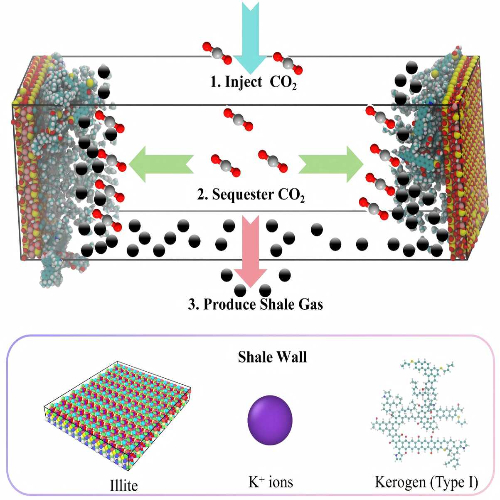
Ultra–deep shale geo–storage that couples secure CO2 sequestration with enhanced CH4 recovery demands explicit links from nanopore physics to reservoir–scale practice, yet how pore size and hybrid mineral-organic interfaces jointly govern CO2–CH4 competitive adsorption, mobility, and CH4 displacement under the Lower Cambrian Qiongzhusi temperature–pressure window remains insufficiently quantified; here we address this by molecular–dynamics simulations in composite illite–TypeI kerogen slit nanopores spanning 2–10nm and five reservoir state points—330.15K and 30MPa, 360.15K and 45MPa, 390.15K and 60MPa, 420.15K and 75MPa, 450.15K and 90MPa—and by extracting gas-surface interaction energies, cohesive–energy density, a dimensionless competitive–adsorption indicator, self–diffusion coefficients, near–wall density integration, and CH4 displacement efficiency during CO2 injection into CH4–saturated pores as constitutive inputs for dual–porosity⁄dual–permeability upscaling. Confinement amplifies selectivity: CO2 consistently outcompetes CH4 on both illite and kerogen, creating CO2–rich adsorption layers that nearly exclude CH4 from 2 nm surfaces; the competitive–adsorption indicator is ‹1 at 2nm (surface–dominated regime), rises to ≈1.3 at 4nm, and reaches ≈2.4–2.5 at 10nm at the highest temperature and pressure (mixed–fluid regime), while diffusion analysis shows CO2 remaining surface–bound and slower than CH4, which—once dislodged—resides in the central mixed fluid and is more mobile. Displacement metrics reveal a clear pore–width control: CH4 displacement efficiency increases from ≈70–77% (2nm) to ≈85-89% (10nm), peaks near 390.15K and 60MPa, and declines slightly at 450.15K and 90MPa as elevated temperature weakens adsorption; near–wall integration confirms persistent CO2 occupancy with a marked preference for illite across all conditions. Collectively, these pore–scale relations deliver a physically grounded design map for field deployment: (1) prioritize illite–rich, small–pore intervals to maximize durable CO2 trapping and storage security; (2) leverage larger nanopores (≥4–10 nm) as the mobility corridor for liberated CH4 to enhance deliverability; (3) schedule injections around moderate temperature and high pressure to balance displacement and retention; and (4) port the measured selectivity–width trends, cohesive–energy densities, diffusivity contrasts, near–wall occupancy fractions, and displacement curves directly into continuum simulators to forecast CO2–EGR performance and monitoring signatures in Qiongzhusi–type ultra–deep reservoirs by connecting atomistic mechanisms to engineering–relevant operating windows and upscaling parameters.
How to cite: Zhang, L., Yuan, C., Tan, X., Stupakova, A., and Song, Z.: Geo–Storage Across Scales: From Nanopore Theory to Reservoir Practice for CO2–Driven Methane Displacement in Ultra–Deep Illite–Kerogen Shales, EGU General Assembly 2026, Vienna, Austria, 3–8 May 2026, EGU26-85, https://doi.org/10.5194/egusphere-egu26-85, 2026.


