
 1,
1,- 1Department of Planetology, Graduate School of Science, Kobe University, Kobe, Japan (223s415s@gsuite.kobe-u.ac.jp)
- 2General Systems Studies, Graduate School of Arts and Sciences, The University of Tokyo, Tokyo, Japan
- 3Center for Planetary Science (CPS), Graduate School of Science, Kobe University, Kobe, Japan
We present the results of our first self-consistent N-body simulations of planet formation performed on the supercomputer “Fugaku”, modeling a large-scale planetesimal disk that extends from beyond the snow line to the ice-giant formation region. In our simulations, we include planet–gas disk interactions, planet–planetesimal interactions, gravitational interaction among all planetesimals (self-stirring), and physical collisions in a self-consistent manner. We discuss the effects of dynamic planetary migration—driven by Type-I migration and planetesimal-driven migration—on the planet-formation process.
Introduction:
In the standard theory of planet formation, planets form “in-situ” around their current orbits (Safronov 1972; Hayashi 1981). However, many problems have been pointed out for this in-situ formation model. For instance, it is difficult to explain the formation of Ice giants (Uranus & Neptune) within the solar system's lifetime (Levison & Stewart 2001). Moreover, recent observations of exoplanetary systems have revealed the existence of diverse planetary systems that cannot be explained without considering migration of planets (Borucki et al., 2010; Ricker et al., 2015). Both the formation timescale of Ice giants and the origins of diverse exoplanetary systems are not easy to explain with the standard theory. Promising mechanisms for such planetary migration include Type-I migration (Ward, 1986) and Planetesimal-Driven Migration (PDM; Fernandez & Ip, 1984). Type-I migration is driven by gravitational interactions between a planet and the gas disk, typically causing the planet to lose angular momentum and migrate inward toward the central star (Tanaka et al., 2002). In contrast, PDM is driven by gravitational scattering with planetesimals, whereby the planet can gain angular momentum from planetesimals and thus migrate not only inward but also outward. Planetary migration through PDM is expected to explain the outward migration of ice giants and the diversity of exoplanets (Malhotra 1993, 1995; Ida et al 2000; Levison & Morbidelli 2003; Nesvorný, 2018). The effects of PDM on planetary migration have been investigated in a number of studies (Kirsh et al., 2009; Capobianco et al., 2011; Minton & Levison, 2014; Kominami et al., 2016; Jinno et al., 2024). However, owing to computational resource limitations, these studies have only focused on characterizing planetary migration behavior itself—each assuming fully formed planets in their initial conditions. As a result, the effect of PDM on the planet formation process has not been explored. Here we perform the first self-consistent N-body simulations of planet formation from a large-scale planetesimal disk, in which planet-gas disk interactions, planet-planetesimal interactions, gravitational interaction among all planetesimals (self-stirring), and physical collisions between planetesimals are all taken into account.
Method:
We assume an axisymmetric protoplanetary disk around a solar‐type star, adopting the framework of the Minimum Mass Solar Nebula model (MMSN) (Hayashi et al., 1981). The snowline in our model is assumed to be at r= 2 AU, as it may have been closer to the Sun due to the viscous accretion of the gas disk and the Sun’s stellar evolution (Oka et al., 2011). For the planet-disk gas interactions, we adopt the gas drag model of Adachi et al. (1976) and employ the Type-I torque model proposed by Ida et al. (2020). The initial radial range of the planetesimal disk extends from 2 AU to 20 AU. We used a total of 354,350 particles (model 1) and 708,700 particles (model 2) to express the disk. The initial eccentricities and inclinations of planetesimals follow a Gaussian distribution with the dispersion <e2>1/2=2<i2>1/2=2rHill/rp, where rHill is the Hill radius of the planetesimal (Ida & Makino 1992).
Results:
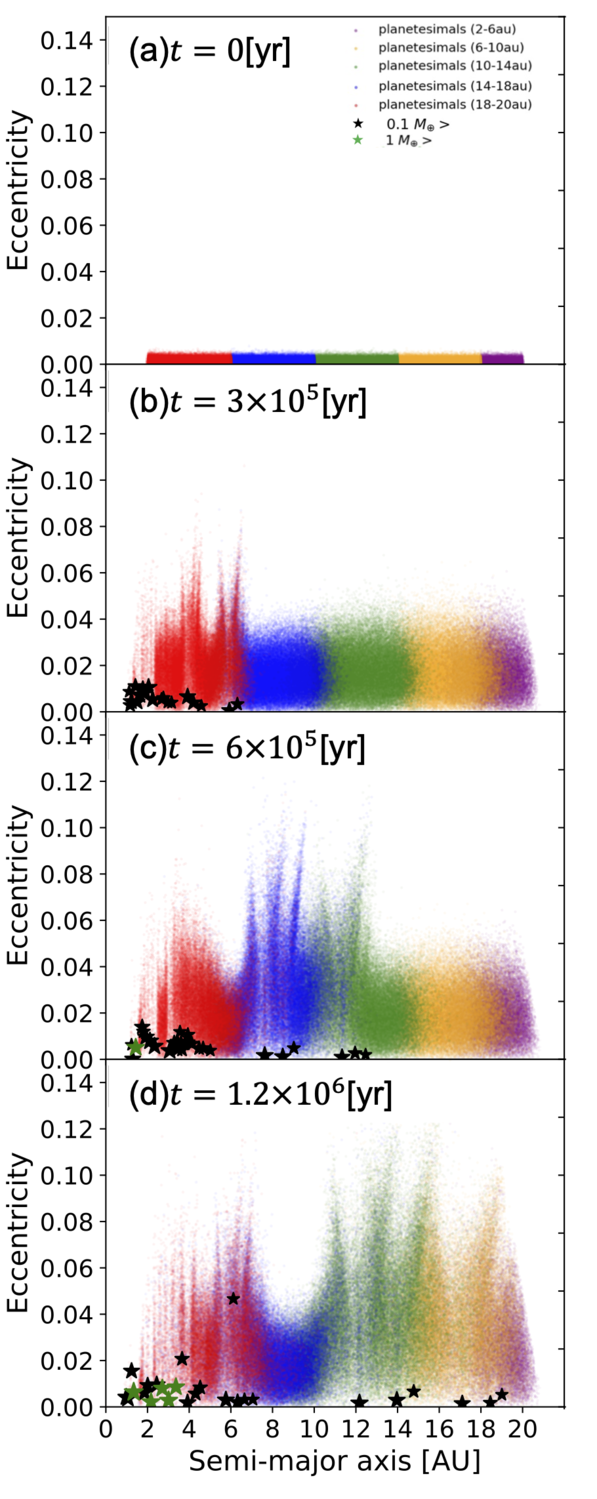
Figure 1 shows the time evolution of model 1 during planet formation within the planetesimal disk. In Fig. 1 (a) and (b), nineteen embryos with masses exceeding 0.1 formed by 0.3 Myr within the initially smoothed planetesimal disk. Two of these embryos migrated outward to 6 AU through outward PDM while scattering the surrounding planetesimals. By 0.6 Myr (Fig. 1 (c)), three embryos had reached the vicinity of 12 AU, followed by another three that migrated outward to around 8 AU. As shown in Fig. 1 (d), these six embryos continued their outward migration, eventually reaching semimajor axes of 12.2 AU, 14.0 AU, 14.8 AU, 17.1 AU, 18.5 AU, and 19.0 AU by 1.2 Myr. Overall, the system exhibits a bimodal distribution of embryos, separated by a wide gap of low‐eccentricity planetesimals between 7 AU and 12 AU, where no embryos are present.
There are two remarkable features in our simulation results:
- Protoplanets formed in the inner disk undergo substantial outward migration through PDM while they grow.
- Protoplanets formed in the inner disk, repel smaller protoplanets located further outward, leading to the outward migration of multiple protoplanets through PDM.
The results of our self-consistent N-body simulations of planet formation from a large-scale planetesimal disk suggest that planets dynamically migrate within the protoplanetary disk during their growth. Our findings may explain the origins of ice giants and also provide theoretical support for the planetary migration necessary to explain diverse exoplanetary systems.
Fig. 1 The time evolution of the system during planet formation within the planetesimal disk.
How to cite: Jinno, T., Saitoh, T., Funato, Y., and Makino, J.: Global N-body simulation of planetary formation: The origins of Ice giants, EPSC-DPS Joint Meeting 2025, Helsinki, Finland, 7–12 Sep 2025, EPSC-DPS2025-1202, https://doi.org/10.5194/epsc-dps2025-1202, 2025.


