
 1,1,1,1
- 1University of Vienna, Institute of Astrophysics, Faculty of Earth Sciences, Geography and Astronomy, Austria (gwenael.van.looveren@univie.ac.at)
- 2International Institute for Applied Systems Analysis (IIASA), Laxenburg, Austria (johnstone@iiasa.ac.at)
Finding an Earth-like planet in the habitable zone of a star has proven exceedingly difficult, as it pushes the detection limits of current instruments. Up to present day, no conclusive detection of a secondary atmosphere around an Earth-sized planet has been made, whilst thick Venus-like atmospheres have been excluded in many observations. This leaves us wondering if atmospheres around rocky planets are rare.
The concept of the cosmic shoreline was proposed as a division between planets with atmospheres and those without atmospheres. This division is based on Solar System planets, comparing the escape velocity and the instellation of the planet. But even in our own Solar System, we can see that the structures of atmospheres are more complicated than just these two parameters. For example, even though the instellation at Venus’ orbital distance is higher than at Earth's, the uppermost layers of our sister planet are considerably cooler. This can be attributed to the high CO2 content of the Venusian atmosphere, which has a cooling effect at higher altitudes. This difference demonstrates the importance of the chemical composition.
In this presentation, we will take a closer look at some of the parameters that influence the thermal structure of a secondary atmosphere. These include the planetary mass, instellation, and atmospheric composition. Using self-consistent model atmospheres, we can determine the thermal losses and what set of parameters results in a loss exceeding the rate at which an atmosphere can be replenished by outgassing. We use such a grid of planetary models to determine the highest instellation a planet can endure before reaching this catastrophic mass loss rate.
However, a planetary system does not only consist of a planet, but also a star. The properties of a host star are equally important in our search for secondary atmospheres. Using stellar evolution models, we determine not only the distance where the catastrophic mass loss rate is reached, but also how it evolves throughout the lifetime of the system. Planets closer in than this distance are unlikely to retain their atmospheres.
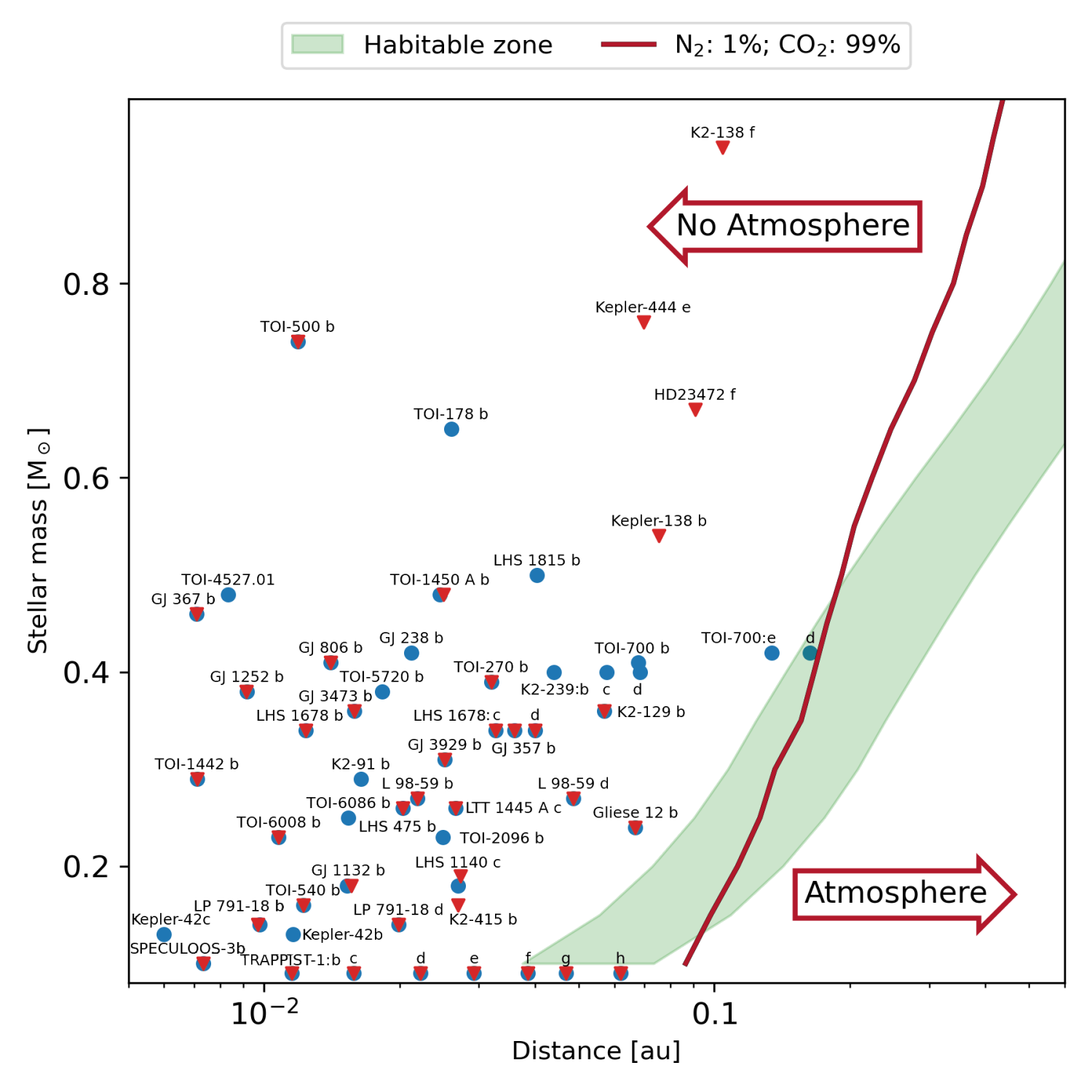
When we calculate the habitable zone of a system, in addition to our atmospheric retention distance, we can estimate which planets could fulfil both the temperature and pressure requirements to support liquid surface water. Our grid of models shows that for stars at an age of 1 Gyr, the entire habitable zone is closer-in than the atmospheric retention distance for all stars with masses below 0.4 solar masses. These conclusions are further complicated if we take into account the initial rotation rate of the star. Initially rapidly rotating stars remain much more luminous in X-ray and UV wavelengths for much longer, exposing the planet to a higher instellation for much longer. Consequently, the atmospheric retention distance is farther out for initially fast-rotating stars.
In the figure below, we show where planets scheduled for observation fall on this stellar mass vs orbital distance plot. The planets represent scheduled JWST targets (blue circles) and Ariel candidates (red triangles) with masses below 2 Earth masses. The red line denotes the atmospheric retention distance for a CO2-dominated atmosphere, whilst the green shaded area shows the habitable zone. This figure demonstrates that it is unlikely that any of these planets will hold on to any significant atmosphere.
How to cite: Van Looveren, G., Boro Saikia, S., Herbort, O., Schleich, S., Güdel, M., Johnstone, C., and Kislyakova, K.: Atmospheric retention distances for rocky exoplanets: Are there even atmospheres where we look?, EPSC-DPS Joint Meeting 2025, Helsinki, Finland, 7–12 Sep 2025, EPSC-DPS2025-1265, https://doi.org/10.5194/epsc-dps2025-1265, 2025.


