
 1,1,
1,1,- 1Department of Space and Planetary Sciences, University of Bern, Bern, Switzerland (liurong.lin@unibe.ch)
- 2LIRA, Observatoire de Paris, Université PSL, Sorbonne Université, Université Paris Cité, CY Cergy Paris Université, Meudon, France
Recent advancements in high-contrast exoplanet imaging have opened the door to adaptive coronagraphy, a new approach that leverages the use of active optical components to dynamically adapt to science goals or observing conditions, for example, to observe multiple star systems. Enabling technologies include liquid-crystal-on-silicon (LCoS) spatial light modulators (SLMs) as programmable focal-plane phase masks (FPMs), or digital micro-mirror devices (DMDs) as dynamic pupil apodizers.
However, these active devices introduce new challenges, such as limitations in spatial resolution, phase precision and accuracy, as well as extra weaknesses due to their pixelated and scalar nature. In this contribution, we present the detailed performance parameter space for pixelated FPM coronagraphs (see Figure 1). We are notably studying the impacts of key parameters such as spatial sampling, phase resolution and stability, and a few typical calibration errors. Using SLM-based systems as a case study, we evaluate several FPM coronagraphs: vortex masks, four-quadrant phase mask (FQPM), Roddier & Roddier and its dual-zone equivalent, and azimuthal cosine masks (ACM). Both monochromatic and broadband (20 percent bandwidth) conditions are considered. Scenarios with and without central telescope obstructions are also assessed, along with varying Lyot stop sizing parameters. Performance is quantified using metrics such as raw contrast (η*), throughput (ηp), and the throughput-to-contrast ratio ηp/√η* , which serves as a proxy for signal-to-noise on an off-axis point source.
Our findings shed light on the error budgets and fundamental trade-offs inherent to pixelated FPM coronagraphs. This is particularly timely with the upcoming first light of the Programmable Liquid-crystal Active Coronagraphic Imager for the 4-m DAG telescope (PLACID) instrument, which will be the first active high-contrast direct imaging instrument to field a LCOS SLM as a programmable digital FPM, operating in the H- to Ks-band. However, the lessons learned from this work may also provide valuable insights beyond the sole use of SLM panels, for instance to printed discretized FPMs or to other future photonic modulators that may exhibit sufficiently fine actuator pitch for focal-plane coronagraphy.

Figure 1, Illustration of the discretization for 8 commonly used coronagraphic FPMs, assuming 10 pixels per diffraction beamwidth: vortex with topographic charge 2, 4, 6 and 8, four-quadrant phase mask (FQPM), Roddier & Roddier, dual zone and azimuthal cosine mask (ACM) with charge 2.
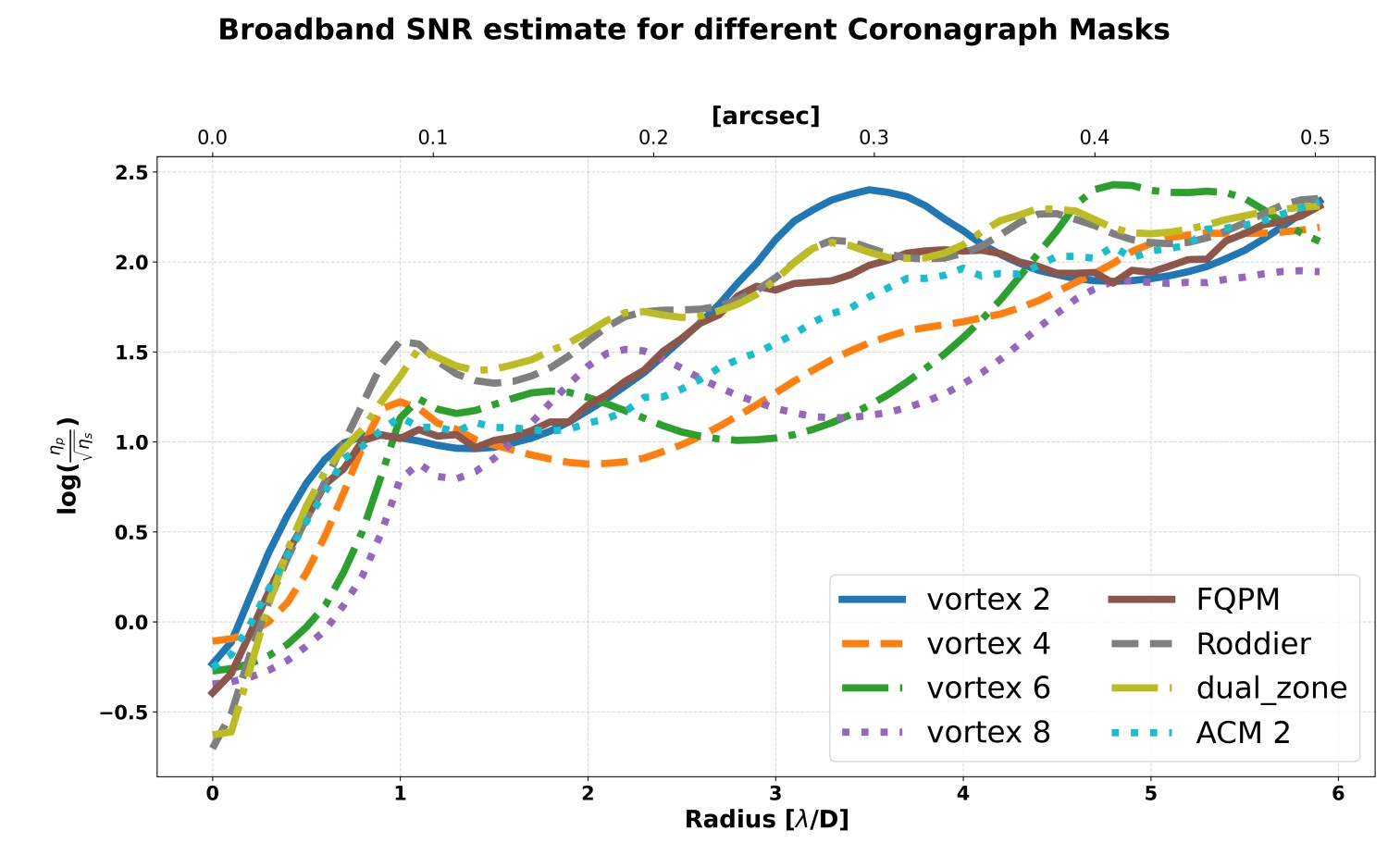
Figure 2, SNR estimate for various coronagraphs in realistic conditions (20% broadband light, DAG telescope pupil with central obstruction, 10 SLM pixels per λ/D, 8-bits digitization). SNR of planetary companion is proportional to ~ ηp /√η* , where ηp is the throughput on an off-axis companion and η* is the transmission on the on-axis host star (null depth).
How to cite: Lin, L., Kühn, J., Potier, A., Tandon, R., and Marquis, L.: Simulating Pixelated Focal-Plane Phase Masks for Coronagraphic High-Contrast Imaging, EPSC-DPS Joint Meeting 2025, Helsinki, Finland, 7–13 Sep 2025, EPSC-DPS2025-127, https://doi.org/10.5194/epsc-dps2025-127, 2025.


