
 1,2,4,5
- 1University of Groningen, Kapteyn Astronomical Institute, Forming Worlds, Groningen, Netherlands (spaargaren@astro.rug.nl)
- 2Department of Astrophysics, University of Vienna T¨urkenschanzstrasse 17 1180 Vienna, Austria
- 3Center for Star and Planet Formation, Globe Institute, University of Copenhagen, Øster Voldgade 5-7, 1350 Copenhagen, Denmark
- 4HUN-REN Research Centre for Astronomy and Earth Sciences, MTA Centre of Excellence 15-17 Konkoly Thege Miklos ut Budapest, 1121 Hungary
- 5Institute of Geophysics, ETH Zurich Sonneggstrasse 5 8092 Zurich, Switzerland
Abstract
Rocky planets in the Solar System exhibit element depletions relative to the Sun that correlate with volatility during disk condensation. To investigate whether this trend extends to exoplanets, we analyze how element volatility varies with proto-planetary disk composition using a statistical sample of stellar abundances. We find that volatility behavior depends strongly on the disk’s C/O ratio, revealing a regime (C/O = 0.75–0.95) where Mg and Si become more volatile while Ca, Al, and Fe retain near-constant volatility. This leads to the formation of planets with high core mass fractions and Ca/Al-rich mantles—potentially distinguishable from both graphite-crusted and Earth-like planets based on bulk density.
Introduction
Rocky planets inherit their material from proto-planetary disks, which reflect the composition of their host stars. To constrain bulk rocky exoplanet compositions, which governs various aspects of their evolution, we can use observed stellar abundances. This requires an additional step of volatility-based element depletion, as observed for the Earth, Mars, and Vesta. Element volatility can vary significantly with bulk gas composition, as proven for disks with varying molar C/O ratios (Larimer, 1979). Here, we aim to extend our understanding of how element volatility varies with bulk proto-planetary disk composition, by simulating condensation sequences for a large statistical sample of disk compositions based on stellar abundance observations.
Methods
We use the GGchem code (Woitke+, 2018) to simulate the composition of condensed solids in chemical equilibrium with the proto-planetary disk gas, as it cools from 2500 K to 400 K, at 1e-4 bar (based on the Solar nebula). We characterize element volatility by the 50% condensation temperatures (Tc), since the Earth shows a direct correlation between Tc values and the depletion of elements in Earth compared to the Sun (e.g., Wang+ 2019). We run these models for a sample of 1,000 stellar abundances taken from the GALAH catalogue (DR3.2, Buder+ 2021), and create parametrizations for element condensation temperatures as a function of bulk disk composition, for major rock-forming and metal-forming elements. We finally apply element depletion, correlated to condensation temperatures updated with these parametrizations, to all stellar abundances in the GALAH catalogue to simulate bulk rocky exoplanet compositions.
Results
We find that the Tc of major rock-forming cations (Ca, Al, Mg, Si, and Na) increases as bulk disk C/O increases, similar to previous research. However, we find that Mg and Si experience a drop in Tc at lower C/O than Ca and Al (0.75-0.85 vs. 0.94-0.95; Fig. 1). This leads to refractory-rich planetary material in this C/O range. On the contrary, Fe has Tc only dependent on its own abundance, and is independent of the disk C/O.
Applying the Earth-Sun devolatilization trend, accounting for disk chemistry-dependent element volatility, reveals a wider range of bulk planet compositions than considered before. Especially, planets with C/O between 0.75 and 0.94 display greater Mg and Si depletions, leading to planets with higher core mass fractions and higher concentrations of Al and Ca in their mantles (Fig. 2). These planets could be observationally distinguishable from lower C/O planets with smaller cores, or higher C/O planets with extensive light graphite crusts, based on their mass-radius relation. Further, if these planets would form with a steeper devolatilization pattern (e.g., a Vesta-like pattern), they could reach Mercury-like core mass fractions, potentially explaining super-Mercury observations.
To assess the geophysical implications of these compositions, we modeled mantle mineralogy as a function of bulk planet composition. We use a Gibbs energy minimization algorithm (Perple_X, Connolly 2005) and thermodynamic databases valid for the whole mantle (Stixrude+Lithgow-Bertelloni, 2024). We confirm the existence of planets with the weak mineral ferropericlase in their upper mantles (Fig. 3). Further, we find that Si-rich planets with quartz present in their bulk mantle, which would have a low-density crust and could be locked out of Earth-like plate tectonics behaviour, are exceedingly rare.
Conclusion
Element volatility in proto-planetary disks varies with bulk composition, particularly the molar C/O ratio. In disks with intermediate C/O values (0.75–0.95), Mg and Si become more volatile than other refractory elements, resulting in rocky planets with elevated core mass fractions and Ca- and Al-enriched mantles. These distinct compositions may produce observable differences in mass-radius relationships and offer a potential explanation for high-density “super-Mercury” exoplanets. Our results highlight a new class of rocky planets shaped by disk chemistry that expands the known diversity of planetary interiors.
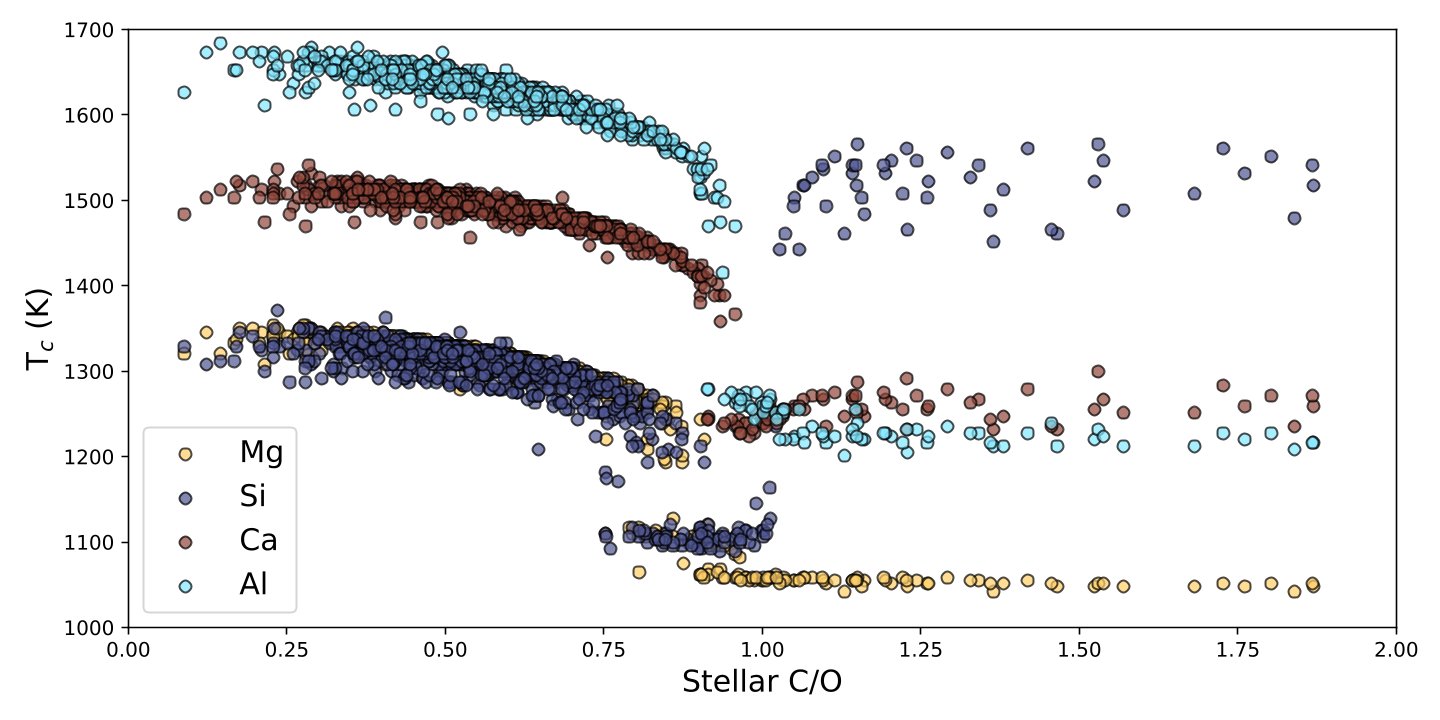
Fig. 1. 50% condensation temperatures (Tc) of key rock-forming cations Mg, Si, Ca, and Al, as a function of bulk proto-planetary disk molar C/O ratios. Tc values are based on condensation sequences of various disk compositions, calculated with GGchem, at 1e-4 bar.
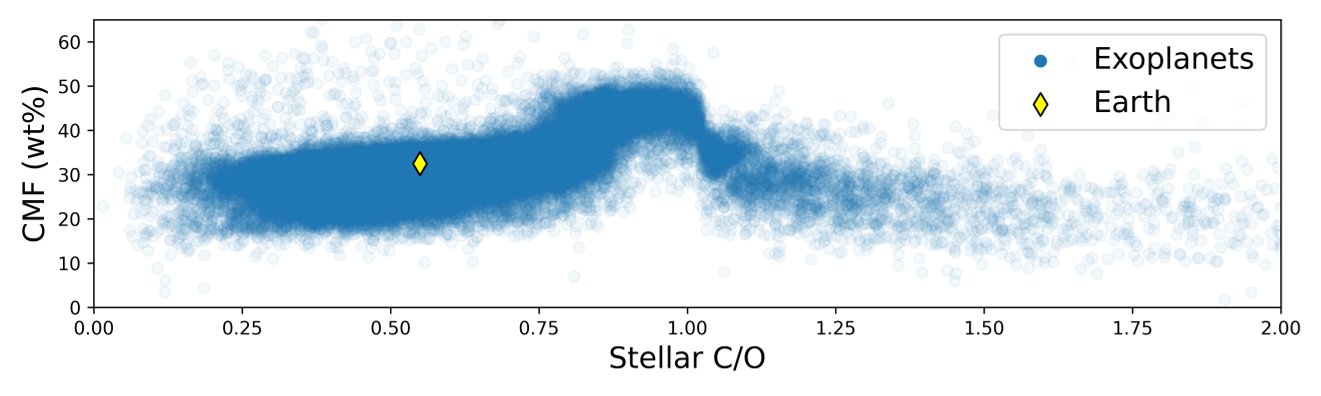

Fig. 2. Bulk planet compositions in terms of mass fraction of the metallic iron core (CMF) and minor element fraction (Ca+Al) of the mantle, as a function of host stellar molar C/O ratios. Planet compositions are calculated by applying element volatility-dependent depletion factors to stellar abundances.

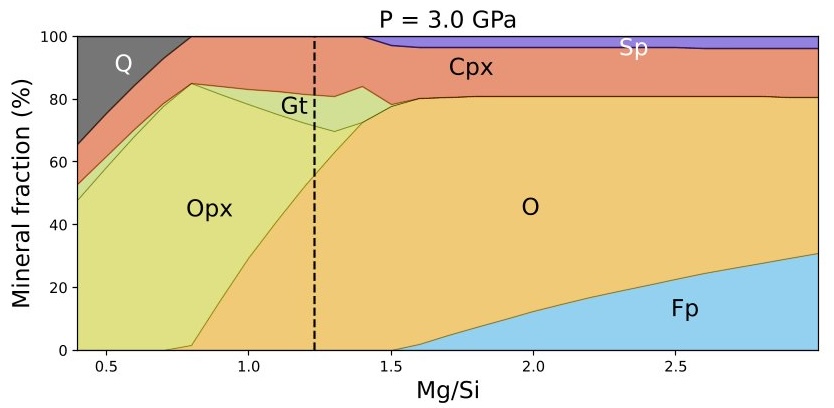
Fig. 3. Predicted distribution of rocky exoplanet bulk mantle Mg/Si ratios (top), and mantle mineralogy (P = 3 GPa) of exoplanets as a function of bulk mantle Mg/Si (bottom). Mineralogy is calculated with Gibbs energy minimization algorithm Perple_X.
Bibliography
Larimer, J. W., & Bartholomay, M. (1979). The role of carbon and oxygen in cosmic gases: some applications to the chemistry and mineralogy of enstatite chondrites. Geochimica et Cosmochimica Acta, 43(9), 1455-1466.
Woitke, P., Helling, C., Hunter, G. H., Millard, J. D., Turner, G. E., Worters, M., ... & Stock, J. W. (2018). Equilibrium chemistry down to 100 K-Impact of silicates and phyllosilicates on the carbon to oxygen ratio. A&A, 614, A1.
Wang, H. S., Lineweaver, C. H., & Ireland, T. R. (2019). The volatility trend of protosolar and terrestrial elemental abundances. Icarus, 328, 287-305.
Buder, S., Sharma, S., Kos, J., Amarsi, A. M., Nordlander, T., Lind, K., ... & Galah Collaboration. (2021). The GALAH+ survey: Third data release. MNRAS 506(1), 150-201.
Connolly, J. A. (2005). Computation of phase equilibria by linear programming: a tool for geodynamic modeling and its application to subduction zone decarbonation. EPSL, 236(1-2), 524-541.
Stixrude, L., & Lithgow-Bertelloni, C. (2024). Thermodynamics of mantle minerals–III: the role of iron. GJI, 237(3), 1699-1733.
How to cite: Spaargaren, R., Herbort, O., Wang, H., Mojzsis, S., and Sossi, P.: Compositional effects on element volatility in extra-Solar proto-planetary disks, EPSC-DPS Joint Meeting 2025, Helsinki, Finland, 7–12 Sep 2025, EPSC-DPS2025-1612, https://doi.org/10.5194/epsc-dps2025-1612, 2025.


