
 1,
1,- 1University of Bern, Physics Institute, Space Research and Planetary Sciences, Bern, Switzerland (oliver.schib@unibe.ch)
- 2Department of Astrophysics, University of Zurich, CH-8059 Zurich
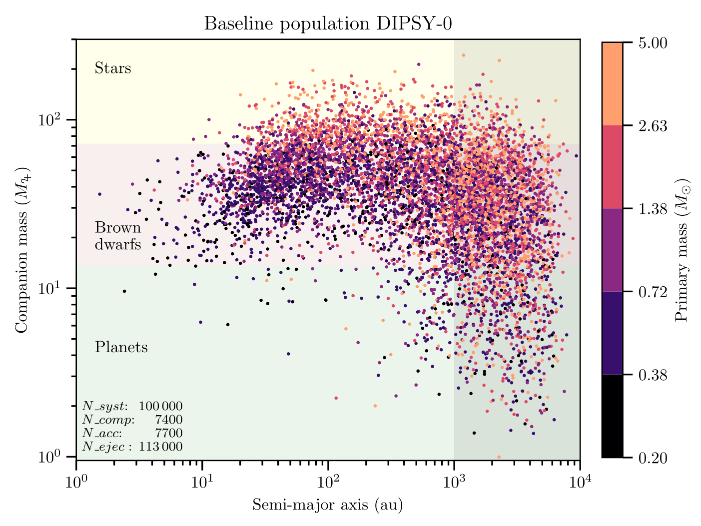
Disc instability remains the leading formation pathway for some of the observed giant planets. In particular, this model can more naturally explain giant planets at large separation, giant planets around M stars, and very young giant planets. However, there are still many open questions regarding this formation mechanism, and the expected population of planets is currently unknown. We developed a comprehensive model for the formation of a star-and-disc system through the collapse of a molecular cloud core and its evolution until disc dispersal and beyond. The model includes the potential fragmentation of the disc as well as the subsequent evolution of any fragments. We apply the model to perform a population synthesis in the disc instability paradigm (DIPSY). We will present the results of the baseline population and discuss the emerging population of companions around different types of stars. We find that, while fragmentation (the formation of bound clumps of gas in the disc, a necessary condition for planet formation in the disc instability model) may only happen in a minority of systems, it often leads to the formation of at least one companion when it does. The inferred population of companions spans a large range of masses, from the planetary to the stellar regime. The figure shows the result of the baseline calculation: the mass-distance diagram for 100’000 systems after 100 Myr. The final host star mass is given as colour code. The results of the population synthesis will provide hints both for the theoretical study of planet formation (e.g. hydrodynamic simulations) and future observational surveys of companions. DIPSY contributes to our understanding of planet formation irrespective of the formation model.
How to cite: Schib, O., Mordasini, C., Helled, R., and Emsenhuber, A.: DIPSY: A New Disc Instability Population Synthesis, EPSC-DPS Joint Meeting 2025, Helsinki, Finland, 7–12 Sep 2025, EPSC-DPS2025-1763, https://doi.org/10.5194/epsc-dps2025-1763, 2025.


