
 1,
1,- 1Instituto de Astrofísica de Andalucía, Física Estelar, Granada, Spain (mcentenera@iaa.es)
- 2Centro Astronómico Hispano Alemán, Almería, Spain
- 3Leibniz-Institute for Astrophysics Potsdam (AIP), Potsdam, Germany
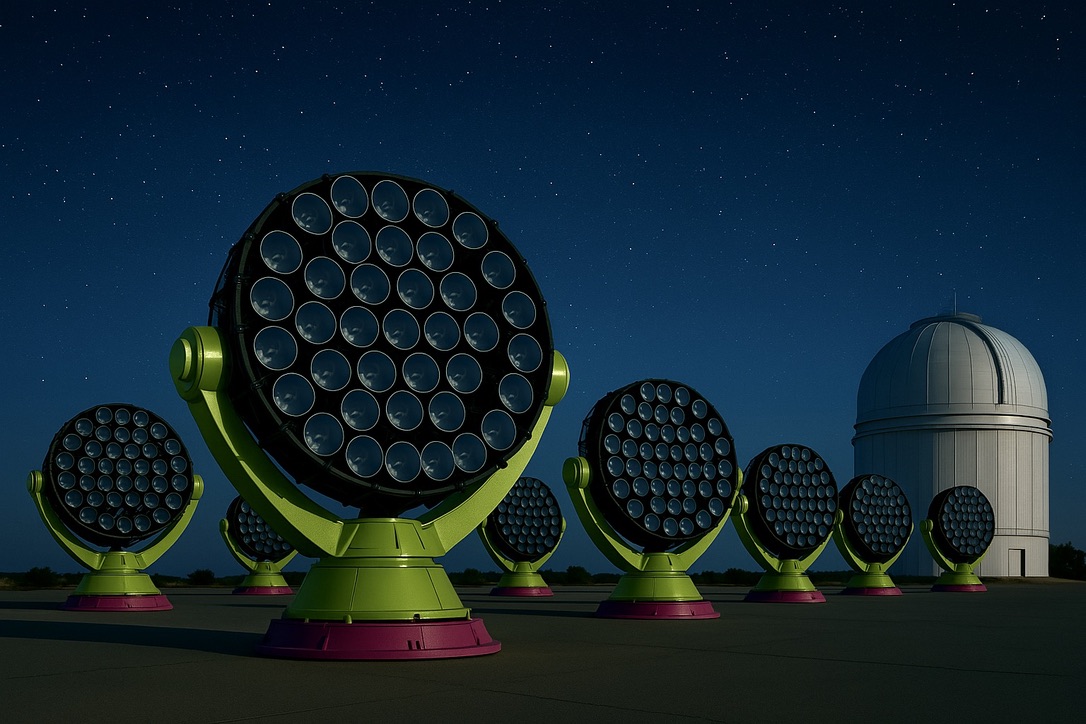
The Multi ARray of COmbined Telescopes (MARCOT) is a novel astronomical facility concept developed to meet the increasing demand for scalable, cost-effective, and modular telescope architectures. This project is structured in multiple phases, the first one is MARCOT Pathfinder, currently installed at the Calar Alto Observatory (CAHA, Spain), features an array of seven small Optical Tube Assemblies (OTAs) operating coherently to enhance the signal-to-noise ratio (SNR)—a critical factor for exoplanet detection via high- precision radial velocity (RV) measurements.
In the second phase, a 5-meter equivalent module is planned, which will push the limits of photonic-enabled technologies and become the telescope with the largest light-collecting capacity at CAHA. Future phases will replicate this module to gradually increase the array’s collecting power, scaling up to 10-meter and eventually 15-meter equivalents. Each module will be housed in its own small dome, preserving modularity while enabling significant scientific scalability.
To achieve these large apertures with high SNR, a multi-mode photonic lantern (MM-PL) is under development. This device couples light from multiple OTAs into a single multi-mode fibre, feeding a high- resolution spectrograph. In this talk, we present the design of MARCOT’s spectroscopic architecture and the development of a dedicated photonic laboratory, aimed at fabricating and characterizing MM-PLs. This facility is essential for optimizing coupling efficiency and validating MM-PL performance through extensive laboratory testing. We will report on the first laboratory characterization of an MM-PL, describe its fabrication process, and present design improvements to maximize transmission efficiency.
In parallel, we have developed simulation codes to estimate the radial velocity precision achievable by different MARCOT module configurations when connected to a high-resolution spectrograph. These simulations indicate that the array will be capable of accessing a significant number of previously unobservable targets, including faint stars, enabling the discovery of new exoplanets beyond the reach of current facilities.
Additionally, a new code is under development to conduct a comprehensive multi-criteria optimization study, aimed at identifying the optimal parameters for the telescope architecture, photonic lantern design, and instrument interface. This systematic approach will guide future design decisions and maximize the overall scientific return of the facility.
There is currently a pressing need for telescopes with greater light-collecting capacity to improve the performance of high-resolution instruments, which are currently limited by the apertures of existing ground- based observatories. This is essential for both exoplanet detection and atmospheric characterization. However, the post-ELT era is constrained by economic limitations that prevent the construction of telescopes beyond ~40 meters. This reality underscores the need for more cost-effective alternatives that can achieve similar scientific goals.
In this context, MARCOT emerges as a promising solution. In the post-ELT landscape, MARCOT and instruments like ANDES will share a small region of sky, allowing MARCOT to perform preliminary observations and help identify the most promising exoplanet targets for ANDES. Due to its extended dedicated observing time for exoplanets, MARCOT will be able to survey a larger number of targets with high cadence. Moreover, in the northern hemisphere, MARCOT will be the only facility offering such a high collecting power combined with significant time dedicated to exoplanet science.
How to cite: Centenera, M., Aceituno, J., Amado, P., and Madhav, K.: MARCOT: Modular Astronomy in the Post-ELT Era through Photonic Integration , EPSC-DPS Joint Meeting 2025, Helsinki, Finland, 7–12 Sep 2025, EPSC-DPS2025-558, https://doi.org/10.5194/epsc-dps2025-558, 2025.


