
 1,2,3,4,2
- 1Institut d'Astrophysique de Paris, CNRS, SU, France (angele.syty@iap.fr)
- 2Dipartimento di Fisica, La Sapienza Università di Roma, Roma, Italy
- 3INAF, Osservatorio Astrofisico di Arcetri, Firenze, Italy
- 4School of Physics and Astronomy, Cardiff University, Cardiff, UK
Ariel is a European Space Agency (ESA) mission that aims to study the atmospheres of a large and diverse sample of transiting exoplanets (Tinetti et al. 2021). Scheduled for launch in 2029 to the L2 Lagrange point. Ariel will observe exoplanets in visible and near-infrared wavelengths (0.5–7.8 µm) via low-resolution spectroscopy. Ariel will use various spectroscopic techniques, including transmission and emission spectroscopy during transits and eclipses, as well as phase curve observations. These measurements will reveal wavelength-dependent variations in the observed spectra, caused by molecular absorption and emission in the planets' atmospheres. This will enable detailed studies of atmospheric composition, clouds, hazes, and thermal structure. To achieve its science objectives, the Ariel consortium must ensure that the noise budget is resilient to different sources of systematics, from the detector, the instrument, or the science scene itself.
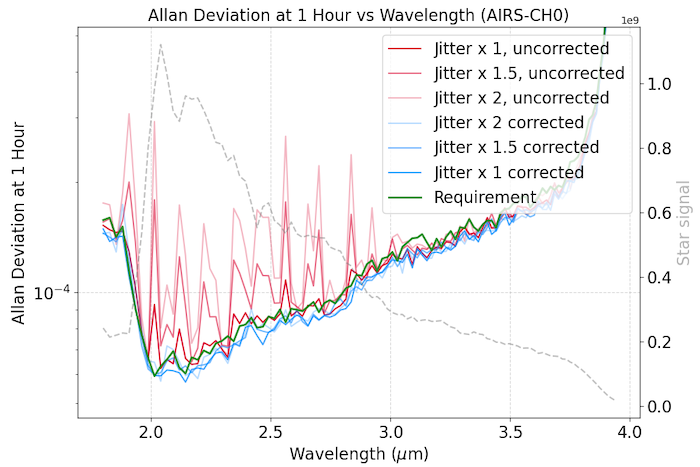
The systematics expected are the jitter of the Line of Sight of the telescope (LoS), the pixels’ response non-linearity (PRNL) and bad pixels on the focal plane. PRNL can be explained as capacitive leakage on the readout electronics of each pixel during the integration time. Bad pixels, identified by their non-nominal behavior, are masked from the detector array. Reaction wheels, meant to ensure the stability of the spacecraft, can eventually reach some resonance frequencies, producing a jitter of the LoS of the telescope. The point spread function on the focal plane is shifted and distorted from frame to frame by this jitter effect. Since the pixel response function varies across and within individual pixels (intra-pixel variations), jitter induces photometric noise. This noise level needs to remain under the threshold of 5% above the photon noise as specified by Ariel design requirements. A jitter detrending method has been designed for this purpose (Bocchieri et al, 2025). We found all these effects to be detrendable. For instance, the attached figure is the Allan deviation plot at a one-hour timescale, an indicator of the noise level at the timescale of a planet transit in front of its host star, as a function of the wavelength. The red curves are the noise level without jitter correction, for three different levels of jitter amplitude. The blue curves are the levels of noise after performing jitter correction. Finally, the green curve is the noise level of the Ariel requirement, i.e., 5% above the level of the photon noise, computed with a reference observation containing no jitter at all. These curves are the averaged Allan deviation results obtained from 50 different random noise realizations (photon noise and readout noise); all the other parameters being left unchanged. After jitter correction, the blue curves meet Ariel’s requirement.
In this contribution, the work will be presented as a part of the Ariel Simulators Software, Management and Documentation (S2MD) Working Group, on studying the combined effect of the jitter of the LoS of the telescope, the PRNL, and the presence of permanent bad pixels on the focal plane of the telescope. This work is based on the use of the ExoSim2.0 simulator (Mugnai et al, 2025) to produce simulated Ariel observations, including a chosen set of systematic effects. I used jitter timelines produced by Airbus Defence and Space (ADS), PRNL maps from the JWST NIRSpec detector as representative of the Ariel focal planes, and random maps of permanently masked bad pixels. This work focuses on the Ariel spectrometer AIRS (AIRS-CH0 and AIRS-CH1). The simulated image time series are processed to correct for the injected systematics, using calibration data with well-defined uncertainty levels, or no calibration data at all, to quantify how sensitive the extracted planet spectrum is to jitter, bad pixels, and PRNL. The models used to correct the previous set of systematics using Bayesian inference will be presented. The results come from three different targets (HD189733, HD209458, and GJ1214), a very bright, bright, and faint target, to capture possible different regimes in the jitter effect, as the exposure time is not the same. This work confirms the resilience of the Ariel instrument design against the set of systematics investigated here. It provides a definition of detrending algorithms that can be considered for implementation in the Ariel data reduction pipeline.
References:
- Giovanna Tinetti et al. “Ariel: Enabling planetary science across light-years”. In: arXiv e-prints,arXiv:2104.04824 (Apr. 2021), arXiv:2104.04824. arXiv: 2104.04824
- Mugnai, L.V., Bocchieri, A., Pascale, E., Lorenzani, A., & Papageorgiou, A. (2025). ExoSim 2: the new exoplanet observation simulator applied to the Ariel space mission. Experimental Astronomy.
- Bocchieri, Andrea, Lorenzo V. Mugnai, Enzo Pascale, Andreas Papageorgiou, Angele Syty, Angelos Tsiaras, Paul Eccleston, Giorgio Savini, Giovanna Tinetti, Renaud Broquet, Patrick Chapman and Gianfranco Sechi. “De-jittering Ariel: an optimized algorithm.” (2025).
Acknowledgments: This work has received support from France 2030 through the project named Académie Spatiale d'Île-de-France (https://academiespatiale.fr/) managed by the National Research Agency under bearing the reference ANR-23-CMAS-0041, and from the Centre National d’Études Spatiales (CNES).
How to cite: Syty, A., Beaulieu, J.-P., Bocchieri, A., Drossart, P., Mugnai, L., and Pascale, E.: Assessing the impact of instrumental systematics on Ariel spectrometer performance using simulated observations, EPSC-DPS Joint Meeting 2025, Helsinki, Finland, 7–12 Sep 2025, EPSC-DPS2025-742, https://doi.org/10.5194/epsc-dps2025-742, 2025.


