
 1,1,1,1,1,
- 1INAF - Astronomical Observatori of Padova, (filippo.tusberti@gmail.com)
- 2Centro di Ateneo di Studi e Attività Spaziali – Giuseppe Colombo (CISAS), Padova
Introduction
The primitive asteroid (101955) Bennu is a B-type with a rubble-pile structure of about 500 m diameter [1, 2]. Bennu has been thoroughly studied thanks to the data derived from NASA’s Origins, Spectral Interpretation, Resource Identification, and Security–Regolith Explorer (OSIRIS-REx) mission [3]. The surface of Bennu is covered by boulders and pebbles that vary in size, color, as well as spectral and thermal properties [4, 5]. Four distinct kinds of rocks have been identified on Bennu [6] and the presence of breccias has been confirmed both from remote [6] and samples analyses [2].
Breccias are distinct rocks that exhibit a wide range of morphologies, reflecting the diverse geological processes involved in their formation. These processes can be summarized by three different groups: sedimentary, like ejecta deposition and compaction [7, 8], impacts [9, 10], and igneous, if the parent body had reached an advanced state of differentiation [11, 12]. In this work, we analyze the morphology of the breccias found on Bennu to retrieve valuable information about their formation and, in turn, the primordial environment of the asteroid parent body.
Datasets and methodology
We used Small Body Mapping tool software in order to select images which were homogeneously distributed across all of Bennu’s surface in order to equally sample the asteroid's surface (Fig. 1). We selected 228 images and analyzed them with the objective of identifying all the breccias. Their identification was based on their typical morphology, characterized by clasts embedded into a finer matrix. We then chose as a starting dataset those boulders whose size was sufficiently large to clearly identify their matrix and embedded clasts. Therefore, we selected and manually segmented a total of 64 breccias and each of their visible clasts by using Qgis mapping tools.
Firstly we observed their geomorphologies in order to analyze their general shape and distribution also through heatmaps. We then extracted the geometrical information of the mapped boulders and clasts like diameter, area, and perimeter. These parameters have been used to calculate all the statistics about their size, as well as their percentage clast content, and the ratio between minimum and maximum axis (axial ratio).
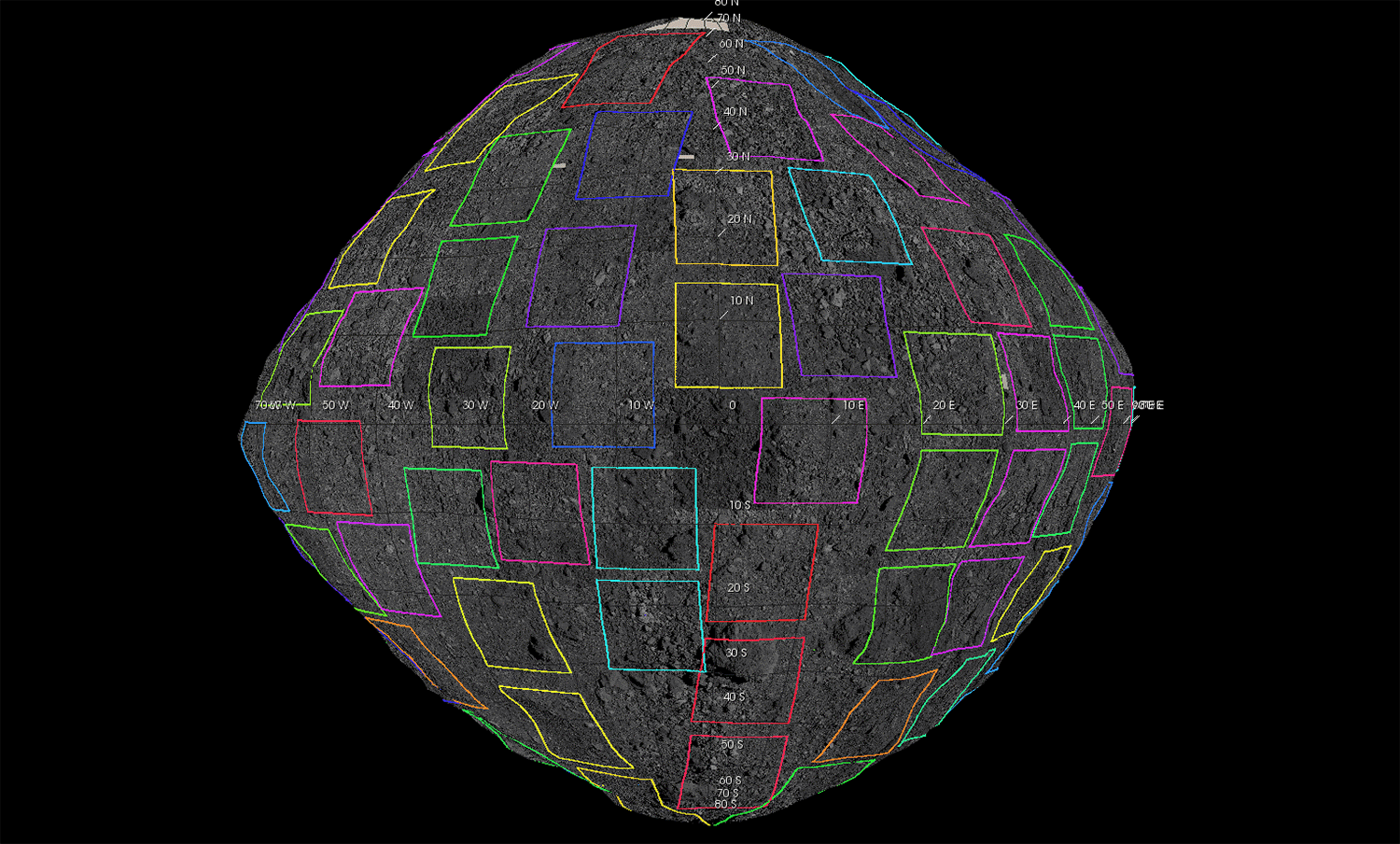
Fig. 1: Footprints of a portion of the images selected to equally represent the entire Bennu.
Results and future development
The mapped boulders have an average size of 10.02 m and a median of 9.46 m, while the clasts clearly show significantly smaller values, with an average of 0.25 m and a median of 0.18 m. The mean axial ratio between the minimum and maximum axis of the breccias is 0.68 while the one of the clasts is higher with 0.73. All these values are consistent with their formation being caused by a sudden event like an impact [13]. Nevertheless, the higher axial ratio observed in the clasts suggest a more rounded appearance. This is likely due to a distinct mechanical behavior and geological history of the clastic material compared to the surrounding breccia matrix.
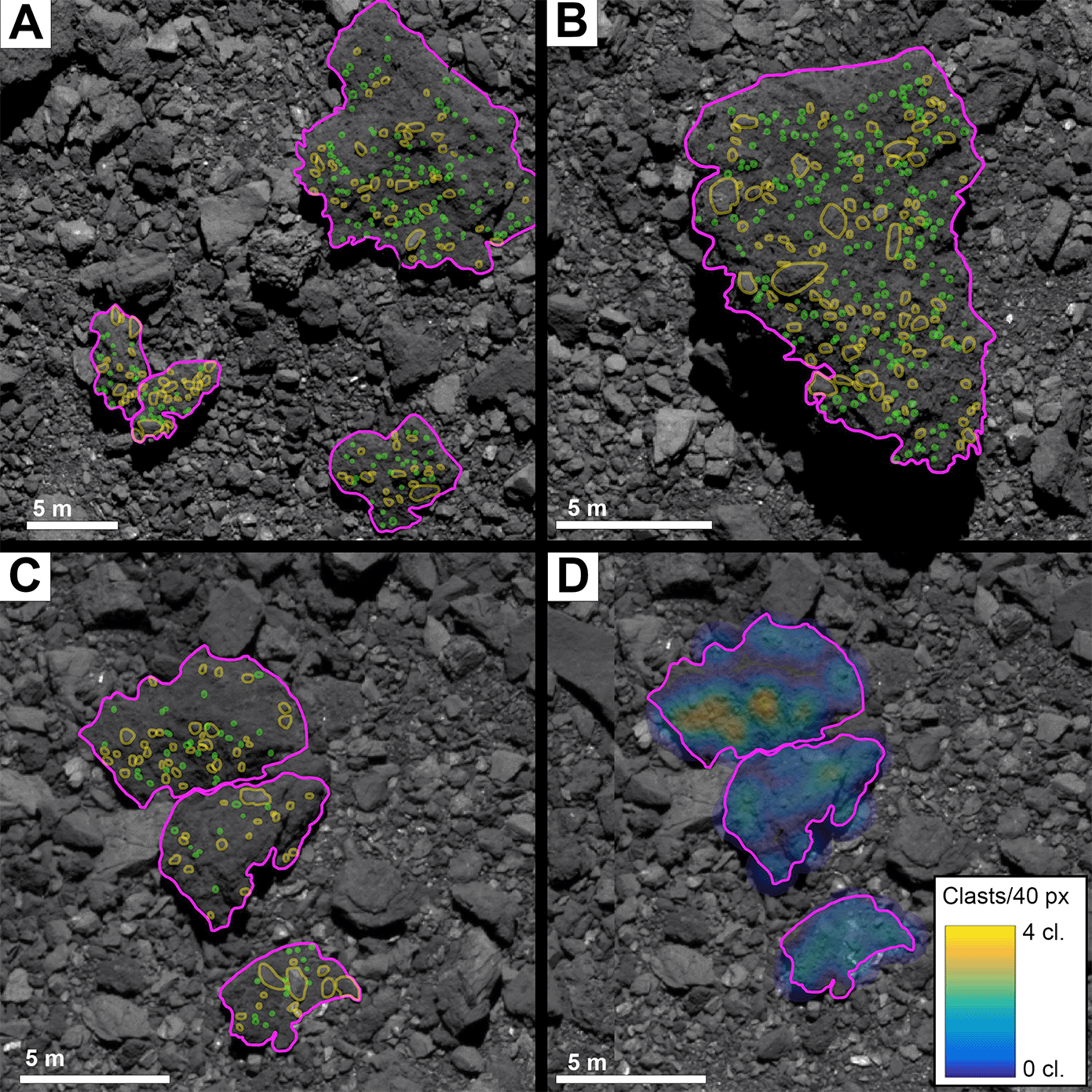
Fig. 2: (A, B, C) example of identification and manual segmentation of the breccias; (D) heatmap based on the embedded clasts shown in (C).
The clasts appear poorly sorted, since their maximum diameters range from 0.15 m to 3.17 m. Moreover, they are equally distributed among the boulders with no imbrications or specific orientation (Fig. 2). The analyzed breccias show a clasts content varying between 3% and 28% of clasts content, defining them as matrix-supported.
These results suggest that these 67 breccias originated from processes that rapidly incorporated into the finer matrix fragments of a different lithology, followed by lithification likely through long-term compaction. Nevertheless, further analyses of the clasts and boulders, like their morphometric parameters and Size Frequency Distribution, will provide deeper insights. These results, integrated with a global mapping of Bennus’ breccias, will be presented at the conference to offer a more detailed reconstruction of the potential environments on Bennu’s parent body.
Acknowledgements: This work was supported by the Istituto Nazionale di Astrofisica (INAF) with the mini grant project 2024 “Unveiling the Secrets of NEAs and Their Parent Bodies: A Surface Lithological Analysis” CUP:C93C24008020001; and from the HERA project (ASI-INAF agreement n. 2022-8-HH.0).
Reference
[1] Barnouin O. S. et al., (2019). Nature geoscience, 12(4), 247-252; [2] Lauretta D. S. et al., (2024). Meteoritics & Planetary Science, 59(9), 2453-2486; [3] Lauretta, D. S. et al., (2019). Nature, 568(7750), 55-60; [4] Walsh, K. J., et al., (2019). Nature Geoscience, 12(4), 242-246; [5] DellaGiustina D. N. et al., (2020). Science, 370(6517). [6] Jawin, E. R. et al., (2023). Journal of Geophysical Research: Planets, 128(12); [8] Merstallinger, A.et al., (2009). ESA Communication Production Office, p. 57; [9] Spray, J.G., (2016). Annu. Rev. Earth Planet. Sci. 44 (1), 139–174; [10] Bischoff A., et al., (2006). Meteorites and the Early Solar System II, pp. 679–712; [11] Beitz E. et al., (2016). Astrophys. J. 824 (12), 29 pp; [12] Ollier, C.D., (2007). Geogr. Fis. Din. Quat. 30 (1), 63–76; [13] Shukla, M.K. et al (2018). Solid Earth Sci. 3 (2), 50–59; [14] Michikami, T., et al., (2010). Icarus 207, 277–284.
How to cite: Tusberti, F., Pajola, M., Lucchetti, A., Penasa, L., Rossi, C., Munaretto, G., and Beccarelli, J.: Geological Characterization of Bennu's Breccias, Europlanet Science Congress 2026, The Hague, The Netherlands, 7–11 Sep 2026, EPSC2026-1005, https://doi.org/10.5194/epsc2026-1005, 2026.


