
- 1Technical University of Munich, Lunar and Planetary Exploration, Lise-Meitner-Str. 9, Ottobrunn D-85521, Germany
- 2Space Exploration Institute, Faubourg de l’Hôpital 68, Neuchâtel CH-2000, Switzerland
Introduction
The accuracy of calculating the mass loss of meteoroids based on optical observations depends on the accuracy of its input parameters. Currently, some, including their velocity and magnitude, can be determined with sufficient preciseness. However, the luminous efficiency is hard to determine through observations. Estimations based on observations and simulations range from 0.02% to 40% (Drolshagen, et al., 2021). Therefore, to provide better estimates of the luminous efficiency the authors propose the mission AllBert EinStein.
Proposed Mission Outline
The mission AllBert EinStein launches artificial meteoroids as a 3U CubeSat onboard a rocket to a sun-synchronous orbit. From this orbit, they are deorbited along with the upper stage. Before entering Earth’s atmosphere, they get deployed to separate from the upper stage. The following reentry is observed from an airplane fitted with multiple cameras and spectrometers. The following figure displays the different mission phases. By knowing the exact reentry velocity and all material and mass properties of the artificial meteoroids, the luminous efficiency can be derived from the observed magnitude of the meteors.

Figure 1: Mission phases based on Frühauf, et a., 2022: 1 – Launch, 2 – Target orbit, 3 – Separation of other payloads, 4 – Deorbit burn, 5 – Separation of AllBert EinStein, 6 – Reentry of AllBert EinStein, 7 – Airborne observation.
Qualification Model
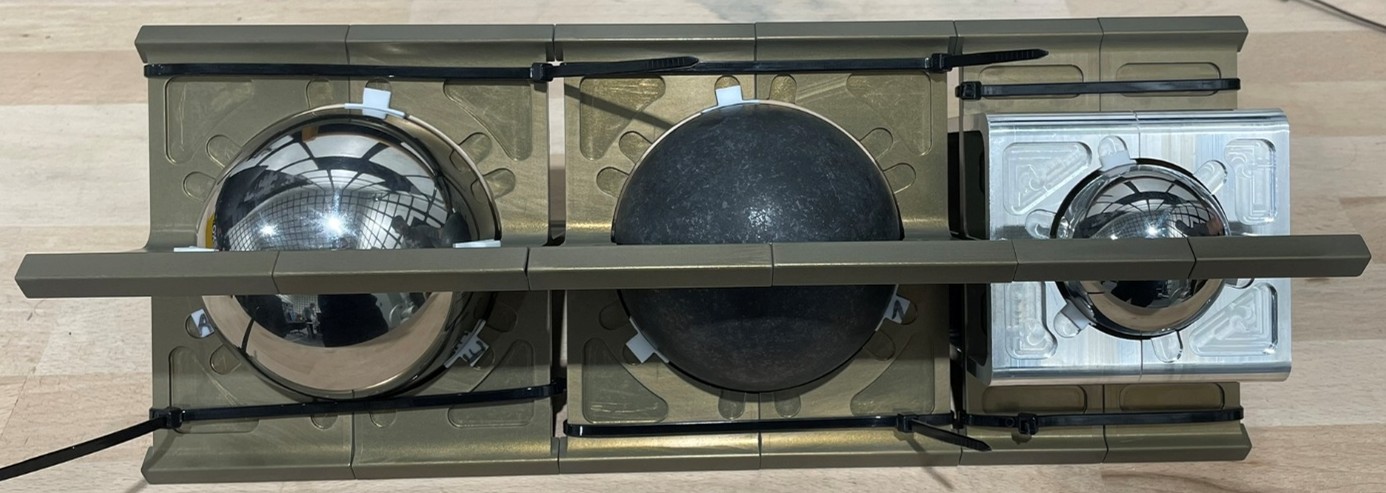
Figure 2: The AllBert EinStein CubeSat. An aluminum structure is holding four artificial meteoroids (three visible).
The payload of the proposed AllBert EinStein mission is shown in figure 2 and consists of four spheres, which are supposed to create the artificial meteors upon reentry. Two spheres are made from iron and two are made from basalt, one each with a diameter of 90 mm and 50 mm. The material is chosen to closely resemble real meteoroids. All spheres together have a mass of 4.86 kg.
To safely hold the spheres during launch, an aluminum structure is developed. To avoid any damage to the spheres by direct contact to the aluminum, spacers made from polytetrafluoroethylene (PTFE) are inserted between the spheres and the remaining structure. The structure’s outer dimensions are based on a standard 3U CubeSat structure in order to fit into any 3U deployer. To reduce friction and the risk of cold welding, all parts in direct contact to the deployer are hard anodized. The structure itself weighs 1.05 kg, leading to a total mass of the payload of 5.91 kg.
Qualification
To ensure mission success, the payload has to be qualified to withstand launch conditions. Rocket launches pose strict requirements on the load bearing capability of the payload and its eigenfrequencies. NASA has developed the standard GSFC-STD-7000A, which establishes requirements for CubeSats testing. The proposed payload has been subject to random vibration testing as required by standard GSFC-STD-7000A and sine sweeps to identify its eigenfrequencies.
To be able to conduct the shaker tests, the payload is inserted into a TestPod provided by Exolaunch GmbH. The sine sweeps show that the first response peak is at 260 Hz with an amplification of 4. This means that an externally applied acceleration of 0.1 g leads to a measured acceleration of the structure of 0.4 g.
The structure and the spheres survive the applied load equivalent of the root mean square of 14.1 g over the frequency range from 0 to 2,000 Hz with no signs of damage, as required by standard GSFC-STD-7000A. The PTFE spacers show signs of limited plastic deformation as they are clamped between the spheres and structure.
Risk Analysis
As artificial meteoroids pose the same threat to people and property on the ground as natural meteoroids, a thorough risk assessment is mandatory. For this mission, the risk assessment is carried out with the ESA tool Debris Risk Assessment and Mitigation Analysis (DRAMA) (European Space Agency, 2024). While DRAMA is originally designed for satellite parts such as thin plates, solar arrays, or rods, the authors adapted it to model solid spheres. In order to do this, the spheres are modelled as layered spheres with heat transfer between the different layers. However, DRAMA is not well-suited to assess basalt spheres as key features that occur during the reentry of stony materials, including fragmentation, are not accounted for.
The risk assessment proves that the iron spheres dissolve completely before reaching an altitude of 60 km. This does not change significantly if the target orbit cannot be reached or the reentry burn fails or does not proceed as intended. Using DRAMA despite its limitations, the large basalt sphere has an impact energy of 160 J in the worst-case scenario. However, in reality the basalt spheres are expected to ablate completely. Nevertheless, the target reentry position is chosen in a way that any remaining debris would impact south of Tasmania.
Conclusion
The proposed AllBert EinStein mission aims at improving the understanding and estimation of the luminous efficiency of meteoroids. Therefore, it launches four artificial meteoroids made of iron and basalt and observes their reentry. The developed payload is both safe and qualified to be launched.
References
Drolshagen, E., Ott, T., Koschny, D., Drolshagen, G., Vaubaillon, J., Colas, F., . . . Poppe, B. (2021). Luminous efficiency based on FRIPON meteors and limitations of ablation models. Astronomy & Astrophysics, 650, A159. Retrieved from https://doi.org/10.1051/0004-6361/202040204
European Space Agency. (2024). Debris Risk Assessment and Mitigation Analysis (DRAMA) Software User Manual. Retrieved from https://sdup.esoc.esa.int/drama/downloads/documentation/DRAMA-Software-User-Manual.pdf
Frühauf, M., Gscheidle, C., Löhle, S., Drolshagen, G., Poppe, B., Reiß, P., & Walter, U. (2022). AllBert EinStein - Eine experimentelle Studie zum Eintritt von Meteoriden in die Erdatmosphäre für planetare Abwehr und Analyse von Space Debris. Munich.
How to cite: Mansel, L., Frühauf, M., and Koschny, D.: Proposed AllBert EinStein Mission to Improve Understanding of Luminous Efficiency of Meteors, Europlanet Science Congress 2026, The Hague, The Netherlands, 7–11 Sep 2026, EPSC2026-1043, https://doi.org/10.5194/epsc2026-1043, 2026.


