
 1,2,1,3,4,1
- 1Institute of Space Research, Department of Planetary Physics, Berlin, Germany (davide.izzo@dlr.de)
- 2Delft University of Technology (TU Delft)
- 3Museum für Naturkunde Berlin
- 4Institut für Geologische Wissenschaften, Freie Universität Berlin
Introduction: Europa’s ice shell controls heat loss and surface–ocean chemical exchange, including the delivery of oxidants needed to sustain habitability-relevant redox gradients [1,2]. Whether this shell is mainly conductive or undergoes solid-state convection remains uncertain, but its dynamical state determines how efficiently material can be transported between the surface and the subsurface ocean [2]. Impacts can perturb this system by depositing heat in the shallow subsurface, locally reducing viscosity and modifying the convection pattern. In some cases, they may even promote surface-to-ocean exchange through melt migration or breaching the ice shell [3,4].
Here, we quantify the long-term thermo-chemical response of Europa’s ice shell to impact-generated anomalies. Using impact-scaling laws [5], we test how post-impact convection and material transport depend on the ice grain size, impactor radius, and impactor salinity.
Methods: We perform thermo-chemical convection simulations with the geodynamical code GAIA in a 2D cylindrical geometry [6]. The models solve the conservation of mass, momentum, energy, and composition for a 30 km ice shell thickness, with fixed temperatures of 110 K at the surface and 268 K at the ice–ocean interface. Each model is first evolved without impacts to define the background thermal state. The setup includes a composite ice rheology [7], pressure- and temperature-dependent thermal expansivity and conductivity [8,9], viscosity-dependent tidal heating [10], and grain sizes of 1 cm, 1 mm, and 0.1 mm.
Impacts are imposed at t=25 kyr as localized, lens-shaped thermal anomalies superposed on the background temperature field (Fig. 1). Rather than resolving shock propagation, excavation, and melt dynamics, we track the long-term evolution impact-induced temperature anomaly estimated from scaling laws [5,11]. We assume a vertical incidence angle, an impact velocity of 15 km/s, and impactor radii of 0.5, 1.0, and 1.8 km, consistent with studies of impact-breaching events and multiring-basin formation on Europa [4,12].
Compositional effects are modeled by advecting impactor material with a particle-in-cell method [13]. We compare passive icy impactors with ice–NaCl impactors whose density depends on salinity, set to 1, 2, and 4 times the concentration of the Earth ocean (Fig. 2). Surface mobilization is modeled through pseudo-plastic yielding: when convective stresses exceed a prescribed yield stress, the near-surface viscosity is reduced, mimicking stagnant-lid weakening or failure (Fig. 3).
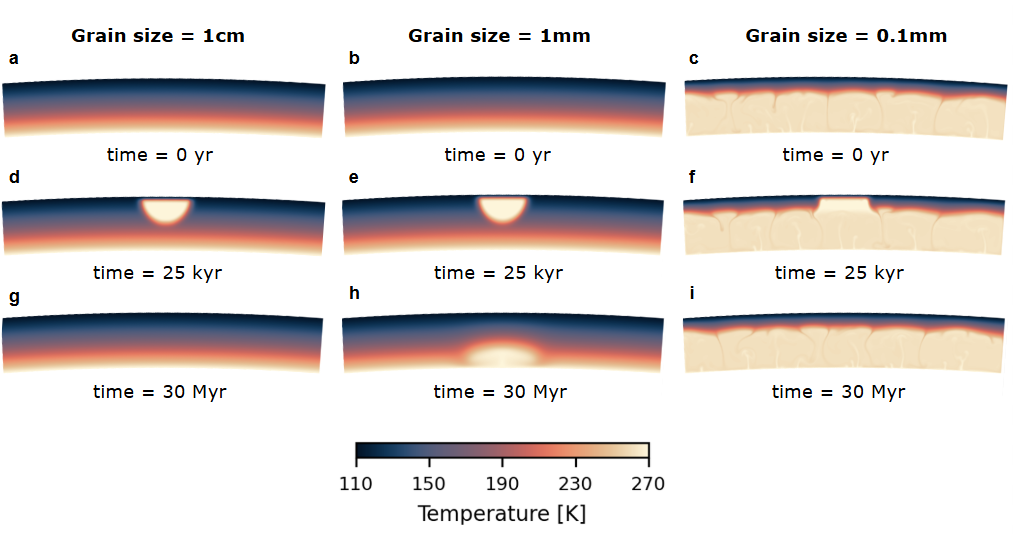
Figure 1: Grain-size control on post-impact thermal evolution for a 1.8 km icy impactor. Columns show grain sizes of 1 cm, 1 mm, and 0.1 mm; rows show the pre-impact state, the anomaly at t=25 kyr, and the final state at t=30 Myr.
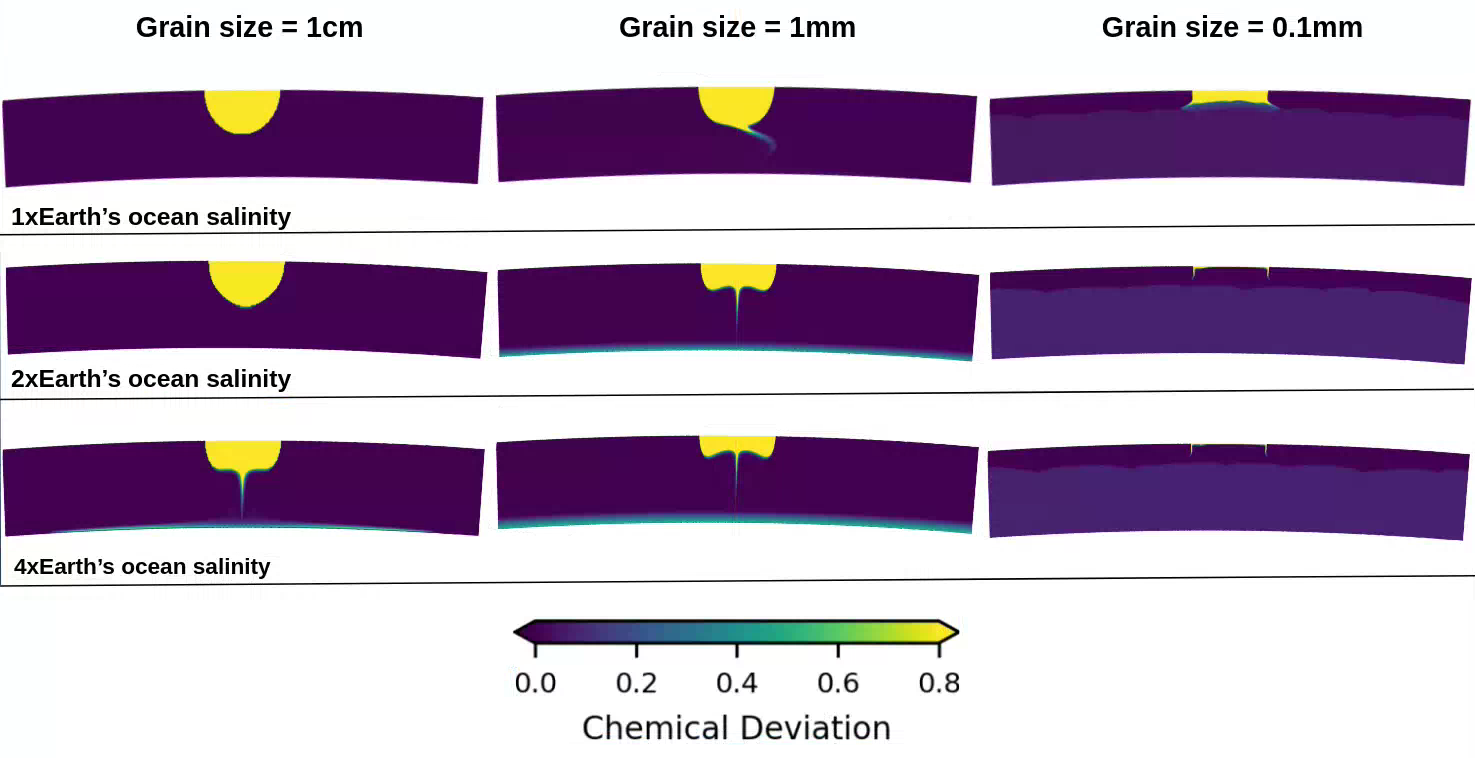
Figure 2: Grain-size and salinity effects on impactor-material redistribution. Final-time snapshots show ice–NaCl impactors for grain sizes of 1 cm, 1 mm, and 0.1 mm, and salinities of 1, 2, and 4 times the concentration of the Earth ocean.
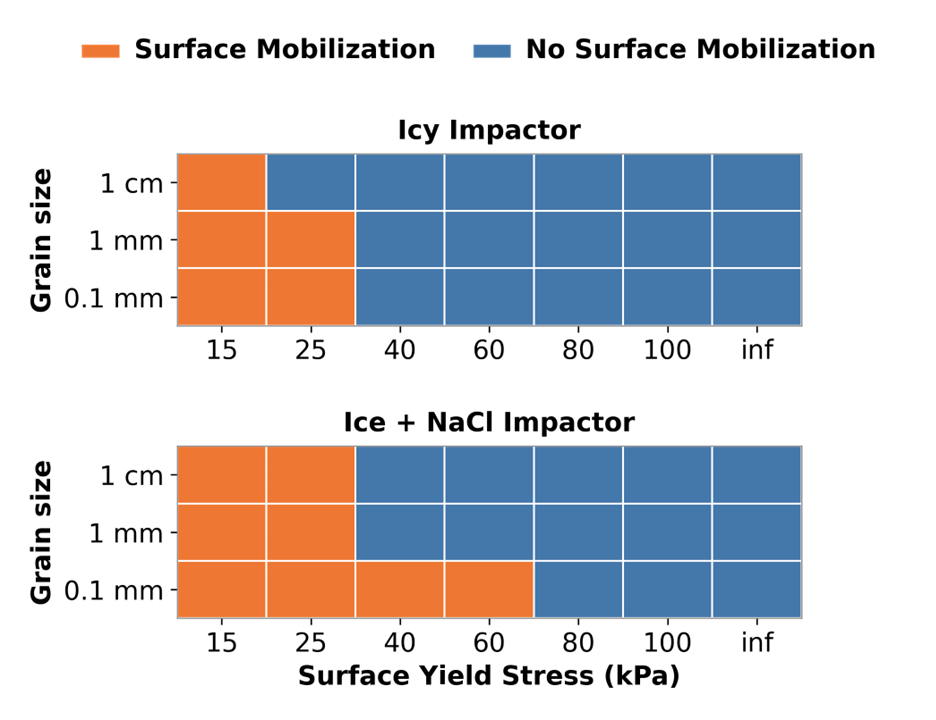
Figure 3: Surface mobilization as a function of grain size and yield stress for a 1.8 km impactor. Models are classified as mobilized when at least 5% of initially near-surface impactor material leaves its original surface region.
Results and discussion: The purely thermal models show that impact-triggered convection is most effective when the shell is close to the convective threshold. For a grain size of 1 cm, the ice shell remains mostly conductive and the anomaly dissipates without initiating convection. For a grain size of 1 mm, a 1.8 km impactor generates a long-lived plume and raises the shell velocity toward ~3 cm/yr. For an already convective ice shell (grain size of 0.1 mm), the impact signal is absorbed into the background flow (Fig. 1).
The thermo-chemical cases show that salinity changes both the amount and the style of material redistribution. For the intermediate grain sizes of 1 mm, material mixed below the initial anomaly depth increases from <1% of the shell volume at 1× Earth-Ocean (EO) salinity, to ~2–4.5% at 2×EO salinity, and ~5–7% at 4×EO salinity. However, the dynamical response also changes: at 1×EO salinity, sinking impactor material displaces the impact-triggered plume, whereas at 2 and 4×EO salinity the denser anomaly suppresses plume development. In the highly convective cases (grain size of 0.1 mm), the volume of mixed material reaches ~10–13% of the total ice shell volume, with little dependence on salinity; higher salinity mainly delays homogenization within the convective layer rather than increasing the final mixed volume (Fig. 2).
Surface mobilization tests use yield stresses of 15–100 kPa plus a no-yield endmember, bracketing weak effective lithospheric strengths inferred from Europa cycloids and pseudo-plastic/fatigue arguments [14–16]. Thermal-only impacts mobilize the surface only for small yield stress values, whereas thermo-chemical impacts promote mobilization at higher yield stresses, suggesting that dense salt-bearing material can enhance stagnant-lid weakening and vertical exchange (Fig. 3).
Outlook: Future work will first use the modeled temperature and salinity variations to estimate their gravity signatures and assess whether impact-related structures could be relevant to Europa Clipper and JUICE observations [17–19]. We will then extend the models from single impacts to impact sequences based on published Europa impact-flux estimates, testing how repeated events affect heating, salt transport, and surface weakening. Finally, the geodynamic models will be combined with shock-physics impact models to better link imposed thermal anomalies to the impact process itself.
References: [1] Hand et al. (2007). [2] Vance et al. (2018). [3] Carnahan et al. (2022). [4] Cox and Bauer (2015). [5] Melosh (1989). [6] Hüttig et al. (2013). [7] Goldsby and Kohlstedt (2001). [8] Feistel and Wagner (2006). [9] Wolfenbarger et al. (2021). [10] Tobie et al. (2003). [11] Reese et al. (2002). [12] Wakita et al. (2024). [13] Plesa et al. (2015). [14] Hoppa et al. (1999). [15] Showman and Han (2005). [16] Hammond et al. (2018). [17] Pappalardo et al. (2024). [18] Roberts et al. (2023). [19] Van Hoolst et al. (2024).
How to cite: Izzo, D., Plesa, A.-C., Dai, K., Santangelo, S., Wünnemann, K., and Hussmann, H.: The Role of Impacts for Europa's Ice Shell Dynamics and Surface-to-Ocean Material Exchange, Europlanet Science Congress 2026, The Hague, The Netherlands, 7–11 Sep 2026, EPSC2026-1051, https://doi.org/10.5194/epsc2026-1051, 2026.


