
 1,1
1,1- 1Institut für Geologische Wissenschaften, Freie Universität Berlin, Berlin, Germany (melih.cakar@fu-berlin.de)
- 2Earth-Life Science Institute (ELSI), Institute of Science Tokyo, Tokyo, Japan
Enceladus is one of the most compelling targets for habitability investigations due to the dynamic interplay between its porous rocky core and the overlying ocean (Waite et al., 2017 ; Choblet et al., 2017). Hydrothermal percolation through the core drives continuous water-rock interaction and facilitates the leaching of biologically relevant elements (Hsu et al., 2015 ; Waite et al., 2017) and potentially insoluble and soluble organic matter (Postberg et al., 2018; Khawaja et al. 2019, 2025). It has recently been demonstrated that complex physicochemical exchanges occur in the ice vents above the water table, where varying freezing of large liquid droplets, differential salt fractionation, and mechanical fragmentation through repeated wall collisions within narrow ice vents can collectively govern the composition and size distribution of the ice grains ultimately ejected into the plume, supported by both experimental laboratory simulations and thermodynamic modelling (Postberg et al. 2026, Science Advances, in review).
Evidence suggests that organic-enriched ice grains form primarily through film or bubble bursting at the ocean surface, where a thin layer of refractory, organic material accumulating at the oceanic water table is dispersed by ascending gas bubbles, generating organic-rich droplets alongside salty water aerosols (Postberg et al., 2018). Aqueous mixtures of salts and soluble organic matter exhibit complex behavior upon freezing, including mutual interactions that influence partitioning, yet this phenomenon remains unexplored in the context of Enceladus-relevant systems at the droplet scale. Here we investigate how dissolved organic compounds influence salt partitioning and their own spatial localization within frozen droplets. Our study evaluates these effects under two contrasting freezing regimes (slow vs. flash freezing) and across varying droplet size, revealing also how thermal kinetics and scale dictate the salt-organics structure. To systematically probe the role of molecular structure and functional group chemistry, we selected representatives spanning key organic classes with different moieties: Glycine as an amino acids, Glycerol as a polyol, and 2,3-dihydroxybenzoic acid (DHBA) as an aromatic model, offering a structural parallel to the complex heterocyclic, N-bearing and O-bearing species recently characterized in Enceladus’ ice grains (Khawaja et al., 2025). Spatial correlations between organic matrices and salts were established via a multi-modal imaging approach; high-resolution Raman micro-mapping identified organic domains, whereas subsequent EPMA provided the high-sensitivity elemental distributions required to delineate salt deposition sites.
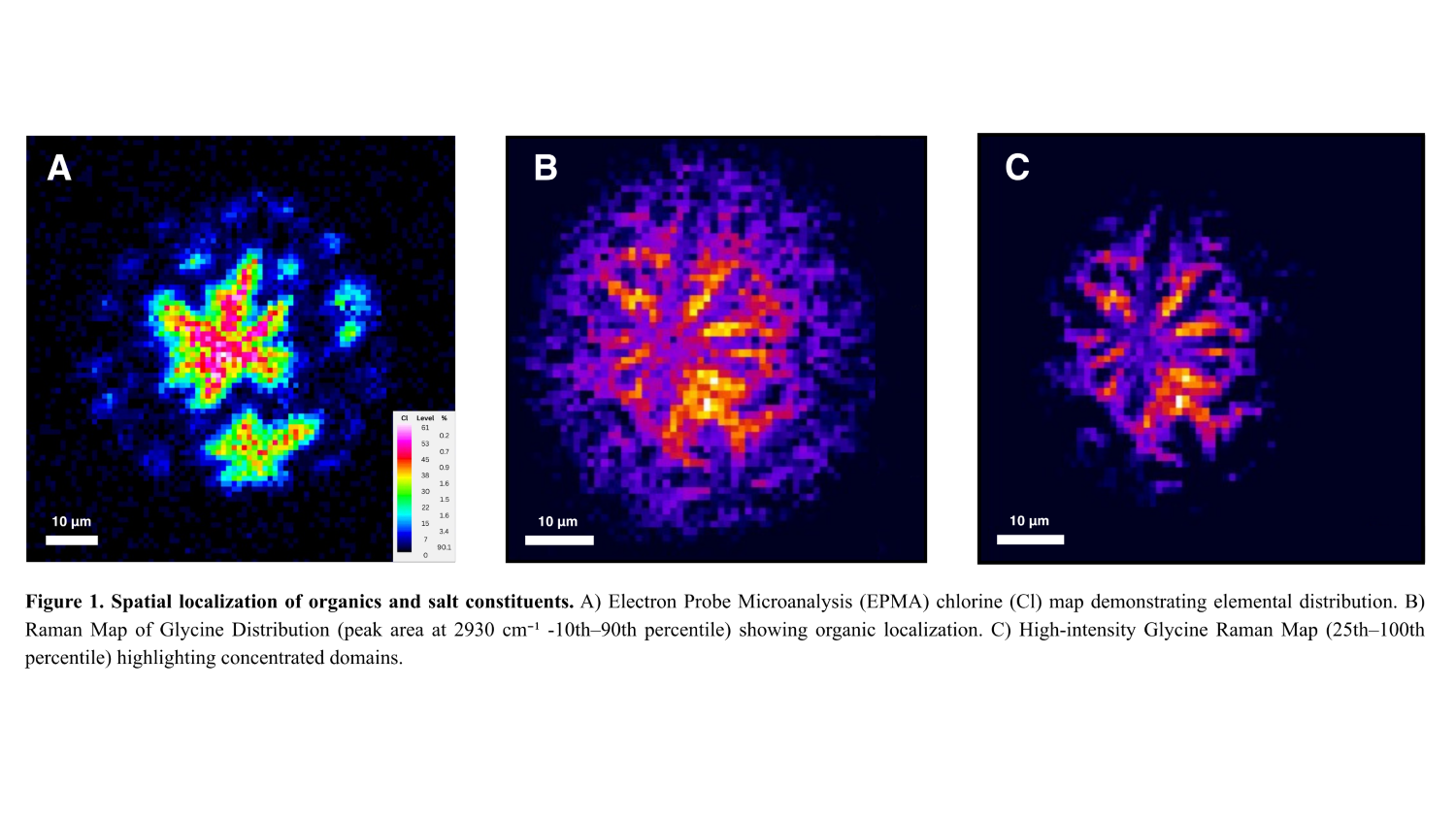
Our results demonstrate that the molecular nature of these organics significantly dictates both salt partitioning and their own spatial localization during freezing. Figure 1 illustrates the behavior of a slow-freezed Glycine-bearing salt matrix. The progressive precipitation of salts concluding with NaCl due to its low eutectic point, induces a marked brine rejection effect, systematically partitioning the amino acids into the diminishing liquid phase. As halite crystals formed, their rigid inorganic lattices rejected the larger organics molecules, leading to a marked cryoconcentration of these compounds within the residual high salinity brine. Consequently, just prior to total solidification at the eutectic point, the organic matter became localized and concentrated at the interfacial margins and grain boundaries of the NaCl crystals since EPMA results also colocalize Na and Cl in these regions. This spatial distribution suggests that the organic fractions mainly remained mobile within the interstitial brine until the final stages of thermal transition, resulting in their eventual entrapment as peripheral inclusions. The same physical phenomenon is also observed with Cysteine amino acid containing analogue droplets in similar sizes, implying this physical positioning can be a common fate for amino acids during freezing.
Our results demonstrate that freshly ejected NaCl-rich grains from wall-collisions would preferentially preserve - or even concentrate - amino acids, thereby representing high-priority sampling targets for future in situ missions to Enceladus. Notably, 2,3-DHBA and glycerol exhibited strikingly distinct partitioning patterns under identical conditions, raising intriguing questions about whether molecular structure and functional group chemistry not only govern organic sequestration in icy grain matrices, but also actively shape the salt crystallization environment itself.
References:
Choblet, G., Tobie, G., Sotin, C., Běhounková, M., Čadek, O., Postberg, F., & Souček, O. (2017). Powering prolonged hydrothermal activity inside Enceladus. Nature Astronomy, 1(12), 841–847. https://doi.org/10.1038/s41550-017-0289-8
Hsu, H.-W., Postberg, F., Sekine, Y., Shibuya, T., Kempf, S., Horányi, M., Juhász, A., Altobelli, N., Suzuki, K., Masaki, Y., Kuwatani, T., Tachibana, S., Sirono, S., Moragas-Klostermeyer, G., & Srama, R. (2015). Ongoing hydrothermal activities within Enceladus. Nature, 519(7542), 207–210. https://doi.org/10.1038/nature14262
Khawaja, N, Postberg, F., Hillier, J., Klenner, F., Kempf, S., Nölle, L., Reviol, R., Zou, Z., & Srama, R. (2019). Low-mass nitrogen-, oxygen-bearing, and aromatic compounds in Enceladean ice grains. Monthly Notices of the Royal Astronomical Society, 489(4), 5231–5243. https://doi.org/10.1093/mnras/stz2280
Khawaja, Nozair, Postberg, F., O’Sullivan, T. R., Napoleoni, M., Kempf, S., Klenner, F., Sekine, Y., Craddock, M., Hillier, J., Simolka, J., Hortal Sánchez, L., & Srama, R. (2025). Detection of organic compounds in freshly ejected ice grains from Enceladus’s Ocean. Nature Astronomy, 9(11), 1662–1671. https://doi.org/10.1038/s41550-025-02655-y
Postberg, F., Khawaja, N., Abel, B., Choblet, G., Glein, C. R., Gudipati, M. S., Henderson, B. L., Hsu, H.-W., Kempf, S., Klenner, F., Moragas-Klostermeyer, G., Magee, B., Nölle, L., Perry, M., Reviol, R., Schmidt, J., Srama, R., Stolz, F., Tobie, G., … Waite, J. H. (2018). Macromolecular organic compounds from the depths of Enceladus. Nature, 558(7711), 564–568. https://doi.org/10.1038/s41586-018-0246-4
Postberg, F., Zou, Z., Sekine, Y., Koga, M., Schmidt, J., Fox-Powell, M., Klenner, F., Hillier, J. K., Khawaja, N., Kadono, T., Çakar, M., Kempf, S., & Srama, R. (2026). Cassini CDA observes compositional diversity in Enceladus' ice grains from slow freezing and fragmentation of oceanic spray. Science Advances. (accepted)
Waite, J. H., Glein, C. R., Perryman, R. S., Teolis, B. D., Magee, B. A., Miller, G., Grimes, J., Perry, M. E., Miller, K. E., Bouquet, A., Lunine, J. I., Brockwell, T., & Bolton, S. J. (2017). Cassini finds molecular hydrogen in the Enceladus Plume: Evidence for hydrothermal processes. Science, 356(6334), 155–159. https://doi.org/10.1126/science.aai8703
How to cite: Çakar, M., Koga, M., Sekine, Y., and Postberg, F.: Mapping Salts and Soluble Organic Matter in Enceladus Analog Ice Grains: Implications for In-Situ Plume Analysis, Europlanet Science Congress 2026, The Hague, The Netherlands, 7–11 Sep 2026, EPSC2026-1088, https://doi.org/10.5194/epsc2026-1088, 2026.


