
 1,2,1,3,2,1
- 1LIRA, Observatoire de Paris, Université PSL, Sorbonne Université, Université Paris Cité, CY Cergy Paris Université, CNRS, Meudon, France (cassandre.chaudesaygues@obspm.fr)
- 2INAF, Astrophysical Observatory of Arcetri, Firenze, Italy
- 3JAXA, Japan Aerospace Exploration Agency, Tokyo, Japan
Introduction
Laboratory measurements in the NIR range allow the detection of spectral signatures, which depend on the structural arrangement and composition of the mineral. In this spectral range, the reported absorption bands indicate vibrational modes (bending, stretching and combination of harmonics) in the minerals [1]. In the case of carbonates and organics, the distinction between those classes can become difficult as their overtones overlap in the 3.2 – 3.6 µm range [2], [3]. The goal of this study is to investigate the relevance and ability of spectral analyses that would provide the contribution of each component and distinguish one from another on the spectra.
Moreover, in the context of the JAXA Martian Moons eXploration (MMX) mission which will be launched in autumn 2026 to investigate on the Martian moons, those minerals are potential candidates of their composition and could then be observed by the MMX Infrared Spectrometer (MIRS) operating in the 0.9 – 3.6 µm range. Their presence would provide important information on the moons’ composition and help constraining their origin [4]. The engineering model of MIRS (EM1) is available at the LIRA – Paris Observatory to support the mission and ground calibration. The EM1 will also be part of the instruments used for this study. This work will help to prepare and optimize the future observations.
Method
To investigate the effects of the contribution of each component, we prepared three series of mixtures of carbonates (dolomite), organics (mix of acids containing aliphatic and aromatic chains), serpentine (antigorite) and dark component (synthetic iron oxide) at INAF – Arcetri Observatory (Italy).
The first series OCS (Organics Carbonates Series) consisted in varying carbonates and organics mixed with a fixed quantity of serpentine to evaluate the bands position depending on the minerals’ interaction. The second series SDS (Serpentine Dark component Series) consisted in mixing fixed and identical amount of carbonates and organics with varying quantities of serpentine and dark component to evaluate the influence of the darkening of a sample on the band depth. The last one SENS (SENsitivity Series) was to mix small quantities of organics and carbonates with serpentine to evaluate the sensitivity of the EM1 and its ability to detect those components. We measured the mixtures and endmembers with three instruments; Bruker VERTEX 70v at INAF, the Bruker Invenio R and EM1 both in LIRA. In this work, we present the results from the VERTEX 70v spectrometer.
For the band analysis, based on the principle that one absorption band can be represented by a gaussian function, or the sum of several gaussian functions [5], we used a Gaussian fitting band program to retrieve the parameters of the absorption bands for each mineral and each mixture. The amplitude, standard deviation and mean of the gaussian function would correspond to the depth, the width, and the centre of the band, respectively. We first applied the method to the endmembers helped by literature [2], [3], [6], [7], then to the mixtures. We used chi-squared method and Z-test to compare the parameters found between the mixtures and the well-known pure endmembers.
Results
The obtained spectra are presented in Figure 1. We retrieved the overtones got from the fit for each mixture. We focus here on the OCS series also displayed on Figure 2, where it shows a non-linear evolution in the spectra, with a possible lower level of sensitivity for the organics than for the carbonates. We focused on the location of the bands to perform the fits and we show one example on the OCS-MIX05 corresponding to a composition of 100% carbonates and 0% organics.
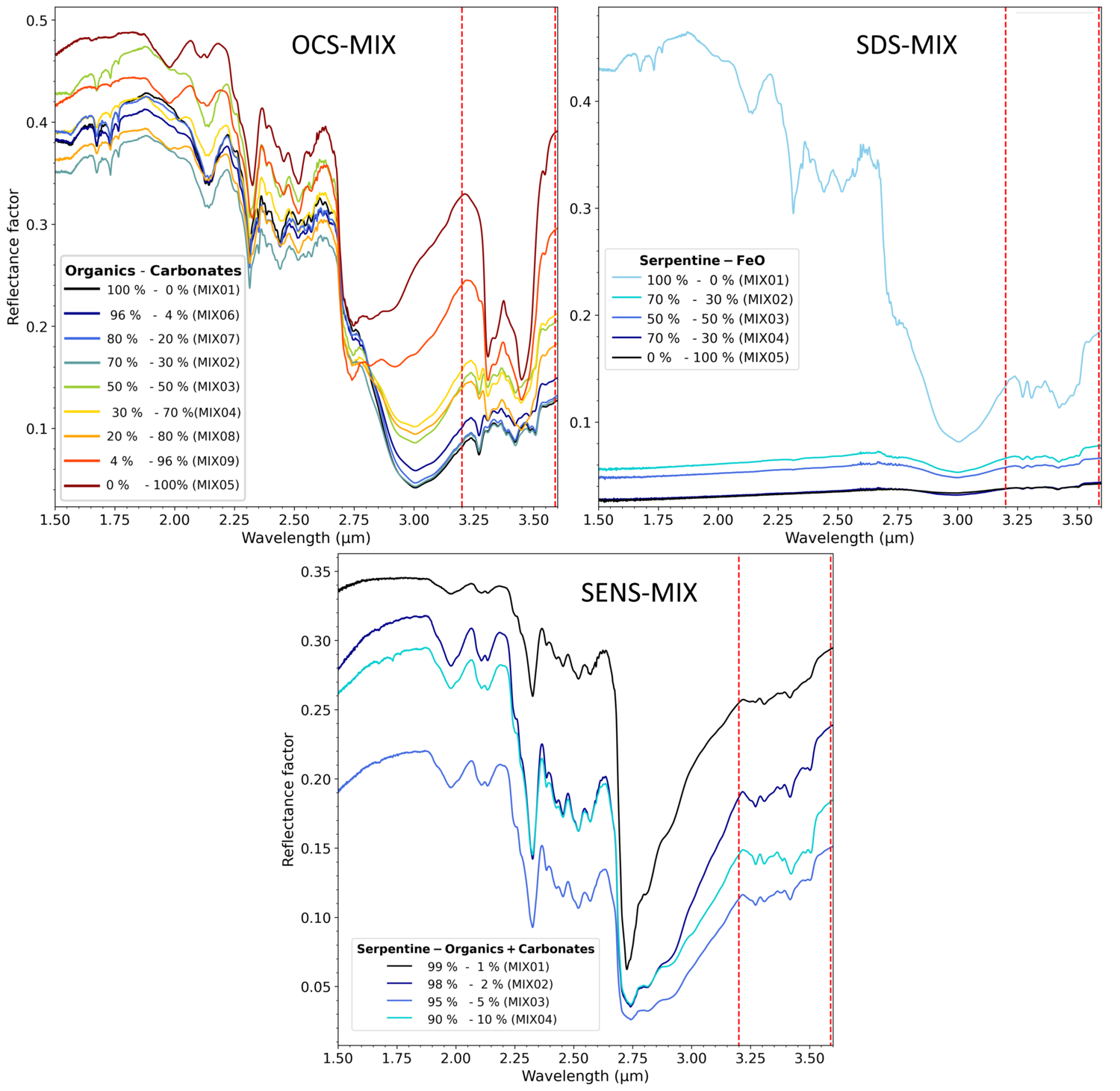
Figure 1: spectra of the OCS (up, left), SDS (up, right), and SENS (down) series. The region of interest (3.2 – 3.6 µm) is shown with red dashed lines. The spectra were obtained in Arcetri.
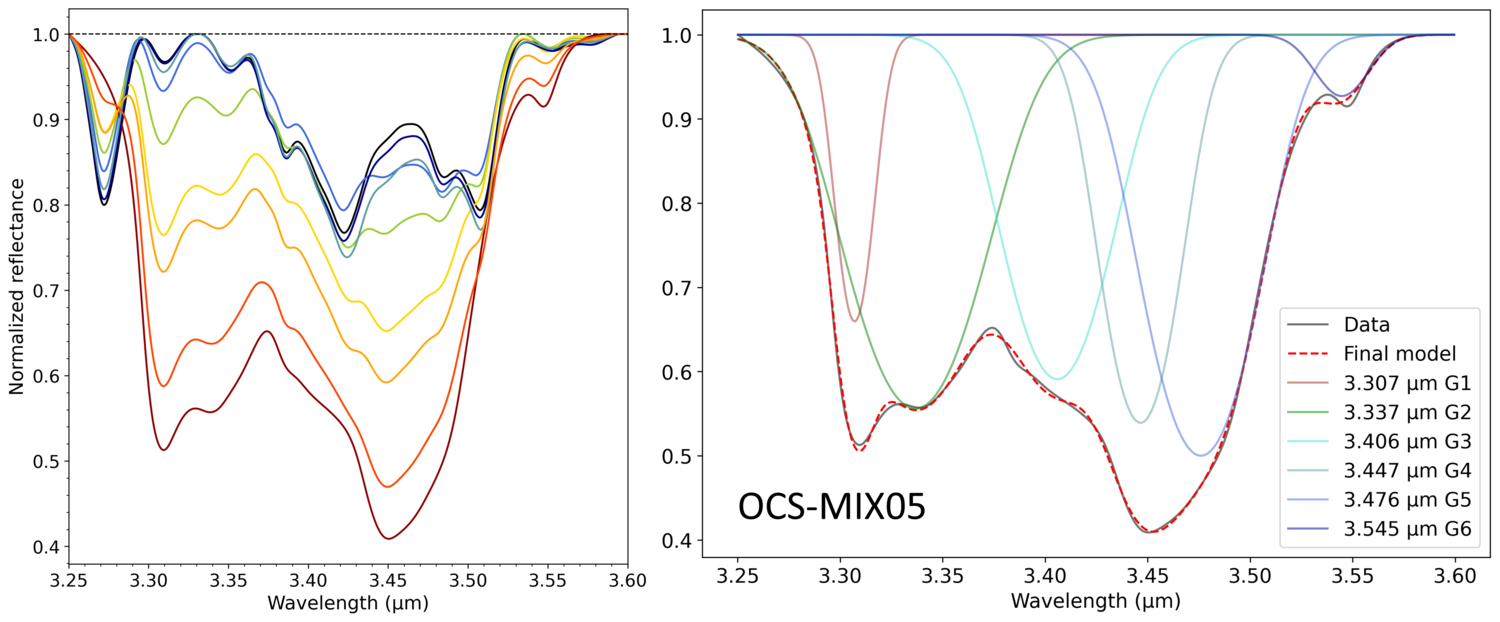
Figure 2: normalized spectra in the 3.2 – 3.6 µm range of the OCS series (left), using the same colour code as in Figure1 and gaussian fit on the normalized spectrum of OCS-MIX05 (right).
Our first results indicate complex interactions between multiple absorptions in this wavelength range. The complete analysis will be presented and discussed.
Acknowledgements
MIRS is built at Paris Observatory in collaboration with CNES and close collaboration with JAXA and MELCO. MMX is developed and built by JAXA, with contributions from CNES, DLR, ESA and NASA. We thank the MMX JAXA teams for their efforts and CNES for the financial support.
Bibliography
[1] G. R. Hunt, « Spectral signatures of particulate minerals in the visible and near infrared », Geophysics, vol. 42, no 3, p. 501‑513, avr. 1977, doi: 10.1190/1.1440721.
[2] E. A. Cloutis, S. E. Grasby, W. M. Last, R. Léveillé, G. R. Osinski, et B. L. Sherriff, « Spectral reflectance properties of carbonates from terrestrial analogue environments: Implications for Mars », Planetary and Space Science, vol. 58, no 4, p. 522‑537, mars 2010, doi: 10.1016/j.pss.2009.09.002.
[3] L. V. Moroz, G. Arnold, A. V. Korochantsev, et R. Wäsch, « Natural Solid Bitumens as Possible Analogs for Cometary and Asteroid Organics »:, Icarus, vol. 134, no 2, p. 253‑268, août 1998, doi: 10.1006/icar.1998.5955.
[4] M. A. Barucci et al., « MIRS: an imaging spectrometer for the MMX mission », Earth Planets Space, vol. 73, no 1, p. 211, déc. 2021, doi: 10.1186/s40623-021-01423-2.
[5] J. M. Sunshine, C. M. Pieters, et S. F. Pratt, « Deconvolution of mineral absorption bands: An improved approach », J. Geophys. Res., vol. 95, no B5, p. 6955‑6966, mai 1990, doi: 10.1029/JB095iB05p06955.
[6] R. N. Clark, T. V. V. King, M. Klejwa, G. A. Swayze, et N. Vergo, « High spectral resolution reflectance spectroscopy of minerals », J. Geophys. Res., vol. 95, no B8, p. 12653‑12680, août 1990, doi: 10.1029/JB095iB08p12653.
[7] V. Vinogradoff et al., « Laboratory Investigations Coupled to VIR/Dawn Observations to Quantify the Large Concentrations of Organic Matter on Ceres », Minerals, vol. 11, no 7, p. 719, juill. 2021, doi: 10.3390/min11070719.
How to cite: Chaudesaygues, C., Barucci, A., Merlin, F., Poggiali, G., Yumoto, K., Alberini, A., and Sultana, R.: Laboratory measurement in the 3.2 – 3.6 µm range of carbonates – organics to investigate their contribution., Europlanet Science Congress 2026, The Hague, The Netherlands, 7–11 Sep 2026, EPSC2026-109, https://doi.org/10.5194/epsc2026-109, 2026.


