
 ,,
,,- University of Oxford, Atmospheric, Oceanic and Planetary Physics, Oxford, United Kingdom of Great Britain – England, Scotland, Wales (sarah.howes@physics.ox.ac.uk)
Introduction
The presence of endogenic hotspots provides a measure of the level of geologic activity of icy moons, since they are indicative of ongoing resurfacing processes. However, to avoid misinterpreting thermal abnormalities, it is first necessary to understand passive thermal emission that is governed by the physical structure of materials. Two important thermophysical properties in such analysis are bolometric Bond albedo and thermal inertia: if diurnal temperature variations can be accurately modeled by adjusting these two parameters, a passive rather than endogenic origin is possible. In this work, we aim to constrain the thermal inertia and Bond albedo across the surfaces of Europa, Ganymede, and Callisto using brightness temperature observations recorded by the Galileo Photopolarimeter-Radiometer (PPR) instrument [1]. By presenting estimated values and their uncertainties for these thermophysical properties, we prepare for future thermal measurements carried out by both Europa Clipper and JUICE.
Methods
We first take average diurnal temperatures of the surfaces of Europa, Ganymede, and Callisto using brightness temperatures recorded by PPR. In this analysis, we use 29 datasets for Europa, notably increased beyond previous efforts [2], comparable to [3]. With less observations available, only 7 datasets each were used for both Ganymede and Callisto.
By translating the observed radiance into brightness temperatures, the variation in temperature with local time is determined for latitude and longitude bins across each of the three moons. These diurnal curves are compared to those predicted by a 1-D thermal model [4] to determine what thermal inertias and Bond albedos can fit the data within a reduced chi-squared cut-off of χ2red ≤1.0. This analysis is used to extensively quantify the uncertainty of the two thermophysical parameters derived from PPR data.
Results
Europa: Ensuring closed upper and lower limits within our χ2red cut-off, we map albedo and thermal inertia for 33% and 24% of Europa's surface area into 6°x6° latitude/longitude bins (Fig. 1, left). We find a range of 0.375-0.75 for albedo and 20-110 J m-2 K-1 s-1/2 (MKS) for thermal inertia, agreeing with [2] and [3]. Our uncertainty analysis indicates well-constrained estimates for albedo, with the average higher and lower ranges overlapping within their uncertainties: Ahigh = 0.11 ± 0.06 and Alow = 0.18 ± 0.12. Uncertainties for thermal inertia remain poorly constrained, with average higher and lower ranges being Γhigh = 103(+153/-103) MKS and Γlow = 17 ± 9 MKS.
Ganymede: Due to less available surface coverage, Ganymede’s surface is divided into 18°x6° longitude/latitude bins in order to meet the diurnal fitting routine requirements (Fig. 1, right). Preliminary results indicate the Bond albedo remains nearly uniform, with an average of 0.42 ± 0.07 across the surface and agreeing well with previous work [6]. Specifically, our χ2red-deduced higher and lower uncertainty ranges of albedo are: Ahigh = 0.10 ± 0.06 and Alow = 0.14 ± 0.08. No apparent distinct surface variations in thermal inertia are as of yet discerned, with global values distributed across a range of 20-70 MKS. Upper limit thermal inertia estimates align with [6] within χ2red-deduced uncertainty ranges of Γhigh = 57 ± 35 MKS and Γlow = 25 ± 11 MKS.
Callisto: With less PPR coverage available, Callisto fits are performed across grouped hemispheric regions, where the Jovian and anti-Jovian hemispheres are analyzed separately. Each hemisphere is divided into 10° latitude strips. Preliminary results for thermal inertia and Bond albedo indicate an overall agreement with lower-bound estimations from previous literature [5,6]. Further constraints are expected to be obtained at the time of the conference.
Conclusion
These results give an indication of the albedo and thermal inertia variation across Europa, Ganymede and Callisto. They aid in preparing for the arrival of Europa Clipper and JUICE to the Jupiter system by improving estimates for passive surface thermal properties and providing uncertainties of their values. This will enable future work to help discern what temperatures may lie above those expected from passive emission alone, providing a critical first step in the search for endogenic heating anomalies. Future work aims to refine the Ganymede and Callisto calculations using a two-component (ice and non-ice) analysis, and characterize the causes behind thermal inertia variations by modeling microphysical ice states for the three Galilean moons.
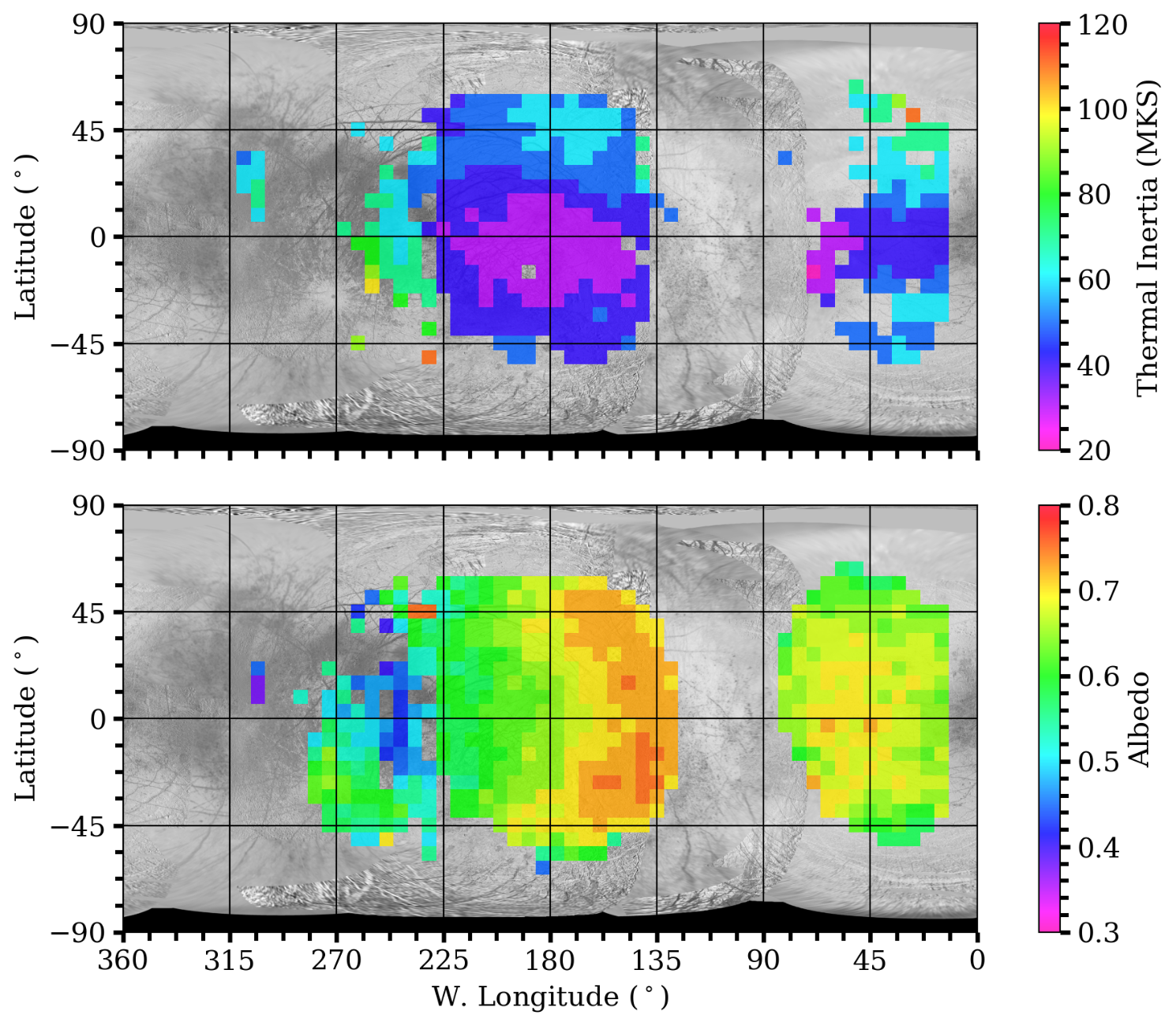
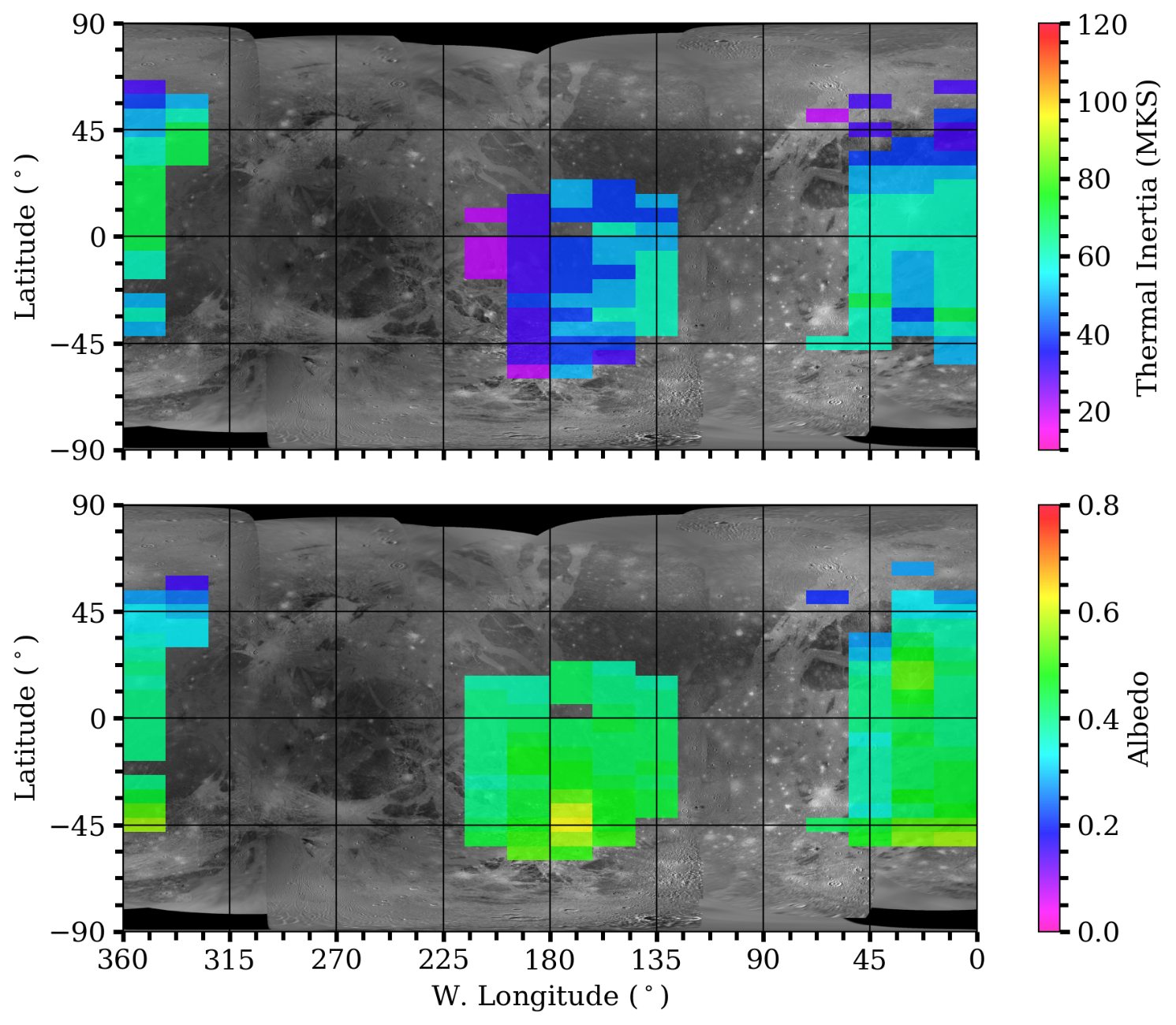
Fig. 1: Thermal Inertia (top) and Bond albedo (bottom) map of Europa (left) and preliminary results for Ganymede (right).
[1] Russell, E.E. et al., 1992. Space Sci Rev 60, 531-563.; [2] Rathbun, J.A. et al., 2010. Icarus 210, 763-769.; [3] Lange, L. et al., 2026. arXiv:2604.14374; [4] Lyster, D. et al., 2025. pp. EPSC-DPS2025-1479; [5] Meyer, C. et al., 2026. Planet. Sci. J. 7, 10; [6] Spencer, J.R. et al., 1989. Icarus 78(2), 337-354.
How to cite: Howes, S., Howett, C., and Lyster, D.: Galileo PPR Thermal Inertia & Albedo Measurements of Europa, Ganymede and Callisto, Europlanet Science Congress 2026, The Hague, The Netherlands, 7–11 Sep 2026, EPSC2026-1104, https://doi.org/10.5194/epsc2026-1104, 2026.


