
 1,1,1,
- 1CNRS, LGL-TPE, ENS de Lyon, Lyon, France (giorgia.confortini@ens-lyon.fr)
- 2Nantes Université, Planetologie et Geosciences, Nantes, France
Trans-Neptunian Objects (TNOs) hold valuable clues about planetary formation processes. Recent spectroscopic observations of their surfaces indicate that they host C–O–H species, including CO2, H2O, CH4, and complex organic molecules, suggesting the possibility of substantial internal carbon reservoirs. JWST observations of TNOs up to 800 km in diameter show surface ices that include carbon-bearing species such as CO2, CO, CH3OH, and complex organic molecules (Pinilla-Alonso et al., 2024). Although surface compositions vary, no systematic trend with object size suggests that these variations are dominated by surface processes.
The surface compositions of larger TNOs display strong methane bands in addition to H2O ice and CO2 (Brown, 2012), and recent hydrogen and carbon isotopic measurements of CH4 on Eris and Makemake suggest an internal origin for these species (Grundy et al., 2024). The bulk densities of icy moons and dwarf planets support the idea that their refractory cores contain a mixture of CI chondrite and carbonaceous material, reinforcing the idea that carbon-bearing molecules at their surfaces may originate from internal activity.
In this study, we use thermodynamic modeling with Perple_X (Connolly, 2005) to investigate carbon speciation and fluid–mineral equilibria within TNO interiors under hydrated conditions. Models were computed over a wide range of oxygen fugacity (logfO2= −10 to −50) and P–T conditions representative of TNO interiors (300–1300 K, 1–7000 bar), assuming a CI elemental composition with carbon content varying from a saturated to a less carbon-enriched system. The internal temperature of TNOs is derived from a thermal model of mid- and large-sized TNOs, Charon and Pluto, assuming 23% leaching of radioactive elements at a differentiation time of 500 Myr. These results are coupled with those from a kinetic model of carbonaceous matter evolution KIMCAM-E (Delarue et al., 2026) to constrain the evolution of metamorphic fluid composition with temperature and size.
The results for the core composition of carbon-saturated systems reveal that at high fO2 and low temperatures, carbonates and hydrated minerals are stable, whereas at lower fO2 and higher temperatures, hydrated minerals are no longer stable and carbon is progressively reduced to graphite. Pressure does not significantly influence these transitions, whereas changes in oxygen fugacity and temperature strongly affect the gas species released from the mineral assemblage into metamorphic fluids. Specifically, the results for COH fluid composition reveal that at high temperatures and in carbon-saturated systems, reduced phases such as methane are stable, while at lower temperatures, oxidized species and CO2 are favored, consistent with the kinetic model. If the carbon content is decreased, methane is replaced by hydrogen-rich fluids, while carbon dioxide is replaced by water-rich fluids.
The predicted metamorphic evolution of mineral assemblages shows that the internal composition is directly reflected in fluid composition, which may eventually reach the surface and form the ice observed on TNOs. By constraining the internal core temperature from thermal models, conditions for TNO interiors can be projected onto phase diagrams derived from the Perple_X thermodynamic model in order to derive their mineralogy, and the fluids generated (figure). The temperature of the core is a function of object size; the larger the TNO, the higher the temperature it can reach for a given composition. As shown by the line of evolution, as temperature—and thus core size—increases, the core composition and fluids become more reduced.
Small TNOs (typically <800 km in diameter) have cold cores and high oxygen fugacity, supporting the idea of oxidized interiors where water and CO2 are stable. Mid-sized TNOs, such as Charon, Quaoar, and Haumea, reach core temperatures high enough to fall within the hydrated domain, where water is the major component of the fluid. In contrast, large TNOs such as Eris, Makemake, Triton, and Pluto, with higher core temperatures and/or lower oxygen fugacity, likely host more reducing phases, leading to the release of reduced fluid species such as methane.
Overall, these findings suggest that redox-driven transformations and metamorphism of carbonaceous matter have significantly shaped the interiors and volatile emissions of icy, carbon-rich bodies in the outer Solar System, influencing their potential habitability. Implications for interpretation of JWST and earlier spectroscopic observations will be discussed.
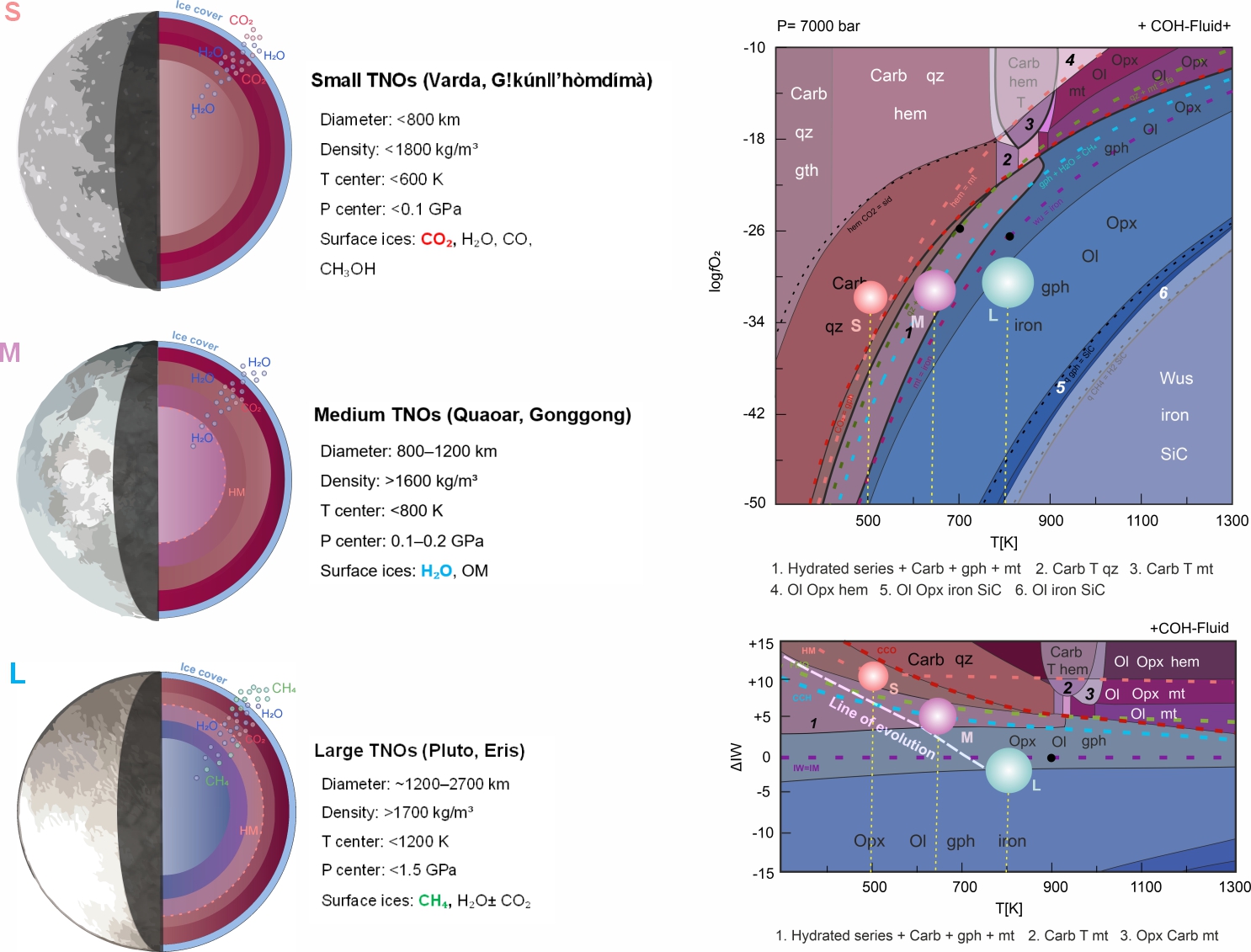
Figure: Core conditions for TNOs of varying sizes are reported on phase diagrams predicted in this study. Fluid composition evolves from oxidized (CO2-rich) to reduced (CH4-rich) when size and internal temperature increases. Mineralogy evolves from carbonated to hydrous then anhydrous minerals.
Acknowledgement
This work was supported by Institut National des Sciences de l'Univers through Programme National de Planétologie, by the Agence Nationale de la Recherche (ANR, project OSSO BUCO, ANR-23-CE49-0003) and by the European Union (ERC, PROMISES, project #101054470). Views and opinions expressed are, however, those of the authors only and do not necessarily reflect those of the European Union or the European Research Council. Neither the European Union nor the granting authority can be held responsible for them.
References
Brown, M. E. (2012). https://doi.org/https://doi.org/10.1146/annurev-earth-042711-105352
Connolly, J. A. D. (2005). https://doi.org/10.1016/j.epsl.2005.04.033
Grundy, W. M. et al. (2024). https://doi.org/10.1016/j.icarus.2023.115923
Pinilla-Alonso, N. et al. (2024). https://doi.org/10.1038/s41550-024-02433-2
How to cite: Confortini, G., Delarue, C., Reynard, B., and Sotin, C.: Thermodynamic, thermal and kinetic modeling of carbon fate in TNO interiors, Europlanet Science Congress 2026, The Hague, The Netherlands, 7–11 Sep 2026, EPSC2026-111, https://doi.org/10.5194/epsc2026-111, 2026.


