
 1,4,
1,4,- 1Institut d’Astrophysique Spatiale, Université Paris-Saclay, CNRS, Orsay, France
- 2Centre national d’études spatiales (CNES), 2, Place Maurice Quentin, 75039, Paris, France
- 3Institut Universitaire de France, Paris, France
- 4Institute of Space and Astronautical Science, Japan Aerospace Exploration Agency, Sagamihara, Japan
- *A full list of authors appears at the end of the abstract
Introduction: Over the last few years, the Hayabusa2 (JAXA) and OSIRIS-REx (NASA) missions brought back samples from the carbonaceous asteroids Ryugu and Bennu [1,2]. Thanks to an agreement between NASA and JAXA, a fraction of both sample collections were exchanged and 0.66 g of Bennu samples were received and analyzed at JAXA’s Extraterrestrial Samples Curation Center (EsCuC) in Sagamihara, Japan [3,4]. The access to both asteroids collection, kept under strictly contamination-controlled conditions, offers a unique opportunity to perform a comparative analysis and better understand primitive asteroid composition and alteration processes. Here we focus on phyllosilicate-related spectral features using near infrared (NIR) hyperspectral microscopy and middle infrared (MIR) micro-spectrometry.
Samples and methods: The Bennu samples are received at ESCuC as five aggregate samples, in August 2024 [5]. After an initial characterization of Bennu bulk material [5,6], on individual millimeter-sized grains were extracted and then analyzed, similarly to Ryugu samples. Such a characterization, performed inside the N2 purged chamber includes the MicrOmega NIR hyperspectral microscope (0.99-3.65 µm, ~20 µm spatial resolution) developed at Institut d’Astrophysique Spatiale (Université Paris-Saclay/CNRS) [6, 7, 8]. Complementary measurements were also conducted with a µ-FTIR point spectrometer (2-12 µm, 100 µm spot size) and a Leica visible microscope [5]. In total, more than 100 Bennu grains (corresponding to a total mass of 134.98 mg) were used in this study to characterize the properties of the phyllosilicates present in the matrix. In particular, we investigated the -OH stretching band at ~2.7 µm (MicrOmega), and the Si-O stretching band near 10 µm (µ-FTIR). 715 Ryugu grains (~1.13 g from chamber A and ~680 mg from chamber C) obtained in similar conditions at EsCuC as well as with laboratory data obtained on Ryugu samples [9-11] and on relevant meteorite analogs [12].
Results: At the mm-scale, MicrOmega measurements reveal a heterogeneous distribution of the -OH absorption band in Bennu grains, both in depth and peak position, similar to Ryugu samples. The average -OH peak position is centered at ~2.716 µm, with nearly 90% of the grains falling within a narrow ±3 nm range (Figure 1). The remaining grains split into two subsets: ~4% are shifted toward longer wavelengths, and ~4% display shorter-wavelength peak positions combined with band depths below 10%.
The redshifted Bennu subset exhibits -OH and Si-O peak positions comparable to the space-weathered Ryugu chamber Aβ population (Figure 1) [11, 13-16]. Beyond this similarity, small but significant differences emerge between the two collections: Bennu grains show systematically shallower ~2.7 μm (OH) bands, lack a deep ~2.7 µm band cluster equivalent to Ryugu's chamber Aα population (Figure 1), and host a shallow, blueshifted ~2.7 µm band population absent from Ryugu. The Christiansen feature is also shifted toward shorter wavelengths in Bennu samples compared to Ryugu samples. Together, these features suggest a less mature or chemically distinct phyllosilicate formation pathway on Bennu's parent body.
A comparison of the (2.7 µm) Band depth vs. Peak position distributions confirms that the two populations are similar yet statistically distinct. This distinction is best explained either by compositional heterogeneity within a single shared parent body, or by derivation from two separate parent asteroids that underwent slightly different alteration histories.
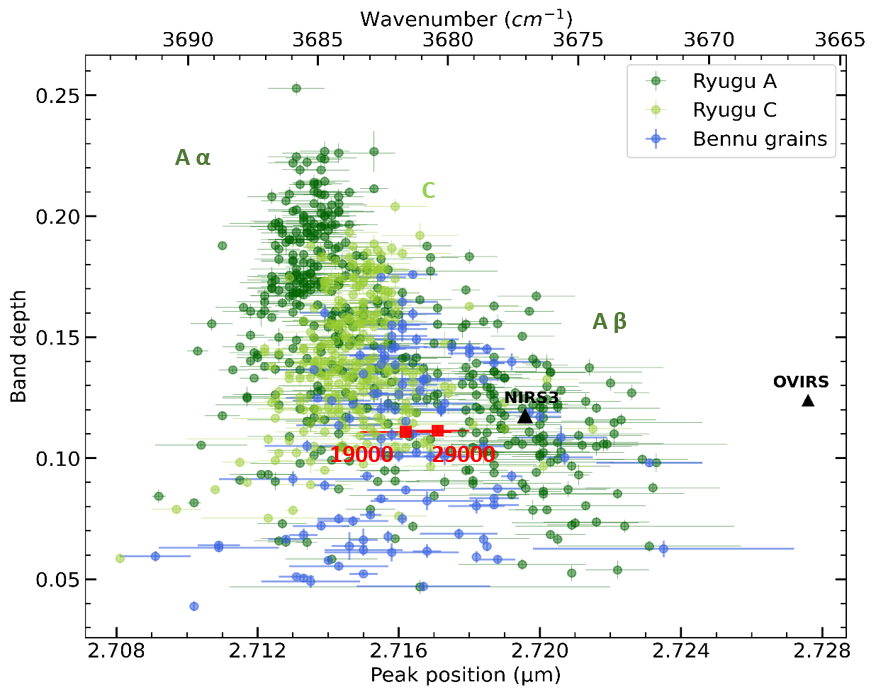
Figure 1. Dispersion diagram showing the comparison between peak position and band depth of the -OH band between 101 Bennu grains (blue) and 715 Ryugu grains (green). Initial bulk samples of Bennu grains are in red [8]. Remote spectra are from [17,18].
References : [1] Lauretta D.S. et al. (2024) Met. And Planet. Sci. 59,9,2453-2486, [2] Yada T. et al. (2022) Nat. Astron. 6, 214-220, [3] Yada, T. et al. (2023), Earth, Planets and Space 75, p. 170. [4] Tahara, R. et al. (2026) Meteoritics & Planetary Science 61.1, p. 182-207. [5] Fukai, R., et al. (2025), Meteorit Planet Sci. [6] Pilorget, C., et al. (2025) [7] Bibring et al. (2017) Astrobiology 17, 621-626, [8] Pilorget C. et al. (2021) Nat. Astron. 6, 221-225, Nat Commun 16, 9532. [9] Dionnet, Z. et al. (2023) Meteorit Planet Sci, 59,10.1111/maps. 14068. [10] Amano, K. et al. (2023), Sci Adv. 9, eadi3789. [11] Onuma, H. et al. Planet. Sci. J. 7 11 (2026) [12] Lantz, C. et al. (2024) Planet. Sci. J. 5 201. [13] Le Pivert-Jolivet T. et al. (2023) Nat. Astron. 7, 1445-1453, [14] Furukawa S. et al. (2025) Sci Rep 15, 14613 [15] Noguchi, T., et al. (2022). Microscopy and Microanalysis, 28(S1), 2726–2728. [16] Nakato, A., Yada, T., Nishimura, M. et al. Earth Planets Space 75, 45 (2023). [17] Hamilton, V.E., et al. (2019). Nat Astron 3, 332–340. 2019 [18] Kitazato, K. et al. (2019), Science364,272-5.
T. Jiang, C. Lantz, R. Sheppard, T. Le Pivert-Jolivet, D. Loizeau, M. Mahlke, T. Okada, R. Fukai, J-P. Bibring, M. Abe, D. Baklouti, Z. Dionnet, Z. Djouadi, Y. Enokido, S. Furukawa, V. Hamm, S. Kawasaki, A. Miyazaki, A. Moussi-Soffys, K. Nagashima, M. Nishimura, F. Poulet, L. Riu, R. Sakurai, R. Shinomishi, R. Tahara, T. Usui, T. Yada, K. Yogata, K. Yumoto
How to cite: Nardelli, L., Brunetto, R., Pilorget, C., and Hatakeda, K. and the ISAS/IAS MicrOmega Curation Team: Spectral variations between Bennu and Ryugu grains: probing alteration processes through a NIR–MIR spectral survey at the ISAS/JAXA Curation Center, Europlanet Science Congress 2026, The Hague, The Netherlands, 7–11 Sep 2026, EPSC2026-113, https://doi.org/10.5194/epsc2026-113, 2026.


