
- 1Faculty of Aerospace Engineering, TU Delft, Delft, the Netherlands (a.s.royakkers@tudelft.nl)
- 2Faculty of Science, VU Amsterdam, Amsterdam, the Netherlands
Introduction
During the earliest stages of the Moon, it is generally believed that the Moon underwent a global Lunar Magma Ocean (LMO) phase, which subsequently cooled resulting in fractional crystallisation [1-7]. The exact duration of this crystallisation is still debated and ages are generally provided by geochronology on lunar rocks. Since most isotope systems are susceptible to changes in temperature, which is impractical considering the considerable amount of (micro)meteorite impacts on the Moon, geochronology on zircons is favoured because of zircon’s stability and insensitivity to changes in environmental conditions.
Proper use of zircons for dating requires a good understanding of the timing of zircon formation during LMO crystallisation. Zircons likely crystallised in the final melt fraction that is strongly enriched in incompatible elements, which is also known as KREEP [8,9], but limited experimental research has yet demonstrated that zircons can indeed crystallise in this melt at lunar conditions [10]. This likely occurred following or during the proposed silicate melt immiscibility [7, 10-13]. Zircon crystallization is governed by the Zr solubility limit of the melt, and therefore, the Zr content of the bulk system. This indicates that the characteristics of the melt are of great importance in the process of crystallising zircons, including the SiO2 activity, degree of polymerisation, diffusion rates, and water content [14-22]. Here, we aim to constrain the Zr solubility of the final dregs of the LMO melt (>99% crystallization), while exploring a number of proposed bulk compositions, to assess the nature and timing of lunar zircon crystallization.
Methods
This study uses the composition of the final melt fraction of the LMO, as experimentally derived by Charlier et al. (2018) and Zhang et al. (2024), to perform zircon crystallisation (saturation) experiments with the focus placed on the partitioning of Zr between the immiscible liquids and Zr solubility and saturation for both immiscible melts. The crystallisation experiments are conducted under lunar conditions, at ~1000 °C and 0.5 GPa, on a piston cylinder press at the HPT lab at TU Delft (Fig. 1,2) and the samples are analysed with the electron probe microanalyzer (EPMA) and the Laser Ablation Inductively Coupled Plasma-Mass Spectrometer (LA ICP-MS) at Utrecht University and the VU Amsterdam, respectively. The piston cylinder press was calibrated using the albite-jadeite-quartz and fayalite-quartz-ferrosilite mineral transitions. Proposed Zr partitioning between the immiscible liquids and modelled Zr solubility limits by e.g. Borisov et al. (2025) will be experimentally tested under lunar conditions. The experimental run products and derived first results will be reported at the meeting.
Conclusions and outlook
Results of this study will create a better understanding of the behaviour of Zr in the final melt fraction of the LMO and the conditions required to crystallise the enigmatic lunar zircons, with possible implications regarding the further evolution of the LMO.
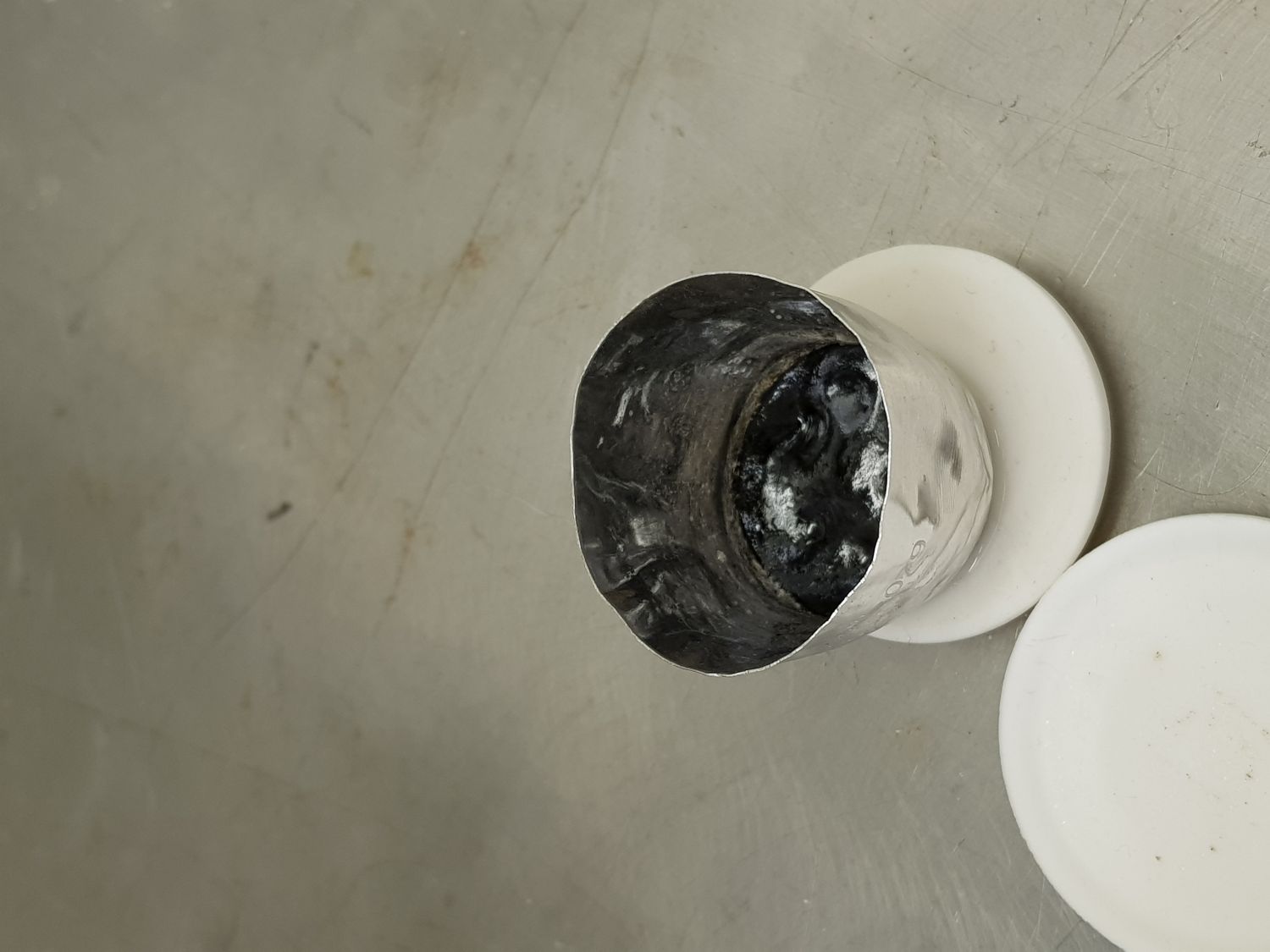
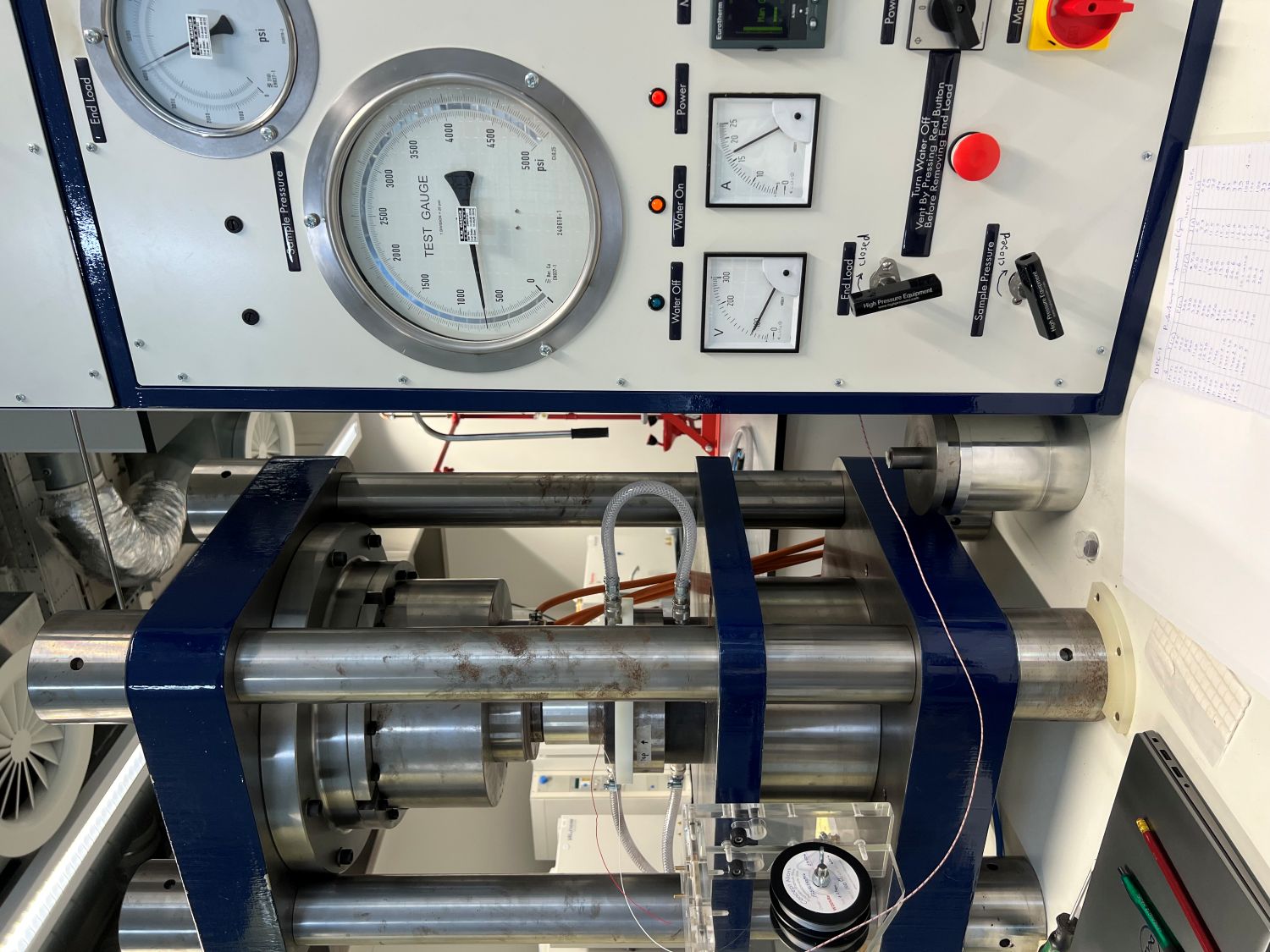
Fig. 1 Pt crucible with glass Fig. 2 Piston cylinder press (HPT lab, TU Delft)
Acknowledgement
This study was supported by the NWO NWA PRELIFE grant.
References
[1] Charlier et al. (2018) GCA [2] Elkins-Tanton et al. (2011) EPSL [3] Lin et al. (2017) Nat. Geoscience [4] Longhi (2003) JGR: Planets [5] Longhi (2006) GCA [6] Rapp & Draper (2018) MaPS [7] Zhang et al. (2024) EPSL [8] Dauphas et al. (2025) PNAS [9] Taylor et al. (2009) EPSL [10] Dickinson & Hess (1982) EPSL [11] Hess et al. (1975) Proceedings Lunar Science Conference, 6th [12] Quick et al. (1977) Proceedings Lunar Science Conference, 8th [13] Roedder & Weiblen (1970) Proceedings of the Apollo 11 Lunar Science Conference [14] Baker et al. (2002) CMP [15] Boehnke et al. (2013) Chemical Geology [16] Borisov et al. (2025) Chemical Geology [17] Borisov & Aranovich (2019) Chemical Geology [18] Crisp & Berry (2022) CMP [19] Gervasoni et al. (2016) CMP [20] Shao et al. (2019) SESCI [21] Shao et al. (2020) Acta Geochemica [22] Watson & Harrison (1983) EPSL
How to cite: Royakkers, A., Steenstra, E., Vroon, P., and van Westrenen, W.: An Experimental Assessment of Zircon Crystallisation in the Final Melt Fraction of the Lunar Magma Ocean, Europlanet Science Congress 2026, The Hague, The Netherlands, 7–11 Sep 2026, EPSC2026-1177, https://doi.org/10.5194/epsc2026-1177, 2026.


