
 1,2,3,
- 1LMD/IPSL, Sorbonne Université, École Normale Supérieure, Université Paris Sciences et Lettres, École Polytechnique, Institut Polytechnique de Paris, CNRS, Paris, France (yangcheng.luo@lmd.ipsl.fr)
- 2Climate School, Columbia University, New York, NY, USA
- 3Department of the Geophysical Sciences, The University of Chicago, Chicago, IL, USA
- 4The Department of Earth & Planetary Sciences, Yale University, CT, USA
Observations of the ultrashort-period rocky exoplanet 55 Cancri e have revealed large and unexplained variability in both visible and infrared brightness. The planet’s mid-infrared brightness temperature has been observed to vary by approximately 1400 K, while the secondary eclipse depth in the visible band has been observed to vary by more than 100 ppm. We investigate whether self-sustained oscillations due to nonlinear feedbacks between magma ocean surface temperature and silicate cloud cover can explain these extreme variations.
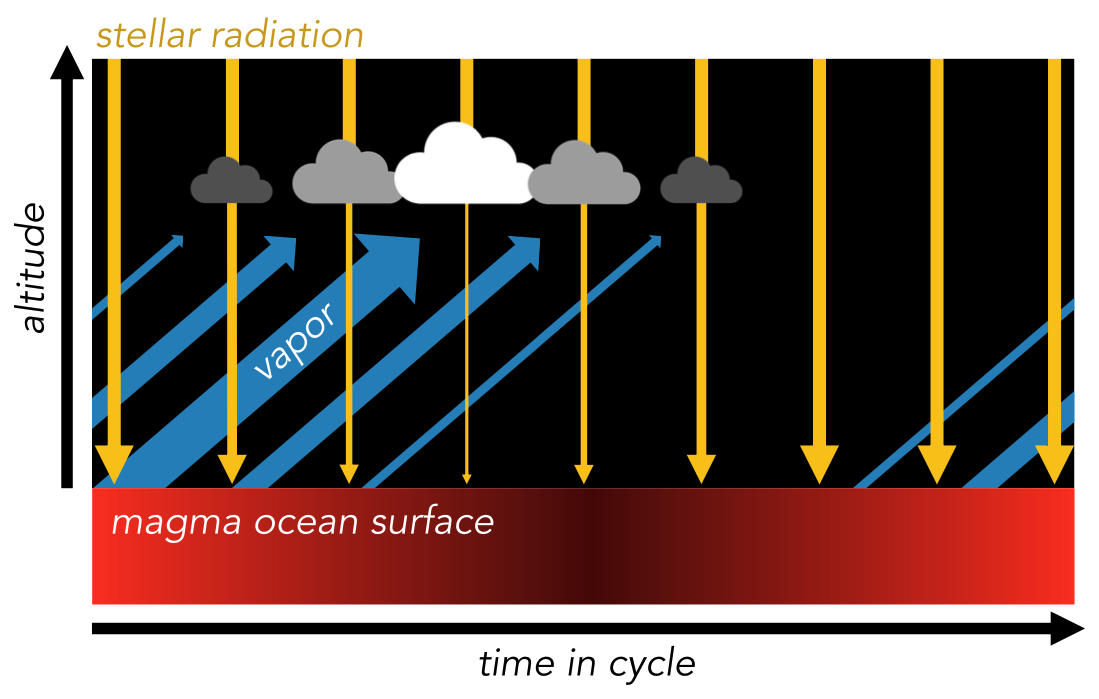
We propose a magma temperature–cloud feedback mechanism illustrated in the figure below. Under cloud-free conditions, intense stellar irradiation heats the magma ocean, enhancing the evaporation of silicate vapor that subsequently condenses into reflective silicate clouds. Once formed, these clouds attenuate incoming stellar radiation, cooling the surface, reducing vapor supply, and suppressing further cloud formation. A time delay between surface heating and cloud formation, potentially caused by atmospheric transport and cloud microphysics, enables self-sustained oscillations in both surface temperature and cloudiness.
Using a simple theoretical model, we show that a broad range of planetary parameters can potentially reproduce the observed variability in infrared secondary eclipse depths. The model also predicts out-of-phase oscillations between visible and infrared brightness, consistent with recent JWST observations. In addition, time-varying and spatially nonuniform cloud cover can potentially produce variations in both the amplitude and phase offset of planetary phase curves.
These results suggest that observable weather cycles driven by magma ocean–cloud feedbacks may operate on lava planets with atmospheres. We further discuss observational tests of the proposed mechanism and future modeling efforts using more sophisticated models to further evaluate this hypothesis.
How to cite: Luo, Y., Loftus, K., Kite, E., and Fan, B.: Magma Temperature–Cloud Feedback as a Possible Explanation for Extreme Brightness Variability on the Lava Planet 55 Cancri e, Europlanet Science Congress 2026, The Hague, The Netherlands, 6–11 Sep 2026, EPSC2026-1213, https://doi.org/10.5194/epsc2026-1213, 2026.


