
 1,1,2,3,2,2
- 1AstrobiologyOU, Open University, UK
- 2HVI & SPE Laboratories, Open University, UK
- 3Electron Microscopy Suite, Open University, UK
Salt-rich (Type III) grains are a major component of the plume material of Saturn’s moon Enceladus, interpreted as frozen aerosolized ocean material ejected from vents in the South Polar Region [1, 2]. Thought to preserve the composition of the source liquid reservoir that lies beneath the icy crust, expelled grains can be used as a tool to understand the chemistry and habitability of the otherwise inaccessible subsurface.
Observed compositional differences between Enceladus salty grain subpopulations are likely to be a combined result of freezing-induced segregation of salts within large droplets and subsequent fragmentation in the vents [1-5]. Within the vents, droplets of ocean fluid must experience an extreme decrease in both temperature and pressure within the vents toward ascension to the surface. A liquid droplet within a low-pressure environment beneath the triple point of water is thermodynamically unstable and should lead to extremely rapid freezing. This is because rapid evaporation ensues at the droplet surface which removes latent heat and simultaneously cools the droplet. Freezing rate controls the microstructure of salt-ice phases [7], with rapid rates having previously been shown to lead to unsegregated salts [4]. This would suggest cooling rates in the plumes must be relatively slow to produce the observed compositional diversity amongst the Type III grains. However, no study has yet investigated the effects of rapid depressurisation, expected to be the dominant cooling mechanism at Enceladus [6], on salt formation in plume ice grains.
Here, we simulated the effect of the low pressure (< 6 mbar) experienced by sub-mm-sized fluid droplets freezing in Enceladus’ vents ascending from the liquid ocean to the vacuum of space. Analogue Enceladus ocean fluid droplets composed of the major salt ions identified within the Type III grains (Na+, Cl-, CO32-/HCO3-, K+, PO43-) were injected into low pressure (0.1 - 4 mbar) and their impacts recorded after one second exposure to low pressure conditions. Freezing behaviour was quantified observing ice particle impacts using high-speed videography. Injected ice grains were allowed to freeze-dry in situ at 0.1 mbar and were subsequently recovered for analysis. Mineralogy was determined using X-Ray Diffraction and the micro-scale distribution of salts within individual grains was determined by Scanning Electron Microscopy – Energy Dispersive Spectroscopy (SEM-EDS). Experimental data was complimented by aqueous geochemical PHREEQC modelling to predict the precipitation sequence of phases under equilibrium conditions within the aqueous solution with decreasing temperature.
Results indicate that rapid freezing is favoured, with 90% of analogue ocean fluid droplets freezing in <1 s at 0.1 mbar pressure. Textures of the recovered salt particles are consistent with flash-frozen desiccated grains, displaying characteristic branching needle structures and small void spaces resulting from ice-templating [4, 7].
The distribution of salts within grains frozen at these conditions displayed clear segregation at the scale of Type III grains particularly between chloride and carbonate phases, as well as clear distinction between the phosphate and potassium phases (Figure 1). Compared to the starting solution, there is a marked decrease in carbon which implies a net carbon loss, which we attribute to CO2 degassing during decompression grain formation. Three distinct regions can be identified at Type III grain scales – a fraction of which have a C/Cl ratio that is consistent with the starting solution, another subtype where the Cl level is 10-30 times greater than the C species and areas where there is 10-20 times more C than Cl. Importantly, rapid freezing under low pressures is capable of producing heterogeneities within sub-mm ice grains on the scale of Type III ice grains, which could form chemically distinct subpopulations if these larger grains were to fragment. This implies that rapid decompression in the vents is consistent with Cassini-observed heterogeneities.
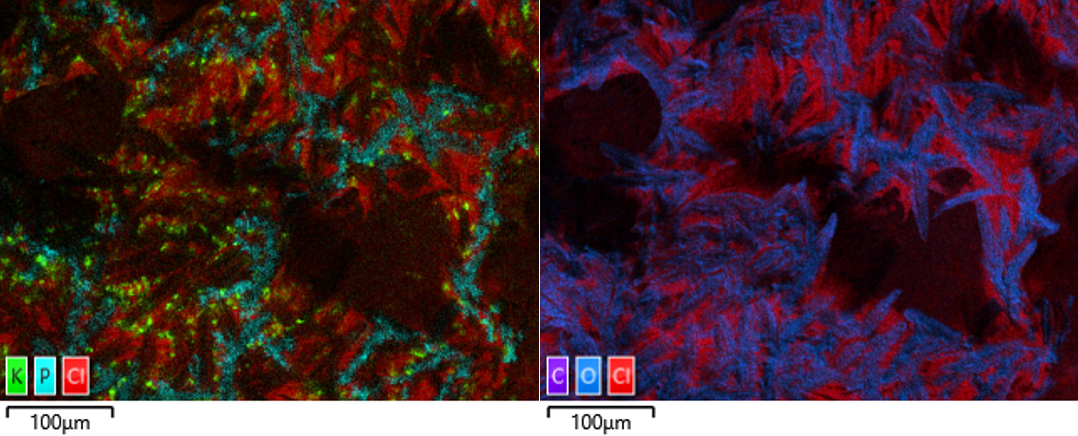
Figure 1: SEM-EDS layered image of Cl (red), P (blue), K (green) phases mapped across ~450 µm region of desiccated salt sample. Clear K-rich hotspots and P-rich veins segregated from other salts within the sample. C- and O-bearing regions are inversely distributed to Cl-rich regions (right panel).
[1] Postberg et al., 2009, Nature; [2] Postberg et al., 2011, Nature; [3] Postberg et al., 2008; [4] Fox-Powell and Cousins, 2021, JGRP; [5] Postberg et al., 2023, Nature; [6] Nakajima and Ingersoll, 2016, Icarus; [7] Chinnery and Fox-Powell, 2025, JGR Planets.
How to cite: Hogan, J., Fox-Powell, M., Hamp, R., Pearson, V., Patel, M., White, L., Sylvest, M., and Emerland, Z.: Segregation of Enceladus’ ocean salts within rapidly frozen droplets at vent-relevant pressures, Europlanet Science Congress 2026, The Hague, The Netherlands, 7–11 Sep 2026, EPSC2026-1326, https://doi.org/10.5194/epsc2026-1326, 2026.


