
 1,3,4,4,4,2
- 1Institute of Geodesy and Geoinformation Science, Technische Universität Berlin, 10553 Berlin, Germany
- 2Institute of Microwaves and Photonics (LHFT), Friedrich-Alexander-Universität Erlangen-Nürnberg (FAU), 91058 Erlangen, Germany
- 3Microwaves and Radar Institute, German Aerospace Center (DLR), 82234 Weßling, Germany
- 4Institute of Space Research, German Aerospace Center (DLR), 12489 Berlin, Germany
Introduction
Among the icy moons of our Solar System, Saturn’s moon Enceladus has emerged as a prime target for astrobiological research. Its potentially habitable environment is characterized by a global subsurface liquid water ocean [1], ongoing geothermal activity at the ocean-core interface [2], and the presence of life-essential elements [3].
To investigate the moon’s geophysical properties and search for biosignatures within its subsurface ocean, the German Space Agency at DLR has launched the Enceladus Explorer (EnEx) initiative. Within this framework, the EnEx-RaTNOS project (Radar Transponder based Navigation and Orbit Determination by Satellite) aims at geodetic mapping, enabled by precision orbit determination through a network of radar transponders deployed on Enceladus’ surface, effectively forming a local positioning system [4].
Research Question
A key prerequisite to achieving the EnEx mission objectives is the identification of stable science orbits. Such orbits should have high inclinations to ensure sufficient coverage of Enceladus’ south polar region, which is of particular scientific interest due to active cryovolcanic geysers [5] and locally reduced ice shell thickness [6]. Depending on the mission design, additional desirable orbital characteristics may include low eccentricity and low altitude to enable uniform global surface coverage, repeating ground tracks with short repeat periods to support Synthetic Aperture Radar (SAR) acquisitions [7, 8], and homogeneously distributed ground-tracks to reduce geographic variability in lander observation errors, thereby improving the quality of estimated geophysical parameters [9]. Highly elliptical orbits with low-altitude passes over the south polar region are also of interest [10]. The design of science orbits satisfying these constraints is especially challenging in the Saturn-Enceladus system, as the strong gravitational perturbations exerted by Saturn rapidly destabilize highly inclined orbits around the small moon, leading to impact timescales on the order of several days [11].
Methodology
Building on previous work by Benedikter et al. (2022) [8] and Auer Wilkins et al. (2025) [12], who identified families of stable, near-circular, periodic orbits using a grid-search method, this study extends the search for viable science orbits in several ways. Firstly, the ephemeris model, previously consisting only of Enceladus’ non-spherical gravity terms [13] extrapolated to degree 85 assuming Airy Isostasy [14, 15] and Saturn’s non-spherical gravity terms [16], is extended by Enceladus’ rotational model described by Park et al. (2024) [13]. Furthermore, the grid-search methodology is expanded beyond near-circular orbit geometries to include highly eccentric trajectories with low-altitude passes over Enceladus’ south pole. While near-circular orbits are analyzed based on a periodicity metric which minimizes the angular deviation between initial and repeating state vectors after an estimated repeat period, highly eccentric orbits are evaluated using a metric which maximizes orbital stability and the quality of south polar coverage. The search for elliptical orbits is based on the translation of known orbital families, such as halo orbits associated with the Saturn-Enceladus Lagrange points [17], from the circular restricted three body problem (CR3BP) model to a high-fidelity ephemeris model.
Preliminary Results
Candidate orbits identified through the grid-search method are analyzed in a full-fidelity ephemeris model using the TU Delft Astrodynamics Toolbox (Tudat). As an initial result of this ongoing work, Figure 1 shows the south pole groundtrack of a candidate orbit identified through a grid-search initialized from the L1 Lagrange point near rectilinear halo orbit [17] and propagated over 5 days. The orbit achieves repeated low-altitude passes below 50 km over the south polar terrain. A broader selection of candidate orbits and a full analysis of their long-term stability will be presented and discussed at the conference.
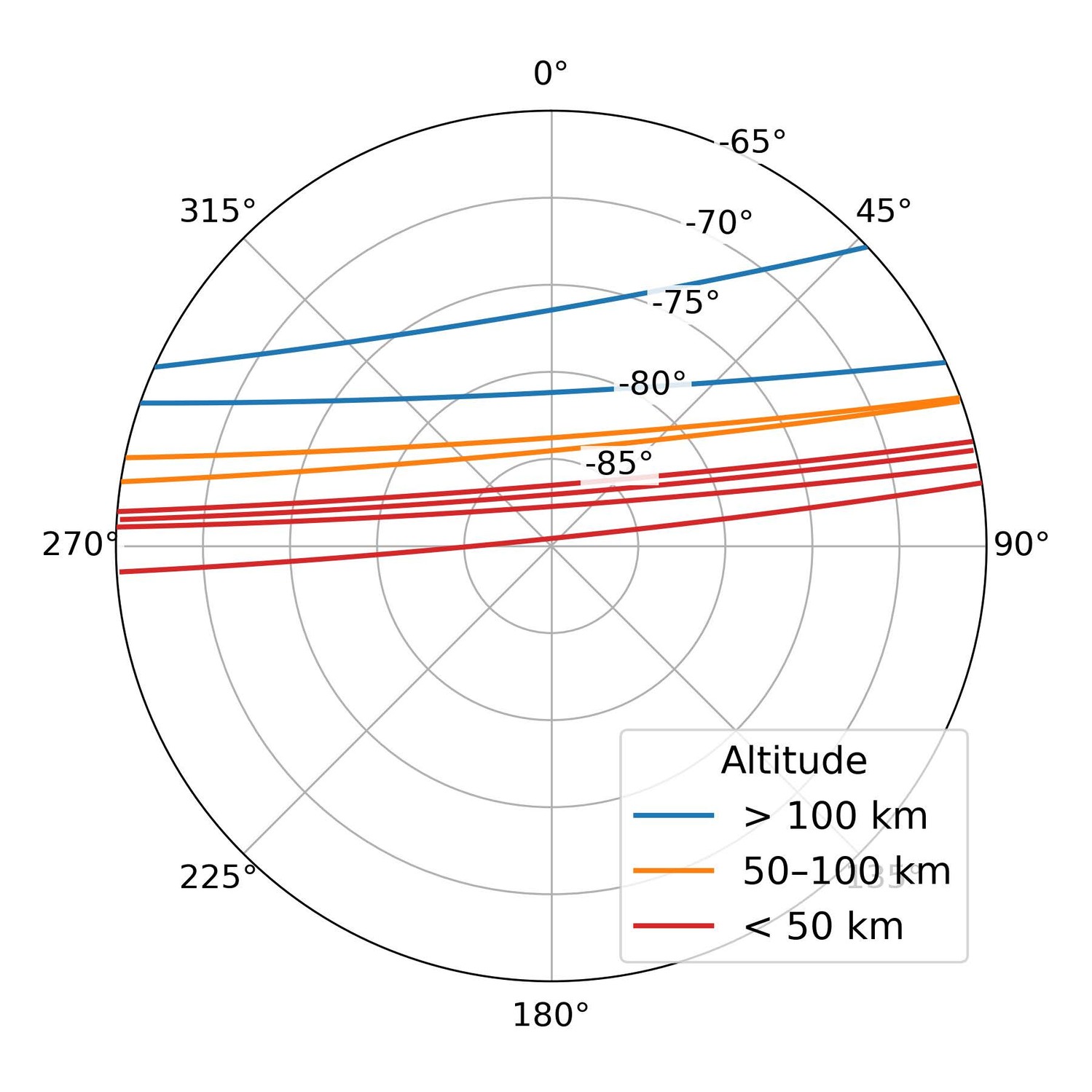
Figure 1: South pole groundtrack of a candidate elliptical orbit propagated over 5 days.
References:
[1] P.C. Thomas et al. Enceladus’s measured physical libration requires a global subsurface ocean. Icarus, 264:37–47, 1 2016.
[2] C. J. Hansen et al. The composition and structure of the Enceladus plume. Geophysical Research Letters, 38(11):n/a, 6 2011.
[3] Weiming Xu et al. Enough Sulfur and Iron for Potential Life Make Enceladus’s Ocean Fully Habitable. The Astrophysical Journal Letters, 980(1):L10, February 2025.
[4] J. Oberst and M. Vossiek. Gesamtvorhabensbeschreibung EnEx-RaTNOS Radartransponder basierte Navigation und Orbitbestimmung von Satelliten. Technical report, 6 2023.
[5] C. J. Mitchell et al. Tracking the geysers of Enceladus into Saturn’s E ring. The Astronomical Journal, 149(5):156, April 2015.
[6] Ondrˇej Cˇadek et al. Enceladus’s internal ocean and ice shell constrained from Cassini gravity, shape, and libration data. Geophysical Research Letters, 43(11):5653–5660, June 2016.
[7] Paul A. Rosen et al. Repeat Pass InSAR at Enceladus- A Geophysics Mission Concept to Understand Dynamics and Habitability. In EUSAR 2024; 15th European Conference on Synthetic Aperture Radar, pages 1318–1323, 2024.
[8] Andreas Benedikter et al. Periodic orbits for interferometric and tomographic radar imaging of Saturn’s moon Enceladus. Acta Astronautica, 191:326–345, February 2022.
[9] Mattia Contarini. Scientific performance analysis for a novel science mission to characterise Enceladus’ interior. Master thesis, Delft University of Technology, 2025.
[10] Spencer Boone, Joan Pau Sanchez Cuartialles, and St´ephanie Lizy-Destrez. Catalog and Characterization of Science Orbit Configurations for an Enceladus Orbiter, 2025.
[11] Ryan P. Russell and Martin Lara. On the design of an Enceladus science orbit. Acta Astronautica, 65(1–2):27–39, July 2009.
[12] Sonasha Auer Wilkins et al. Search for Stable Orbits around Saturn’s Moon Enceladus using Numerical Modeling. 2025.
[13] R. S. Park et al. The Global Shape, Gravity Field, and Libration of Enceladus. Journal of Geophysical Research: Planets, 129(1), January 2024.
[14] George Biddell Airy. On the computation of the effect of the attraction of mountain-masses, as disturbing the apparent astronomical latitude of stations in geodetic surveys. Philosophical Transactions of the Royal Society of London, (145):101–104, December 1855.
[15] Donald L. Turcotte and Gerald Schubert. Geodynamics. Cambridge University Press, March 2002.
[16] Robert. A. Jacobson. The orbits of the main Saturnian satellites, the saturnian system gravity field, and the orientation of Saturn’s pole. The Astronomical Journal, 164(5):199, October 2022.
[17] Spencer Boone, Andrea Bellome, Joan Pau S´anchez, and St´ephanie Lizy-Destrez. Approach strategies for inserting into Enceladus science orbit configurations. Acta Astronautica, 240:198–207, March 2026.
How to cite: Auer Wilkins, S., Neumann, W., Oberst, J., Gambacorta, L., Benedikter, A., Marx, V., Stark, A., Hussmann, H., Wickhusen, K., and Vossiek, M.: Stable High-Inclination Orbits around Enceladus for South Polar Coverage, Europlanet Science Congress 2026, The Hague, The Netherlands, 7–11 Sep 2026, EPSC2026-1340, https://doi.org/10.5194/epsc2026-1340, 2026.


