
 1,
1,- 1The Hong Kong Polytechnic University, Research Centre for Deep Space Explorations, Department of Land Surveying and Geo-Informatics, Hong Kong (jialong.ren@polyu.edu.hk)
- 2The Hong Kong Polytechnic University, Wenzhou Technology and Innovation Research Institute, New Material Technology and Marine Engineering Equipment Research Center
- 3The Hong Kong Polytechnic University, Department of Civil and Environmental Engineering
Near-Earth asteroid (469219) Kamo‘oalewa (provisional designation 2016 HO3) is the first target of the ongoing Tianwen-2 sample-return mission. Ground based observations measured its rotation period at only about 28 minutes [1], while the low thermal inertia value (Γ = 150 or 181 J m−2 K−1 s−1/2) estimated from the Yarkovsky effect determination implies a thermal insulating layer on the surface [2]. The first goal of this work is to facilitate the sample collection of the Tianwen-2 mission with a prediction of the current status of the possible regolith layer on Kamo‘oalewa. The second goal is to build a framework of regolith evolution on small fast-rotating asteroids as a reference for future observations and studies.
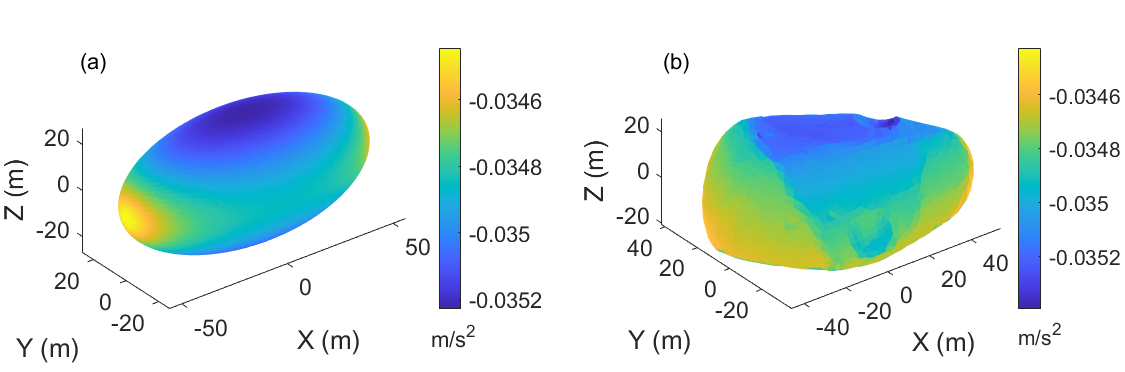
Figure 1: Net outward normal acceleration from gravity, centrifugal force, and van der Waals forces. Under the choice of surface parameters, cleanliness S =0.1 and particle radius r = 1 mm, the van der Waals force dominates the surface dynamical environment.
On the basis of a shape model reconstructed from light curve data, we use numerical simulations to calculate the acceleration from gravity, fast rotation, and the van der Waals cohesive force. Figure 1 shows the net outward normal acceleration for an ellipsoidal shape model on the left and a reconstructed model on the right. We found that the poles have a higher chance of hosting regolith, and the regolith may also rest on the walls of craters that face toward the rotation axis, making them potential sample collection sites. On the surface of Kamo‘oalewa, the van der Waals force is strong enough to hold particles up to several centimeters against the centrifugal force [3].
Surface dynamic environment analysis alone is not sufficient to determine the existence of regolith on Kamo‘oalewa. We further compared the mass change rates of regolith due to thermal fatigue fragmentation, micro-impact ejecta escape and electrostatic dust lofting (illustrated in Fig. 2), which are the smae processes considered in [4] for sub-kilometer asteroids.
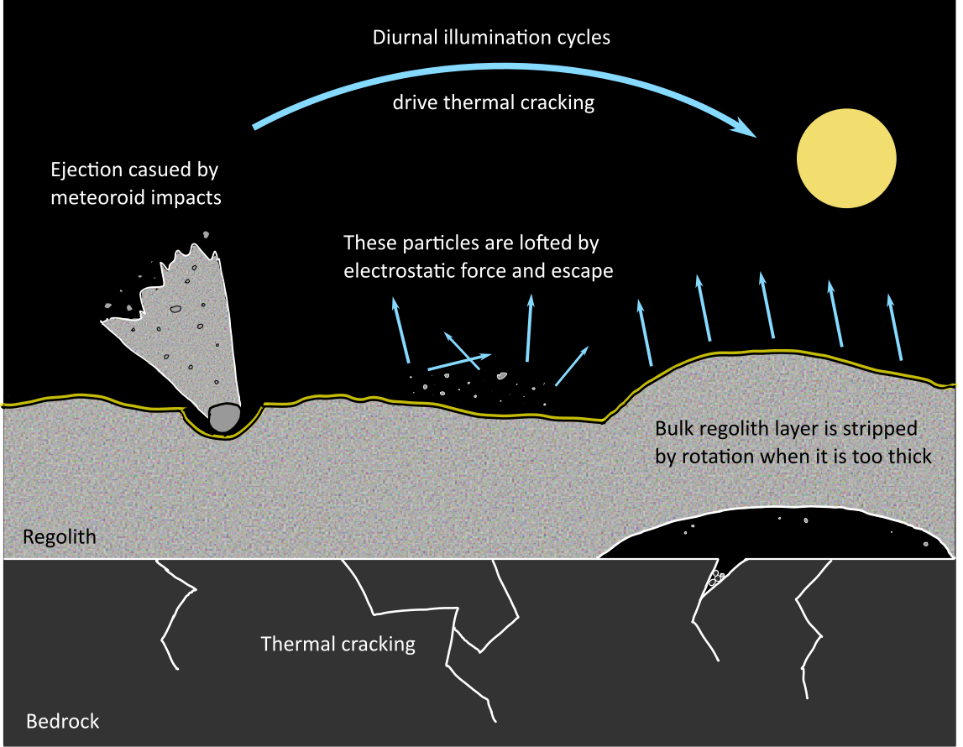
Figure 2: Physical processes that produce and remove regolith on Kamo‘oalewa.
We use finite element analysis software, Abaqus, to simulate the thermal stress field of Kamo‘oalewa under seasonal and diurnal temperature cycles, with different thicknesses (H) of the regolith layer. At each latitude, the stress excursion at the top of the bedrock as a function of H is incorporated into the ordinary differential equations (ODEs) for regolith total mass and grain size distribution evolutions. The negative feedback between H and thermal fragmentation rate is considered together with regolith removal processes of micro-impact ejecta escape and electrostatic dust lofting in the ODEs.

Figure 3: Equilibrium regolith thicknesses at different latitudes. Panels a and b show the results for models with obliquities γ = 99.3◦ and γ = 45◦, respectively. The equilibrium thickness ranges for ordinary chondrite material are shown by the shaded red areas, and the ones for norite material by the blue. The dashed lines represent scenarios with only diurnal thermal fragmentation, with the same choice of colors for the different materials. The left and right ordinates show dimensionless and dimensional thicknesses of the regolith layer, respectively. In panel a, the black line indicates that the highest H (φ) is allowed by a cohesive strength of 0.055 Pa.
The competition between the regolith production and removal processes results in an equilibrium regolith thickness. As shown in Fig.3, the equilibrium thickness increases with latitude because the seasonal thermal fatigue is more efficient. Under different choices of materials and obliquities and a range of possible fragmentation rates, the equilibrium thickness is estimated to be 0.4-71 mm [5], equivalent to 0.3-53.5 diurnal regolith thermal skin depth. Our prediction of the equilibrium H satisfies both constraints from thermal inertia observations [2] and cohesive strength estimations on airless bodies. We therefore suggest that a thin regolith layer is likely to be observed on Kamo‘oalewa by the Tianwen-2 mission.
Reference
[1] Warner, B. D., Harris, A. W., & Pravec, P. 2021, Asteroid Lightcurve Data Base (LCDB) Bundle V4.0
[2] Fenucci, M., Novakovi´c, B., Zhang, P., et al. 2025, A&A, 695, A196
[3] Ren, J., Wu, B., Hesse, M. A., et al. 2024, A&A, 692, A62
[4] Hsu, H. W., Wang, X., Carroll, A., Hood, N., & Horányi, M. 2022, Nat. Astron., 6, 1043
[5] Ren, J., Wu, B., Liu, W., et al. 2026, A&A, 708, A142
How to cite: Ren, J., Wu, B., Liu, W., Yu, T., and Li, H.: Thin Regolith Layer Anticipated on the Surface of the Tianwen-2 Target Asteroid (469219) Kamo‘oalewa, Europlanet Science Congress 2026, The Hague, The Netherlands, 7–11 Sep 2026, EPSC2026-142, https://doi.org/10.5194/epsc2026-142, 2026.


