
 ,,
,,- University of Münster, Institut für Planetologie, Münster, Germany (philipp.kost@uni-muenster.de)
Introduction
On 13 April 2029, asteroid (99942) Apophis will fly by Earth with a distance of approximately 38,000 km. Several authors suggest that the gravity field of Earth may lead to surface reshaping, e.g., by avalanches [1,2,3]. These events will be observed through planned space missions, providing insights into the granular dynamics of surfaces of small rubble-piles asteroids. A key parameter of the physics of granular material is the so-called static angle of repose, which describes the angle of a slope that must be exceeded to start an avalanche [4]. Understanding this parameter and its variation with grain size and gravity, especially the extrapolation to low gravity conditions as present on Apophis, is an important field of research.
To provide ground truth on this parameter under Earth and reduced gravity conditions, the static angle of repose was experimentally investigated in a rotating tumbler setup using highly monodisperse glass beads. Several grain sizes ranging from 37 µm up to 193 µm were investigated to specifically examine the influence of cohesion on the angle of repose. Vacuum experiments were conducted in the laboratory and under reduced gravity conditions in the GraviTower Bremen (ZARM). Future campaigns will expand the dataset to include hyper-gravity, as well as additional reduced gravity data.
Laboratory Experiments
To investigate the influence of particle size on the angle of repose, highly monodisperse, spherical soda-lime-glass beads were selected as sample material. With particle grain sizes noted above, vacuum experiments were conducted under Earth’s gravity, particularly focusing on the increasing dominance of cohesion (Bond number, [5,6]) below roughly 100 µm. Cohesive behaviour has been observed through a significant increase in the angle of repose with decreasing grain size, as shown in Figure 1. Furthermore, the current results largely follow the model of the grain-size-dependent angle of repose developed by Elekes & Parteli (2021) [6].
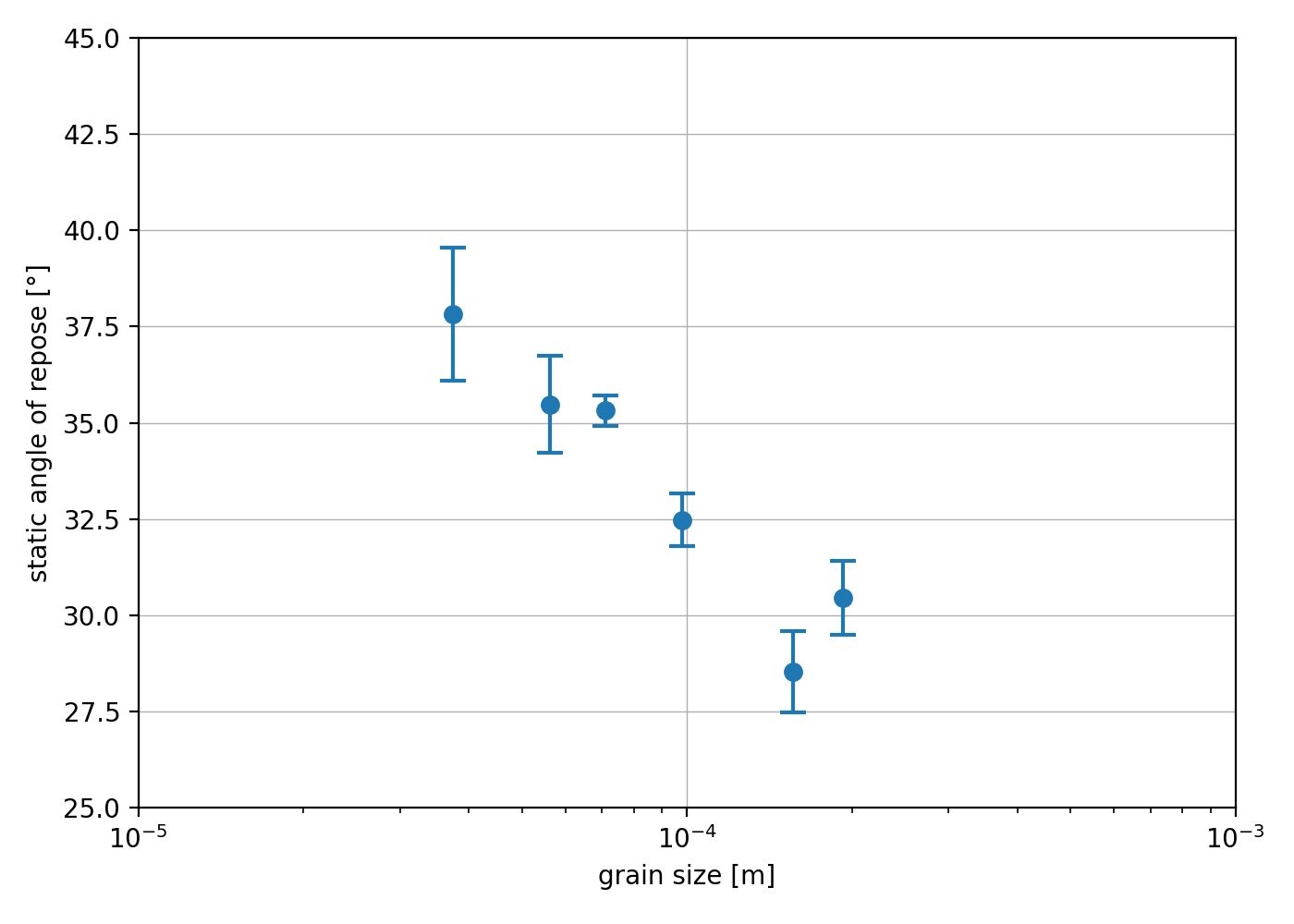
Figure 1: Static angle of repose over sample material grain size. Highly monodisperse spherical soda-lime-glass beads have been used as sample material. Error bars denote standard deviation from experiment repetition.
GraviTower Experiments
To thoroughly investigate the effect of gravity on the angle of repose as a function of particle size, a first series of experiments was conducted in February 2026 at the GraviTower Bremen Pro at ZARM in Bremen. Thanks to the GraviTower’s very high repetition rate and our simultaneous execution of two experiments per flight, a large dataset was obtained, counting 354 flights (=708 data points) in total. Experiments were conducted under various reduced gravity conditions (Mars-g, 3.0 m/s², 2.5 m/s², Moon-g) using the sample materials from the laboratory experiments described above.
In some experiments, the time of an avalanche start - and thus the measured static angle of repose - was significantly influenced by vibration induced by the drop tower capsule, as well as by mechanically induced vibrations within the experimental setup. Temporarily negative gravitational values additionally led to a brief “lift off” of the sample material in some cases. This effect was reduced through mechanical adjustments made on-site and the high experiment repetition rate also enables to apply a quality filter on the data. Analysed experiment data show a clear and significant increase in the static angle of repose for all grain sizes examined under reduced gravity compared to Earth’s gravity. Contrary to expectations, a relative decrease is observed from Martian to smaller gravity. This behaviour has not yet been fully understood, and may have technical origin (disturbances as described above) or founded in granular physics: A reduction of the volume filling factor for reduced gravity conditions, as suggested by Elekes & Parteli (2021) [6], may reduce contact networks and thus increase system instability, potentially making the granular heap more susceptible to disturbances. However, it is important to note that the downward trend of the static angle of repose for accelerations smaller than Martian gravity is comparably low to the generally observed trend of a strong increase for all grain sizes when compared to Earth’s gravity.
Perspective
Future campaigns at ZARM planned for this year will build on the currently obtained dataset with the goal to minimise disturbances and expand it to include hyper-gravity, as well as further broadening the data for reduced gravity conditions. We aim to connect and interpret our experimental results in the context of granular physics to enhance knowledge about the effect of cohesion (Bond number, [5,6]) and its influencing parameters on the angle of repose. Together with live observations during the flyby of Apophis in 2029, the understanding of the behaviour of granular materials, specifically small rubble-piles asteroids, under various gravity conditions will be substantially increased.
Acknowledgements
We acknowledge financial support by the DLR Agency (50WM2544) and the support of the ZARM team during the experiment campaigns.
References
[1] G. Noiset et al., 2022. EPSC 2022-1159. https://doi.org/10.5194/epsc2022-1159
[2] Ballouz et al., 2024. The Planetary Science Journal, 5 (11), 251. https://doi.org/10.3847/PSJ/ad84f2
[3] Kim et al., 2023. MNRAS, 520 (3), 3405-3415. https://doi.org/10.1093/mnras/stad351
[4] M.G. Kleinhans et al., 2011. J. Geophys. Res. 116, E11. https://doi.org/10.1029/2011JE003865
[5] Scheeres et al., 2010. Icarus, 210:968. https://doi.org/10.1016/j.icarus.2010.07.009
[6] Elekes & Parteli, 2021. PNAS, 118 (38), e2107965118. https://doi.org/10.1073/pnas.2107965118
How to cite: Kost, P.-M., Güttler, C., Bannemann, L., and Gundlach, B.: Avalanches on asteroid (99942) Apophis: static angle of repose of granular material under reduced gravity, Europlanet Science Congress 2026, The Hague, The Netherlands, 7–11 Sep 2026, EPSC2026-146, https://doi.org/10.5194/epsc2026-146, 2026.


