
 1,23
1,23- 1University of Turku, Finland (tomas.kohout@utu.fi)
- 2The Czech Academy of Sciences
- 3University of Helsinki, Filnand
Space weathering (SW) consists of the solar wind component dominated by ~1 keV H+ ion irradiation, and the micrometeorite bombardment caused by hypervelocity impacts of sub-mm dusty grains. Both SW components are simulated in the laboratory independently by distinct agents. Proton bombardment is used to simulate the solar wind and pulse laser irradiation is used to simulate the microimpacts. The total energy deposited during the laboratory simulations is then converted to an equivalent exposure time in interplanetary environment for a given heliocentric distance. Here we present the spectral changes for equivalent exposure time at 1 au designated as EET. The proton bombardment simulations cover typically 10-103 years EET, while the laser irradiation cover longer time scales of 107-1010 years EET with a time gap of 104-106 years EET not sufficiently covered by SW experiments. This time gap causes difficulty to predict EET from reflectance spectra within this time interval [1]. [2] conducted both proton and pulse laser irradiation experiments on identical olivine and orthopyroxene samples and characterized related material and reflectance spectra changes. Results indicate that proton irradiation-related spectral changes saturate around 103 EET in both minerals (meaning that increased irradiation does not result in additional significant spectral changes) while laser irradiation starts to produce detectable spectral changes only around 108 EET.
The implication of this observation is that the SW evolution is non-linear with an interval of 104-106 years EET where SW does not produce significant changes in reflectance spectra. In Fig. 1 we present an example of combined solar wind – microimpact SW spectral evolution of olivine and orthopyroxene. First, rapid evolution of solar wind induced spectral changes concentrated mainly at 0.5-1.5 µm is observed within initial thousand years of exposure. This is followed by microimpact induced SW spectral attenuation over broader 0.5-2.5 µm range becoming noticeable only at ~107 years EET.
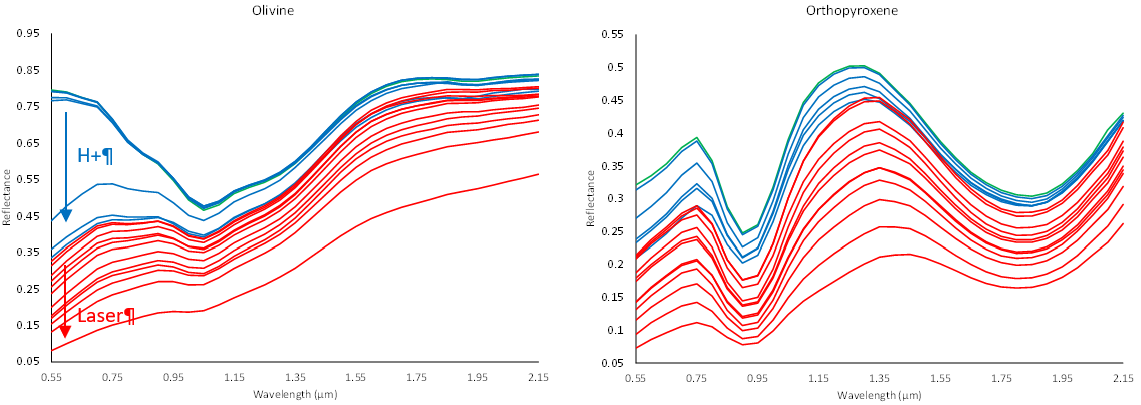
Figure 1: SW spectral evolution of olivine (left) and orthopyroxene (right). Solar-wind dominated SW is indicated at timescales of 50-500 years (from upper to lower blue curve) and microimpact dominated SW at timescales of 108-1010 (from upper to lower red curve). The unaltered pristine spectrum is green.
ASPECT is a flexible hyperspectral imager based on tunable Fabry-Perót interference filter [3]. It consists of three independent Vis-NIR imaging channels, one single-point SWIR spectrometer, and a dedicated data processing unit (DPU) based on Xiphos Q7 (Table 1). ASPECT is the prime payload of Milani CubeSat carried by ESA Hera mission [4] to binary asteroid Didymos-Dimorphos.
The spectral range of ASPECT, especially the range 0.7-1.6 µm of the imaging Vis-NIR1/2 channels, cover the key spectral area of 0.5-1.5 µm where the abovementioned rapid SW onset occurs on timescales 10-103 years EET. ASPECT will conduct global hyperspectral mapping of the target asteroids with a resolution of 1 m/px from 5 km and will be able to detect resurfacing on both asteroids either excavation of fresh material caused by DART spacecraft impact or deposition of fallback ejecta.
Table 1: ASPECT parameters.

How to cite: Kohout, T. and Palamakumbure, L.: Detection of a rapid onset of the space weathering and its non-linear temporal evolution with ASPECT hyperspectral imager of the ESA Hera / Milani mission, Europlanet Science Congress 2026, The Hague, The Netherlands, 6–11 Sep 2026, EPSC2026-191, https://doi.org/10.5194/epsc2026-191, 2026.


