
 1,1,1
1,1,1- 1Institut supérieur de l'Aeronautique et de l'Espace (ISAE-Supaero), Université de Toulouse, Toulouse, France
- 2Institut de Recherche en Astrophysique et Planetologie (IRAP), Toulouse, France
Seismology is a frequently used technique to understand the interior of planetary bodies. It has been widely used on Earth, as well as other celestial bodies such as the Moon (with Apollo missions [1]), on Mars (with the InSight mission [2]), and will be used in upcoming missions such as RAMSES to the asteroid Apophis [3] and even Dragonfly to Titan [4]. Planetary bodies are covered by a layer of regolith, a fine grain layer with a non-linear elastic behaviour that deforms seismic signals. Since planetary seismometers are placed on the surface or in the near sub-surface, they are directly coupled with this regolith layer. It is thus crucial to understand the behaviour of seismic waves in such material to fully interpret seismometer data. The propagation of seismic waves is influenced by the regolith properties, but also by the different levels of gravity. However, while the velocity of seismic waves is known to be pressure dependent the dependency factor often deviates from elastic theory predictions [e.g. 5,6]. Here we perform experiments to study the pressure dependence of the seismic velocities of planetary simulants.
In this context, we use a modified bender element experiment (Figure 1). A sample is placed inside a latex membrane of 10 cm in diameter and 20 cm height, with one bender element at each side. A vacuum pump is connected to the bender elements to apply a partial vacuum inside the sample. A pressure controller and a barometer are also used to have a precise estimation of the pressure inside our sample, and prevent leaks. With respect to classical bender element experiments, the sample is placed horizontally to minimize the effect of gravity and reach lower confining pressure levels (currently 10 to 85 kPa) [7]. Seismic waves (4 kHz sine pulse) are then transmitted through the sample. Experimental results for several different lunar, martian and asteroid regolith simulants will be presented during the conference and their pressure sensitivity factors will be compared.
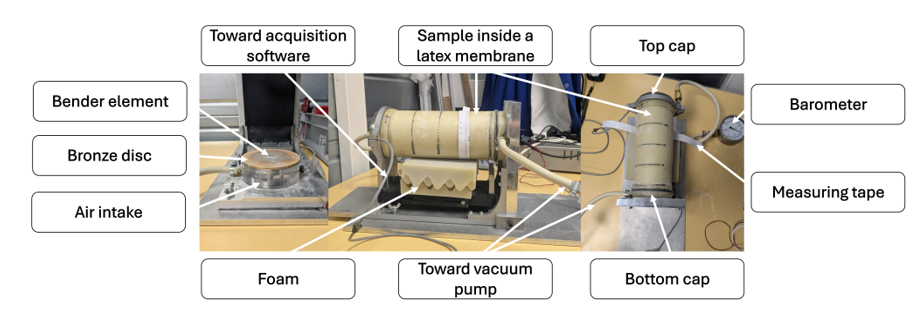
Figure 1: Horizontal bender element experiment set-up.
This work is funded by the European Research Council (ERC) GRAVITE project (Grant Agreement N° 1087060).
References
[1] Bates, James R. ALSEP termination report. Vol. 1036. National Aeronautics and Space Administration, Scientific and Technical Information Office, 1979.
[2] Lognonné, Philippe, et al. "SEIS: Insight’s seismic experiment for internal structure of Mars." Space Science Reviews1 (2019): 12.
[3] Murdoch, Naomi, et al. Seismic Instrument for Asteroids (SIA): the RAMSES seismometer. No. EPSC-DPS2025-417. Copernicus Meetings, 2025.
[4] Lorenz, Ralph D., et al. "Dragonfly: A rotorcraft lander concept for scientific exploration at Titan." Johns Hopkins APL Technical Digest3 (2018): 14.
[5] Johnson, David Linton, et al. "Nonlinear elasticity of granular media." Physica B: Condensed Matter1-3 (2000): 134-138.
[6] Makse, H. A., et al. "The apparent failure of effective medium theory in granular materials." Physics and Chemistry of the Earth, Part A: Solid Earth and Geodesy1-2 (2001): 107-111.
[7] Betancourt, JP Castillo, et al. "Wave velocities and Poisson ratio in a loose sandy Martian regolith simulant under low stresses: 1. Laboratory investigation." Journal of Geophysical Research: Planets11 (2023): e2023JE007988.
How to cite: Amsili, A., Peignon, A., Margerin, L., and Murdoch, N.: Seismic velocity characterisation of planetary simulants, Europlanet Science Congress 2026, The Hague, The Netherlands, 7–11 Sep 2026, EPSC2026-193, https://doi.org/10.5194/epsc2026-193, 2026.


