
- 1RIU Cologne, Planetary Research, Cologne, Germany (kerstin.peter@fip-koeln.de)
- 2Laboratory for Atmospheric and Space Physics, University of Colorado, Boulder, USA
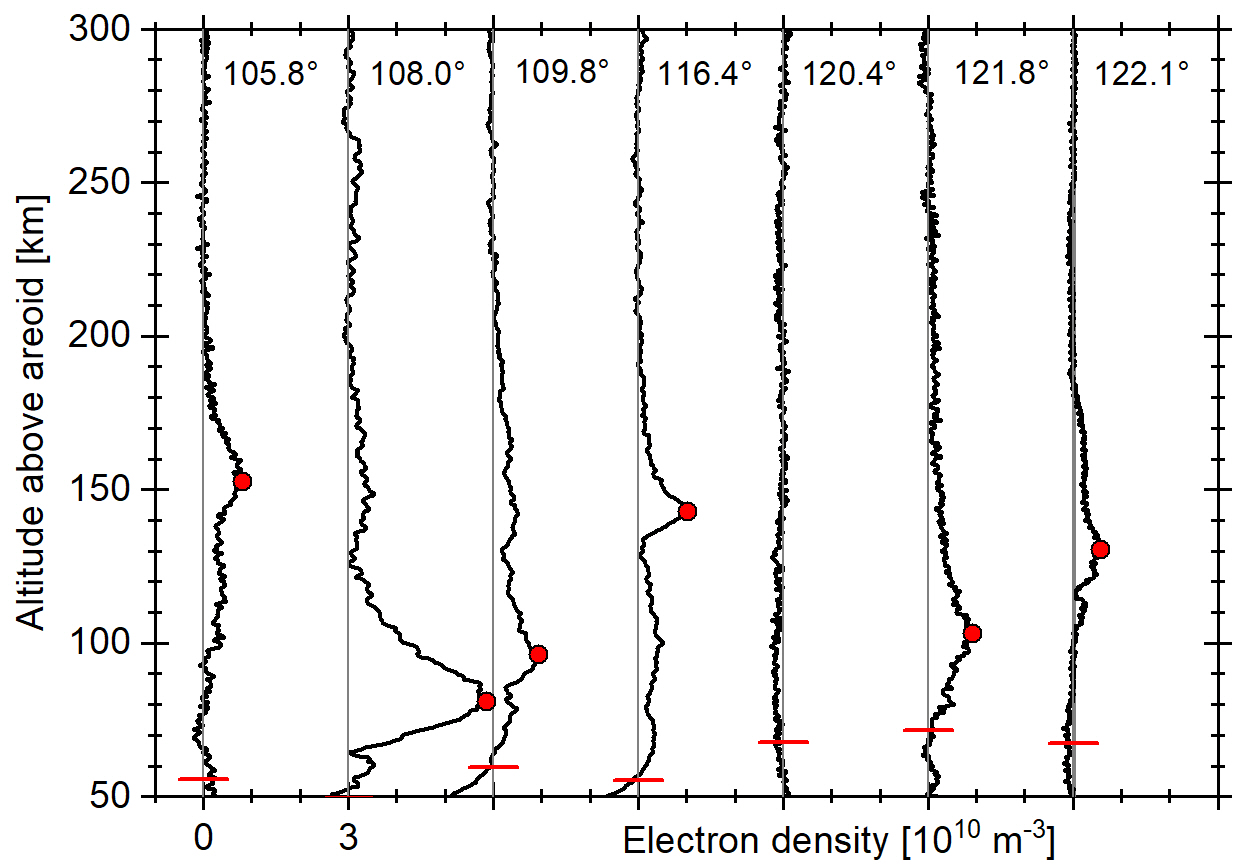
Fig. 1:. 7 MaRS terminator/nightside electron density profiles observed between August and September 2005. All profiles have an offset of 3·1010 m−3 to the neighbouring profiles. The vertical gray line indicates zero electron density for each profile. The red dot indicates the identified peak electron density, and the vertical red line indicates the lowest valid altitude of the profile.
The Mars Express (MEX) spacecraft has been orbiting Mars since December 2003. Its MaRS (Mars Radio Science) experiment uses spacecraft-Earth radio occultations to provide information about the ionospheric electron density and the pressure, density and temperature of the lower neutral atmosphere.
In this study, the variability of the Martian ionosphere (Figure 1) for solar zenith angles (SZAs) > 90° is investigated using Mars Express MaRS Earth occultation measurements acquired between 2004 and 2021. A total of 587 high-quality MaRS profiles is analyzed, supported by solar flux proxies derived from MAVEN LPW-EUVM observations, heliocentric distance, and model-derived crustal magnetic field information. The selected dataset covers SZAs up to 125°.
A substantial ionosphere is identified in 96% of the lit nightside observations, indicating that direct ionization by solar irradiation remains sufficient to sustain an ionosphere in this region under all observed levels of solar irradiance at Mars. In the deep nightside region, 68% of the observations still contain a detectable ionospheric signature. A clear correlation is observed between the occurrence of ionospheric signatures and solar irradiation flux.
The altitude of the upper ionospheric peak on the lit nightside increases up to SZAs of ~100°, showing a clear correlation with enhanced solar irradiation and atmospheric dust loading. Peak electron densities and total electron content on the deep nightside are small compared to those on the lit nightside, apart from isolated profiles likely associated with intense solar events (profile 2 in Figure 1).
These results highlight the complex and variable nature of the Martian terminator and nightside ionosphere and emphasize the importance of future radio science investigations of the deep nightside. Upcoming missions such as the proposed ESA M-MATISSE mission would provide critical new constraints on the structure and dynamics of the deep nightside ionosphere of Mars.
How to cite: Peter, K., Pätzold, M., Thiemann, E., and Tellmann, S.: The terminator and nightside ionosphere of Mars as seen by Mars Express MaRS radio science, Europlanet Science Congress 2026, The Hague, The Netherlands, 7–11 Sep 2026, EPSC2026-213, https://doi.org/10.5194/epsc2026-213, 2026.


