
 12
12- 1Université Paris Cité / CNRS /IPGP, IPGP, CAGE, Paris, France (charnoz@ipgp.fr)
- 2Centro de Astrobiología CSIC-INTA, Torrejón de Ardoz, Madrid, Spain (iherreros@cab.inta-csic.es)
The 2029 close encounter of asteroid (99942) Apophis with Earth will provide a unique natural experiment to investigate how tidal forcing, seismic shaking, and varying surface accelerations affect the mechanical response of a small body. ESA-JAXA’s RAMSES mission is designed to rendezvous with Apophis before the encounter and monitor its physical and geological evolution during the flyby, offering an unprecedented opportunity to detect surface reorganisation, slope failure, regolith transport, and possible mass shedding in real time.
Mass-wasting processes are expected to be particularly sensitive to the poorly constrained mechanical properties of asteroidal regolith. In this work, we introduce RAVEL (Regolith Astrodynamics in Variable Effective Low-gravity environments), a model particularly well suited to simulate potential motion of surface material on Apophis at closest approach to Earth. The model couples the instantaneous orbital configuration with the surface acceleration field and integrates the trajectories of massless Lagrangian tracers over the asteroid topography. These trajectories are interpreted as kinematic pathways of potential regolith mobilisation rather than as individual particle motions. Because the surface mechanical properties of Apophis remain largely unconstrained, we consider a cohesionless material and explore two end-member effective friction angles: ϕ = 20º and ϕ = 30º which bracket relatively high- and low-mobility regimes.
Our preliminary results show that Apophis may develop locally steep dynamical slopes during the encounter, with values reaching up to approximately 45º in some regions. Under the low-friction end-member, mobilisation is more spatially extensive and produces longer Regolith Migration Pathways (RMPs), indicating that surface material could be redistributed over significant distances and, in favourable locations, approach conditions potentially compatible with detachment or shedding. The higher-friction case strongly reduces the number and length of active pathways, but does not suppress mobilisation entirely: motion remains concentrated in the steepest and most dynamically perturbed regions. The comparison between both end-members suggests that the geometry of the main migration corridors is primarily controlled by the topography and encounter-induced acceleration field, whereas the assumed friction angle modulates the extent, runout, and efficiency of transport.
Our model, RAVEL, provides a predictive framework for interpreting RAMSES observations before, during, and after the 2029 flyby and will contribute to identify, prior to approach the regions where surface material is the most susceptible to be tidally displaced during the encounter. Conversely, comparison with RAMSES imaging and shape-model updates will allow the mechanical response of Apophis to be used as a constraint on regolith friction, cohesion, and near-surface structures. The determination of the Regolith Migration Pathways therefore offers a direct link between dynamical modelling and observable geomorphological change, contributing to the broader objective of using Apophis as a natural laboratory for asteroid geophysics and planetary defence.
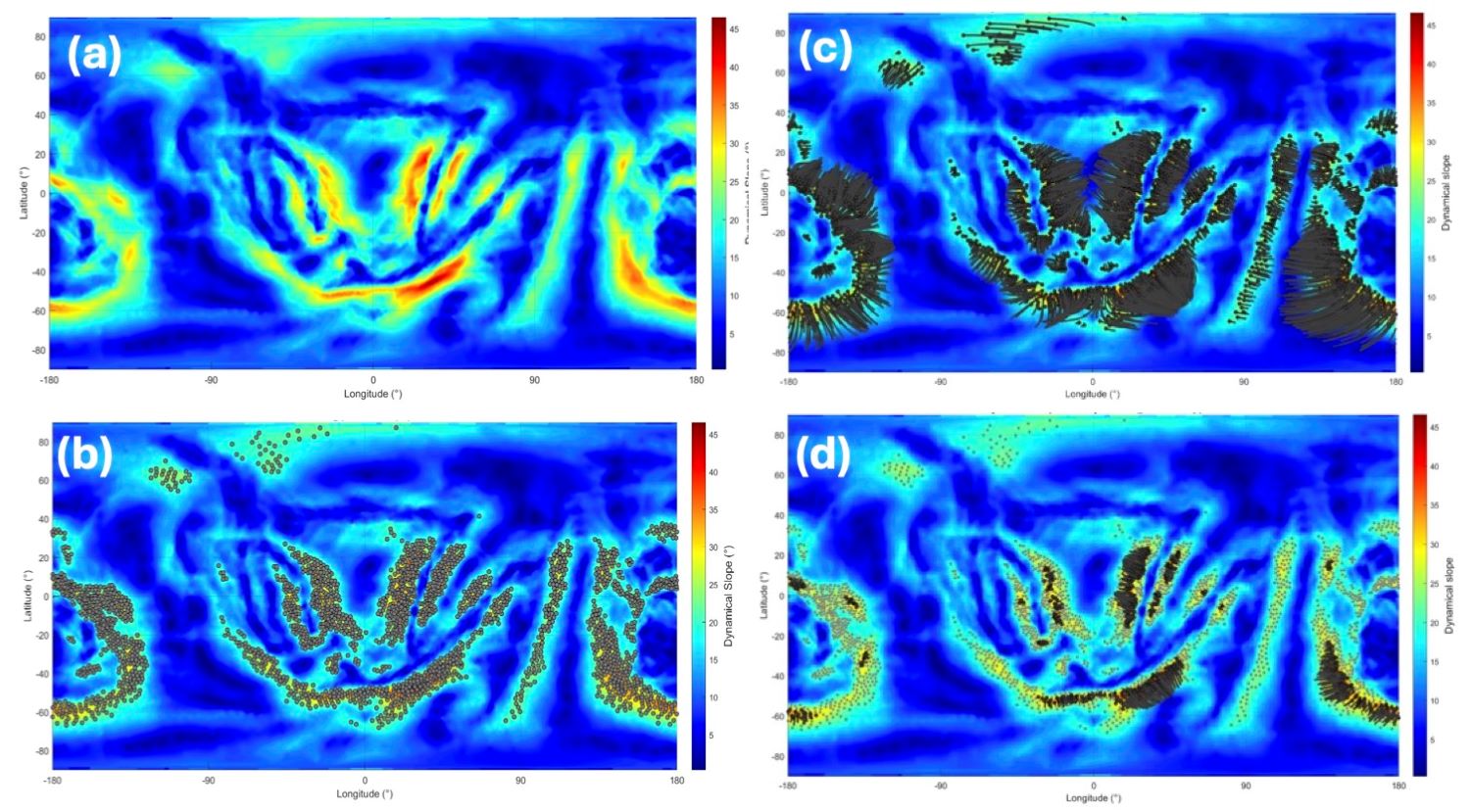
Figure 1: a) Dynamical slope on the surface of Apophis at maximum Earth approach; b) Starting points for the RMPs with dynamical slope higher than 20º; c) RMPs for ϕ = 20º; d) RMPs for ϕ = 30º.
How to cite: Charnoz, S. and Herreros, I.: Regolith Migration Pathways on Apophis during the 2029 Earth close encounter: Implications for RAMSES observations, Europlanet Science Congress 2026, The Hague, The Netherlands, 6–11 Sep 2026, EPSC2026-250, https://doi.org/10.5194/epsc2026-250, 2026.


