
 ,,
,,- University of Helsinki, Geography and Geosciences, Helsinki, Finland (lakshika.palamakumbure@helsinki.fi)
Space weathering (SW) progressively alters the optical and spectral properties of airless bodies through solar wind irradiation and micrometeorite impacts, modifying surface reflectance (e.g., Pieters et al. 2000). As a time-dependent process, SW provides a useful proxy for constraining surface exposure age and resurfacing histories of asteroids, offering insights into regolith dynamics, collisional evolution, and orbital environment effects across the inner Solar System. This work develops and applies machine-learning-based approaches to quantitatively estimate model-based SW ages of chondritic asteroids at multiple scales, from asteroid families to individual near-Earth asteroids (NEAs).
This study introduces a novel ensemble machine-learning framework design to exploit visible and near-infrared reflectance spectra. The framework combines a convolutional neural network (CNN), optimized to capture subtle wavelength-dependent spectral features, with four tree-based regression models, namely, gradient boosting regressor (GBR), K-nearest neighbour (KNN) regressor, extra tree regressor (ETR), and random forest regressor (RFR). These models are trained on published laboratory reflectance spectra of space-weathered silicate material, including olivine, pyroxene, olivine-pyroxene mixtures, and ordinary chondritic meteorites. SW effects are simulated experimentally through H+ irradiation to reproduce solar wind irradiation and pulse laser irradiation to mimic micrometeorite impacts, allowing the model to learn time-dependent spectral evolution under controlled conditions. The ensemble approach improves robustness and generalization by integrating nonlinear feature extraction with physically interpretable regression trends.
This framework is applied to spacecraft-derived spectral datasets of the near-Earth asteroids (25143) Itokawa and (433) Eros. For Itokawa, reflectance spectra obtained by the Near-Infrared Spectrometer onboard the Hayabusa mission reveal a highly heterogeneous distribution of SW ages, ranging from ~1.9 kyr to 2.5 Gyr. These results indicate rapid solar wind-driven alteration combined with efficient regolith turnover, consistent with the asteroid’s small size, rubble-pile structure, and observed grain-scale mobility. Older SW ages correspond to relatively stable regions such as Arcoon, while younger surface reflects recent resurfacing or regolith disturbance. In contrast, spectra from the Near-Infrared Spectrometer onboard NEAR Shoemaker show that Eros exhibits more spatially uniform and generally older SW ages (~0.4-2 Gyr), dominated by micrometeorite, reflecting a more mature yet dynamically evolving surface. These results align with previous spectral studies and with laboratory analyses of returned Hayabusa samples, validating the machine-learning approach.
Furthermore, we extend the study to population-level analysis using Sloan Digital Sky Survey (SDSS) data. A supportive Vector Regression (SVR) model, independently trained on laboratory SW spectra, is applied to SDSS visible reflectance data to estimate SW ages of S-type and V-type asteroid families, including Flora, Massalia, Vesta, Eunomia, Maria, Merxia, and Koronis (Figure 1). Several families display median SW age broadly consistent with their reported dynamical ages, suggesting quasi-steady surface evolution following family-forming collisions. In contrast, other families exhibit younger SW ages systematically, pointing to ongoing resurfacing driven by impacts, YORP-induced spin evolution, and slower SW rates at larger heliocentric distances. These results highlight the complex interplay between SW, regolith reworking, and dynamical processes on the timescale of hundreds of millions of years.
Overall, this work demonstrates that machine-learning techniques calibrate with laboratory spectral measurements, enabling a quantitative interpretation of asteroid surface exposure histories, moving beyond the largely qualitative or semi-quantitative approaches used in SW studies (e.g., Willman & Jedicke 2011, Nesvorny et al. 2005). By linking high-resolution spacecraft observations and large asteroid photometric datasets, the work provides a unified framework for interpreting SW signatures across spatial scales (Hapke 2001, Brunetto et al. 2015). The derived SW ages, however, are dependent on model-derived irradiation and impact conditions of the interplanetary environment, as well as assumptions embedded in laboratory simulations of solar wind and micrometeorite processes. Despite these limitations, the results offer new quantitative constraints on the interplay between SW, regolith dynamics, and asteroid evolution, advancing our understanding of surface processes on airless bodies through the Solar System.
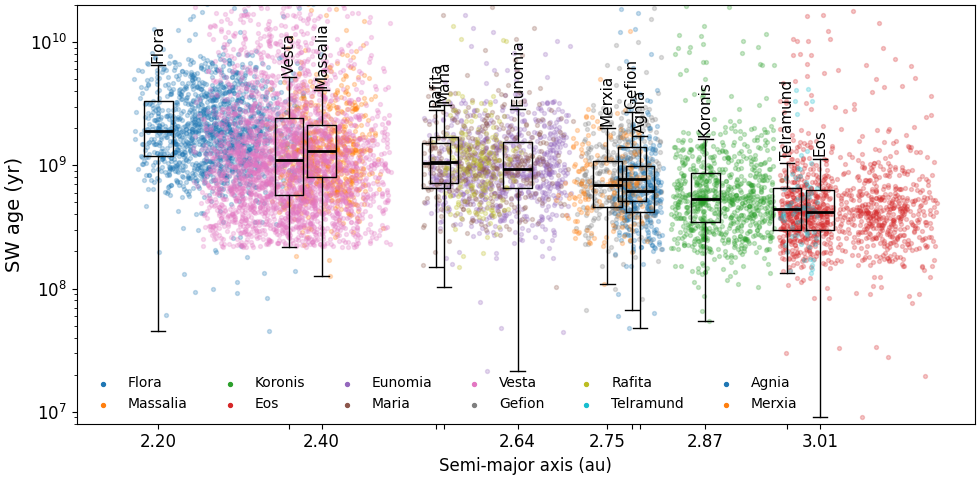
Figure 1: SW age of asteroid families and corresponding box plot showing the statistical distribution of each family.
Brunetto et al. 2006 DOI 10.1051/0004-6361/202243587
Hapke 2001 DOI 10.1029/2000JE001338
Nesvorny et al. 2005 DOI 10.1016/j.icarus.2004.07.026
Pieters et al. 2000 DOI 10.1111/j.1945-5100.2000.tb01496.x
Willman & Jedicke 2010 DOI 10.1016/j.icarus.2010.08.022
How to cite: Palamakumbure, L., Korda, D., and Kohout, T.: Aging in space: Space weathering age of chondritic asteroids, Europlanet Science Congress 2026, The Hague, The Netherlands, 7–11 Sep 2026, EPSC2026-308, https://doi.org/10.5194/epsc2026-308, 2026.


