

- University of Oxford, Department of Physics, Atmospheric, Oceanic, and Planetary Physics, Oxford, United Kingdom of Great Britain – England, Scotland, Wales (duncan.lyster@physics.ox.ac.uk)
Accurately characterizing the endogenic thermal signatures of icy moons requires a detailed understanding of surface heating driven by insolation, surface properties and local terrain. Due to the lack of high-resolution thermal observations, Europa’s surface temperatures have historically been sufficiently modelled using smooth surface or one-dimensional approximations [1]. However, Europa’s complex terrains alter local illumination conditions and surface temperatures. Here, we use TEMPEST, an open-source, python based thermophysical model [2, 3] to investigate the significance of radiative self-heating and light scattering on interpretation of Europa’s thermal IR emission, with a particular focus on detectability of near-surface liquid-water reservoirs by high spatial resolution (≤100 m/pixel) observations soon to be taken by Europa Clipper’s E-THEMIS instrument [4].
Passive heating by solar illumination was modelled under Europa-like conditions using TEMPEST, which solves a surface energy balance that includes solar flux, thermal emission, vertical heat conduction, and (optionally) scattering, radiative self-heating and macroscopic surface roughness. The 1D periodic conduction solver at its core is based on thermprojrs [5]. Comparing a smooth sphere (fig. 1a, c) to the topographic digital elevation model (DEM) (fig. 1b, d) reveals that while mean temperatures remain comparable, topography introduces substantial heterogeneity. For example, the DEM has a wider distribution of surface temperatures due to local slope and shadowing effects. Thermal radiance scales with Temperature4 (Stefan-Boltzmann law), so the small minority of hotter regions can dominate the thermal IR signal (fig. 2). We show that rough terrain emits significantly higher total radiance than a smooth sphere despite the similar mean kinetic temperature.
Simulated topographic temperature maps show that light scattering and radiative exchange with local terrain cause increased surface temperature heterogeneity, with local temperature increases in deep fractures as high as 35 K (fig. 3). Temperature heterogeneity can systematically bias mean temperature measurements, and localised mutual radiative heating can lead to apparently anomalous warm regions, potentially mimicking endogenic heating, or obscuring indications of conductive heating from near-surface water reservoirs. To place these effects in the context of E-THEMIS detectability, we will use first-order conductive heat-flux calculations to estimate the surface expressions of idealised subsurface liquid-water reservoirs at different depths and spatial scales. These calculations will provide test cases for distinguishing plausible endogenic thermal anomalies from topographically induced radiance variations. This work shows that if topography is ignored, the excess radiance caused by it could be misinterpreted as a region of lower thermal inertia (in daytime), or even an endogenic heat source (hotspot). Accurately modelling terrain reduces the risk of false positives when searching for plume sources or active regions.
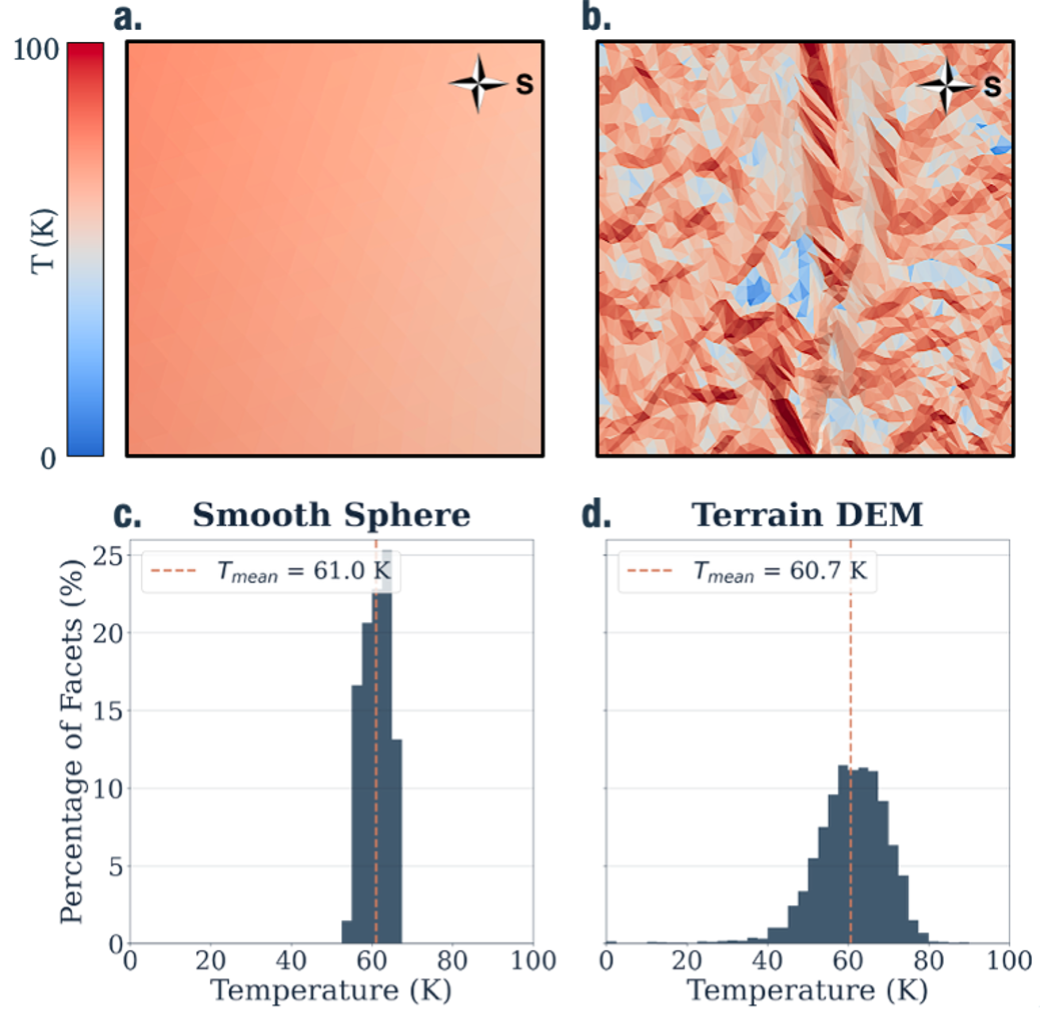
Figure 1: Surface temperature maps for a section of an icy moon modelled as a smooth sphere (a) and using a digital elevation model (DEM) of Enceladus (b) using Europa thermal parameters. Histograms (c) and (d) show the distribution of surface temperatures within the above terrain samples.
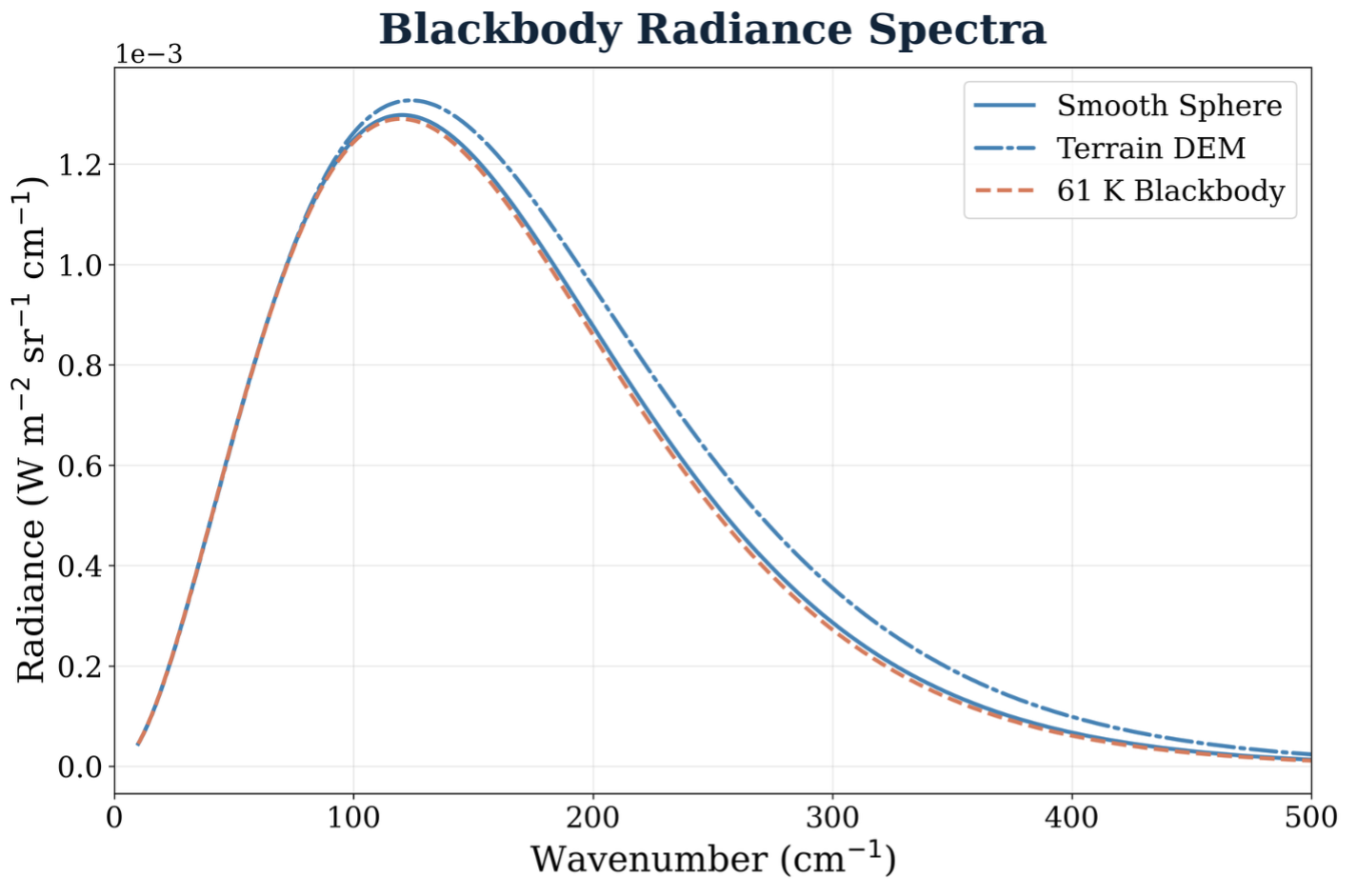
Figure 2: The integrated surface radiance from each terrain sample. The T4 dependence of radiance leads to significantly higher emission from the DEM terrain.
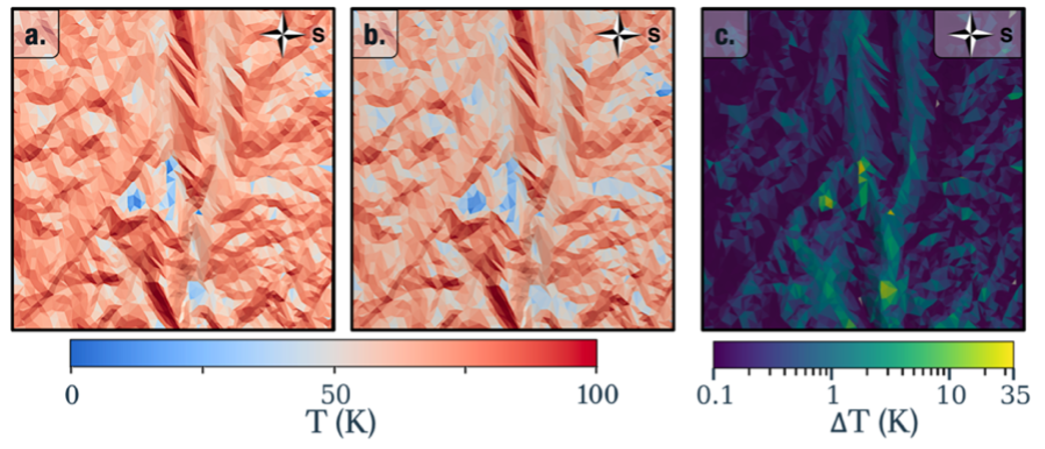
Figure 3: Simulated Europa surface temperatures without (a) and with (b) multiple scattering and radiative self-heating. Panel (c) shows the resulting temperature difference, with local increases up to 35 K in shadowed terrain. Enceladus DEM [6] provides an icy-terrain analogue for topographic heating effects. Future work will repeat this analysis using Europa-specific topography where available.
References:
[1] Rathbun, J. A., Rodriguez, N. J., & Spencer, J. R. (2010). Galileo PPR observations of Europa: Hotspot detection limits and surface thermal properties. Icarus, 210(2), 763-769.
[2] Lyster, D., Howett, C., & Penn, J. (2025). TEMPEST: A Modular Thermophysical Model for Airless Bodies with Support for Surface Roughness and Non-Periodic Heating. EPSC-DPS 2025, 1479.
[3] Chivers, C.J., Hayne, P.O. and Schmidt, B.E. (2025). Prospects For Detecting Shallow Liquid Water Bodies At Europa Using E-Themis. LPSC 2025, 1226.
[4] Christensen, P.R., Spencer, J.R., Mehall, G.L., Patel, M., Anwar, S., Brick, M., Bowles, H., Farkas, Z., Fisher, T., Gjellum, D. and Holmes, A. (2024). The Europa thermal emission imaging system (E-THEMIS) investigation for the Europa clipper mission. Space Science Reviews, 220(4), 38.
[5] Spencer, J.R., Lebofsky, L.A., and Sykes, M.V. (1989). Systematic biases in radiometric diameter determinations. Icarus, 78(2), 337-354.
[6] Park, R.S., Mastrodemos, N., Jacobson, R.A., Berne, A., Vaughan, A.T., Hemingway, D.J., Leonard, E.J., Castillo-Rogez, J.C., Cockell, C.S., Keane, J.T. and Konopliv, A.S. (2024). The global shape, gravity field, and libration of Enceladus. Journal of Geophysical Research: Planets, 129(1), e2023JE008054.
How to cite: Lyster, D. and Howett, C.: Thermophysical Modelling of Europa’s Surface: Influence of Topography on E-THEMIS Sensitivity to Localised Endogenic Heating, Europlanet Science Congress 2026, The Hague, The Netherlands, 7–11 Sep 2026, EPSC2026-341, https://doi.org/10.5194/epsc2026-341, 2026.


