

- Forschungszentrum Jülich, JSC, Jülich, Germany (s.pfalzner@fz-juelich.de)
The population of over six thousand detected exoplanets demonstrates remarkable diversity, spanning rocky planets, ocean worlds, and gas giants. The astrophysical mechanisms driving this broad spectrum of planetary outcomes are not yet fully constrained. Here, we systematically analyze the interplay between protoplanetary disc lifetime, host star mass, and the resulting planet type to elucidate the underlying physical processes.
The evolution and dispersal timescale of protoplanetary discs constitutes a pivotal constraint on the planet formation process. While the mean disc lifetime offers a first-order estimate for the temporal window available for planet assembly, it fails to account for the considerable star-to-star scatter and the systematic dependence on stellar mass. To overcome these limitations, we quantify the full disc lifetime probability distribution as a function of stellar mass. Our analysis uncovers a strong mass dependence: fitting the distributions with a Weibull profile, we identify maxima at tmaxH = 3. 7 Myr for higher-mass stars (~1—3 MSun) and tmaxL = 7.2 Myr for low-mass stars (~0.01—0.2 MSun), assuming an initial disc fraction of finit = 80%. All distributions are intrinsically broad (typically 3.2 Myr < s < 4.7 Myr), with the low-mass star sample showing a somewhat greater width.
Our results further indicate that a significant fraction of stars are not initially encircled by a protoplanetary disc (60% < finit < 90% at cluster zero age), with the initial disc fraction dropping to approximately finit ≈ 40% for higher-mass stars. Potential mechanisms—such as external photoevaporation, stellar encounters, and variations in core accretion efficiency—may account for the observed dispersion and the mass dependence in disc lifetime distributions and initial disc fractions.
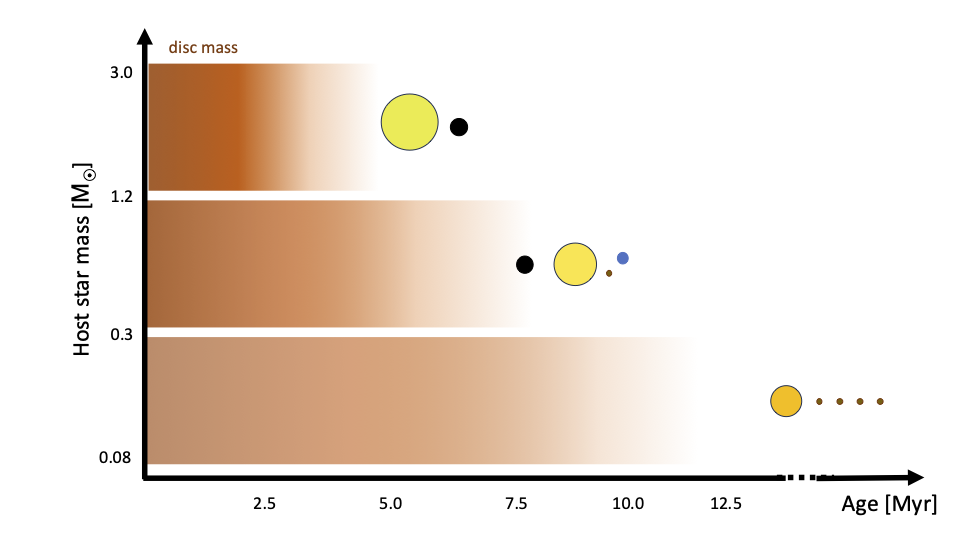
To probe the link between disc lifetime diversity and the architecture of planetary systems, we utilize planetary bulk densities as diagnostics for planet classification. Our findings reveal three distinct host star mass regimes associated with planet type: (1) For Ms < 0.3 MSun, the formation of rocky planets is strongly favoured; (2) in the range 0.3 MSun < Ms < 1.2 MSun, all planet types are present but ocean worlds predominate; and (3) for Ms > 1.2 MSun, gas giants emerge as the dominant population.
The corresponding disc lifetimes for different planet types vary substantially: giant planet formation predominantly occurs within 1–4 Myr, ocean worlds assemble within 5–10 Myr, and rocky planets may require disc survival beyond 10 Myr. Planet formation efficiency declines sharply with increasing stellar mass and decreasing mean disc lifetime; fewer than 6–13% of stars in the 1.5–3 MSun range host giant planets, while rocky planets are prevalent (>60%) around low-mass stars. We discuss the critical role of disc lifetime in setting the overall efficiency of planet formation.
How to cite: Pfalzner, S., Wagner, F. W., and Dincer, F.: Stellar Mass, Disc Lifetimes, and the Origins of Exoplanet Diversity , Europlanet Science Congress 2026, The Hague, The Netherlands, 7–11 Sep 2026, EPSC2026-35, https://doi.org/10.5194/epsc2026-35, 2026.


