
 1,1,2,
- 1Nantes Université, Université d’Angers, Le Mans Université, CNRS, Laboratoire de Planétologie et Géosciences, LPG UMR 6112, 44000 Nantes, France.
- 2LGLTPE, ENS de Lyon, Université de Lyon, 46 allée d’Italie, 69003 Lyon, France.
Icy moons are not static layered bodies, but evolving systems whose present-day structure records a history of accretion, heating, melting, fluid migration, and freezing. Subsurface ocean formation is both a major outcome of this evolution and a key control on its subsequent trajectory, governing heat transfer between the rocky interior and the outer ice shell as well as the redistribution of salts and organic compounds relevant to habitability [1]. For the largest bodies, differentiation may also lead to metallic core formation, which is central to understanding Ganymede, the only icy moon known to possess an intrinsic magnetic field. Understanding when and how moons differentiate is therefore essential for interpreting the diversity of ocean worlds, from fully differentiated bodies such as Ganymede to less differentiated moons such as Callisto. Yet, the timing and efficiency of differentiation remain strongly dependent on poorly constrained initial conditions, including body size, ice–rock–metal-organics fractions, radiogenic inventory, orbital evolution, and the ability of melt to segregate through a compacting matrix.
Here, we present BOREAS — Biphasic flows in Ocean moons: Role in Evolution And Segregation — a new numerical code designed to model the internal differentiation of icy bodies. The code solves the coupled evolution of a deformable solid matrix and a migrating liquid phase in one-dimensional spherical geometry [2]. It allows porosity generation, melt migration, matrix compaction, latent heat exchange, and heat transport to evolve self-consistently. The same formalism can be applied to two end-member differentiation problems: the upward segregation of liquid water through an ice–rock mixture, and the downward segregation of a denser metallic liquid during core formation. This flexibility makes it possible to explore both ocean formation and iron core differentiation in icy satellites within a common physical framework.
In the absence of tidal heating, first results show that ocean formation is slow on geological timescales. For chondritic radiogenic heating, internal melting typically begins after a few tens of millions of years, but complete ice–rock differentiation requires much longer timescales, from approximately 500 Myr to 1.75 Gyr depending on moon size, with smaller bodies evolving faster than larger ones. Increasing either the initial rock fraction or the radiogenic heat production accelerates differentiation by promoting earlier and faster melting. The model also predicts that migrating water can pass through warm outer-core regions before joining the hydrosphere, creating a transient leaching zone that may contribute to the delivery of soluble and organic compounds to the ocean [Fig 1].
Preliminary simulations of metallic differentiation suggest a very late event. Without tidal heating, the segregation of metallic liquid and the formation of a metallic core only occur in the largest icy moons, typically after 4 Gyr. In Ganymede-sized bodies, core formation may therefore still be ongoing at the present epoch. This result opens an alternative interpretation of Ganymede’s intrinsic magnetic field: rather than requiring a ancient fully formed cooling core [3], the field may be linked to the dynamics of a core still forming today.
BOREAS therefore provides a unique tool to investigate the internal differentiation of icy worlds, with direct relevance for the interpretation of observations by the upcoming ESA-JUICE mission and by other missions targetting ocean-worlds.
[1] Hussmann, H., Sohl, F., & Spohn, T. (2006). Subsurface oceans and deep interiors of medium-sized outer planet satellites and large trans-neptunian objects. Icarus, 185(1), 258-273.
[2] Bercovici, D., Ricard, Y., & Schubert, G. (2001). A two-phase model for compaction and damage: 1. General theory. Journal of Geophysical Research: Solid Earth, 106(B5), 8887–8906.
[3] Schubert, G., Zhang, K., Kivelson, M. G., & Anderson, J. D. (1996). The magnetic field and internal structure of Ganymede. Nature, 384(6609), 544–545.
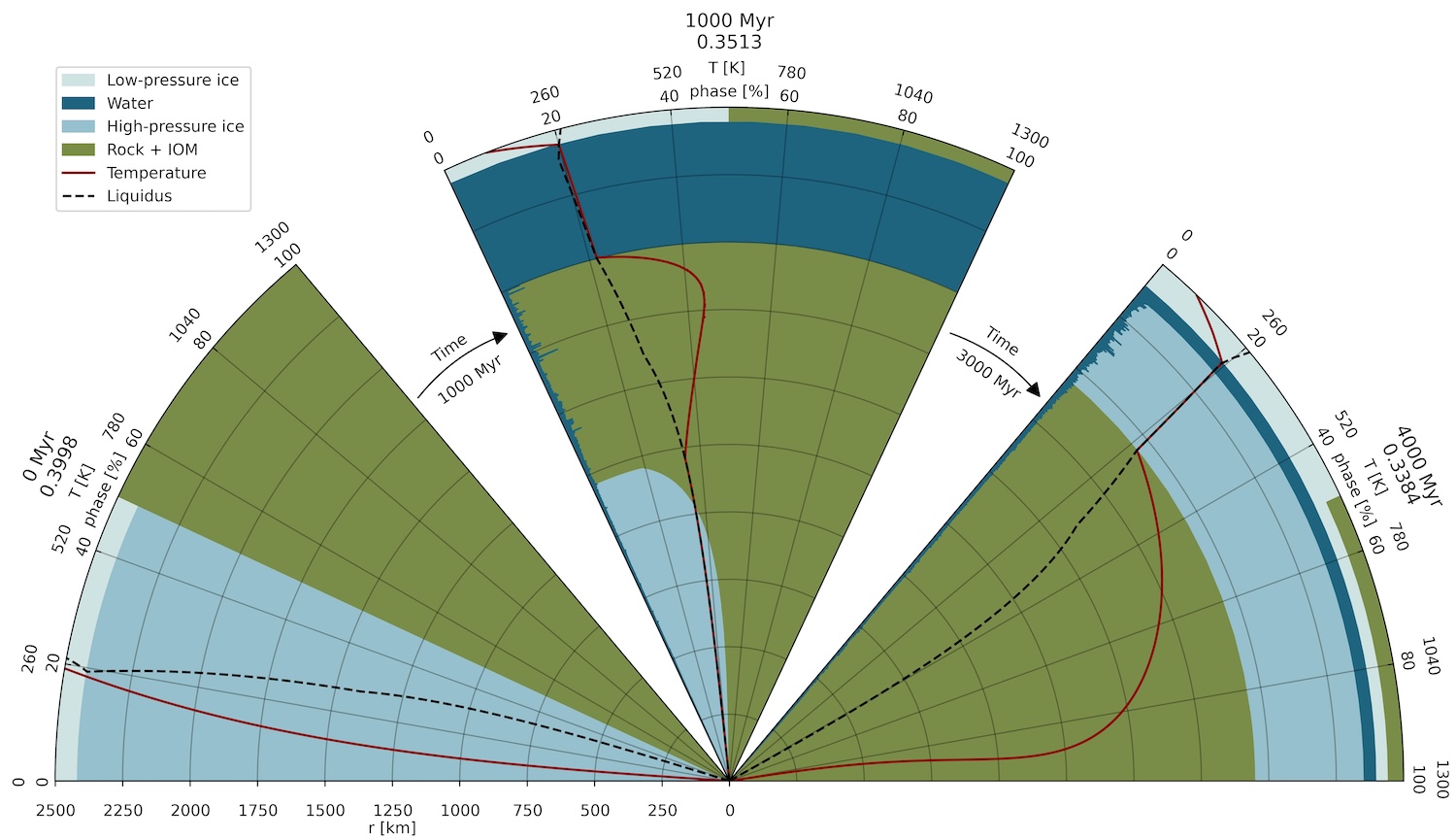
[Fig 1] Snapshots of the internal evolution of a Ganymede-sized reference simulation from an initially homogeneous ice–rock mixture to a differentiated body after 4 Gyr. Colors show the local volume fractions of refractory material, low-pressure ice, high-pressure ice, and liquid water. The red curve shows the radial temperature profile, and the dashed black curve the pressure-dependent liquidus.
How to cite: Pinceloup, M., Bouffard, M., Choblet, G., Labrosse, S., and Sotin, C.: BOREAS: A biphasic code for exploring the timing and diversity of differentiation pathways in icy moons, Europlanet Science Congress 2026, The Hague, The Netherlands, 7–11 Sep 2026, EPSC2026-351, https://doi.org/10.5194/epsc2026-351, 2026.


