
 1,
1,- 1Laboratoire de Planétologie et Géosciences (LPG) , Nantes Université, France
- 2L’Institut des Matériaux de Nantes Jean Rouxel (IMN), Nantes Université, France
Organic matter (OM) has been found in numerous meteorites, and recently on comets and asteroids. The OM from primitive small bodies contains a soluble (SOM) and an insoluble part (IOM) locked in the mineral matrix. This OM is extracted using different protocols based on the separation of SOM with various solvents, followed by mineral digestion using acid treatments.[2-3] These treatments may transform the molecules found within each fraction. Therefore, assessing the effect of these extraction procedures is crucial.
Previous works used infrared spectroscopy (IR) to reveal the varying effects of several extraction protocols.[4-5] Authors reported differences in C-rich fragments of meteorites and asteroids for treated and untreated OM. Increase of C=O bond intensities and CH2/CH3 ratios, together with more pronounced aromatic C-H features, confirm alterations induced by treatment. However, due to the limitations of IR analysis and the absence of sufficient quantities of untreated material, a more detailed evaluation of possible alterations is still missing.
We suggest using synthetic analogues of primordial OM (in our case from the Nebulotron experiment, which mimics gas-phase reactions in the solar nebula) to study the effect of extraction protocols. Previous analyses of untreated Nebulotron organics confirmed their similarity to IOM extracted from chondrites,[6] while they still contain a minor soluble fraction. These synthetic samples provide abundant mineral-free material to assess the effect of extraction protocols, both in separating and transforming the soluble and insoluble fractions potentially found in primordial OM.
Current work is focused on solid fractions, using IR spectroscopy and Fourier transform ion cyclotron resonance mass spectrometry (FT-ICR-MS) to assess potential alterations in Nebulotron OM resulting from common extraction protocols. We describe results for the starting material (Neb-OM, grey), the "harsh" protocol based on HCl/HF treatment after [3] (H, red) and the "mild" protocol based on CsF/dioxane biphasic extraction after [2] (M, blue).
The intensity ratios obtained from IR experiments confirmed structural modifications induced by each treatment (Figure 1A). We noticed a decrease in the C=C/CH ratio for both H and M compared to the starting material, even more significant for M (Figure 1B). Together with more pronounced aromatic C-H features for both treated samples compared to the starting Neb-OM (Figure 1A), it might indicate fragmentation of large condensed ring structures into smaller aromatic units.

Figure 1. A – Stack of IR spectra from two acquisitions of the same treated/untreated solid OM material, with interpretation of regions of interest; untreated Neb-OM – grey, H – red, M – blue. Relative intensity ratio of B – C=C stretching (1612 cm-¹) to aliphatic C-H bending (1444 cm-¹); C – CH₂ asymmetric stretching (2923 cm-¹) to CH₃ asymmetric stretching (2954 cm-¹). Error bars corresponding to 4 acquisitions.
The CH2/CH3 ratio (Figure 1C) increases for H, consistent with acid-promoted cleavage of terminal methyl groups and shortening of aliphatic chains, while M leaves this ratio unchanged, suggesting that dioxane-CsF affect less aliphatic chain length. These IR results are consistent with tendencies previously reported in [4-5]. No clear trend is observed yet for the C=O/C=C ratio.
FT-ICR MS measurements provide the m/z distribution of molecules. Venn diagram analysis (Figure 2A) shows 2332 peaks (48%) are common to all three samples. H generates more exclusive peaks (1049, 22%) than M (284, 6%), suggesting acid treatment produces a greater diversity of new molecular species. Additionally, 848 peaks (17%) are shared by H and M but absent in Neb-OM, while 229 Neb-OM-exclusive peaks (5%) are irreversibly lost after both treatments.
The average m/z distribution (Figure 2C) reveals that H is strongly enriched in low molecular weight compounds (m/z 100–250) compared to untreated Neb-OM, consistent with acid-promoted fragmentation of larger molecules into smaller species. M follows the Neb-OM distribution more closely, suggesting a milder effect on the sample. DBE (Double Bond Equivalents) represents the number of rings and double bonds in detected molecules. Both H and M treatments result in a significant shift of the DBE distribution of detected compared to untreated Neb-OM (Figure 2B).
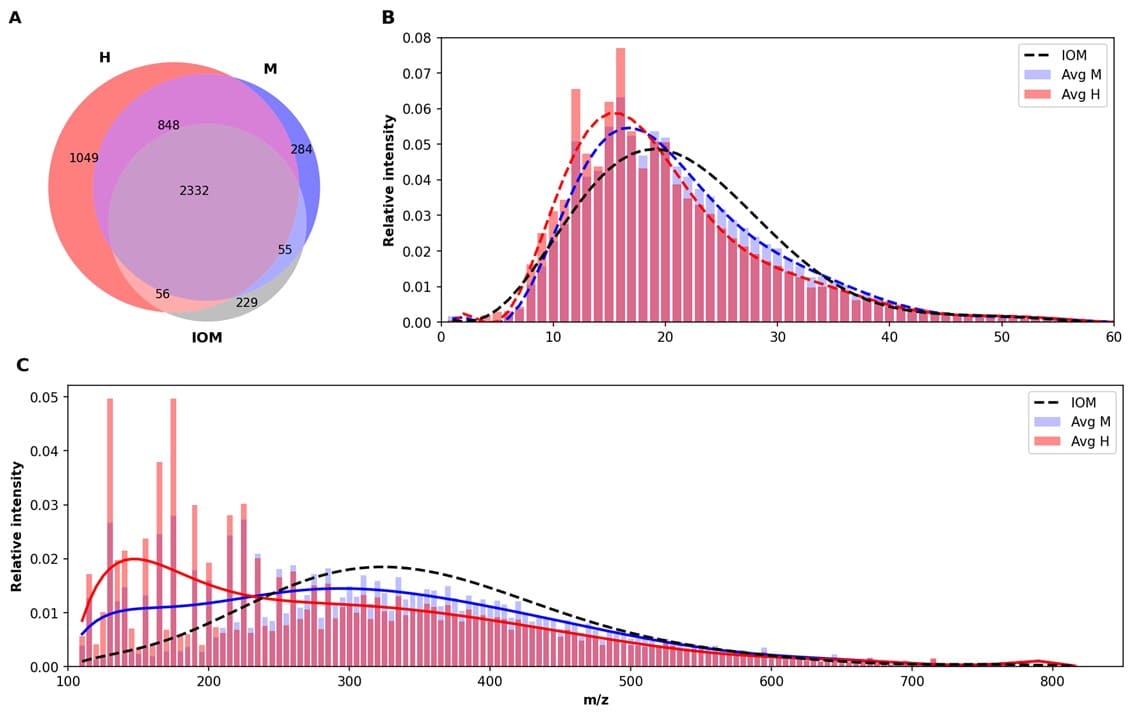
Figure 2. A – Venn diagram of common and unique molecular peaks between H, M and Neb-OM (H and M represent the union of two replicates). B – Average DBE distributions of H, M and Neb-OM. Bars represent relative intensities summed at each DBE value and averaged across replicates; IOM is shown as a polynomial fit. C – Average m/z distributions of H, M and Neb-OM, showing only m/z values common to all three samples; lines are polynomial fits. Bars represent relative intensities summed within 5 Da bins and averaged across replicates.
The peak of the polynomial fit is at a maximum DBE of 15 for H, 19 for M, and 21 for Neb-OM, with a significant loss of peaks in the 20-40 DBE range for both protocols. H shows a larger difference, consistent with acid-promoted cleavage of organic structures, supported by the increased CH₂/CH₃ ratio and pronounced aromatic C–H features observed in IR spectroscopy. M has a milder effect and shows slightly lower depletion at DBE values below 15. Molecules above DBE 40, likely corresponding to highly condensed, graphite-like polycyclic aromatic structures, demonstrated only minor changes due to their chemical inertness.
These preliminary results, obtained from a single Neb-OM batch, demonstrate that commonly used extraction protocols induce measurable and chemically distinct alterations, detectable after just one treatment cycle. Future work will extend these findings using solid-state nuclear magnetic resonance (ssNMR), more detailed FT-ICR-MS analysis, and characterisation of the collected SOM fractions, alongside a second set of experiments on a different IOM batch to confirm reproducibility. This better understanding of protocol-induced alterations will provide a more reliable framework for the interpretation of IOM composition in extraterrestrial samples.
Literature References:
[1] Pizzarello et al., Acc. Chem. Res. 2006, 39, 4, 231–237.
[2] Cody et al., GCA, 2002, 66, 1851-1865.
[3] Remusat et al., Meteorit.Planet.Sci., 2008, 43, 1099-1111.
[4] Kebukawa et al., 2024, Meteorit Planet Sci, 59, 1845-1858.
[5] Kebukawa et al., 2019, Meteorit.Planet.Sci., 54-7, 1632–1641.
[6] Lévêque et al., 2024, ACS Earth Space Chem., 8, 1281-1295.
How to cite: Shvetsova, A., Fariñas, M., Bollengier, O., La, C., Paris, M., and Sotin, C.: Assessing the Chemical Impact of Insoluble Organic Matter Extraction Protocols and Its Implications for Extraterrestrial Organic Matter, Europlanet Science Congress 2026, The Hague, The Netherlands, 7–11 Sep 2026, EPSC2026-352, https://doi.org/10.5194/epsc2026-352, 2026.


