
 1,1,4,6,6,
- 1Nantes Université, Univ. Angers, Le Mans Université, CNRS, Laboratoire de Planétologie et Géosciences, LPG UMR 6112, Nantes 44000, France (maria.farinas@univ-nantes.fr)
- 2Earth-Life Science Institute (ELSI), Institute of Science Tokyo, Tokyo 145-0061, Japan
- 3Institut des Sciences de la Terre d’Orléans (ISTO), UMR 7327, Univ. Orléans, CNRS, BRGM, OSUCUMR 7327, Orléans 45100, France
- 4Université de Lorraine, LCP-A2MC, Metz 57000, France
- 5CEISAM, Nantes Université, UMR-CNRS 6230, Nantes F-44000, France
- 6Dipartimento di Scienze della Terra “Ardito Desio”, University of Milan, Milan, 20122, Italy
Organics are present throughout a wide range of Solar System objects, including dust particles, small bodies (comets, meteorites, asteroids), and planetary objects (planets, satellites, and trans-Neptunian objects (TNOs)). Significant quantities of primordial organic matter may have survived the accretion and differentiation of colder planetary bodies, as inferred from the moment of inertia of several icy moons1. These organic materials would affect the physical and chemical evolution of these worlds, and hold major astrobiological implications as potential precursors of molecules of known life2. Hydrous pyrolysis can be used to simulate parent-body processing (e.g., thermal metamorphism and aqueous alteration) and estimate its impact on organic chondritic material3. In this context, this study investigates the molecular evolution of bulk synthetic primordial organic matter under pyrolytic conditions, focusing on the influence of temperature, time, and water content on volatile release and molecular transformation.
To this end, synthetic analogues of primordial organic matter produced in the Nebulotron experiment4, through ionization of gas mixtures in a high-temperature plasma reactor, were used as the starting materials. The bulk composition of the organics has been estimated through elemental analysis at C100H34O20N8. The samples were loaded in Au/Pd capsules under dry and hydrous conditions (0, 20, and 50 wt.% H₂O) before precision welding under an Ar atmosphere. They were then pressurized at 400 MPa in an internally heated pressure vessel and held at 150, 250, or 350 °C for 2, 24, or 240 h. Each T-t batch involved six capsules (three water ratios, each with a duplicate). Following thermal treatment, volatile species were analyzed using two different detection strategies: either gas chromatography (GC-TCD) or a quadrupole mass spectrometer (QMS), both coupled to capsule-piercing devices. Evolved volatile species (H₂O, H₂, CO, CO₂, and CH₄) were monitored, with CO₂ consistently quantified (>LOQ) across experiments. The residual organic matter was subsequently characterized by positive-mode LDI-FTICR-MS.
The results show that volatile release is clearly controlled by temperature and water content. The amounts of H₂O and CO₂ increase with temperature and initial water content. CO₂ production increases notably between dry (0 wt.%) and low-water (20 wt.%) conditions, with only minor differences at higher water content (50 wt.%). Only limited differences between 2 and 24 h are observed, though a general increase in CO₂ production at is seen at 240 h. H₂ was only quantified by QMS under the most severe conditions (350 °C, 240 h, 20–50 wt.% H₂O), accompanied by a maximum in CH₄ production measured by GC, in agreement with previous works5,6.
FTICR-MS results reveal that temperature is the main driver of molecular evolution among the three experimental variables explored. This is supported by the systematic shift toward higher double bond equivalency (DBE) values with increasing temperature (Fig. 1), which reflects a progressive increase in the unsaturation of the residual organic matter. Time becomes a secondary control, relevant at 350 °C, where longer times enhance the enrichment in more unsaturated populations. Water content, for its part, promotes a strong transition between dry (0 wt.%) and hydrous (20 wt.%) conditions, followed by a smaller additional change at higher water content (50 wt.%), suggesting a threshold response of the organic matrix.
A complementary perspective on the results helps complete the evolutionary picture: the initial organic matter is dominated by functionalized CHN and CHNO families, and increasing temperature, time, and water content drive a progressive compositional shift toward CHN-dominated assemblages (Fig. 2, 3), consistent with deoxygenation, cleavage of functional groups, and condensation processes. A key point is that, even under hydrous conditions, thermal decomposition appears to dominate over oxidation. Under the most severe conditions, the organic residue evolves toward increasingly reduced compositions through progressive heteroatom loss, ultimately yielding a residue with an important contribution from C-only species, together with an overall reduction in molecular diversity. This trend is further captured in the H/C–O/C space, where increasing temperature concentrates molecules in more reduced and less oxygenated domains, while water modulates the redistribution of molecular populations.
Ultimately, we address (i) some consequences of exposing primordial organic matter to different pyrolytic conditions, a process that not only provides insight into its chemical evolution but has also been proposed as a potential pathway for nucleobase formation7, and (ii) an interpretation of the results without the influence of the multiple overlapping processes inherent to natural samples, such as contamination and chemical pretreatment (reported even in returned asteroid samples8), which can complicate the analysis of intrinsic chemical signatures.
References
1Néri, A.; et al. Earth Planet. Sci. Lett. 2020, 530, 115920. DOI:10.1016/j.epsl.2019.115920
2Lévêque, P.; et al. ACS Earth Space Chem. 2024, 8 (7), 1281–1295. DOI:10.1021/acsearthspacechem.3c00311
3Martins, Z.; et al. Space Sci. Rev. 2020, 216 (4), 54. DOI:10.1007/s11214-020-00679-6
4Kuga, M.; et al. Earth Planet. Sci. Lett. 2014, 393, 2–13. DOI:10.1016/j.epsl.2014.02.037
5Okumura, F.; Mimura, K. Geochim. Cosmochim. Acta 2011, 75, 7063–7080. DOI:10.1016/j.gca.2011.09.015
6Miller, K. E.; et al. Geochim. Cosmochim. Acta 2025, 390, 38–56. DOI:10.1016/j.gca.2024.12.026
7Oba, Y.; et al. Commun. Chem. 2026, 9 (1), 132. DOI:10.1038/s42004-026-01966-z
8Cody, G. D.; et al. Geochim. Cosmochim. Acta 2025, 413, 33–47. DOI:10.1016/j.gca.2025.09.009
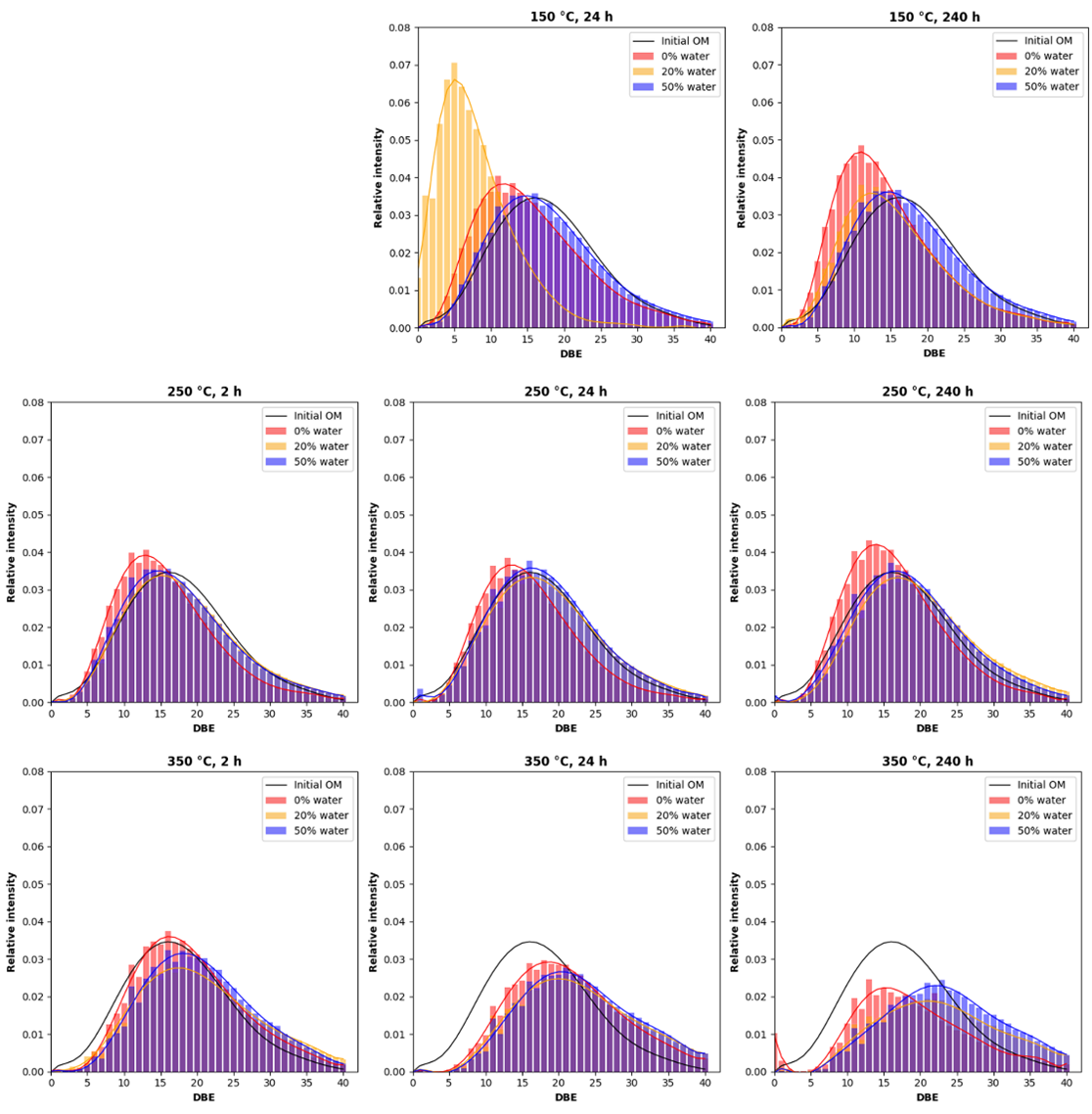
Fig. 1. Distribution of relative intensity as a function of DBE across all experimental conditions.
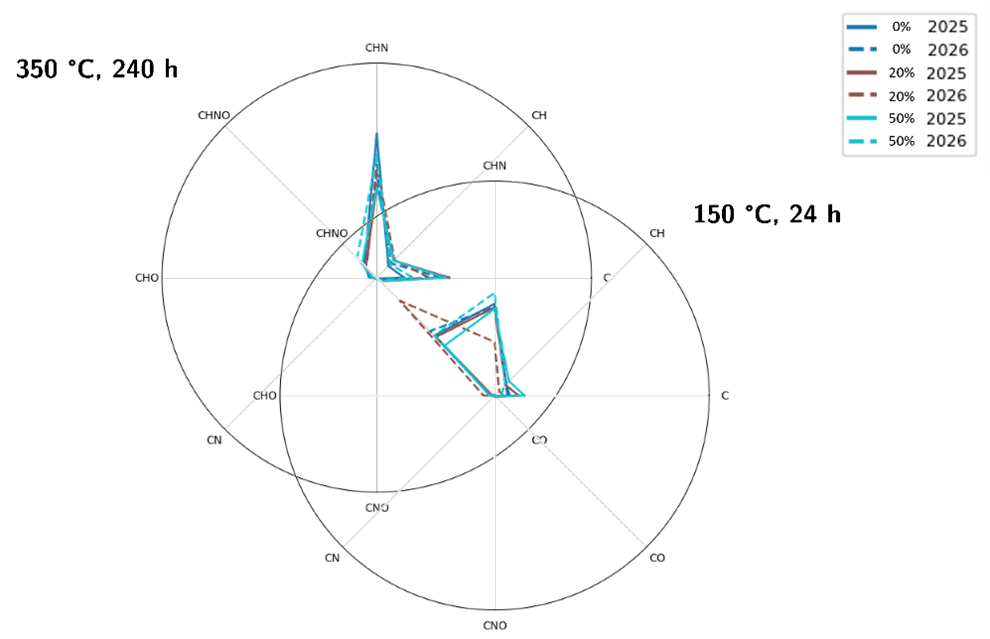
Fig. 2. Comparison of intensity-weighted chemical family distributions between the first (150 °C-24 h) and final (350 °C-240 h) experimental conditions.
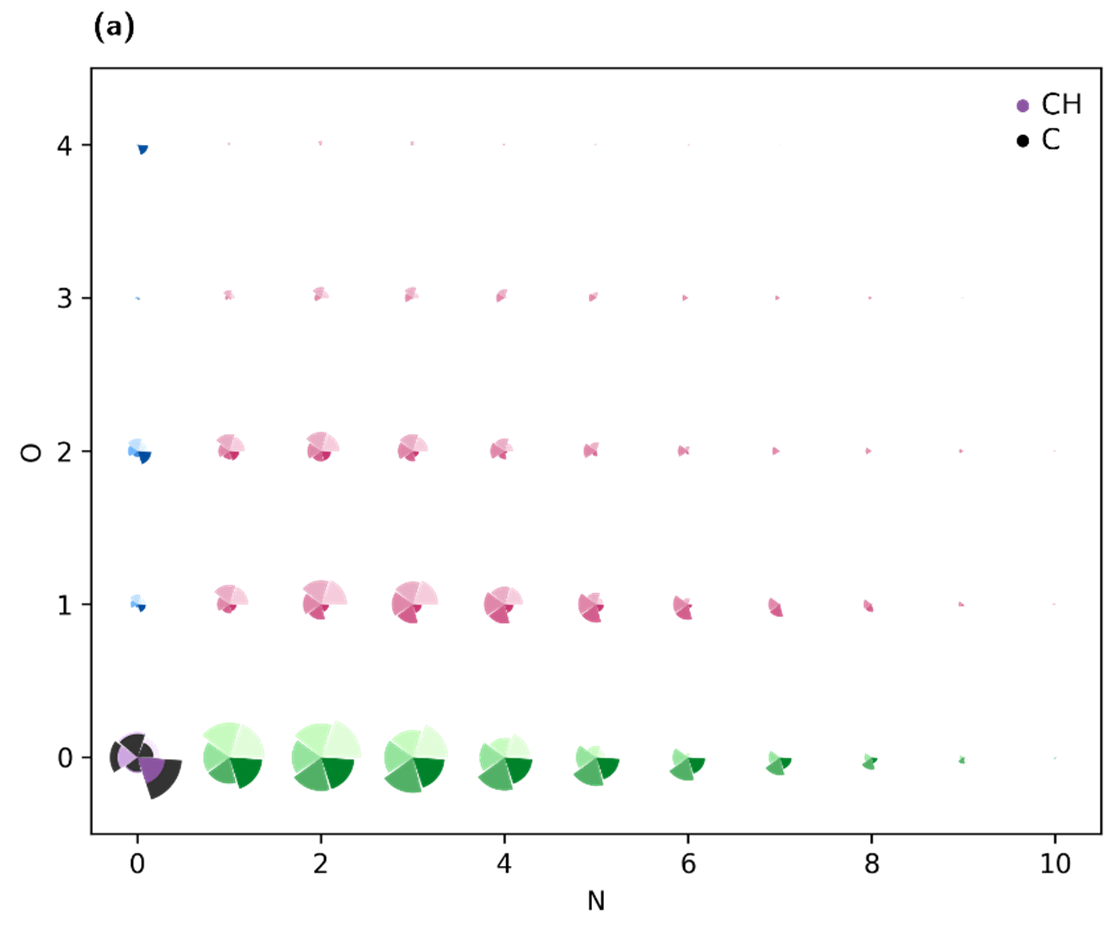
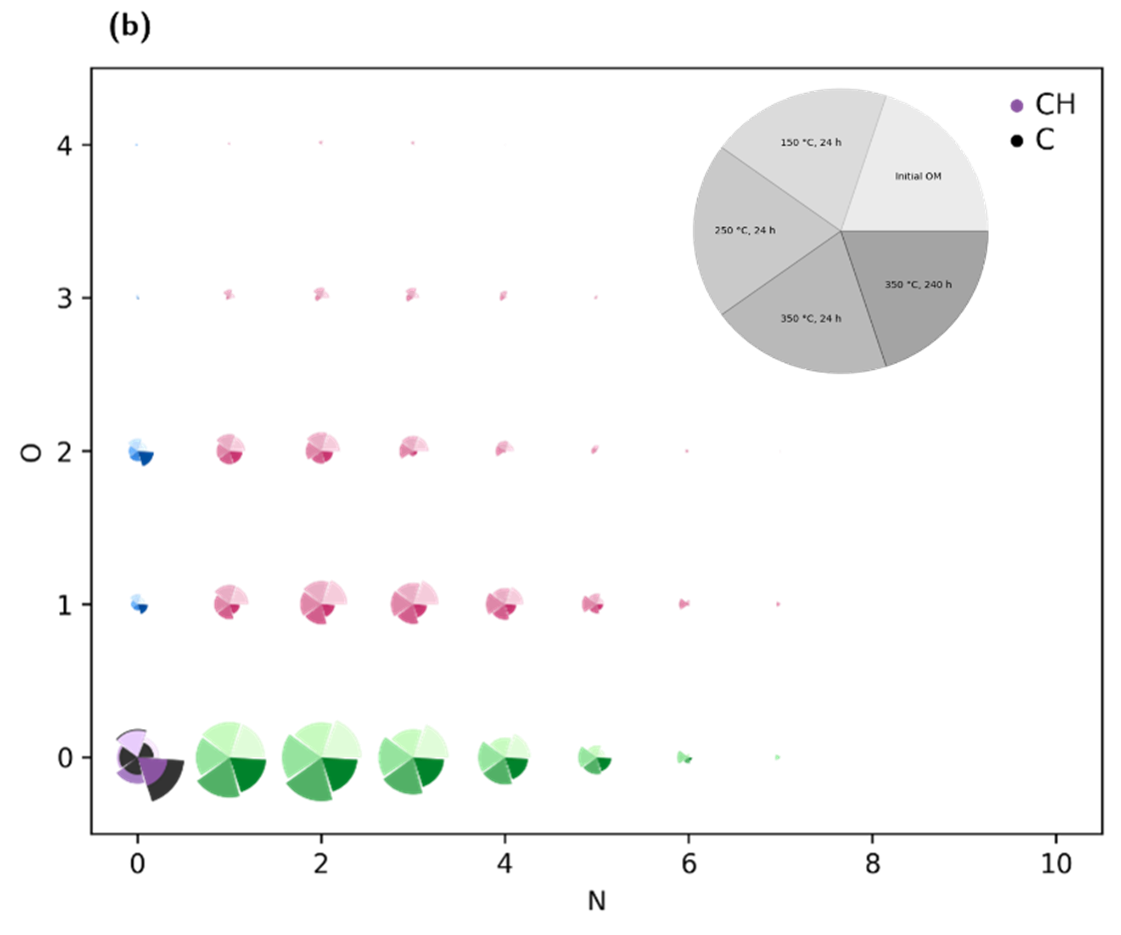
Fig. 3. Sector representation of the molecular family distribution under selected experimental conditions for (a) dry (0 wt.% H₂O) and (b) hydrous (50 wt.% H₂O) systems. Colors indicate molecular families (e.g., CHN in green) and each point in the x–y compositional space represents a subfamily (e.g., CHN1). Size is proportional to the weighted relative abundance, calculated from the mean intensity between the two experimental batches.
How to cite: Fariñas, M., Bollengier, O., Lévêque, P., Shvetsova, A., Champallier, R., Hertzog, J., Le Menn, E., Queffelec, C., Toffolo, L., Tumiati, S., and Sotin, C.: Thermochemical evolution of chondritic organic matter analogs under (hydrous)pyrolytic conditions, Europlanet Science Congress 2026, The Hague, The Netherlands, 7–11 Sep 2026, EPSC2026-358, https://doi.org/10.5194/epsc2026-358, 2026.


