
 1,2,3,1
- 1Politecnico di Milano, Department of Aerospace Science and Technology, Department of Aerospace Science and Technology, Milano, Italy (ericscott.frizzell@polimi.it)
- 2University of Maryland - College Park, Department of Geological, Environmental, and Planetary Sciences, College Park, USA
- 3University of Maryland - College Park, Department of Aerospace Engineering, College Park, USA
Introduction
Lunar regolith is repeatedly subjected to mechanical shaking from impacts, moonquakes, tidal forcing, and thermal cracking [1]. Future in-situ activities such as lander operations, rover traffic, construction, and mining will extend the range of disturbances acting on the surface. These disturbances may alter regolith density, strength, and thermal properties without producing obvious visible modification, making the vibratory response of regolith important for both surface evolution and future exploration.
Lunar cold spots provide the primary motivation for this work. Cold spots are distal regions of reduced thermal inertia surrounding young impact craters, commonly interpreted as areas of lowered near-surface bulk density [2]. Although cold spots are associated with impacts, their formation mechanism remains unknown. Recent work suggests that sustained, low-acceleration shaking following lunar impacts may contribute to regolith de-compaction [3]. However, cold spots are not the only setting in which mechanically induced de-compaction may matter: any repeated forcing capable of perturbing the contact network may modify the bulk state of regolith.
The response of a granular assembly to shaking is not controlled by forcing alone. Initial packing fraction influences whether applied vibrations lead to dilation or compaction [4], and preparation history (how the material reached its current packing and contact state) can also influence its later response [5]. This is especially relevant for lunar regolith, which is typically compacted outside cold spot regions [6,7], though the exact process responsible for that state remains uncertain (impact processes, quaking, micrometeoroid impact, etc.). Here we ask whether sustained low-frequency shaking can dilate lunar-like regolith, and how that response changes with preparation history.
Methods
We use discrete element method simulations [8] to examine the history-dependent response of lunar-like regolith to sustained low-frequency shaking. We prepare two slender 50 cm columns of synthetic lunar regolith following the procedures and rocky-regolith-like material parameters used in [9]. The spherical particles experience Hertzian contact forces, damping, high sliding and rolling/twisting friction, and cohesion, giving them effective properties intended to represent rough, dissipative, cohesive regolith grains. Periodic boundary conditions in the horizontal directions represent a laterally continuous slice of regolith.
The two columns differ in preparation history. In the “poured” case, particles are inserted near the maximum column height and settle slowly under lunar gravity, producing a relatively compact poured state. In the “pre-tapped” case, particles are inserted rapidly, settle into a looser initial state, and are then regularized by tapping until the average packing fraction oscillates about a compacted steady state. This produces poured and pre-tapped states with comparable average packing fractions (60.8% vs 61.8%, respectively), but different preparation histories and contact-network structures.
We then apply shaking using a sinusoidally oscillating particle shake plate at the floor. The imposed shaking has frequency f = 20 Hz and varying non-dimensional peak acceleration , Γ=ap/gL, where ap is the peak shake-plate acceleration and gL is lunar gravity. This procedure follows the tapping framework of [4] and was previously implemented in [10]. We quantify the bulk response using column-height change, Δh , relative to the initial 50 cm state. Positive Δh indicates dilation; negative Δh indicates compaction.
Results
The preliminary results show that the pre-tapped and poured columns follow similar qualitative trends, but differ substantially in magnitude and detailed evolution (Fig. 1). For Γ=1, both cases undergo brief initial dilation followed by net compaction. For Γ≤0.1, both beds slowly dilate and reach steady state after several thousand taps as in [4]. However, the magnitude of dilation is much smaller in the poured case (Fig.1, left) than in the pre-tapped case (Fig. 1, right), differing by roughly an order of magnitude. The pre-tapped column also evolves more intermittently, including abrupt rearrangement or slip-like events, while the poured column evolves more smoothly.
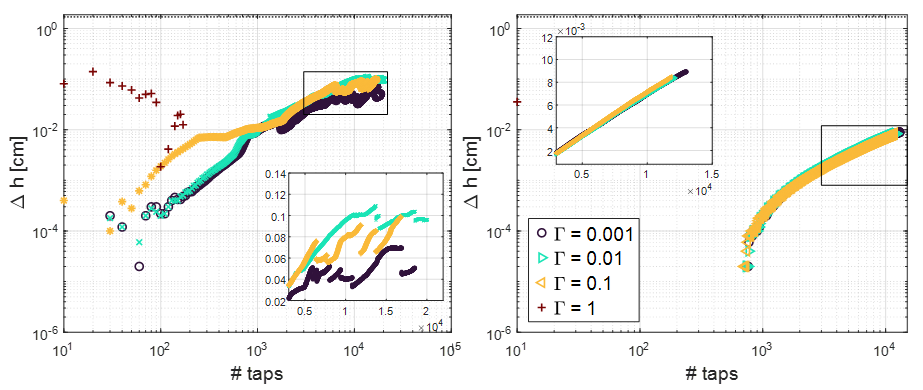
Figure 1. Column-height change relative to the initial 50 cm state as a function of tap number for varying at f=20 Hz. Time is obtained by dividing tap number by frequency. The left panel shows the pre-tapped column and the right panel shows the poured column. Positive height change indicates dilation, while negative height change indicates compaction and is not shown on the logarithmic scale. Insets show late-time steady-state behavior, though we have not yet reached steady state for the poured case. The same legend applies to both panels.
These results show that the response to repeated shaking is not determined by forcing amplitude and frequency alone. Instead, the magnitude and evolution of bulk density change depend on initial packing state, contact-network structure, and preparation history. For cold spots, the low acceleration vibrations considered in this work can contribute to near-surface dilation with an efficiency that depends on how the regolith’s high compaction state was achieved. More broadly, repeated low-frequency forcing from non-impact induced surfaces may produce changes in surface density and mechanical state. Mechanically induced regolith modification should therefore be treated as a history-dependent granular process.
Acknowledgements
EF and FF acknowledge funding of the European Union’s Horizon Europe research and innovation programme under grant agreements No. 101264707 (Marie Skłodowska-Curie Actions Postdoctoral Fellowship, SEISMOR) and No. 101077758 (ERC, TRACES). Views and opinions expressed are however those of the authors only and do not necessarily reflect those of the European Union, the European Research Council Executive Agency, or the European Research Executive Agency. Neither the European Union nor the granting authorities can be held responsible for them. NS and VL acknowledge support from NASA SSERVI GEODES grant 80NSSC19M0216.
References
[1] Lognonné et al. 2009, Journal of Geophysical Research: Planets, 114(E12), E12003.
[2] Bandfield et al. 2014, Icarus, 231, 221–231.
[3] Schmerr et al. 2025, 56th Lunar and Planetary Science Conference, LPI Contributions 3090, abstract 2160.
[4] Knight et al. 1995, Physical Review E, 51(5), 3957–3963.
[5] Mouraille et al. 2009, Engineering Fracture Mechanics, 76(6), 781–792.
[6] Colwell et al. 2007, Reviews of Geophysics, 45, RG2006.
[7] Hayne et al. 2017, Journal of Geophysical Research: Planets, 122(12), 2371–2400.
[8] Kloss et al. 2012, Progress in Computational Fluid Dynamics, 12(2/3), 140–152.
[9] Frizzell and Hartzell 2024, Granular Matter, 26(4), 90.
[10] Frizzell and Hartzell 2023, Granular Matter, 25(4), 75.
How to cite: Frizzell, E., Schmerr, N., Hartzell, C., Lekić, V., and Ferrari, F.: History-dependent bulk density changes of lunar regolith under sustained shaking, Europlanet Science Congress 2026, The Hague, The Netherlands, 7–11 Sep 2026, EPSC2026-360, https://doi.org/10.5194/epsc2026-360, 2026.


