
 1,2,3,
- 1CNR-INO Istituto Nazionale di Ottica, Largo E. Fermi, 6, I-50125 Firenze, Italy
- 2Istituto Nazionale di Astrofisica, Osservatorio Astrofisico di Arcetri, Firenze, Italy
- 3Dipartimento di Ingegneria Meccanica, Chimica e dei Materiali, Unità di Ricerca del Consorzio Interuniversitario Nazionale per la Scienza e Tecnologia dei Materiali (INSTM) - Università degli Studi di Cagliari, via Marengo 2, 09123 Cagliari, Italy
Regolith-covered surfaces exist in several planetological environments, including the Moon, Mars, NEAs, etc, some of which have been identified as first targets for future colonization outposts. Clearly, the development of advanced technologies in the framework of ISRU concept is a key asset to boost human space explorations on these celestial bodies. In particular, the use of regolith resources available in-situ will produce, through a significant decrease of transportation expenses, an intensification of manufacturing processes to fabricate constructions and protections, as well other useful installations and apparatuses possibly required, like for instance solar thermal energy harvesting systems and thermal energy storage media, which are the applications considered in the present study.
Once a proper site choice is carried out, the lunar surface shows advantageous conditions for solar energy harvesting due to the high solar irradiance. However, due to the length of lunar days/nights, energy storage is a major issue to be faced. Thermal energy storage (TES) appears the most suitable energy storage approach for future extra-terrestrial human colonies or robotic stations. In a possible energy generation scheme, solar collectors on the Moon harvest sunlight and concentrate it into solar absorbers constituted by sintered regolith blocks exchanging heat with some heat transfer medium. Sensible-heat TES units could be made by processed regolith as well, and buried under the surface to benefit from thermally insulating characteristics of the surrounding powdered regolith. The use of the same starting material to be tailored, by means of optimized processing approaches, for various applications, is a formidable challenge to which the present work aims to bring its contribution.
Therefore, taking as case-study the JSC-1A lunar regolith simulant, we processed the powders into sintered ceramic bulks by the Spark Plasma Sintering (SPS) technique, taking the sintering temperature as variable process parameter to produce samples with diverse relative densities and surface porosities, and we characterized the obtained products in terms of composition, icrostructure and optical properties.
Powders were first sintered at 700-900°C, in vacuum and under mechanical pressure. Obtained pellets showed relative densities of about 86 and 98%, respectively. No additional phases were detected after SPS compared to original powder, even if some changes were observed in their relative amounts, in particular for the glassy part. Optical properties (spectral absorptance α(λ) or emittance ε(λ), integrated solar absorptance α and estimated integrated thermal emittance ε) were evaluated from experimental spectra both for ceramics and powders, in the temperature range from 100K, representative of the night temperature value on the lunar equatorial surface, to possible temperatures for the technological applications of interest in the present work (1300 K max, slightly below the melting temperature of the regolith simulant).
Powdered regolith simulant shows consistently lower solar absorptance α and thermal emittance ε at all temperatures, in comparison to sintered specimens (Fig. 1).
The ideal material for a thermal solar absorber should have a high solar absorptance and the lowest possible thermal emittance at operating temperatures. With a properly dimensioned sunlight collecting system, the working temperature of the absorber is quickly reached and steadily maintained during the illumination period, e.g., the lunar day. In this sense, the system is similar to solar receivers on Earth, with the advantage of the absence of thermal losses due to conductive and convective heat exchanges with the surrounding atmosphere.
Focusing on applications, the higher solar absorptance of sintered pellets makes them more suitable for solar receivers in cavity-like architectures. For operating temperatures <1000K, the sample sintered at 900°C appears the most promising, due to the highest solar absorptance and lowest thermal emittance. At 1000K both pellets show the same α/ε ratio, while, beyond such temperature, the sample sintered at 700°C shows lower emittance. As the latter specimen is also characterized by a lower solar absorptance, system-specific evaluations should be made case by case, according to the system architecture, to identify the most suitable material depending on the working temperature.
For buried sensible-heat TES applications, the material should operate between its maximum allowable temperature (melting temperature in the range 1100-1125°C) and ~250 K, i.e. the almost constant temperature of lunar regolith just below the surface [1], with thermal cycles corresponding to the day-night cycles. The most relevant optical parameter here is the thermal emittance only. Showing the lowest emittance for temperatures > 500K, the ceramic sintered at 700°C results therefore the best option with respect to the other processed pellet. Powdered regolith would actually show an even lower emittance, but its poor thermal conductivity would make difficult its actual usage as heat storage medium.
In conclusion, similarly to what reported in the literature for thermophysical properties, these results show that powder sintering changed the optical properties of the regolith simulant in a process-dependent way. Specifically, the process parameter investigated in the present study, the sintering temperature, is generally found to increase spectral absorptance/emittance with respect to pristine powders. Integrated solar absorptance and thermal emittance resulted therefore enhanced in all conditions [2].
These results open interesting perspectives for ISRU applications, allowing to exploit the different properties of both pristine powders and their sintered bricks, as well as of the proper interplay among them.
References
[1] M. F. Palos, et al (2020) https://doi.org/10.1016/j.actaastro.2020.02.005
[2] Licheri, et al (2022) https://doi.org/10.1016/j.actaastro.2022.09.016
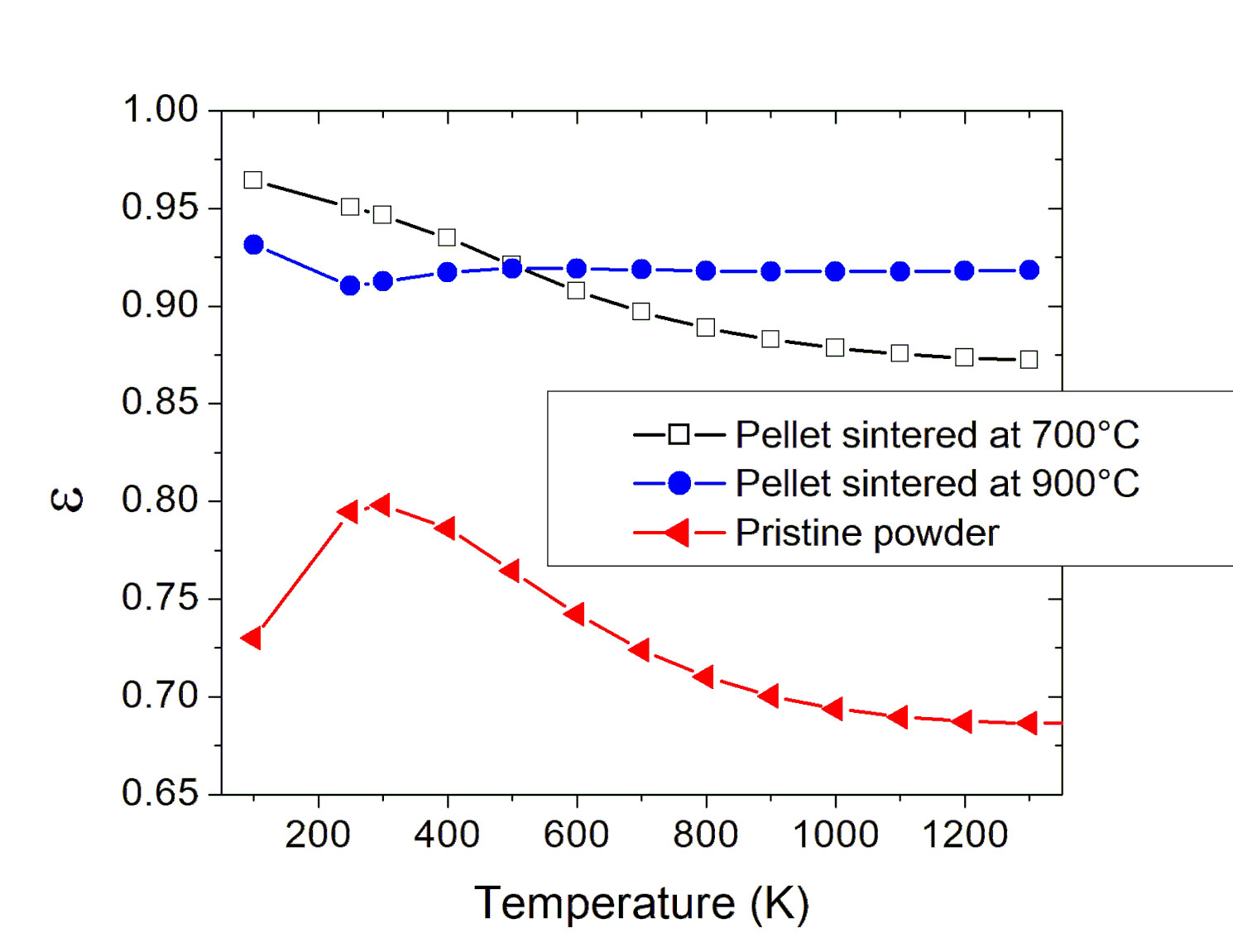
Figure 1: Calculated integrated thermal emittance (ε) of investigated materials. Integrated
solar absorptance values are α=0.88 for the pellet sintered at 700°C, α=0.92 for the pellet
sintered at 900°C and α=0.77 for the powder.
How to cite: Sani, E., Dell'Oro, A., Licheri, R., Orrù, R., and Cao, G.: Spark Plasma Sintering and Optical Characterization of Lunar Regolith Simulant, Europlanet Science Congress 2026, The Hague, The Netherlands, 6–11 Sep 2026, EPSC2026-401, https://doi.org/10.5194/epsc2026-401, 2026.


