
 1,1,1,2,2,
- 1CNRS, Lyon, France (bruno.reynard@ens-lyon.fr)
- 2Nantes Université, Planetologie et Geosciences, Nantes, France
With the Europa Clipper and JUICE missions in the Jovian system, and Dragonfly mission planned for launch in 2028, large icy moons and their subglacial oceans draw a renewed attention. Dwarf planets, currently scrutinized with the JWST, also constitute icy worlds with potential oceans at various stages of their evolution. Icy moons and dwarf planets provide a "water-world" model for studying potential prebiotic chemistry or extraterrestrial habitats in their subglacial oceans, and understanding the formation and properties of postulated ocean-exoplanets. Icy moons and dwarf planets are formed in the outer solar system in very different physico-chemical conditions than the terrestrial planets in the inner solar system. In particular, carbon, the fourth most abundant element in the Solar photosphere, was detected in abundance in comets (45 wt% of the refractory dust; Bardyn et al. (2017), in plumes emanating from Enceladus (Postberg et al., 2018), and on Ceres (Marchi et al., 2019).
Using equation of states for ices, silicates, and organics, the value of the moment of inertia (MoI) of icy moons (Titan, Enceladus, Dione, Europa, Ganymede) and dwarf planets (Ceres, Haumea) suggest that organic molecules are a major compound of their refractory core (Reynard and Sotin, 2023). During the thermal evolution of the refractory core, the composition evolves and the density of the remaining carbonaceous compound increases as H and heteroatoms are released, eventually reaching the density of graphite (Fig. 1; Delarue et al. (2025).
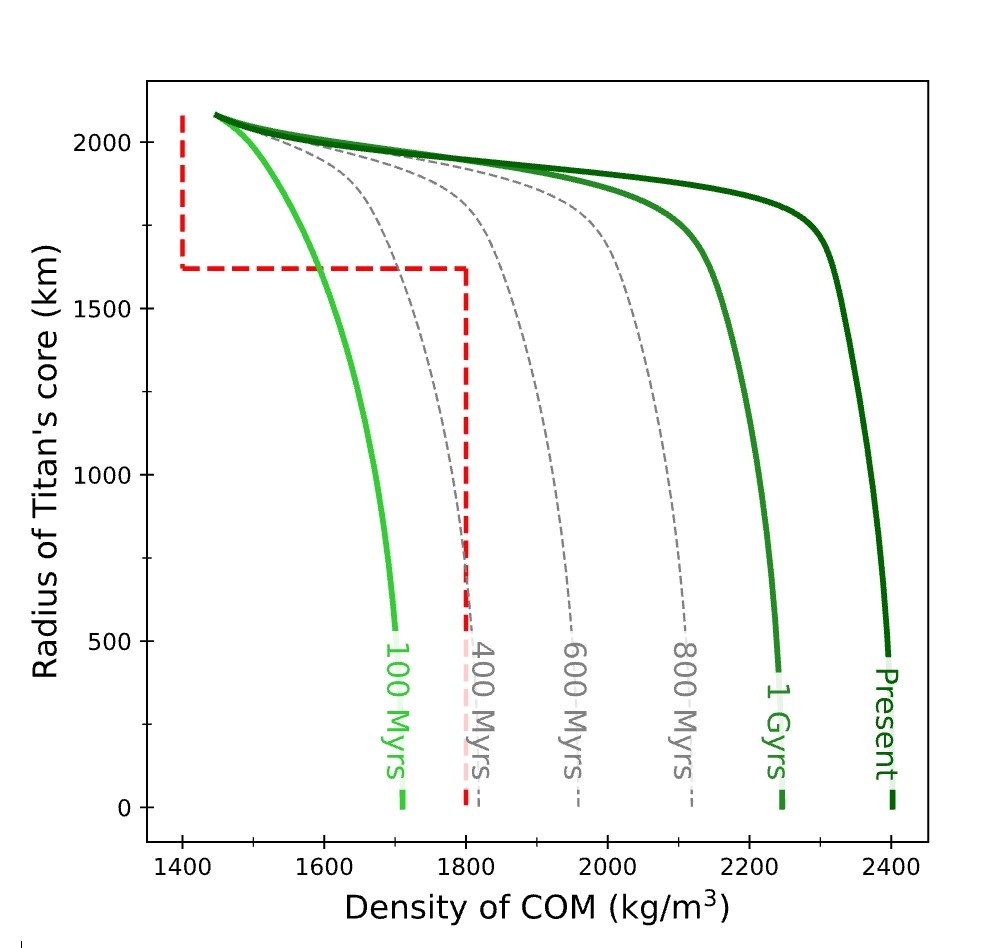
Figure 1. Kinetic evolution of COM density. The curves represent the time evolution, from 100 Myr to present time, of the COM along with temperature profiles expected at such time (see text for details). The COM densities evolve quickly for the first hundred million years, and almost all the material is transformed within Titan’s core after 1 Gyr. The values are larger than those of Reynard & Sotin (2023) (dashed red lines) which were based on laboratory measurements without taking into account the kinetics. The denser the COM, the higher its concentration needed to match the moment of inertia factor.
Gravitational data inform on the present state of the refractory core, suggesting that the organic fraction could be a larger fraction of the initial body. In an effort to retrieve the initial fractions of ice, silicates, and organics, two models were developed. First a kinetic model (KINCAM-E) was developed to describe the transformation of the carbonaceous compound with time and temperature. This model is based on experimental data with long duration pyrolysis. Second, a thermo-chemical model was developed to describe the feedback of the carbonaceous compound evolution on the thermal evolution. This model includes the migration of volatiles produced by the degradation of the organic compound to the hydrosphere. It also includes the dehydration of the hydrated silicates as the temperature increases. In these models, the mass of the body is fixed and partitioned between silicates, ice, and organics. The evolution of the radius and other parameters is followed. Only models consistent with the present value of the radius and the MoI are retained. First applied to Titan, this thermo-chemical evolution model shows that the initial fraction of organics composing Titan is similar to cometary amount, for accepted values of a leaching parameter L0 describing radioactive elements dissolution in the hydrosphere and differentiation delay (Fig.2). The model is applied to the icy Galilean satellites, and implications for future observations by JUICE and Europa Clipper will be discussed.
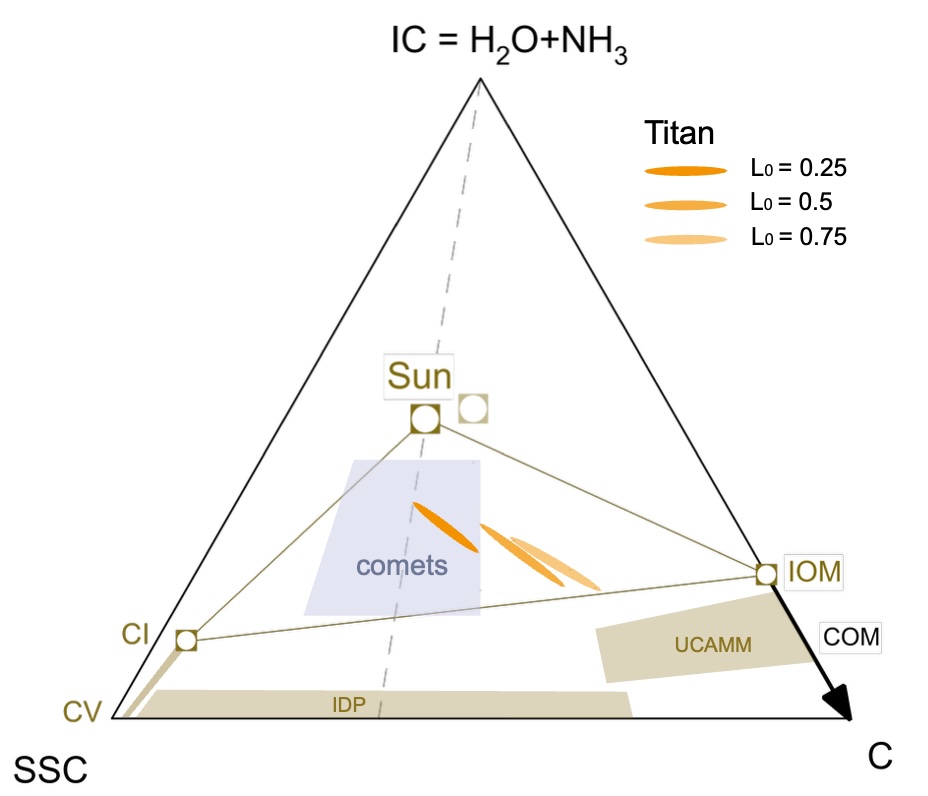
Figure 2. Composition of Titan and potential precursors (Sun, comets, IDP and UCAMM, CI and CV chondrites) in a ternary diagram (SSC: dry silicate-sulfide, IC: hydrosphere and water in silicates; C: pure carbon). Carbonaceous matter composition (COM) evolves from IOM-like to pure carbon during heating. Three orange ellipses represent model results for Titan assuming different values of L0 and compatible with MoI. The center values of the ellipses correspond to the initial MoI estimate of 0.3414 (Iess et al., 2012). The blue area indicates the loosely defined compositional range of comets. For the Sun, the composition from Lodders (2021) is indicated by the largest symbol, and a recent carbon-rich estimate of composition (Truong et al., 2024) is shown as a dimmer symbol.
References
Bardyn, A., Baklouti, D., Cottin, H., Fray, N., Briois, C., Paquette, J., Stenzel, O., Engrand, C., Fischer, H., Hornung, K., Isnard, R., Langevin, Y., Lehto, H., Le Roy, L., Ligier, N., Merouane, S., Modica, P., Orthous-Daunay, F.-R., Rynö, J., Schulz, R., Silén, J., Thirkell, L., Varmuza, K., Zaprudin, B., Kissel, J., Hilchenbach, M., 2017. Carbon-rich dust in comet 67P/Churyumov-Gerasimenko measured by COSIMA/Rosetta. Monthly Notices of the Royal Astronomical Society 469, S712-S722.
Delarue, C., Reynard, B., Sotin, C., Fellah, C., Cardon, H., Montagnac, G., Confortini, G., Ferreiro Mählmann, R., 2025. Carbon-rich interiors of Ganymede and Titan: application of a kinetic model of carbonaceous organic matter transformation, EPSC, Helsinki (Finland), Finland.
Iess, L., Jacobson, R.A., Ducci, M., Stevenson, D.J., Lunine, J.I., Armstrong, J.W., Asmar, S.W., Racioppa, P., Rappaport, N.J., Tortora, P., 2012. The tides of Titan. Science 337, 457-459.
Marchi, S., Raponi, A., Prettyman, T.H., De Sanctis, M.C., Castillo-Rogez, J., Raymond, C.A., Ammannito, E., Bowling, T., Ciarniello, M., Kaplan, H., Palomba, E., Russell, C.T., Vinogradoff, V., Yamashita, N., 2019. An aqueously altered carbon-rich Ceres. Nature Astronomy 3, 140-145.
Postberg, F., Khawaja, N., Abel, B., Choblet, G., Glein, C.R., Gudipati, M.S., Henderson, B.L., Hsu, H.-W., Kempf, S., Klenner, F., Moragas-Klostermeyer, G., Magee, B., Nölle, L., Perry, M., Reviol, R., Schmidt, J., Srama, R., Stolz, F., Tobie, G., Trieloff, M., Waite, J.H., 2018. Macromolecular organic compounds from the depths of Enceladus. Nature 558, 564-568.
Reynard, B., Sotin, C., 2023. Carbon-rich icy moons and dwarf planets. Earth and Planetary Science Letters 612, 118172.
How to cite: Reynard, B., Confortini, G., Delarue, C., Kervaso, M., Pinceloup, M., and Sotin, C.: Thermo-chemical modelling of organic-rich icy worlds of the outer solar system, Europlanet Science Congress 2026, The Hague, The Netherlands, 7–11 Sep 2026, EPSC2026-418, https://doi.org/10.5194/epsc2026-418, 2026.


