
 1,2,3,4,6
- 1Instituto de Astrofisica de Canarias, Tenerife, Spain (jmlc@iac.es)
- 2Departamento de Astrofísica, Universidad de La Laguna, Tenerife, Spain
- 3Institute of Space Science, Magurele, Romania
- 4University of Craiova, Craiova, Romania
- 5Institute for Astronomy, Edinburgh, UK
- 6Institute for Space Astrophysics and Planetology, Rome, Italy
The ESA Hera spacecraft was sucessfully launched on October 7, 2024, with the aim of studying binary asteroid (65803) Didymos [1]. The moonlet of the system, named Dimorphos, was impacted by the NASA DART spacecraft on September 26, 2022, as part of the first test of a kinetic impactor deflection technology. DART impact changed the orbital period of Dimorphos around Didymos, generating a huge cloud of dust and debris observable from the Earth. Asteroid Didymos has been extensively observed in the visible to near-infrared (vnir) using ground-based telescopes [2,3,4]. It is classified as an S-type, dominated by mafic silicates, mostly pyroxene and olivine, that show two very characterisic absorption bands at 1 and 2 mm. Band center and depth, together with spectral slope, can be used to infer compositional information on the surface of the asteroid. In addition, space weathering (sw) effects in such surfaces inlcude decrease in albedo and band depth and reddening in the slope.
Hera is expected to arrive to Didymos in October 2026, when the spacecraf will progressively reduce its distance to the system, getting as close as ~1 km to the surface of Dimorphos at the final stage, in June-July 2027. One of the instruments onboard is HyperScout-H (HSH), a hyperspectral imager operating in the 650-950 nm wavelength range that provides spectral and spatial information simultaneously [5]. Its wavelength coverage allows to measure several spectral parameters, like the position of the minimum and the maximum of the 1 mm absorption band (i.e. an estimation of its depth), and the spectral slope (Fig. 1, Bottom). These parameters will be used, in combination with the information provided by the other instruments onboard the spacecraft, to create compositional and space weathering maps (high-level products) of the surfaces of the two asteroids through all the mission phases. In this work we present what we expect to measure with HSH at the arrival to the system, including different potential scenarios regarding Dimorphos status after the DART impact. We use as a reference the collection of Didymos vnir spectra (Fig. 1, Top) obtained with XSHOOTER at the 8.2m VLT (ESO, Chile), right before and after the DART impact, to measure several spectral parameters and to compare with meteorite spectra. These measurements will define the compositional and space weathering space where to locate HSH measurements.
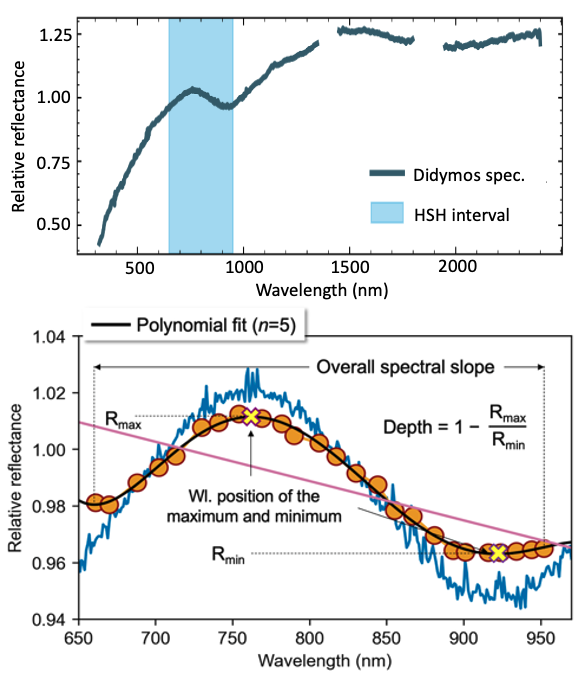
Figure 1. Top: visible to near-infrared spectrum of (65803) Didymos obtained with XSHOOTER at VLT on the nigtht of September 27, 2022, after the DART impact. The blue region indicates the wavelength range covered by the HSH instrument onboard the Hera spacecraft. Bottom: visible spectrum of Didymos (in blue) as seen by HSH (orange circles), and different spectral parameters measured.
References
[1] Michel, P., et al. Planet. Space Science 2022, 3, 160-181, [2] de León, J., et al. Astron. Astrophys. 2010, 517, 23-48, [3] Polishook, D., et al. Planet. Space Science 2023, 4, 229-24, [4] Lazzarin, M., et al. Nat. Comm. 2026, 17, id.551, [5] Popescu, M., et al. Space Sci. Rev. 2025, 221, id.112
How to cite: de Leon, J., Prodan, G., Popescu, M., Opitom, C., and Migliorini, A.: Compositional characterization of asteroid Didymos from ground-based spectra in preparation of the arrival of the ESA Hera mission, Europlanet Science Congress 2026, The Hague, The Netherlands, 7–11 Sep 2026, EPSC2026-440, https://doi.org/10.5194/epsc2026-440, 2026.


