
 ,,
,,- Department of Astrophysics, University of Vienna, Vienna, Austria (ivan.stankovic@univie.ac.at)
Motivation
The thermal structure, heating/cooling balance, and mass loss of exoplanet atmospheres are controlled by a multitude of factors, including the host star's properties, the planet's formation history and size, and the chemical composition of the atmosphere itself. In terms of chemistry, metallicity and the C/O ratio are commonly used to characterise exoplanet atmospheres. While these metrics work reasonably well for hydrogen-dominated gas giants, they cannot capture the atmospheric complexity of rocky exoplanets. Given the chemical diversity already detected in exoplanets, from H2O, CO2, CH4, to SO2 and potentially CS2, and knowing that nitrogen- and oxygen-rich atmospheres both exist in our own Solar System, the question of how much chemistry alone matters, and how to best describe it, comes naturally.
Model and grid
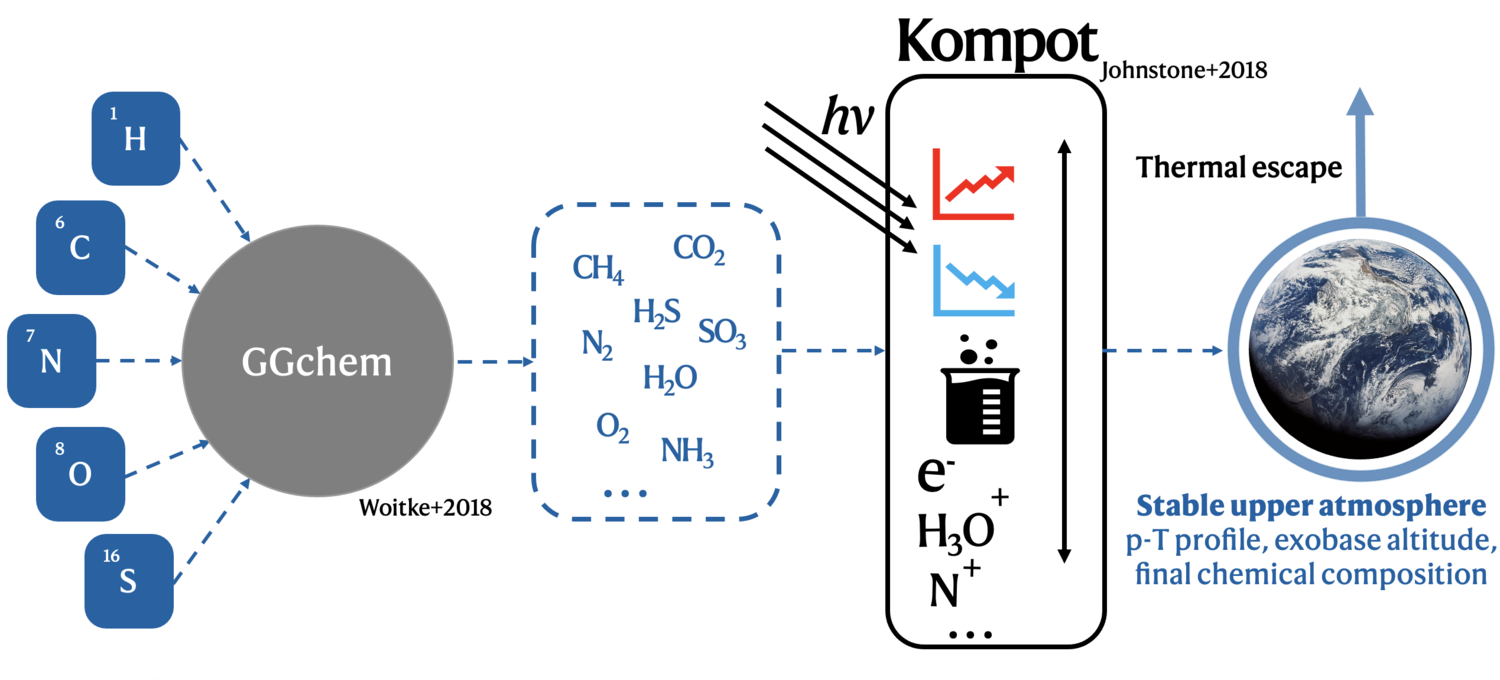
We constructed a grid of upper atmospheric models for an Earth- (1 au) and Venus-like (~0.7 au) planet by systematically varying the elemental ratios of hydrogen, carbon, nitrogen, oxygen, and sulfur while keeping all other parameters fixed. Each composition was modelled to steady state using The Kompot Code, a first-principles self-consistent 1D model that accounts for the mutual influence of atmospheric photochemistry with thermal structure, stellar irradiation, and vertical transport via eddy and molecular diffusion. The figure below illustrates the modelling workflow. The equilibrium chemistry model GGchem is used as an intermediary to produce molecular abundances which are used as a starting condition for Kompot.
Thermal structure
We find that chemistry has an important impact on both the atmospheric thermal structure and mass loss. While temperatures in the middle regions of the upper atmosphere (around 10-5 to 10-6 bar) remain broadly similar across compositions, exobase temperatures range from a few hundred to several thousand Kelvin depending on the elemental mixture. This is driven primarily by the heating/cooling balance and the presence of efficient cooling molecules such as CO2 and H2O. These elevated exobase temperatures directly correspond to significantly enhanced thermal mass loss.
Mass loss and irradiation dependence
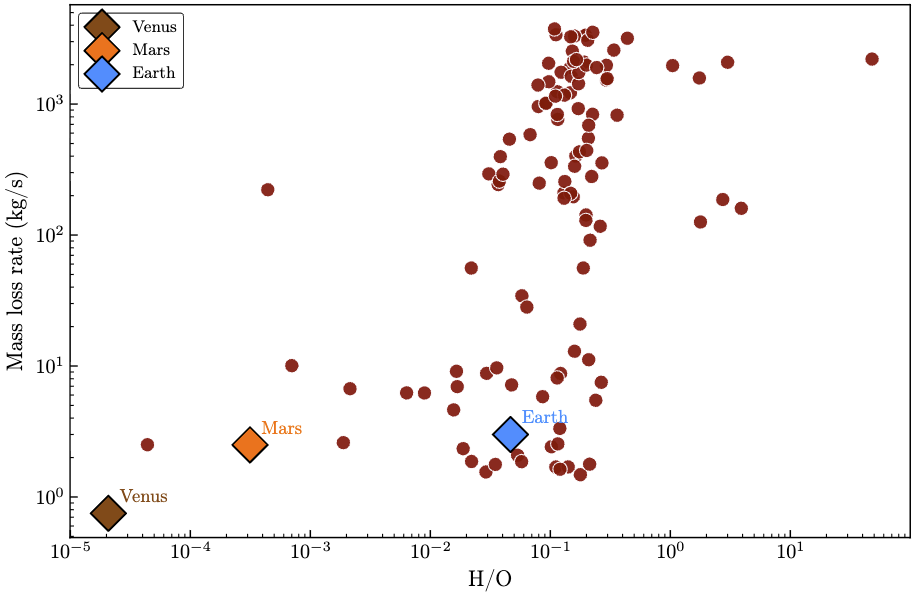
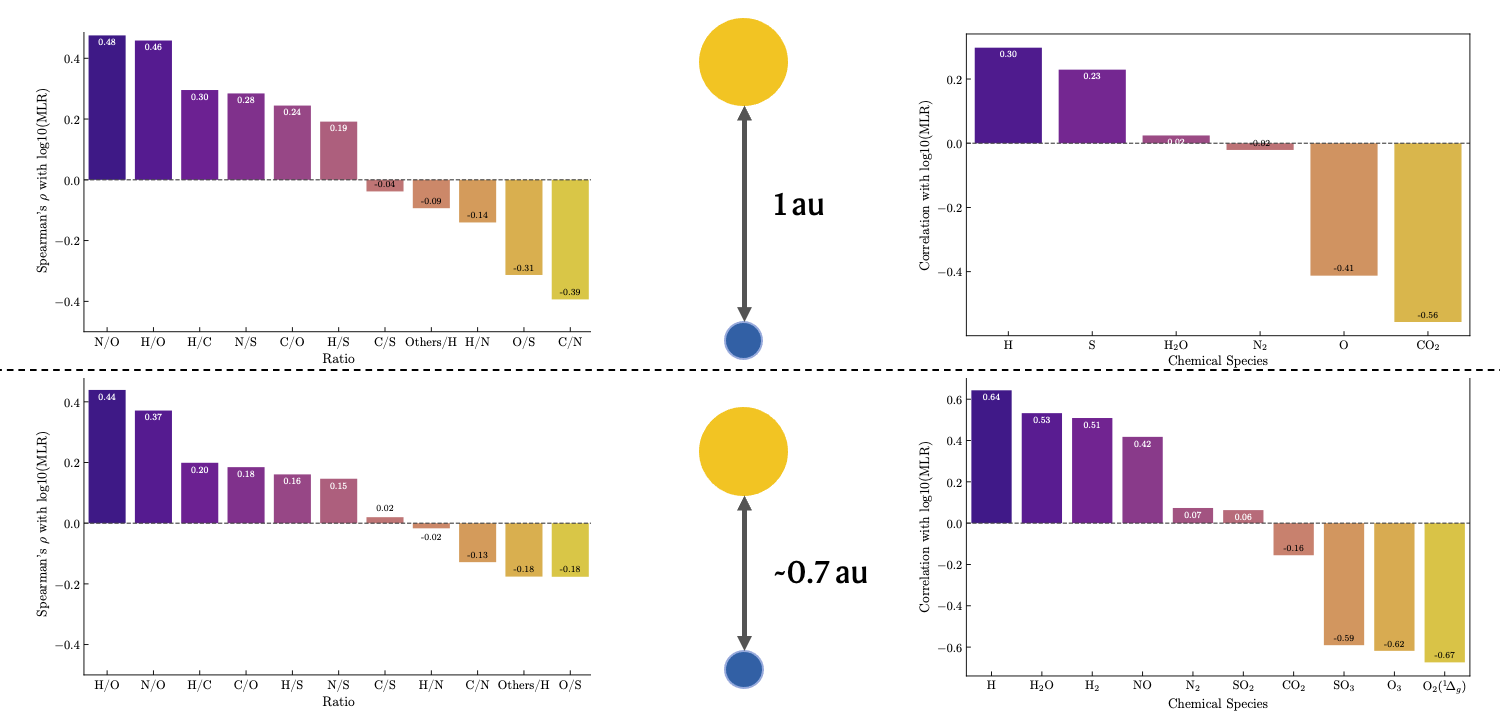
For Earth-like irradiation conditions, around 70% of the compositions remain stable, with a mass loss rate < 1 kg/s. Isolating the cases with significant mass loss reveals clear correlations: escape rates increase with H/O and N/O, while higher O/S and C/N ratios act to stabilise the atmosphere. These elemental ratios control the abundances of different molecules in the atmosphere. Therefore, they trace the presence of efficient cooling molecules such as CO2, which directly reduce mass loss rates. The figure below shows the dependence of the mass loss rate on the H/O ratio, with the addition of Venus, Earth, and Mars for reference.
For a closer-in Venus-like planet, H/O remains a consistent driver of mass loss, while N/O becomes less significant. C/N also loses its significance in reducing the mass loss. More strikingly, water, which has no significance for mass loss at Earth-like distances, becomes strongly correlated with increased mass loss at Venus-like distances, suggesting a fundamental shift in the role of individual molecules with irradiation level. Similarly, CO2 is strongly anticorrelated with mass loss at 1 au, but this correlation all but disappears at 0.7 au. The figure below shows these correlation shifts, both for elemental ratios and molecules.
Implications
None of this behaviour can be captured by the C/O ratio alone. Rocky exoplanets therefore require a more complete elemental description. Our results offer new constraints for assessing atmospheric survival and have direct implications for how we interpret and prioritise observations of rocky- and sub-Neptune exoplanet atmospheres with the JWST and the upcoming ESA Ariel mission. These results also open the question of whether mass loss rates and thermal structure can be observationally traced to molecular abundances or elemental ratios, and if the opposite is feasible as well.
How to cite: Stanković, I., Güdel, M., Boro Saikia, S., Van Looveren, G., and Robeling, N.-M.: Does chemistry alone significantly shape rocky exoplanet atmospheres?, Europlanet Science Congress 2026, The Hague, The Netherlands, 7–11 Sep 2026, EPSC2026-462, https://doi.org/10.5194/epsc2026-462, 2026.


