
 3,3
3,3- 1Solar System Science and Exploration Division, Southwest Research Institute, 1301 Walnut St, Ste 400, Boulder, CO, USA
- 2Groupe de Spectrométrie Moléculaire et Atmosphérique (GSMA), Université de Reims Champagne-Ardenne, CNRS, 51687 Reims cedex, France
- 3Aix-Marseille Université, CNRS, CNES, Institut Origines, LAM, Marseille, France
- 4Astronomy & Astrophysics Section, School of Cosmic Physics, Dublin Institute for Advanced Studies, 31 Fitzwilliam Place, Dublin D02 XF86, Ireland
Introduction
The icy Galilean moons — Europa, Ganymede, and Callisto — are major targets in the search for habitable environments because they likely harbor subsurface oceans beneath their icy crusts. Assessing their habitability requires understanding the origin and evolution of complex organic molecules (COMs), which are key precursors of prebiotic chemistry.
Although COMs have not yet been directly detected on the Galilean moons, upcoming missions such as ESA’s JUICE and NASA’s Europa Clipper will provide new constraints on the abundance and distribution of organics, salts, and volatile ices through infrared, submillimeter, and mass spectrometry observations.
While the formation and transport of COMs have been extensively studied in protoplanetary disks, their evolution within circumplanetary disks (CPDs), where giant-planet satellites form, remains poorly understood. COMs inherited from the protosolar nebula may have been altered or destroyed during transport into Jupiter’s CPD, while the CPD itself may also have enabled in situ organic synthesis through thermal and photochemical processing of icy particles.
This study investigates the formation and transport of COMs in Jupiter’s evolving CPD using a time-dependent disk model coupled to particle transport calculations. Two formation pathways are explored: thermal processing of NH3:CO2 ices [1] and UV photochemistry of CH3OH-rich particles [2]. The goal is to determine under which conditions COMs can form, survive, and become incorporated into the Galilean moons.
Methodology
The study employs a two-dimensional gas-starved model of Jupiter’s CPD, which evolves from a hot, massive disk to a colder and less dense configuration as Jupiter’s accretion rate decreases with time. The nominal model assumes an initial accretion rate of 6.6 × 10⁻⁶MJ yr−1, a depletion timescale of 20 kyr, a turbulent viscosity parameter α = 10−3, and a centrifugal radius of 50 RJ. The thermodynamic structure of the CPD is controlled by viscous heating, radiative cooling, and irradiation from a young Jupiter with a surface temperature near 2000 K. The model naturally produces shadowed regions that can cool the disk locally by up to 100 K.
Particle transport is modeled using a Lagrangian framework accounting for gas drag, turbulence, diffusion, and settling. Simulations track particles ranging from 1 μm to 1 cm released at different epochs and locations within the CPD. Two COM formation pathways are explored: thermal processing of NH3:CO2 ices between 80 and 260 K, and UV photochemistry of CH3OH-rich ices. UV fluence is computed self-consistently along particle trajectories while accounting for attenuation by gas and dust opacity.
The simulations therefore couple disk evolution, particle transport, irradiation exposure, and ice chemistry to determine where and when COMs can form and survive within Jupiter’s CPD.
Results
The simulations show that thermal processing dominates COM formation within Jupiter’s CPD. Particles drifting inward through the disk systematically cross regions with temperatures between 80 and 260 K, where NH3:CO2 ices are efficiently converted into COM-bearing material within a few hundred years.
At early epochs (t0 = 50 kyr), particles smaller than 1 mm remain strongly coupled to the gas, while larger particles rapidly migrate inward due to gas drag. Figure 1 shows that many trajectories intersect the thermal COM formation zone located between ~20 RJ and the centrifugal radius. In contrast, UV-driven chemistry is much less efficient. CH3OH-rich particles generally sublimate before accumulating sufficient UV fluence to trigger substantial photochemical COM formation. Only a limited fraction of small particles released late in the disk evolution reach irradiation thresholds derived from laboratory experiments. As the CPD evolves and gas densities decrease, particle-gas coupling weakens and even micron-sized grains drift inward. The thermal processing region simultaneously migrates closer to Jupiter, but particles continue to experience efficient thermal processing before significant UV irradiation occurs.
The simulations also show that increasing particle density, turbulent viscosity, or lowering the disk accretion rate further suppresses irradiation-driven chemistry by shortening particle residence times within the disk. Overall, the results indicate that thermal processing of NH3:CO2 ices is the dominant COM formation pathway in Jupiter’s CPD, whereas UV photochemistry plays only a secondary role under nominal conditions.
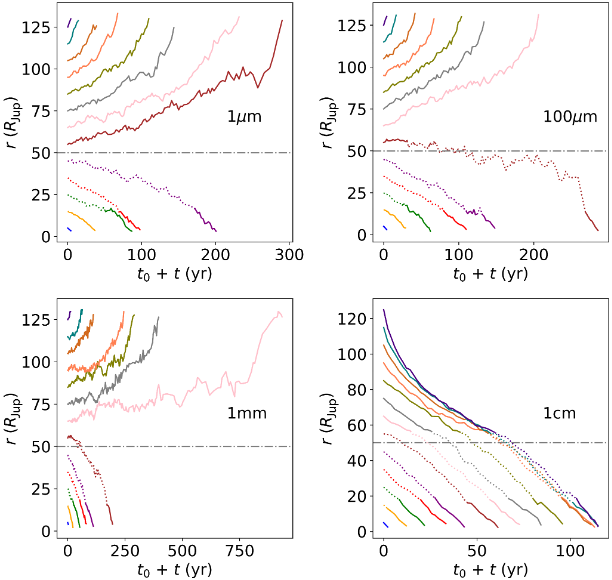
Fig. 1. Median radial trajectories of 1 µm, 100 µm, 1 mm, and 1 cm particles as a function of time in our nominal CPD model. The particles are released one scale height above the CPD midplane at t0 = 50 kyr. Particle trajectories are computed in both the radial and vertical directions, but only their projection onto the CPD midplane is shown here for clarity. Median trajectories are shown at 10 Rjup intervals in the midplane, spanning from 5 to 135 Rjup in the CPD. Dotted lines highlight portions of these trajectories that intersect the COM formation zone via thermal processing in the CPD. The horizontal dotted-dashed line indicates the location of Rc.
Conclusions
This study shows that COMs can form efficiently within Jupiter’s CPD through thermal processing of icy particles drifting through warm disk regions. In contrast, UV-driven photochemistry is generally inefficient because particles sublimate before accumulating sufficient irradiation doses.
The results suggest that the Galilean moons may have inherited part of their organic inventory directly from the CPD, although COM survival strongly depended on local thermal conditions and accretion histories. The hotter inner disk likely destroyed most organics incorporated into Io and possibly Europa, whereas the colder formation environments of Ganymede and especially Callisto favored preservation of COM-rich material.
The study also highlights the need for improved laboratory photochemical data and more comprehensive chemical models, including mixed-ice chemistry and grain-surface processes.
Overall, the results indicate that thermal processing within Jupiter’s CPD could have generated and preserved organics later incorporated into the Galilean moons. Future observations from JUICE and Europa Clipper will provide key constraints on the origin and survival of organics within the Jovian system. All results and interpretations are presented in [3].
References
[1] Bossa, J. B., et al. 2008, A&A, 492, 719, doi: 10.1051/0004-6361:200810536
[2] Tenelanda-Osorio, L. I., et al. 2022, MNRAS, 515, 5009, doi:10.1093/mnras/stac1932
[3] Mousis, O., et al. 2026, PSJ, 7(2), id.41, doi:10.3847/PSJ/ae3559
How to cite: Mousis, O., Petetin, C., Benest Couzinou, T., Schneeberger, A., and Bennacer, Y.: Forging Complex Organics in Jupiter’s Circumplanetary Disk, Europlanet Science Congress 2026, The Hague, The Netherlands, 7–11 Sep 2026, EPSC2026-474, https://doi.org/10.5194/epsc2026-474, 2026.


