
 2,
2,- 1Astronomy & Astrophysics Section, School of Cosmic Physics, Dublin Institute for Advanced Studies, 31 Fitzwilliam Place, Dublin D02 XF86, Ireland
- 2Aix-Marseille Universite, CNRS, CNES, Institut Origines, LAM, Marseille, France
- 3Solar System Science and Exploration Division, Southwest Research Institute, 1301 Walnut St, Ste 400, Boulder, CO, USA
Introduction
The Galilean moons exhibit a strong radial density gradient, from the nearly dry Io to the ice-rich Ganymede and Callisto. Increasing evidence favors a primordial origin for this gradient, inherited during satellite formation within Jupiter’s circumplanetary disk (CPD). In this framework, volatile-rich pebbles drifting inward through the CPD progressively lost volatiles through sublimation and dehydration, imprinting a radial compositional gradient before moon accretion.
Volatile transport near icelines has long been considered a key mechanism shaping satellite composition. In protoplanetary disks, radial drift and phase transitions generate volatile enrichments through the cold-finger effect. Similar processes may occur in CPDs, but previous studies often neglected the coupled evolution of the disk itself.
Another possible enrichment mechanism is the formation of shadow-induced cold traps. In this scenario, the optically thick inner CPD casts a shadow onto outer regions, reducing irradiation from the young, hot Jupiter and creating local temperature minima where volatiles condense efficiently.
This study investigates whether volatile transport within Jupiter’s CPD can generate local enrichments and radial compositional gradients consistent with the Galilean moons, with particular emphasis on the relative roles of icelines and shadow-induced cold traps.
Methodology
The study combines a two-dimensional CPD evolution model with a volatile transport model that tracks the coupled evolution of major volatile species in both vapor and condensed phases. The CPD is modeled within a gas-starved framework with time-dependent accretion onto Jupiter. Two end-member depletion scenarios are investigated: a rapidly dissipating disk depleted within 300 kyr, and a slowly evolving disk dissipating over 1 Myr.
The CPD structure depends on viscous heating, disk opacity, and irradiation from a young Jupiter with a surface temperature near 2000 K. Turbulent transport is modeled using an α-viscosity prescription with αvalues ranging from 10−4 to 10−2. The simulations also include self-shadowing of the CPD, capable of generating localized cold traps.
The volatile transport model follows H2O, CO, CO2, CH4, N2, NH3, H2S, PH3, Ar, Xe, and Kr through advection, diffusion, radial drift, condensation, and vaporization. Solid transport is modeled with a two-population dust evolution framework that determines grain growth and drift. Additional tests explore the influence of turbulence, disk composition, dust-to-gas ratio, and centrifugal radius.
Results
The simulations reveal distinct behaviors between the slowly and rapidly depleting CPD scenarios. In the slowly depleting case, volatile evolution is controlled by the location of icelines relative to the turnover radius, which separates the inner inward-accreting flow from the outer outward-spreading flow and lies interior to the centrifugal radius. When an iceline is located beyond the turnover radius, strong enrichment peaks develop, with condensate abundances reaching up to five times their initial values, as found for H2S, CO2, NH3, and PH3. In contrast, when the iceline lies interior to the turnover radius, species become strongly depleted beyond the centrifugal radius, as observed for water and refractory material. As a result, the remaining solids become progressively dominated by the more volatile condensates.
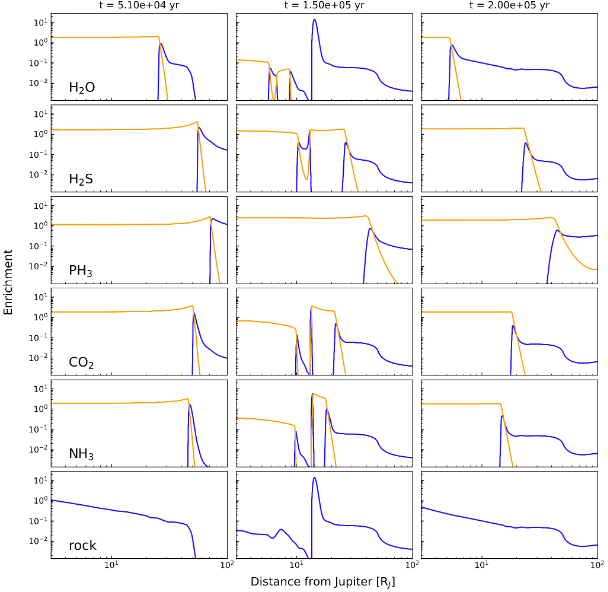
Fig. 1. Volatile species develop strong depletion and enrichment patterns in the rapidly depleting CPD model assuming protosolar initial composition. From top to bottom, the panels display H2O, H2S, PH3, CO2, NH3, and the refractory rocky phase while the columns correspond to evolutionary times of 50, 150, and 200 kyr. Blue and orange curves trace the enrichments of the ice and vapor phases, respectively. Most condensates become depleted throughout the disk, whereas transient enrichment peaks peaking up to about 10 times the initial abundance emerge near icelines during the shadow-induced cold-trap phase around 150 kyr.
In the rapidly depleting case (see Fig. 1), volatile condensates are strongly depleted throughout most of the disk, typically by factors of 10–100 relative to their initial abundances. Unlike the slow-depletion scenario, iceline enrichment peaks remain below initial abundances because rapid disk evolution prevents sustained accumulation of solids and vapor. A major result is the emergence of a transient shadow-induced dust trap between 10 and 15 RJ around 150 kyr after disk formation. Local cooling of up to 100 K creates a pressure maximum and dust trap capable of enriching solids by up to a factor of ten relative to initial abundances. However, this enrichment persists for only ~20 kyr because the shadow evolves rapidly with the disk opacity structure.
Sensitivity tests show that lower α values produce denser disks with longer-lived shadowed regions, increasing cold-trap efficiency. Higher dust-to-gas ratios also prolong shadow lifetimes. In contrast, varying the initial volatile abundances does not qualitatively change the enrichment patterns. Overall, the slowly depleting disk produces volatile enrichment at the icelines location while in the rapidly depleting case, Icelines alone are inefficient at generating sustained enrichments because the CPD evolves too rapidly. High enrichment is only reached within a transient shadow-induced dust traps.
Conclusions
This study shows that volatile icelines in Jupiter’s CPD can generate long-lived enrichment regions in slowly depleting disks, similar to those predicted in protosolar nebula models. However, the efficiency of these enrichments depends strongly on the iceline location relative to the turnover radius.
In rapidly depleting disks, volatile abundances are globally depleted, and significant enrichments occur only during short-lived episodes associated with shadow-induced cold traps. These traps can locally enhance solid abundances by up to an order of magnitude, suggesting that shadow-driven processes may dominate over classical iceline pileups in shaping CPD solid distributions.
The results further indicate that streaming instability and satellitesimal formation are unlikely to occur directly at icelines because dust-to-gas ratios remain below unity. Alternative mechanisms, such as trapping in shadow-induced pressure maxima or capture of planetesimals from the protosolar nebula, may therefore be required.
The modeled volatile distributions naturally produce an inner volatile-poor region and a more volatile-rich outer CPD, consistent with the radial compositional gradient of the Galilean moons. In the slowly depleting case, the outermost disk becomes depleted in both water and refractory material, leaving solids dominated by the most volatile condensates.
References
Schneeberger, A., Bennacer, Y., Mousis, O. Volatile enrichment in Jupiter’s circumplanetary disk requires shadow-induced cold traps. Astronomy & Astrophysics, submitted.
How to cite: Schneeberger, A., Bennacer, Y., and Mousis, O.: Shadow-Driven Volatile Enrichment in Jupiter’s Circumplanetary Disk, Europlanet Science Congress 2026, The Hague, The Netherlands, 7–11 Sep 2026, EPSC2026-481, https://doi.org/10.5194/epsc2026-481, 2026.


