
 1,2,1
1,2,1- 1Physics Institute, Space Research and Planetary Sciences, University of Bern, Bern, Switzerland (christian.reinhardt@unibe.ch)
- 2Department of Astrophysics, Faculty of Science, University of Zürich, Zürich, Switzerland
Introduction: The formation of the Martian moons, Phobos and Deimos, remains a long-standing problem in understanding the formation and early evolution of Mars. Their small masses, irregular shapes and relatively low-albedo reflectance spectra suggest that they are captured objects (Burns 1992). However, their orbital characteristics, i.e., their low eccentricities and inclinations, are very difficult to reconcile with capture (Burns 1992) and suggest that they formed in-situ from orbiting debris. The giant impact (GI) scenario proposes that Phobos and Deimos accreted from circum-planetary disk formed in a large collision and is currently the most successful in-situ formation scenario that can explain their dynamical properties (Rosenblatt et al. 2011; Craddock 2011). Prior work used 3D smoothed particle simulations to model the impact (Rosenblatt et al. 2016, Hyodo et al. 2017, Canup & Salmon 2018) but was very limited in resolution and modeled the materials as ideal fluids neglecting the effect of material strength. However, recent studies (Kurosawa & Genda 2018, Emsenhuber et al. 2018, Ballantyne et al. 2023, Ballantyne et al. 2024, Denton et al. 2025) suggest that the rheology can play a key role in modelling such intermediate scale impacts, significantly influencing the thermal, chemical and compositional history of the colliding bodies. These properties are crucial for generating accurate predictions of the GI scenario, including the resulting chemical composition and volatile inventory, which are key to interpreting data returned by the Martian Moons eXploration (MMX) mission.
Methods: We revisit the two impact scenarios proposed by Hyodo et al. (2017; H17) and Canup & Salmon (2018; C18) using the novel Smoothed Particle Hydrodynamics (SPH) code pkdgrav3 (Potter et al. 2018, Meier et al. 2026, Meier et al. submitted). The effect of material strength is incorporated via a pressure-dependent shear strength model (Jutzi 2015), following the approach by Emsenhuber et al. (2018) and Ballantyne et al. (2023). Mars and the impactor are assigned the same masses and compositions as in previous studies, and iron and rock are represented using the ANEOS equations of state (Thompson & Lauson 1972; Melosh 2007) for iron and forsterite from Stewart et al. (2019, 2020). The impact velocity ranges from ∼ 6 to 7 km/s, while the impact angle varies between 15° and 75°. Compared to previous studies, we increase the numerical resolution by three orders of magnitude and adapt the minimum resolution for each impact such that the circumplanetary disk mass predicted in earlier work is resolved with at least ∼1000 particles. Prior to the impact both bodies are placed ten mutual radii apart to allow for tidal deformation before the impact. For each combination of impact angle and velocity we perform a simulation with a fluid and solid (intact: luni and fully damaged: lund) rheology and determine the disk mass, composition and thermal state.
Results: For both rheological models, we find that the disk mass depends on the impact angle. However, the disk masses and impact angle where most debris is ejected differ substantially between the fluid and solid rheology (see Figure 1). Also, the inferred disk composition (Martian vs. impactor material) and thermal state are very different. While all disks in the fluid case contain a substantial fraction of Martian material, the disks in the solid case are dominated by impactor material. Overall, the compositional difference between the two rheological models is approximately 20%. Successively increasing the simulation resolution reveals that the disk mass decreases substantially, whereas the disk composition remains largely unaffected (see Figure 2). The thermal state of the disk is substantially colder than found in previous studies (see Figure 3). In all cases, the majority of the material remains below the melting point of rock, although for a solid rheology up to ∼20% of the material may experience melting, implying significantly less thermal processing than previously assumed.
Conclusions: Our work shows that rheology and numerical resolution play key roles in modeling the formation of Phobos and Deimos from an impact-generated debris disk. The inferred disk mass and composition depend strongly on the assumed rheology and are very different from those found in previous studies, while the thermal state remains consistently colder and less thermally processed than previously suggested. Furthermore, we observe that increasing the numerical resolution results in lower disk masses but does not substantially alter the disk’s composition and thermal state. Taken together, our findings suggest that the impact scenarios proposed in prior work may need to be revised and that realistic modeling of the rheology is crucial for making accurate predictions for the giant-impact scenario, including the chemical composition and volatile content, that are required to interpret data returned by the MMX mission.
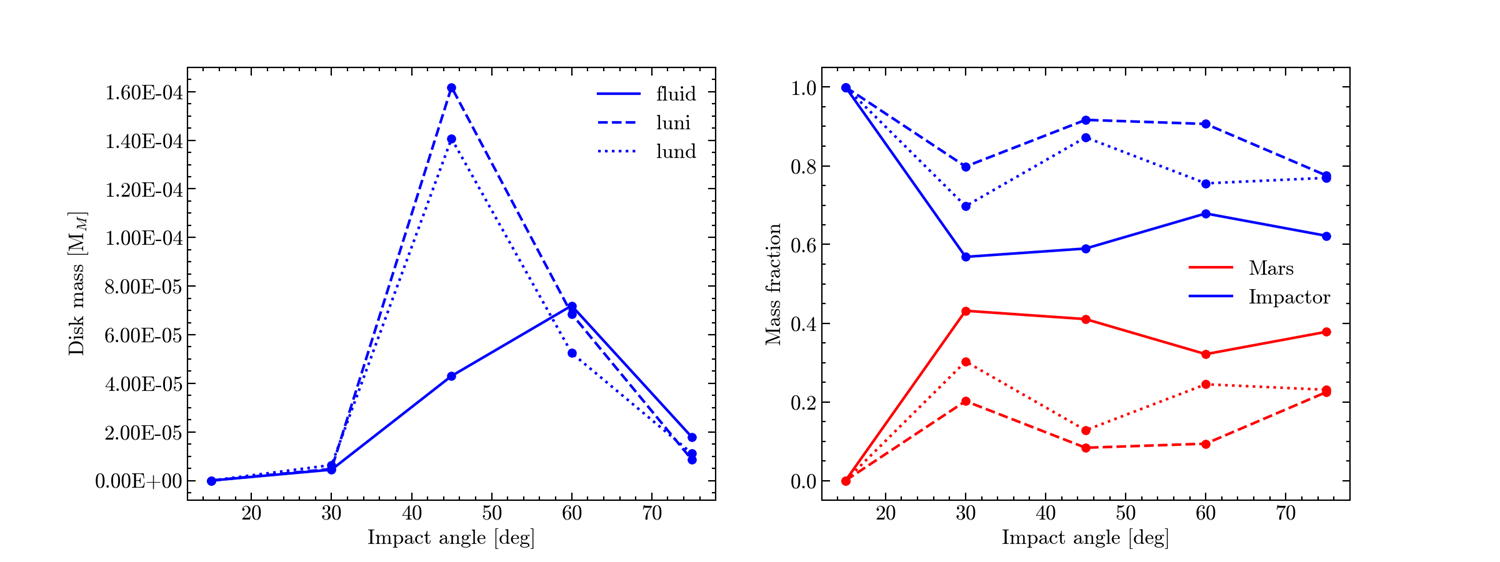
Figure 1: for a fluid (solid line), solid intact (dashed line) and solid damaged (dotted line) rheology. The impact velocity in all simulations is ∼6 km s-1 . The disk mass and composition (Martian: red versus impactor: blue) is strongly influenced by the rheology. Whereas a fluid rheology, as assumed in previous studies, yields a disk containing a substantial fraction of Martian material, accounting for shear strength in the solid phase results in a disk composed primarily of impactor-derived material. Rheology therefore plays a critical role in the interpretation of MMX samples.
Figure 2 : The disk mass (left panel) and composition (right panel) versus impact angle obtained assuming a fluid rheology and different numerical resolution (3×10⁶: solid, 3×10⁷: dashed and 3×10⁸: black dot). The impact velocity in all simulations is ∼6 km s-1 . The inferred disk mass decreases with increasing numerical resolution, while the disk composition remains nearly constant.
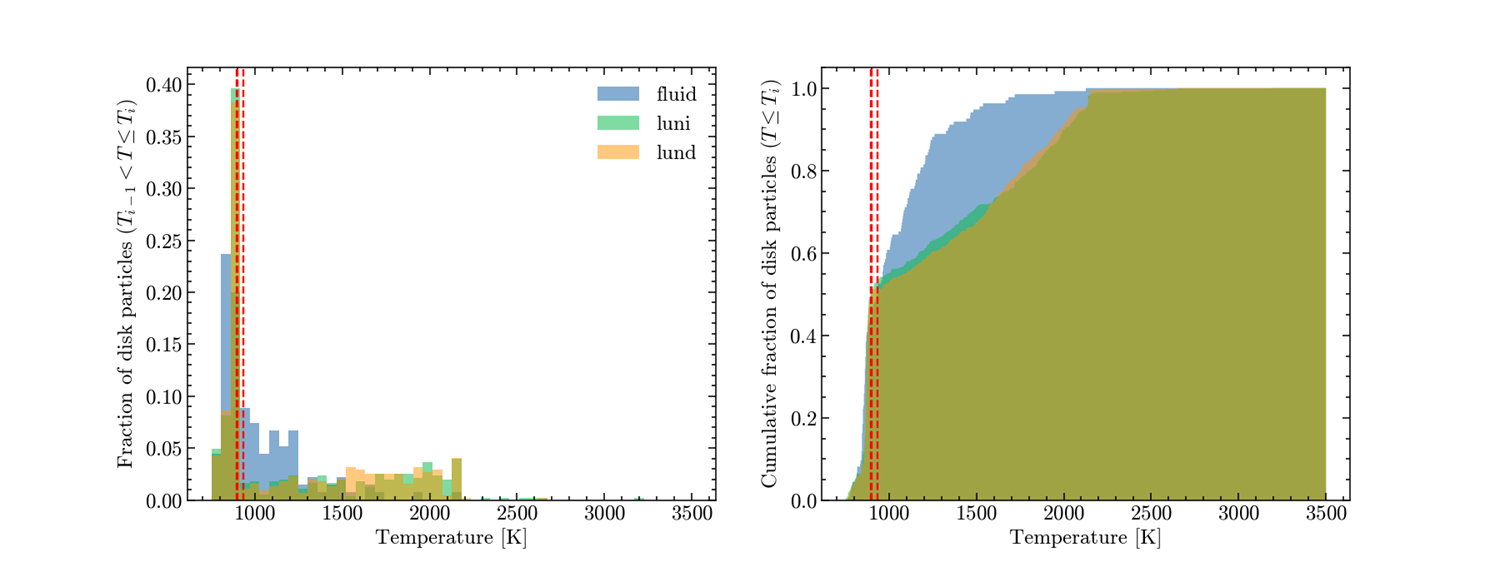
Figure 3: The temperature distribution (left: count, right: cumulative) in the disk after an impact occurring at 45° and ∼6 km s-1 for different rheologies and a resolution of 3×10⁶ particles. The disk material is substantially colder than inferred in previous studies and all disks have median temperatures of ∼900 K, so most of the material remains below the melting point. The hottest disks are obtained for a solid rheology where ∼20% of the material may experience melting.
How to cite: Reinhardt, C., Jutzi, M., and Meier, T.: The impact origin of Phobos and Deimos revisited, Europlanet Science Congress 2026, The Hague, The Netherlands, 7–11 Sep 2026, EPSC2026-483, https://doi.org/10.5194/epsc2026-483, 2026.


