
 2,
2,- 1University College London, Department of Chemistry, 20 Gordon Street, London WC1H 0AJ, United Kingdom
- 2Natural History Museum, Cromwell Road, South Kensington, London SW7 5BD, United Kingdom
- 3ISIS Neutron and Muon Facility, Rutherford Appleton Laboratory, Didcot, United Kingdom
Vast subsurface oceans are thought to exist beneath the ice shells of several icy worlds in the Solar System.1 A new era of detailed exploration of these environments is rapidly approaching, with NASA’s Europa Clipper and ESA’s JUICE (JUpiter ICy moons Explorer) missions both expected to arrive in the Jovian system in the early 2030s. Interpreting the data returned by these missions requires a detailed understanding of the geochemistry and physical behaviour of icy multicomponent systems under planetary interior conditions. While the properties of pure ice have been studied extensively, our understanding of salt-containing aqueous systems including those at elevated pressures remains comparatively limited.2
Among the salts of interest, magnesium chloride (MgCl2) is particularly important, as it is the second most abundant salt in Earth’s oceans and is also considered highly relevant to the chemistry of icy moons.3 Despite this significance, only limited work has been carried out on the high-pressure polymorphism of MgCl2 hydrates, especially within the pressure regime most relevant to icy moon interiors.4, 5
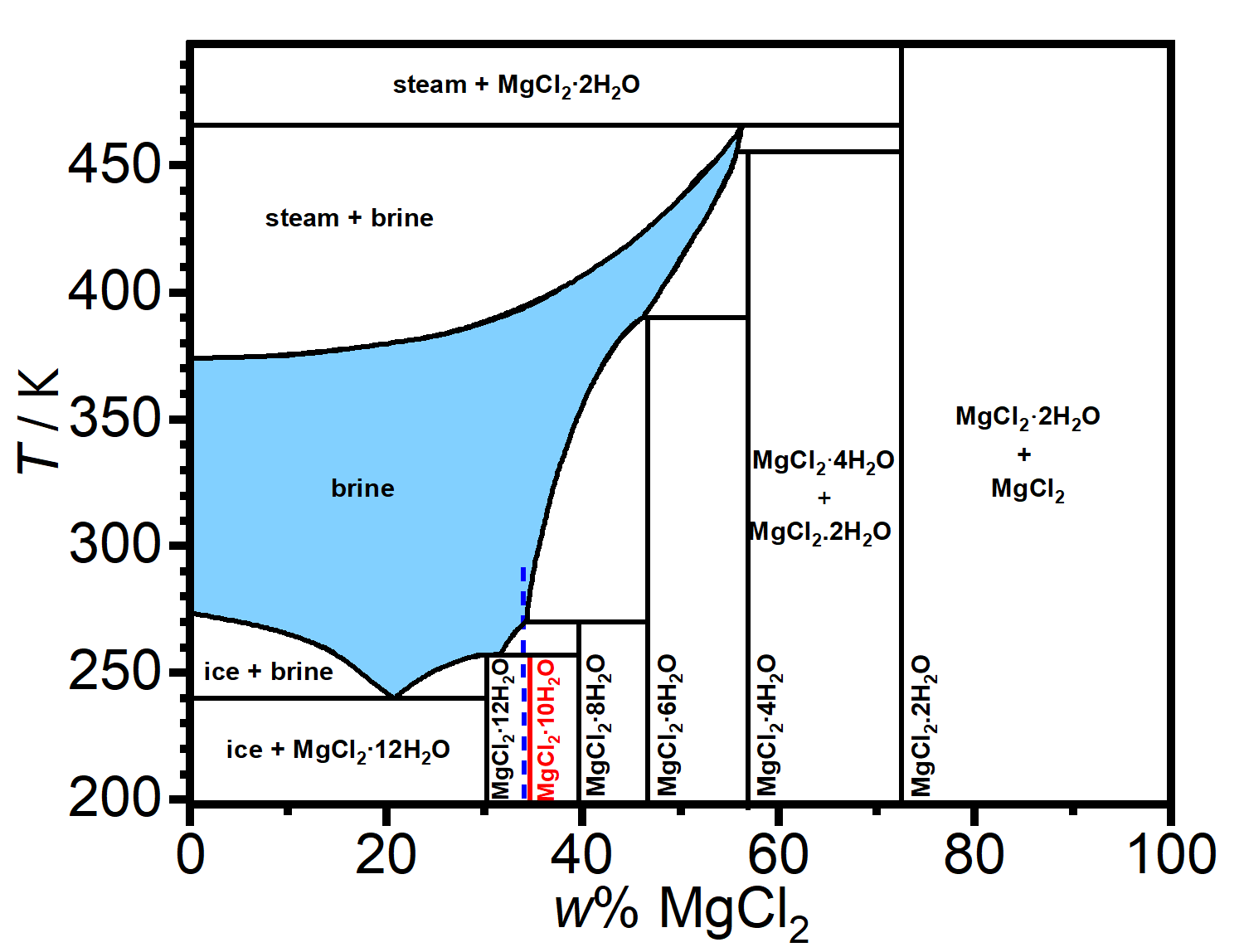
Fig. 1 Phase diagram of H2O-MgCl2 at ambient pressure. Red line represents 34.6 w% solution equivalent to MgCl2·10H2O. Blue dashed line represents the experimental concentration of 34 w% equivalent to MgCl2·10.3H2O (adapted from 6)
Magnesium chloride forms a wide range of hydrate phases with the general formula MgCl2·nH2O. At ambient pressure, hydrate phases with n = 1, 2, 4, 6, 8, and 12 have been reported, demonstrating the considerable structural complexity of this system (see Figure 1). The first magnesium chloride hydrate structure to be determined was that of bischofite, MgCl2·6H2O, in 1934. High-pressure investigations have since revealed additional polymorphs, including MgCl2·10H2O. Most recently, a second decahydrate polymorph, MgCl2·10H2O-II, was identified under pressure, further highlighting the complex high-pressure behaviour of magnesium chloride hydrates.7
To gain further insights into the freezing behaviour of MgCl2 solutions, neutron diffraction experiments were carried out at the ISIS Neutron and Muon Source using TiZr gas-pressure cells with argon employed as the pressure-transmitting medium.8 Pressures of up to 0.4 GPa were explored, covering the intermediate pressure regime, particularly relevant to icy moon interiors. The use of gas-pressure technology offers several important advantages compared to diamond-anvil approaches. Since the pressure is controlled directly through an external compressor, there is no need for an internal pressure marker. This enables the pressure to be determined and maintained with high accuracy throughout the experiment, including during heating and cooling cycles. Furthermore, the use of argon as the pressure medium ensures highly hydrostatic conditions and minimises non-hydrostatic stress effects that can broaden diffraction peaks or influence phase behaviour.
The gas-cell approach also allows the entire sample volume to be frozen. This is particularly important for binary systems such as MgCl2–H2O, where multiple crystalline phases can coexist and spatial inhomogeneities may otherwise complicate the interpretation of diffraction data. An additional advantage is that the full crystallisation sequence occurring over a broad temperature range can be monitored directly. Although the relatively long acquisition times for neutron diffraction patterns limited the temperature resolution to approximately 10°C, the measurements nevertheless enabled the progressive formation of the different hydrate and ice phases to be followed in situ.
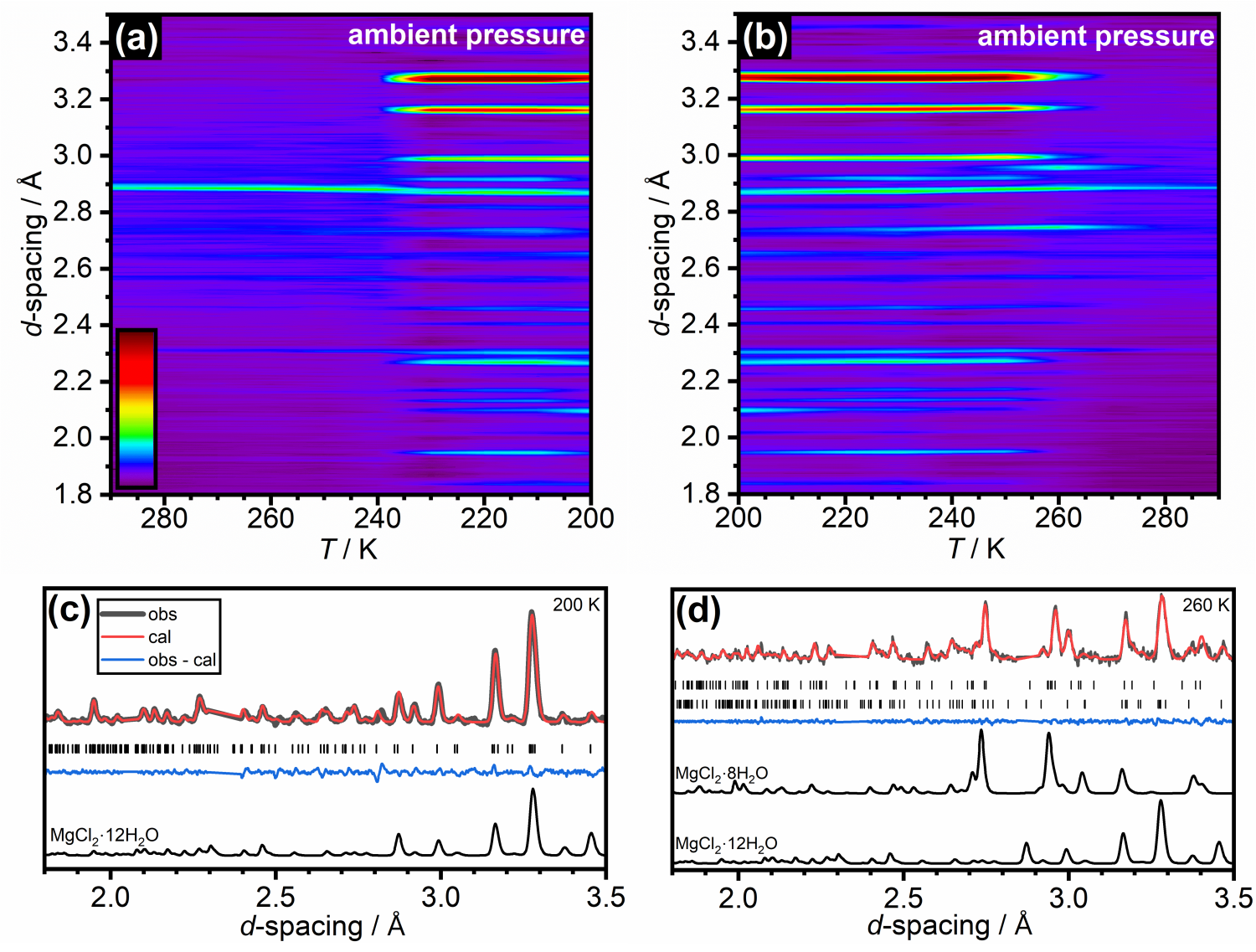
Fig. 2 Neutron diffraction data of 31.66 w% MgCl2 in D2O collected at ambient pressure upon (a) cooling from 290 K to 200 K and (b) heating from 200 K to 290 K. Le Bail fits (red) of the experimental neutron diffraction data (grey) are shown at (c) 200 K and (d) 260 K. Rietveld simulations are shown below in black. The tick marks in (c) are for MgCl2·12H2O and (d) MgCl2·12H2O with MgCl2·8H2O on top.
The experiments were conducted using a MgCl2 concentration close to the ambient-pressure saturation limit, corresponding to a MgCl2 to D2O ratio of 1:10.3. Upon cooling at ambient pressure, the expected MgCl2·12D2O phase crystallised following supercooling (Figure 2). In contrast, the anticipated octahydrate phase proved difficult to obtain and was observed only transiently upon subsequent heating and immediately prior to melting. This behaviour highlights the kinetic complexity of hydrate formation in the MgCl2–H2O system and demonstrates that the crystallisation of individual hydrates can be highly sensitive to temperature pathways.
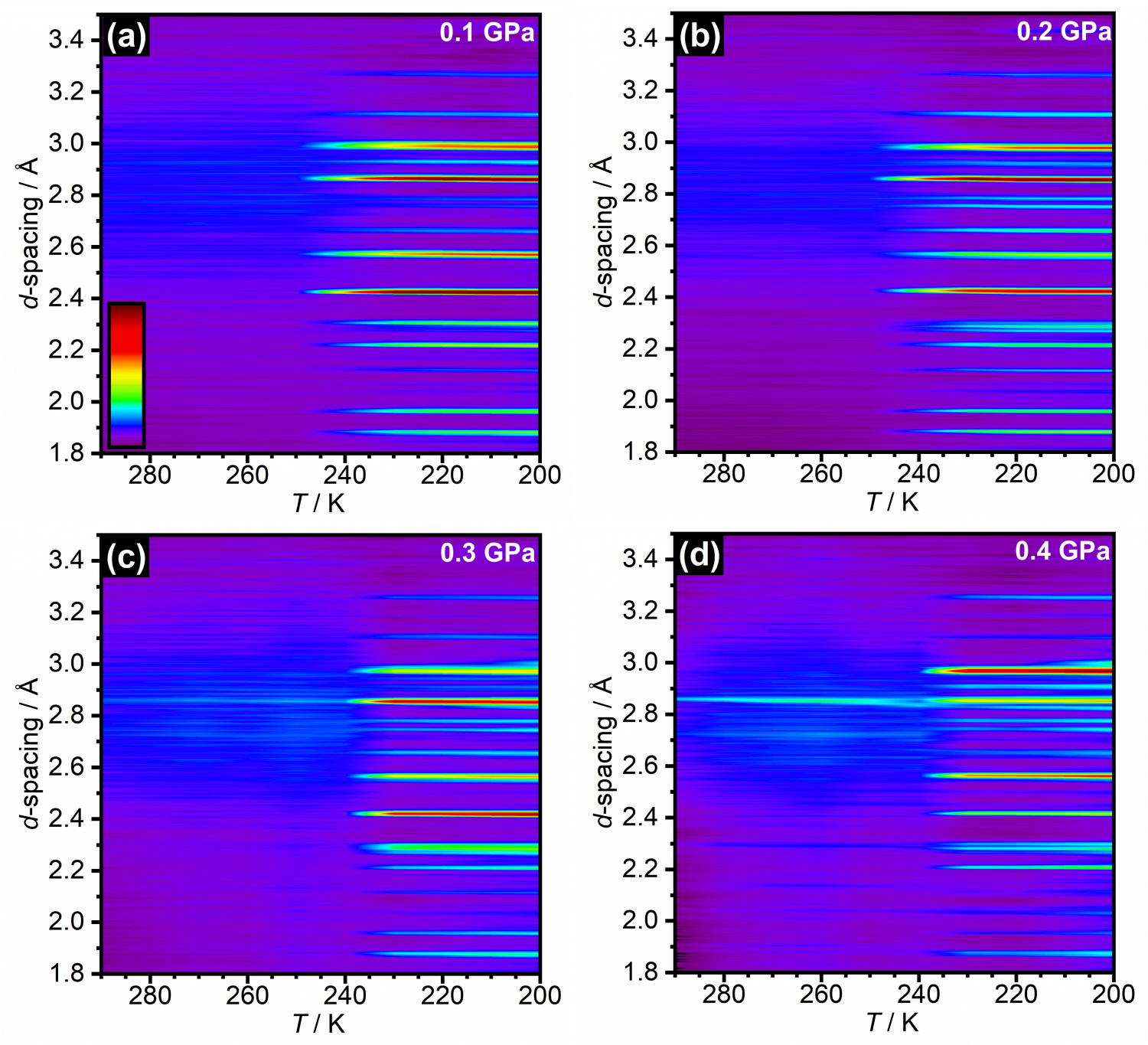
Fig. 3 Neutron diffraction data of 31.66 w% MgCl2 in D2O upon cooling from 290 K to 200 K at pressures of (a) 0.1 GPa (b) 0.2 GPa (c) 0.3 GPa and (d) 0.4 GPa.
Remarkably, increasing the pressure to only 0.1 GPa fundamentally altered the crystallisation behaviour. Under these conditions, the newly discovered high-pressure decahydrate polymorph MgCl2·10H2O-II was obtained (Figure 3). The observation that such a comparatively small increase in pressure changes the preferred hydrate phase underlines the delicate balance of stability relationships in the MgCl2–H2O system. MgCl2·10H2O-II was subsequently also observed upon freezing the solution at 0.2, 0.3 and 0.4 GPa, indicating that this phase is the stable one over the investigated pressure range and at our chosen concentration.
With increasing pressure, the crystallisation of ice II was found to occur at lower temperatures relative to the MgCl2 hydrate. This behaviour can be rationalised by the slight excess of water present in the investigated solution compositions. In addition, increasing pressure resulted in an increase of the eutectic temperature of the system. The accurate control of both pressure and temperature throughout the experiments further enabled the determination of reliable equations of state of MgCl2·10H2O-II, representing another important advantage of the gas-pressure neutron diffraction approach. These results provide essential constraints on the phase behaviour of MgCl₂ solutions under icy moon interior conditions, with direct implications for interpreting geophysical data from the JUICE and Europa Clipper missions.
(1) Space Sci. Rev., 2020 216 7.
(2) J. Chem. Phys., 2019 150.
(3) Astrophys. J., 2013 145 110.
(4) Struct. Chem., 2015 71 74.
(5) Cryst. Struct. Commun., 2019 75 1605.
(6) Can. Mineral., 2009 47 457.
(7) ACS Earth Space Chem., 2026 10 434.
(8) High Press. Res., 2016 36 493.
How to cite: Beaumont, M., Li, J., Novoveska, M., Collings, I., Bull, C., and Salzmann, C.: Crystallization of Magnesium Chloride Solutions at Icy Moon Conditions, Europlanet Science Congress 2026, The Hague, The Netherlands, 7–11 Sep 2026, EPSC2026-510, https://doi.org/10.5194/epsc2026-510, 2026.


